



A private-label floor washer project rarely goes wrong because the logo is a few millimeters too high or the carton uses the wrong shade of blue. The more expensive problems usually appear later, when a product that looked promising as a sample has to be turned into hundreds or thousands of units that all behave the same way.
That transition is easy to underestimate. A buyer receives a sample, tests it in the office, tries a few wet and dry spills, checks the roller and likes the overall feel. The next discussion naturally moves toward color, packaging and branding. At that point the project can appear to be almost finished, although in manufacturing terms many of the decisions that determine the final product have not yet been locked.
A floor washer is particularly sensitive to this. Battery capacity changes runtime and can affect weight. Roller and scraper choices influence how much water remains on the floor. Tank structure affects handling and maintenance. The charging dock is part of the storage experience, while self-cleaning and drying introduce another set of components that have to behave consistently after repeated use. Even a small change that seems harmless on a quotation sheet can alter the way the customer experiences the product.
For a private-label buyer, the useful question is therefore not simply whether the sample is good. It is whether the team can describe exactly what was good about that sample, preserve those characteristics through customization, and then reproduce them during mass production.
That is the point at which an OEM sample becomes a real product.
Start by Defining the Version You Actually Want to Buy
Model names are convenient when buyers and suppliers first communicate, but they are not detailed enough for final approval. The same floor-washer platform may be offered with different batteries, colors, plugs, accessories or packaging configurations. In some projects, relatively small hardware or software changes may also be available.
Minfu currently positions the Y20 as a customizable wet-and-dry floor-washer platform with 20KPa suction, 180° lay-flat operation, dual water tanks and selectable battery configurations. Its OEM information also covers housing colors, regional plugs, logo application, color-box packaging and multilingual manuals.
For an early sample, that flexibility is helpful. Before production, however, flexibility has to become specificity.
A buyer should be able to identify the approved battery configuration, roller, charger, plug, accessories, housing color, packaging contents and user documentation without relying on memory or a string of emails. This does not require a fifty-page technical document. A controlled specification sheet, supported by an approved physical sample and the final artwork files, is often far more useful than a large folder full of discussions that nobody wants to revisit six months later.
There is another reason to do this early. Many product decisions are connected. A brand may initially ask for the largest available battery because the longer runtime looks more competitive on a product page. Once that battery is installed, the team may decide that the machine no longer fits the lightweight positioning they originally wanted. An additional accessory may improve retail value but require a different insert and larger carton. A color change may be commercially attractive but introduce a new material batch that needs to be confirmed before production.
These are normal decisions in an OEM project. They only become expensive when they are made after packaging, certification work or production preparation has already moved ahead.

Product Testing Should Come Before the Packaging Claims
There is a strong temptation to begin the visual side of a private-label project as soon as possible. Once the logo appears on the housing and a designer produces the first retail-box render, the project suddenly feels much more real. For sales teams preparing a launch, that momentum can be useful, but it also creates a risk: marketing starts defining the product before the product has finished defining itself.
A better sequence is to confirm the claims that actually matter to customers before they are printed permanently on a box.
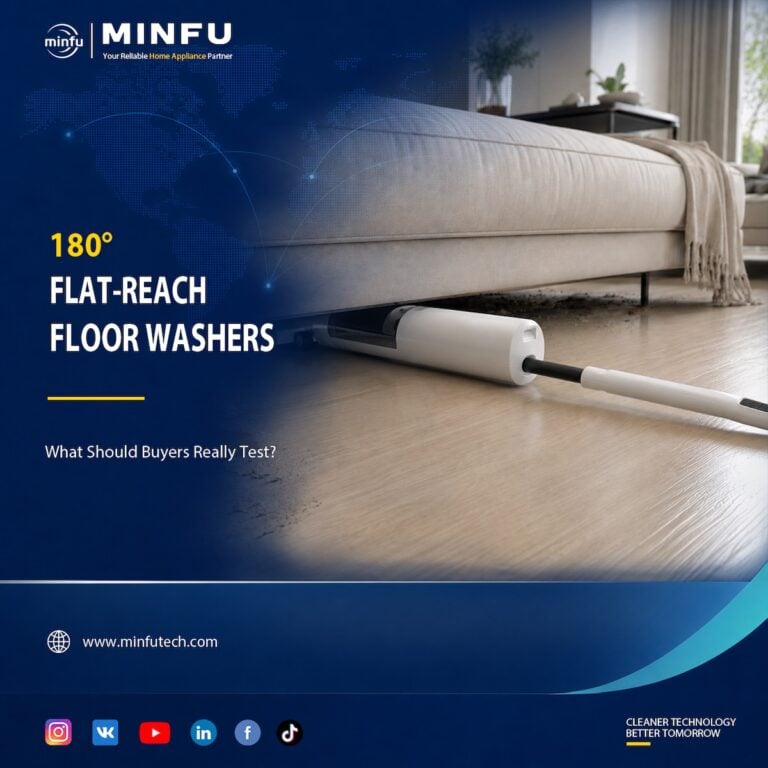
If the product is going to be sold around 180° flat-reach cleaning, the sample should be used beneath realistic low furniture with wastewater already inside the machine. The earlier article 180° Flat-Reach Floor Washers: What Buyers Should Verify explains why the advertised angle says relatively little about usable clearance, water control and cleaning performance once the body is fully reclined.
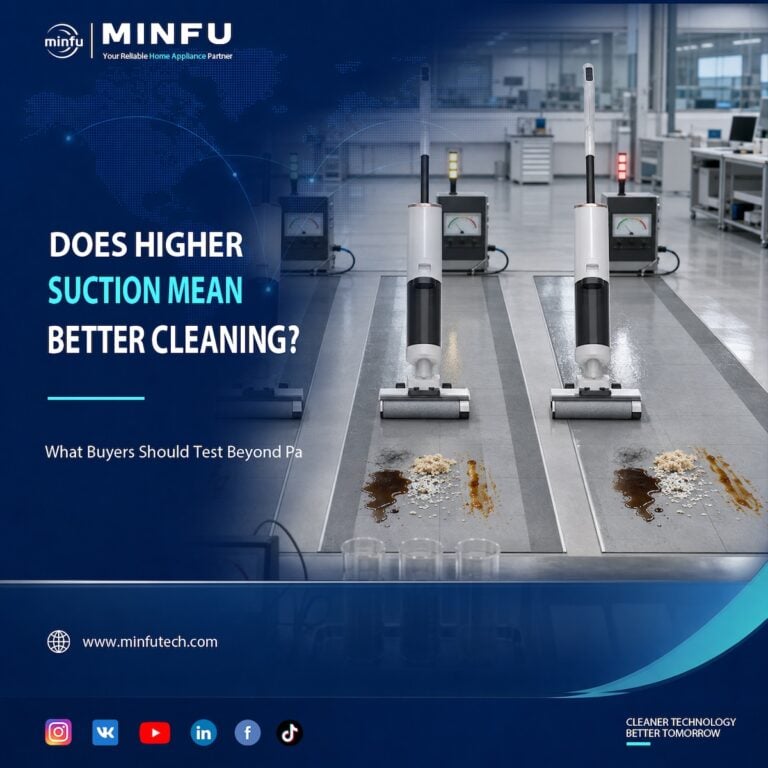
The same caution applies to suction. A large Pa number is easy to print on a carton, but the finished floor is what the customer judges. In Does Higher Suction Mean Better Cleaning in a Wet Dry Vacuum?, we looked at the relationship between suction, roller contact, water delivery, scraping and wastewater recovery. A sample that produces a strong laboratory suction reading but leaves sticky residue or too much water behind still needs work.
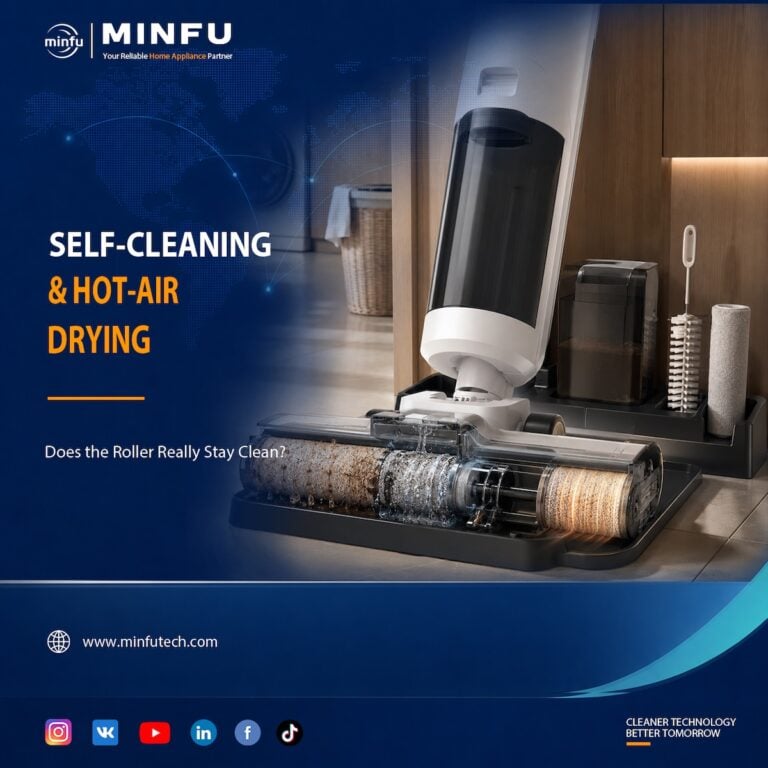
Maintenance claims deserve the same treatment. Self-cleaning and roller drying sound simple when reduced to two icons on a package, yet both are affected by the way the product has actually been used. The roller should be tested after real food residue, hair and dirty water rather than after a demonstration performed with an almost-clean machine. That issue is covered in Floor Washer Self-Cleaning and Hot-Air Drying: What Buyers Should Test.
None of this means packaging design needs to wait until every engineering task is complete. Artwork and structural packaging work can develop in parallel. The important distinction is that product claims, technical specifications and included accessories should not be treated as final until the corresponding product configuration is final.
A designer can change a rendering in an afternoon. Reprinting thousands of cartons is a different problem.
Good Private Label Development Starts with the Customer, Not the Customization Menu
OEM suppliers naturally present customization as a list of possibilities: logo, color, battery, plug, packaging, manual, accessories. Buyers can easily approach the project in the same way and start selecting options one by one.
That is not always the best way to build a coherent product.
Consider two possible briefs. One says the buyer wants a floor washer with strong suction, a large battery, a white body and customized packaging. Another explains that the product will be sold mainly online to customers living in urban apartments, where storage space is limited and users regularly move the machine between a kitchen, living room and bedrooms.
The second brief gives the product team much more to work with. It suggests that weight, maneuverability and storage may deserve more attention than maximizing every specification. It may affect the appropriate battery, tank size, dock footprint and even the accessories included in the box.
This was the central argument in Lightweight Floor Washers: Balancing Weight, Runtime and Tank Capacity. Battery runtime, water capacity and handling should be considered together because the customer experiences them together. The battery does not exist separately from the weight of the machine, and the clean-water tank does not exist separately from the number of times the customer needs to stop at the sink.
A useful product brief therefore describes the intended user and sales environment before it describes the customization.
What size homes are typical? Is the product expected to clean one floor or be carried upstairs? Will the dock sit in an open kitchen where appearance and drying noise are noticeable? Is the product aimed at a price-sensitive marketplace seller, a specialist appliance retailer or a distributor building a higher-end local brand? Which features will actually appear in advertising?
Once those questions are reasonably clear, the customization becomes easier to justify. The larger battery is chosen because the target customer needs it, not because it is the largest available option. A spare roller is added because maintenance convenience is part of the brand proposition, not because another competitor happens to include one.
Private label works best when the finished product feels intentional rather than assembled from the longest possible feature list.
Localization Is More Than Changing the Plug
Regional plugs and voltage requirements are obvious because the product cannot be used properly without them. Localization problems in manuals and packaging are less obvious, but they can cause just as much friction after launch.
Minfu’s current OEM offering includes regional plug configurations as well as customized branding, packaging and multilingual manuals. The practical challenge for a buyer is making sure all of those pieces describe the same final machine.
A common source of trouble is translation that gradually strengthens the original engineering claim. “Helps reduce roller moisture” becomes “completely dries the roller.” A product designed primarily for sealed hard floors is casually described as an all-surface cleaner. A self-cleaning cycle becomes “maintenance-free.” None of these changes may look dramatic during artwork approval, particularly when the team reviewing the translation is separate from the team that tested the sample.
The safest approach is to review the manual, packaging and product listing against the approved specification rather than translating each document independently. Technical terms should remain consistent, accessories should use the same names everywhere, and maintenance instructions should reflect what a customer will actually need to do.
This also makes customer support much easier. When the manual calls a component a “brush roller,” the website should not call the same part a “mop cylinder” while the service team refers to it by an internal factory part name. Small inconsistencies create unnecessary confusion when a consumer is already contacting the brand because something needs replacing.
Good localization does not draw attention to itself. The customer simply feels that the product was made for the market in which it is being sold.
Treat the Packaging Sample as a Product Test
By the time packaging is discussed in detail, most attention is usually on graphics. For a floor washer, the structural side deserves equal attention.
The machine has a tall body, tanks, a floor head, charging equipment and accessories that must survive distribution without moving around enough to damage one another. The packaging also determines the customer’s first physical interaction with the product. Someone who has never seen the assembly process needs to understand what to remove first, where the handle connects, which tank is which and how the product reaches a usable state.
A good packaging test therefore starts by doing something surprisingly simple: give the finished package to someone who was not involved in the project and watch them open it.
Do they find the quick-start guide before they need it? Do they mistake packaging material for an accessory? Does the handle slide into place naturally? Are the charger and cleaning tools easy to locate? Can the product be removed without turning a large carton upside down in the living room?
Those observations are much more useful than looking at the closed box on a meeting-room table.
Transport protection should be tested separately. The insert has to keep the machine, dock and accessories from becoming impact points for one another. Tanks and removable parts need adequate restraint, while the overall package should still be practical for warehousing and distribution. Minfu’s OEM service currently includes customized color boxes, cartons, labels and multilingual manuals, making this stage part of the private-label process rather than something that sits outside it.

The Golden Sample Needs to Represent More Than Appearance
Once the hardware configuration, branding, accessories and packaging have been confirmed, the project needs a reference that everyone recognizes as the intended production version. This is commonly called the golden sample.
Its value is easy to misunderstand. A golden sample should not simply be the nicest-looking unit available in the office. It should represent the combination of decisions that the buyer has actually approved.
That includes appearance, but it also includes performance.
If the approved floor washer was tested for residual moisture after one pass, the golden sample should reproduce that behavior. If a particular battery was chosen because it provided a suitable balance of runtime and handling, that same configuration should be present. The final roller, scraper, water tanks, charging dock, plug and accessories should match what is expected to reach customers.
This becomes particularly important when development has taken several rounds. An early engineering sample may have performed well but used a temporary housing color. A later marketing sample may look correct but contain another battery. Packaging may have been designed around yet another accessory set. Without one final reference, different departments can all be working from versions that were correct at different points in the project.
The golden sample brings those versions back together.
For practical purposes, it also gives both sides something concrete to compare with when questions arise during production. A photograph can confirm color and logo placement, but it is much less useful for judging roller fit, tank engagement, wheel feel or the sound of the machine during operation.
Mass Production Is Really a Consistency Test
Sample development asks whether a product can perform well. Mass production asks whether the factory can repeat that performance.
Those are not the same task.
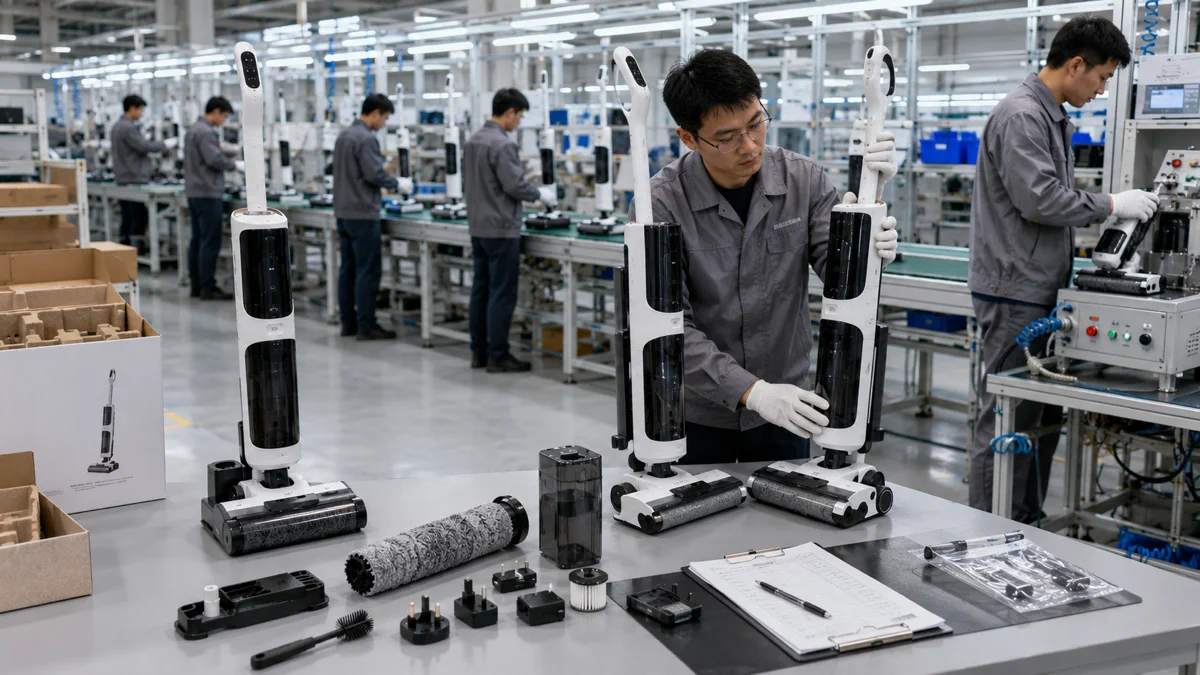
A carefully prepared engineering unit can receive more individual attention than a normal production unit. Once manufacturing begins at scale, assembly sequence, incoming components, sealing, electrical connections, battery packs, roller installation and final inspection all have to operate within controlled limits rather than depending on one technician remembering how the original sample was built.
Minfu describes its cleaning-appliance manufacturing process as combining assembly controls, automated processes, production traceability and product testing, while the Y20 information includes production-stage checks such as suction, battery and final QC.
From the buyer’s side, however, the most useful QC plan is not necessarily the one with the longest checklist. It is the one that protects the characteristics that caused the product to be approved in the first place.
For a floor washer, that might include tank sealing and fit, roller installation, charging, basic suction performance, water delivery, abnormal noise, visible leakage, wheel operation, self-cleaning function and cosmetic consistency. Some checks can reasonably be performed on every unit, while time-consuming endurance or repeated-use tests are normally better suited to controlled sampling.
The exact combination depends on the product and order, but the logic should already be familiar by this stage. The buyer has spent the sample phase learning which differences are noticeable to a customer. Those same characteristics should help determine what deserves attention during production.
This is also where a golden sample earns its keep. When a line sample looks slightly different, feels harder to steer or leaves more water behind, there is a real reference available rather than a debate based on recollection.
Do Not Leave After-Sales Planning Until the Product Is Already Selling
The first shipment usually receives most of the attention in an OEM project. It represents the launch date, inventory and sales opportunity, so it naturally dominates the schedule. Spare parts and service preparation can appear less urgent until customers actually begin asking for them.
With a floor washer, that delay is risky because several parts are handled routinely by the user. Rollers wear and become dirty. Filters need maintenance. Tanks are removed frequently. Cleaning tools get misplaced. Chargers can be damaged. Depending on the product structure, other removable components may also need replacement during the useful life of the machine.
The right spare-parts plan does not require a warehouse full of every possible component. It requires knowing which items are likely to be consumed, lost or damaged, how they are identified, and how quickly the brand can obtain replacements.
The manual should support this. The service team should use the same component names that appear in customer-facing materials, and replacement parts should be easy to match with the correct production version. When battery, roller or accessory configurations differ between projects, version control becomes especially important.
After-sales preparation also affects the commercial decision about what goes into the first carton. A spare roller may increase the packaging size and cost slightly, but it can make sense for a brand that wants maintenance convenience to be part of its positioning. Another brand may prefer a smaller retail package and sell consumables separately. Either approach can work when it is deliberate.
The mistake is discovering after launch that nobody decided.
From Sample Approval to Production Approval
A useful way to think about the entire process is that there are really two approvals.
The first is product approval. The buyer decides that the floor washer, in a particular configuration, is suitable for the intended market.
The second is production approval. The buyer has enough evidence that the final branded version, packaging and manufacturing controls are ready to reproduce that product consistently.
Between those two points, the project usually needs to settle several practical questions: the final configuration, market-specific hardware, product claims, packaging contents, manual language, reference sample, QC requirements and spare-parts support. They do not all have to happen in a rigid sequence, and real OEM projects often move several workstreams forward at the same time. What matters is that unresolved engineering decisions do not become permanent marketing claims, and that production does not begin while different teams are still working from different versions of the product.
For buyers still comparing possible suppliers, the earlier Top 5 Cordless Wet Dry Vacuum Cleaner Manufacturers in China for 2026 provides a broader look at supplier evaluation. Buyers who are not yet certain whether they are sourcing a traditional wet-dry vacuum, a floor washer or a vacuum mop may also find Wet Dry Vacuum vs Floor Washer vs Vacuum Mop: What Is the Difference? useful before moving into customization.
For a project based on Minfu’s current platform, the Y20 wet and dry floor washer page provides the current product positioning and available OEM direction. Because battery, packaging and other project details can vary according to the final configuration, the quotation and approved sample should remain the source of truth for the actual order.
The final goal is not to customize every element that can technically be changed. It is to arrive at a version that makes sense for the customer, document that version clearly, and give the production team a realistic standard to reproduce.
That is when a factory sample stops being a promising machine on a meeting-room floor and becomes a product that a brand can confidently put into the market.
Frequently Asked Questions
What should I confirm before approving a private-label floor washer sample?
The approved sample should represent the intended hardware configuration rather than simply the correct model name. Battery, roller, water tanks, charger, plug, accessories and any performance-related configuration should be confirmed first. Branding and packaging can develop alongside this work, but technical claims should be based on the version that will actually enter production.
Is a golden sample necessary for a floor washer OEM project?
For a customized production order, a final reference sample is extremely useful because photographs and specification sheets cannot capture every characteristic of the product. The golden sample gives the buyer and factory a common reference for appearance, component configuration, fit, operation and the key performance characteristics accepted during development.
When should packaging design be finalized?
Structural and graphic packaging work can begin before all testing is complete, but technical specifications, accessories and performance claims should not be locked until the product configuration is stable. Final packaging should also be tested with the actual product and accessories rather than approved only from a digital rendering.
What floor washer spare parts should a private-label brand prepare?
The exact list depends on the product, but rollers, filters, cleaning tools, chargers and frequently handled removable parts deserve early consideration. Brands should also confirm part identification and replenishment arrangements before launch so that customer service is not forced to solve basic replacement issues after products are already in the market.
How much can a floor washer be customized for a private-label project?
Customization can range from relatively straightforward branding, housing color, regional plugs, packaging and manuals to more involved hardware or configuration changes, depending on the platform and order. Minfu currently lists brand packaging, housing colors, battery configurations and localized power plugs among its OEM options. The more a project moves away from an existing standard configuration, the more important it becomes to reconfirm testing, cost, MOQ, lead time and any compliance implications before production.