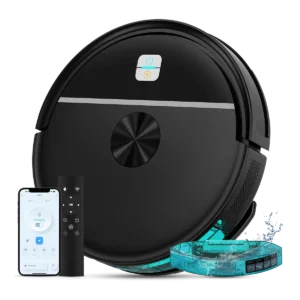

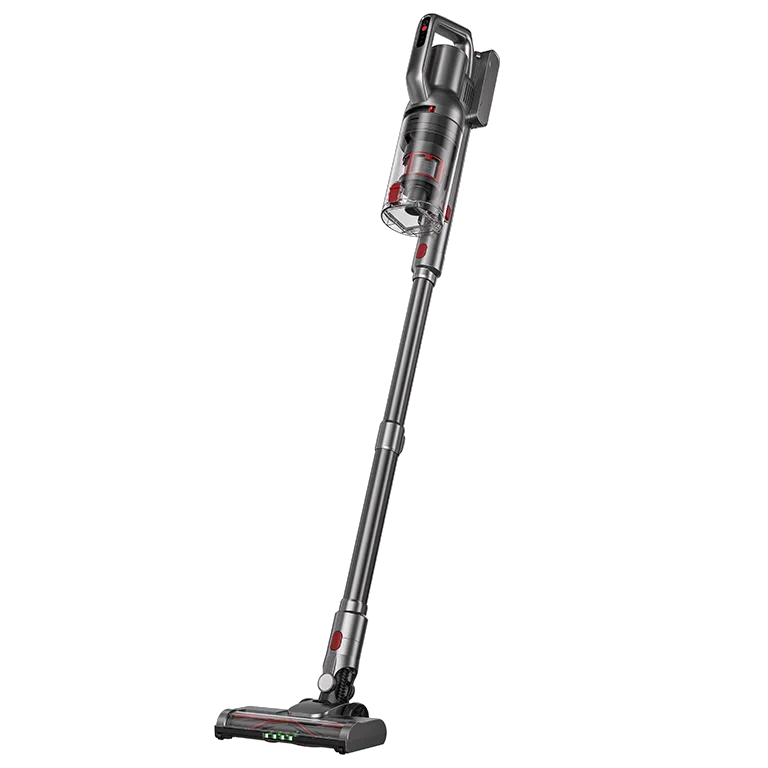
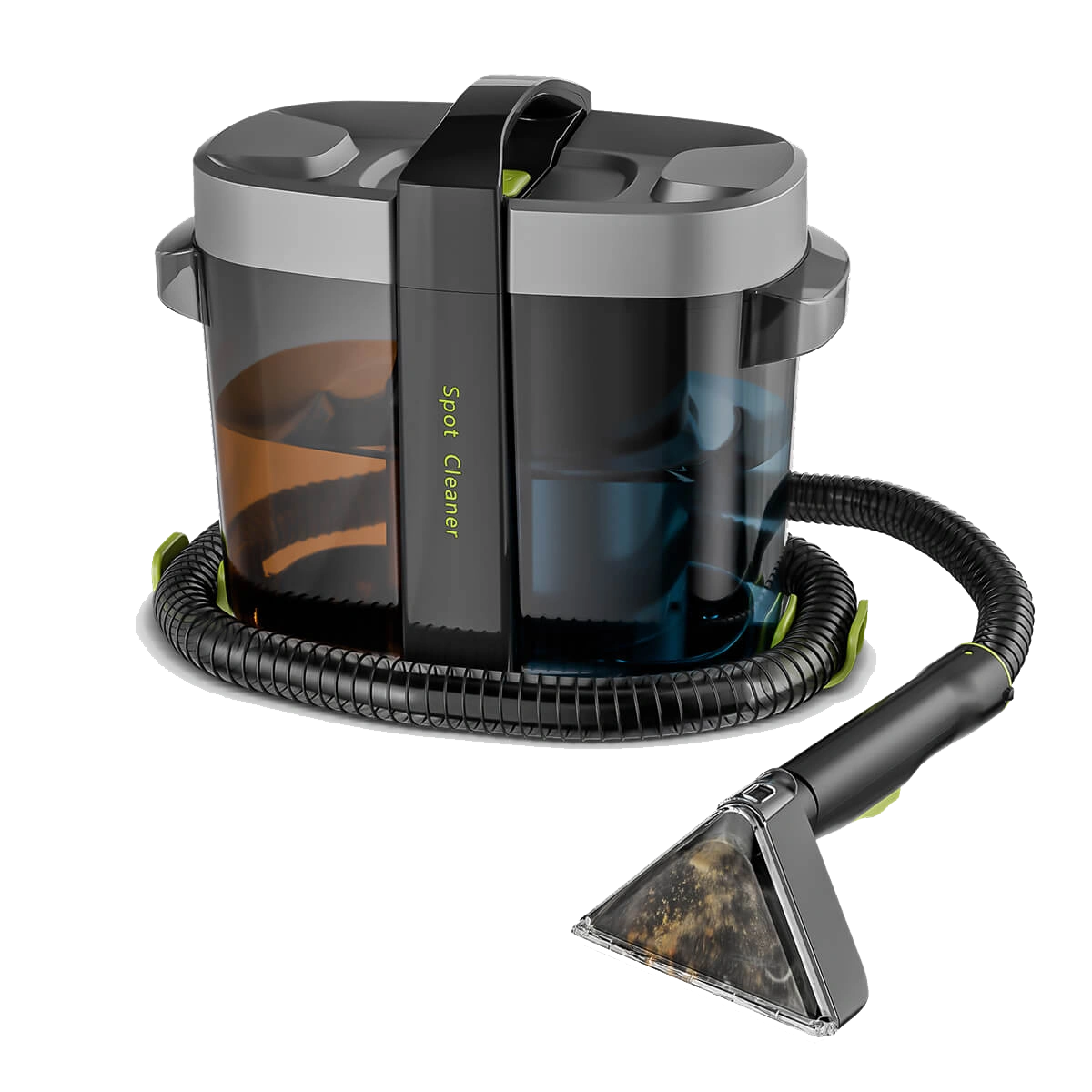

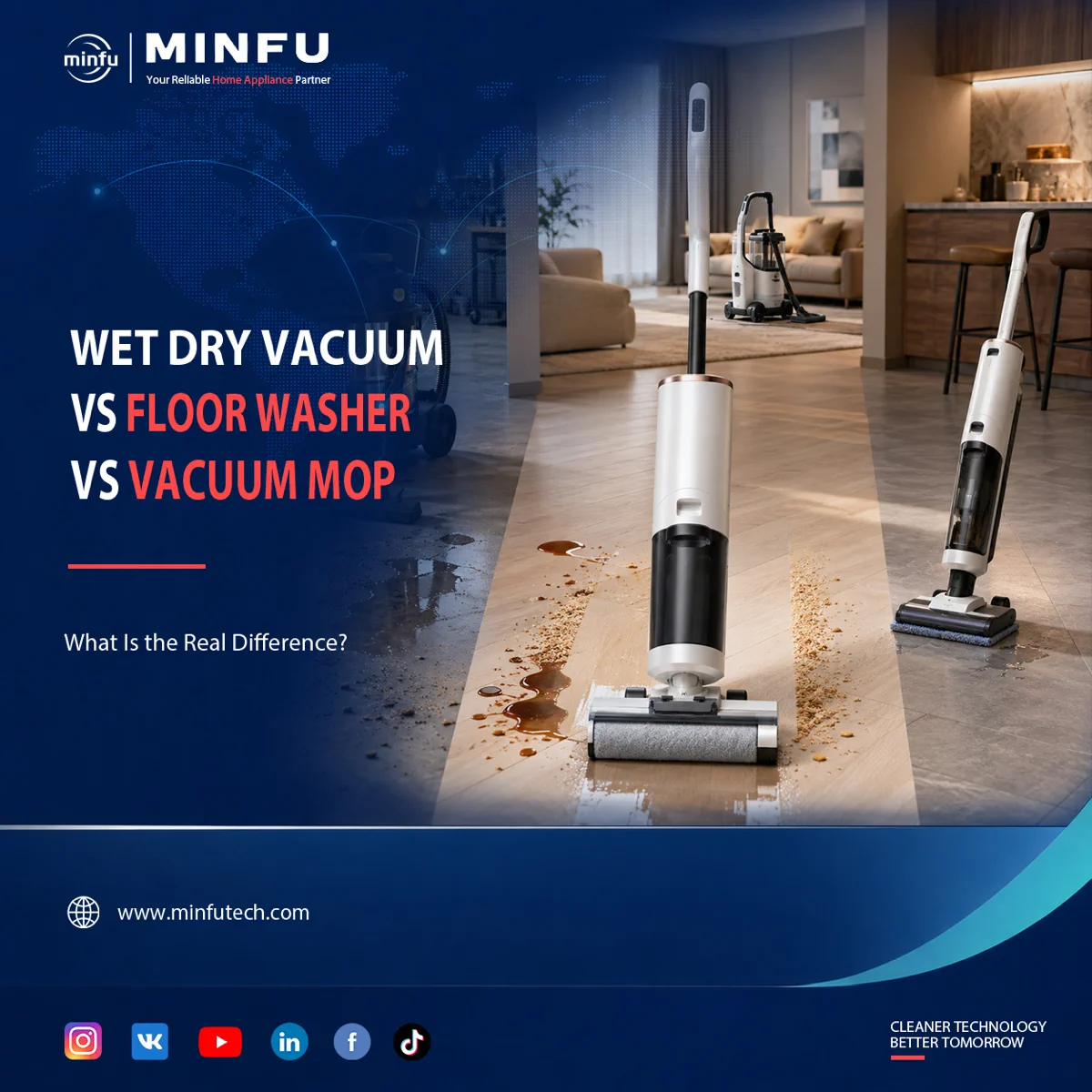

A buyer sends an enquiry for a “wet dry vacuum cleaner” and receives three very different catalogues.
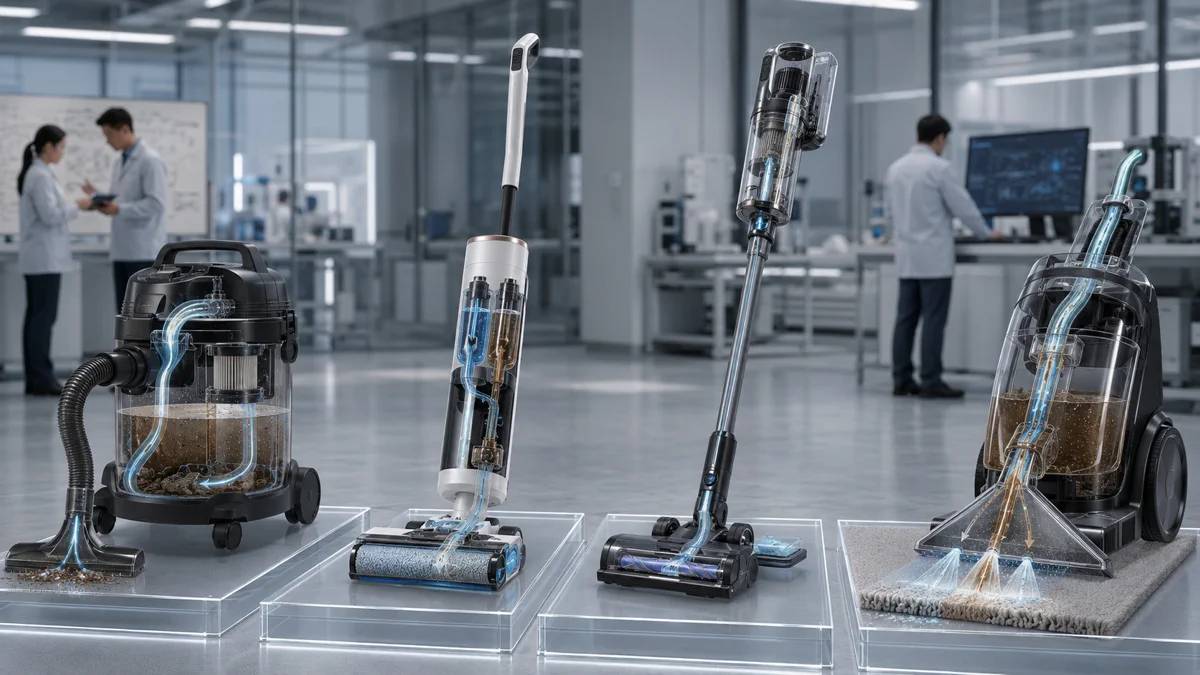
The first supplier offers a large canister machine with a hose, wheels and a collection tank. The second proposes an upright cordless appliance with a roller brush, clean-water tank and dirty-water tank. The third shows a lightweight stick vacuum with a damp pad attached behind the suction head.
All three suppliers may believe they are offering the correct product.
That is the problem.
“Wet dry vacuum,” “floor washer” and “vacuum mop” are frequently used as overlapping commercial terms, but they do not always describe the same machine. Tineco markets its upright roller machines under both “floor washers” and “wet dry vacuums.” Roborock uses “wet-dry vacuums” for its F25 and Flexi floor-cleaning ranges. BISSELL describes CrossWave products as wet dry vacuums and multi-surface cleaners. Kärcher, however, uses “wet and dry vacuum cleaner” for robust canister machines intended to collect dry dirt, damp material and liquids in homes, garages, workshops and professional environments.
For consumers, inconsistent naming may only create a confusing search result.
For an importer or private-label brand, it can lead to the wrong supplier shortlist, unsuitable product samples, misleading advertising and avoidable returns.
The easiest way to understand the category is not to begin with the product name. Begin with what happens to the water.
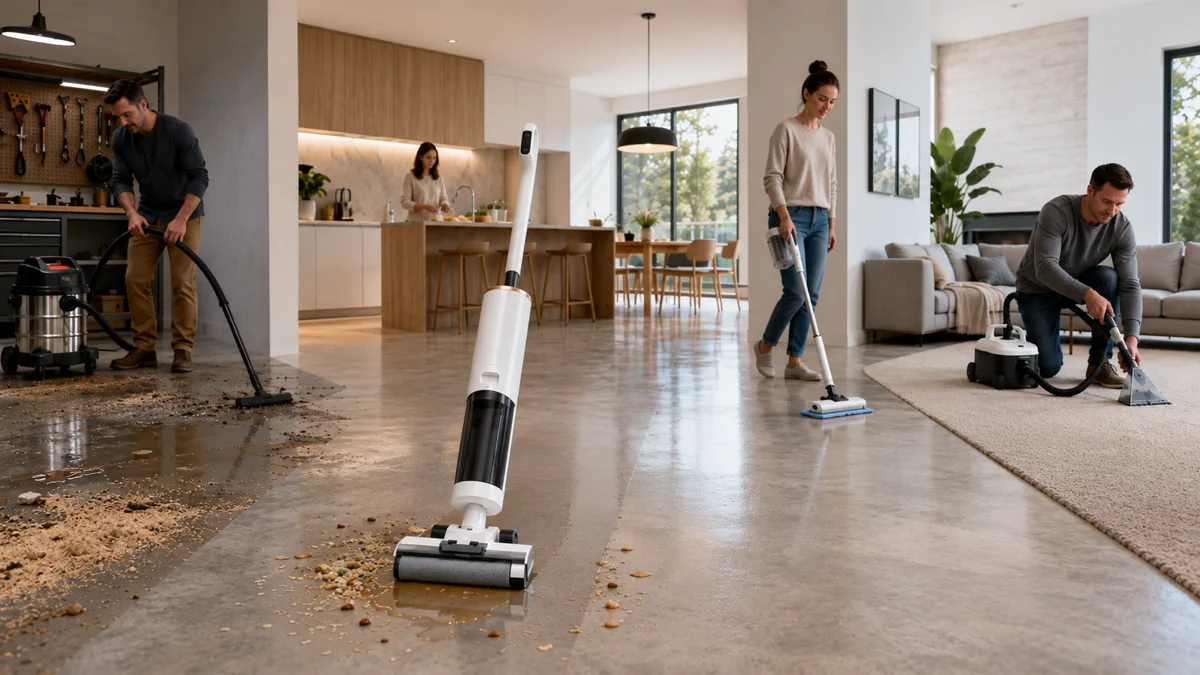
One Search Term Can Describe Very Different Machines
Product terminology develops through retail habits rather than through one universally applied naming system.
A manufacturer may choose “wet dry vacuum” because the machine collects both dry debris and liquid. Another may prefer “floor washer” because the product dispenses clean water and actively washes the floor. A retailer may call the same appliance a “vacuum mop” because that phrase is easier for consumers to understand.
The words may change even when the underlying machine remains similar.
This is why buyers should not qualify a supplier from the category name alone. A more useful first question is:
Does the machine only collect liquid, or does it also dispense clean water and scrub the floor?
That distinction separates a traditional wet-and-dry vacuum from the modern cordless floor washer family.
| Product category | Main cleaning action | Water system | Typical cleaning head | Common applications |
|---|---|---|---|---|
| Traditional wet and dry vacuum | Collects dry debris, damp dirt and liquid | Collection tank, usually without active clean-water washing | Hose and suction nozzle | Garages, workshops, cars, renovation and commercial cleaning |
| Cordless wet dry vacuum | Vacuums, washes and recovers dirty water in one pass | Separate clean- and dirty-water tanks | Powered roller brush | Sealed household hard floors |
| Floor washer | Actively applies water, scrubs and recovers wastewater | Separate clean- and dirty-water tanks | Powered roller brush or dual rollers | Routine hard-floor washing |
| Vacuum mop | Broad retail term for a product that vacuums and mops | Varies by product design | Roller, mop pad or combined head | Light daily floor maintenance |
| Carpet extractor | Sprays cleaning solution and extracts it from textile fibres | Solution tank and recovery tank | Extraction nozzle or powered carpet brush | Carpets, rugs, upholstery and fabric surfaces |
The most important point is that the middle three terms can overlap.
A cordless wet dry vacuum, floor washer and vacuum mop may refer to the same product family. The name alone does not tell the buyer how effective the water recovery is, how the roller is cleaned or which surfaces have actually been tested.
A Traditional Wet and Dry Vacuum Collects Water but Does Not Necessarily Wash
The traditional wet and dry vacuum is usually built around a large collection container, suction hose and interchangeable nozzles.
Its job is to collect materials that would be unsuitable for an ordinary household vacuum: sawdust, coarse debris, damp dirt, spilled water and workshop waste. Kärcher, for example, uses the category for robust machines intended for applications around the house, garden, garage and workshop. Its battery-powered WD models retain the familiar canister, hose and collection-tank architecture.
These machines can remove water from a surface, but that does not mean they wash the floor in the way a modern floor washer does.
A traditional wet and dry vacuum normally does not continuously supply fresh water to a powered roller. It does not separate clean water from recovered dirty water during normal floor washing, and it may require the operator to apply water or detergent separately.
That makes it valuable for liquid pickup and heavy-duty cleaning, but less convenient for routine household mopping.
This distinction is especially important for online sourcing. Searching only for “wet dry vacuum manufacturer” can bring up factories specializing in 12-litre, 20-litre or larger workshop vacuums rather than suppliers of cordless hard-floor washers.
A buyer seeking a product like the Minfu Y20 should therefore use more specific phrases such as:
cordless wet dry vacuum cleaner
cordless floor washer
wet dry floor cleaner
hard-floor washer
These terms better describe the household upright product architecture.
A Floor Washer Uses Fresh Water, Mechanical Agitation and Recovery
A floor washer does more than collect a spill.
During normal operation, clean water is delivered to the roller or floor-cleaning area. The powered roller agitates dirt on the surface, while the suction and scraper system recover the resulting dirty water into a separate tank.
The user is therefore not repeatedly spreading the same bucket of water across the floor.
Tineco describes its FLOOR ONE machines as wet dry vacuums and floor washers that handle wet and dry messes on hard floors. Roborock similarly markets its current F25 and Flexi ranges as wet-dry vacuums with roller cleaning, edge access and flat-reach functions. BISSELL’s CrossWave products are sold as wet dry vacuums that vacuum and wash floors simultaneously.
These products belong to broadly the same modern floor-washing family, although their internal structures and market positioning can differ substantially.
One may use a single soft roller and a compact charging base. Another may use dual rollers, heated washing or a docking station that automatically supplies and drains water. Some models focus on lightweight handling, while others accept a heavier structure in exchange for larger tanks, longer runtime or more automated maintenance.
The product name does not reveal these trade-offs.
For B2B buyers, the more meaningful questions are how the water is applied, how much dirty water is recovered, whether the roller maintains contact across the full cleaning width and how much moisture remains on the floor after one pass.
“Vacuum Mop” Is Useful for Marketing but Weak as a Technical Definition
“Vacuum mop” is often the easiest phrase for consumers to understand.
It suggests that one appliance replaces both a vacuum cleaner and a mop. For product listings, social media and introductory advertising, that can be useful.
The problem is that the term does not describe one fixed structure.
A full floor washer with dual tanks and a powered roller may be sold as a vacuum mop. A cordless vacuum with a small water tank and a passive damp pad may use the same name. The two products may offer very different cleaning results, water recovery and maintenance requirements.
This is an inference from the overlapping terminology used by major brands rather than a formal industry classification. Tineco, BISSELL and Roborock all use different combinations of “floor washer,” “wet dry vacuum” and “multi-surface cleaner” for products that perform broadly similar vacuum-and-wash functions.
For that reason, “vacuum mop” works better as a consumer-facing descriptor than as the only category name in a technical specification or supplier agreement.
A purchase specification should define the actual system:
Cordless upright hard-floor washer with powered roller, clean-water dispensing, dirty-water recovery and separate clean- and dirty-water tanks.
That sentence is less attractive as a retail title, but it leaves far less room for misunderstanding between the buyer and manufacturer.
A Carpet Extractor Is a Different Product Again
A carpet extractor also applies water and recovers wastewater, but it is designed around textile fibres rather than sealed hard floors.
During spray extraction, water and detergent are introduced into the carpet or upholstery and then vacuumed out together with loosened dirt. The surface may require additional rinsing and drying before normal use.
This differs from a hard-floor washer in several ways.
A carpet extractor must move cleaning solution into a deeper, absorbent surface. Its brush, nozzle, pump pressure and recovery path are designed for textile cleaning. A floor washer works mainly at the surface of tile, vinyl, laminate, sealed wood or similar hard flooring.
There are exceptions. BISSELL markets some CrossWave models for both sealed hard floors and refreshing area rugs. That does not mean every cordless floor washer is suitable for rugs, however. Surface compatibility depends on the specific roller, water delivery, suction recovery and testing completed for that model.
A buyer should therefore never assume that turning off the water converts a floor washer into a carpet vacuum.
Before making a carpet or rug claim, the final sample should be tested for fibre resistance, water recovery, roller entanglement, cleaning effectiveness and drying time. The manufacturer should also confirm whether the intended claim is covered by its instructions and compliance documentation.
Where the Minfu Y20 Fits
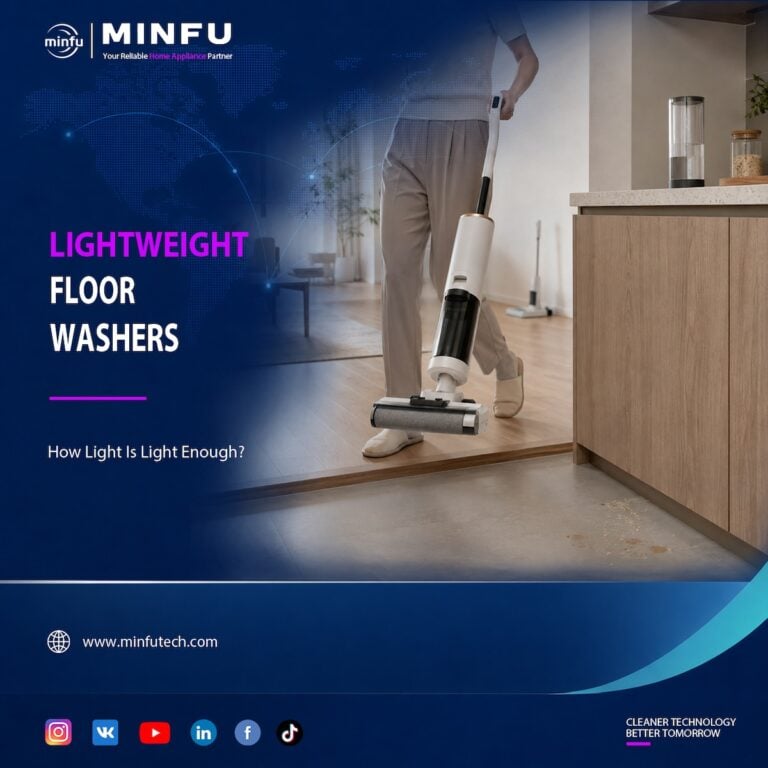
The Minfu Y20 belongs to the household cordless floor-washer category.
It is not a workshop-style canister wet and dry vacuum, and it is not a carpet extraction cleaner.
Its product architecture includes a powered floor roller, a 680ml clean-water tank, a 450ml dirty-water tank and suction-assisted wastewater recovery. The current landing page positions it as a 3kg lightweight wet and dry floor washer with 20kPa suction, 180-degree lay-flat cleaning, one-touch self-cleaning, hot-air roller drying and power-assisted wheels. Battery configurations from 2600mAh to 4000mAh are listed with project-dependent runtimes.
This means the most accurate primary B2B description is:
Minfu Y20 cordless wet dry floor washer
For search visibility and buyer familiarity, the product can also be described as:
cordless wet dry vacuum cleaner
lightweight floor washer
vacuum mop for hard floors
private-label hard-floor cleaner
The phrases should support each other rather than compete.
The landing page can use “cordless wet dry vacuum cleaner manufacturer” to attract sourcing searches, while the hero section and product description explain immediately that the Y20 is a lightweight hard-floor washer.
That prevents industrial vacuum buyers from misunderstanding the product and helps household appliance buyers recognize its actual use.
Buyers reviewing suppliers for this category can also read the cluster’s main sourcing guide:
Top 5 Cordless Wet Dry Vacuum Cleaner Manufacturers in China for 2026.
The current Y20 platform and OEM options are available through the Minfu Y20 wet and dry floor washer page.
Product Naming Should Change with the Sales Channel
A good product does not need to use exactly the same phrase everywhere.
It needs a consistent definition expressed in language appropriate to each channel.
On a manufacturer website, the primary term should help professional buyers identify both the product and the supplier relationship:
Cordless Wet Dry Vacuum Cleaner Manufacturer
or:
Cordless Floor Washer OEM Manufacturer
On an e-commerce product page, the wording can be more consumer-friendly:
Cordless Floor Washer and Vacuum Mop for Hard Floors
A distributor catalogue can combine commercial and technical language:
Y20 Lightweight Cordless Wet Dry Floor Washer
Technical files should be more precise and less promotional:
Cordless hard-floor cleaning appliance with clean-water dispensing and dirty-water recovery
The wrong approach is to switch product meaning from one channel to another.
If the factory quotation describes a hard-floor washer, the retail listing should not quietly expand it into a carpet cleaner, steam mop or industrial liquid vacuum. Every additional surface or cleaning claim must be supported by the final product configuration and relevant testing.
Product naming also affects keyword quality.
“Wet dry vacuum” has a larger but less precise search intent because it includes workshop machines. “Floor washer” is more accurate for the Y20 but may have lower familiarity in some markets. “Vacuum mop” is easy for consumers to understand but too broad to stand alone in a supplier agreement.
Using the three terms together—while clearly defining the product—usually provides the best balance.
Buyers Should Compare Systems, Not Labels
Two products sold as floor washers may still be very different.
One may dispense water continuously, while another gives the user manual spray control. One may recover most of the applied water in a single pass, while another leaves visible moisture behind. A lightweight model may be easier to move and cheaper to ship but may have smaller tanks or a shorter standard runtime.
This is why sample evaluation should begin with the intended use rather than the marketing name.
A buyer targeting apartment users may prioritize low weight, compact storage and cleaning beneath furniture. A family-oriented product may require larger tanks, stronger edge cleaning and better hair management. A premium retail product may need heated self-cleaning, roller drying and more automated maintenance.
The sample should then be tested using realistic debris and stains.
Dry cereal, hair, rice, coffee, sauce and muddy water expose different parts of the cleaning system. The buyer should observe whether debris is pushed forward, how quickly liquid is recovered, whether the machine leaves streaks and how the roller smells after being stored overnight.
The maintenance experience matters just as much.
A machine may clean the floor well but become difficult to sell if the dirty-water tank is awkward to empty, the roller cover traps residue or replacement filters are unavailable. Category naming attracts the initial buyer; product design determines whether the user keeps the machine.
The next article in this cluster will examine one of the most visible design claims in the category:
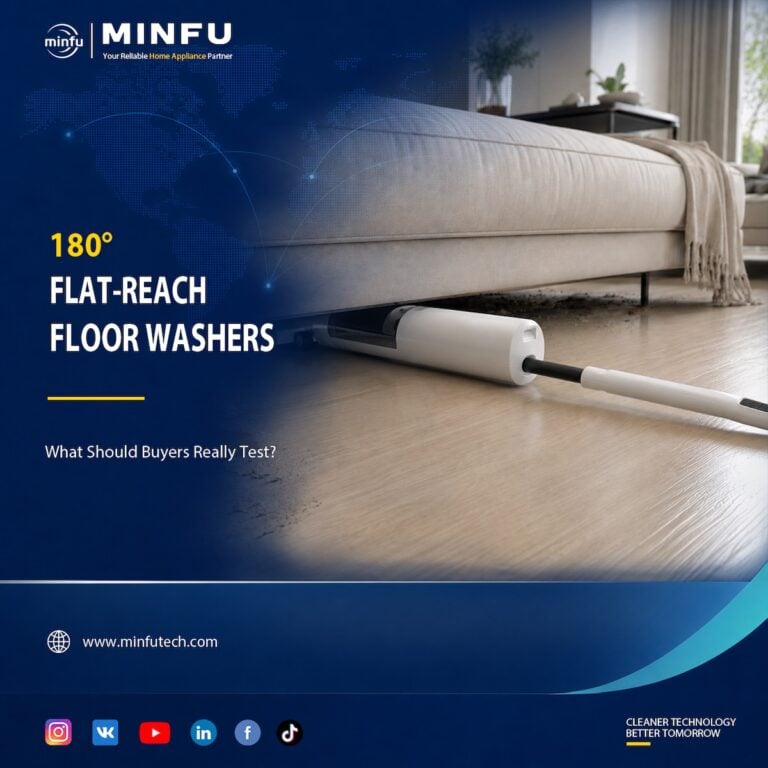
180° Flat-Reach Floor Washers: What Buyers Should Verify
It will focus on water-air separation, wastewater leakage, suction stability, steering and usable clearance beneath furniture.
Final Thoughts
The difference between a wet dry vacuum, floor washer and vacuum mop cannot be understood from the name alone.
A traditional wet and dry vacuum is mainly designed to collect dry debris and liquids. A modern cordless wet dry vacuum or floor washer supplies clean water, agitates the floor and recovers wastewater during the same pass. “Vacuum mop” is a broader marketing phrase that may describe several different product structures.
For importers, the safest approach is to define the product by its water path, brush system, recovery method and intended surfaces.
That definition should remain consistent across the supplier quotation, golden sample, packaging, certification documents and retail listing.
The Minfu Y20 is best positioned as a lightweight cordless wet dry floor washer for sealed hard floors. “Vacuum mop” can support consumer communication, while “cordless wet dry vacuum cleaner manufacturer” can help reach professional sourcing traffic.