

Introduction
At 9 p.m., a commercial building may be quiet enough for an autonomous floor scrubber to begin its scheduled cleaning route. The corridors are mostly empty, the robot has a stored map, and no operator needs to walk behind it.
For the next hour, everything may go according to plan.
Then a delivery trolley blocks a passage. Later, the machine reaches a low-water condition. When the shift ends, its dashboard reports that the cleaning mission is complete—but someone still needs to check the floor and prepare the equipment for tomorrow.
So was the operation really unsupervised?
The answer depends on what we mean by the word.
Modern commercial cleaning robots can perform defined floor-care tasks without continuous manual steering. They can navigate mapped areas, respond to some environmental changes and, depending on their configuration, support charging and task management through automated systems. Those capabilities are valuable, particularly for facilities where the same floor areas need attention every day.
But there is a substantial difference between a robot that can clean independently and a cleaning operation that can run without human involvement.
For facility managers and cleaning contractors, that distinction matters more than any claim of 24/7 autonomy. It determines how much work the robot genuinely removes from a shift, how frequently staff must intervene and whether unattended operation is appropriate for the building.
The Short Answer: Can Commercial Cleaning Robots Operate Unsupervised?
Yes, commercial cleaning robots can carry out defined cleaning missions without continuous human control, but that does not mean they can operate indefinitely without human oversight.
A properly configured autonomous floor scrubber may follow a mapped route, clean an assigned zone and respond to certain obstacles independently. Some systems can also return to charging stations or workstations and support automated resource handling.
However, routine preparation, cleaning-solution management, maintenance, abnormal events and verification of cleaning results may still require trained personnel.
The actual level of autonomy depends on the robot model, hardware configuration, software capabilities, facility conditions and operating procedures.
The practical objective should therefore be to reduce unnecessary operator involvement—not to assume that human responsibility disappears.
Unsupervised Cleaning Begins Before the Robot Starts Moving
The first hour of an autonomous cleaning shift is often determined by work completed before the robot receives its Start command.
Someone must establish that the cleaning area is suitable, the intended route is available and the equipment is ready for the assigned task.
Consider a large office building with a main lobby, two long corridors and a service entrance. The robot may have cleaned all three areas successfully the previous evening. But the building is hosting an event today, and temporary furniture now occupies part of the lobby.
The original map may still be accurate enough for localization. That does not mean the original cleaning plan remains appropriate.
A trained operator or facility supervisor may need to revise the cleaning zone, restrict access to temporary areas or adjust the schedule before the mission begins.
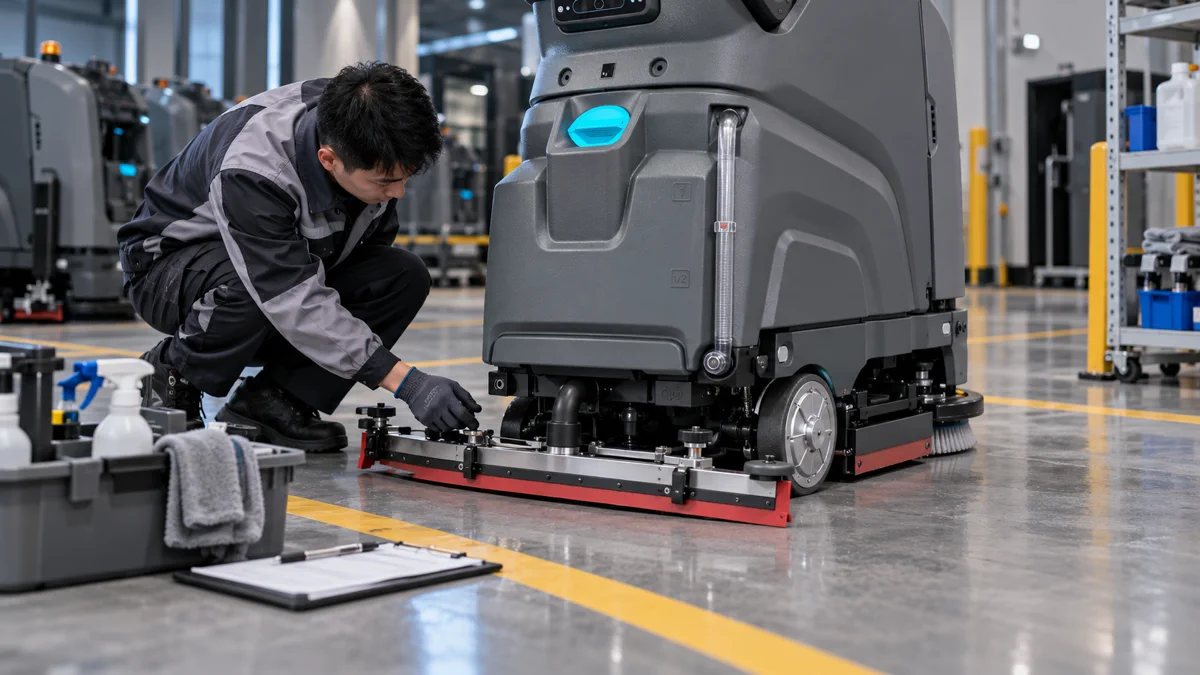
The equipment itself also needs attention. Brushes and squeegees should be in suitable condition, tanks should be prepared as required, and any charging or workstation infrastructure should be ready.
These actions are not evidence that the robot has failed to achieve autonomy. They are part of commissioning and maintaining a dependable commercial cleaning operation.
The more often the environment changes, the more important this preparation becomes.
What Actually Happens During an Unattended Cleaning Mission?
Once the robot begins working, the facility no longer needs a person continuously deciding when to move forward, where to turn or how to follow each section of the planned cleaning route.
The machine takes over those repeated driving decisions within its supported operating conditions.
A simplified mission includes several connected activities: maintaining its position on a map, following the assigned cleaning path, monitoring its immediate surroundings, operating the cleaning hardware and updating the task status.
The navigation and perception systems handle the movement problem. The brushes, water-delivery components and recovery system handle the physical floor-cleaning process.
These two parts must remain coordinated.
A robot could follow its navigation route correctly while experiencing a cleaning-system problem. Conversely, the cleaning hardware could function normally while the robot becomes unable to continue because an aisle is blocked.
That is why an uninterrupted driving demonstration is not sufficient evidence of successful unattended cleaning.
The machine must perform the intended floor-care task throughout the mission, not simply travel across the assigned area.
The Building Will Not Stay Exactly as It Was Mapped
Temporary obstacles are a normal part of commercial facilities.
A trolley may occupy a corridor for ten minutes. A group of visitors may gather near an entrance. Warehouse employees may move materials into a previously clear aisle.
Depending on the navigation system and operating conditions, a robot may slow down, wait, safely navigate around an obstacle or interrupt the mission.
A blocked route should not automatically be treated as a navigation failure.
Sometimes stopping is the correct response.
The important operational questions are what happens after the interruption, whether the machine can continue the task appropriately and how an operator is informed when assistance is required.
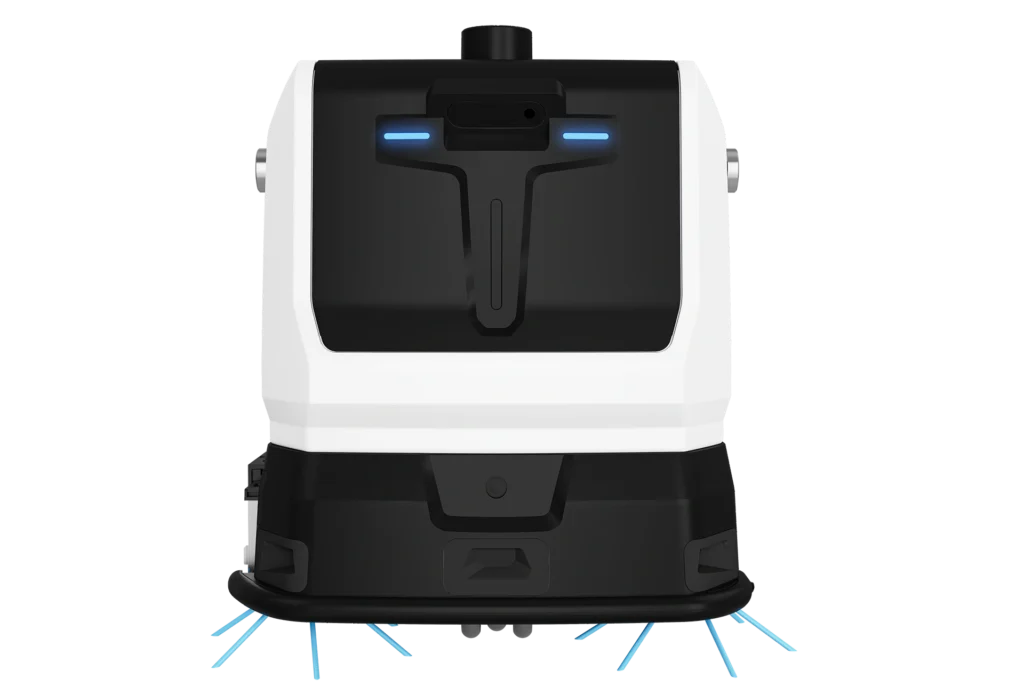
For example, our LT10 commercial cleaning robot is designed for dynamic commercial environments and includes obstacle-response behaviors such as yielding, pausing and adjusting movement around changing traffic.
Those capabilities support autonomous operation. They do not guarantee that every possible obstruction can be resolved without human involvement.
What Happens When the Robot Runs Low on Battery or Water?
This is where the practical limits of unsupervised operation become much easier to see.
A cleaning robot uses several resources during a shift. It consumes battery energy, uses cleaning liquid during wet scrubbing and collects wastewater.
The robot may have enough battery capacity to complete a planned route but insufficient water for the entire task. Alternatively, its recovery tank may reach capacity before the battery is depleted.
These are separate operating limits.
Manufacturers often describe runtime in hours, but runtime alone does not establish how long the robot can clean independently. Actual mission duration also depends on floor conditions, cleaning settings, obstacle delays and servicing requirements.
Automatic Charging Is One Part of the Solution
Some autonomous floor scrubbers can return to a compatible charging dock when required.
With the correct configuration, this reduces the need for staff to manually connect the charger between missions.
But several actions should be distinguished:
Returning to a charging location is one capability. Aligning and docking successfully is another. Beginning the charging process is another. Resuming an interrupted cleaning mission after charging is yet another.
A robot advertised with automatic charging should not automatically be assumed to support all of these functions.
The specific workflow should be confirmed for the supplied model.
Water Management Is a Separate Challenge
Automatic charging does not refill a clean-water tank or empty a recovery tank.
A commercial cleaning robot may need additional infrastructure to carry out these tasks without manual intervention.
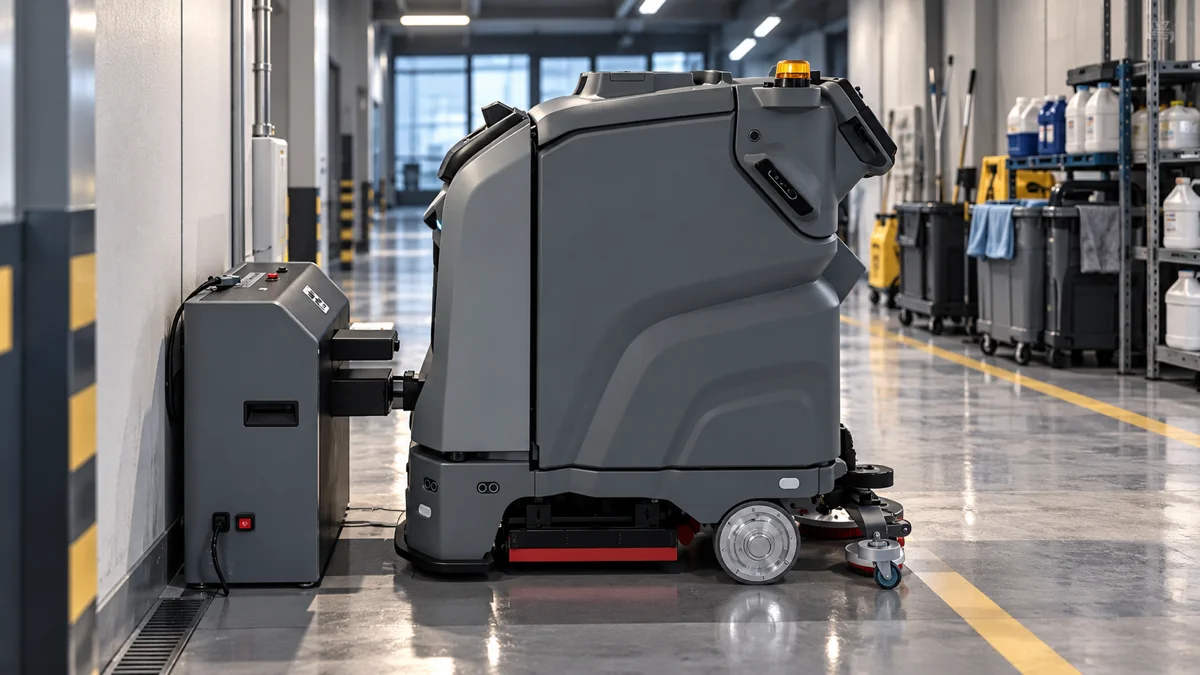
Some industry platforms use dedicated workstations connected to appropriate water, drainage and electrical services. Depending on the system, these workstations can support functions such as water refilling, wastewater disposal and charging.
For example, Kärcher’s KIRA B 50 docking station is a documented industry example of a system designed to automate these resource-exchange activities.
That demonstrates what is technically possible. It does not mean the same features are standard on every commercial robot.
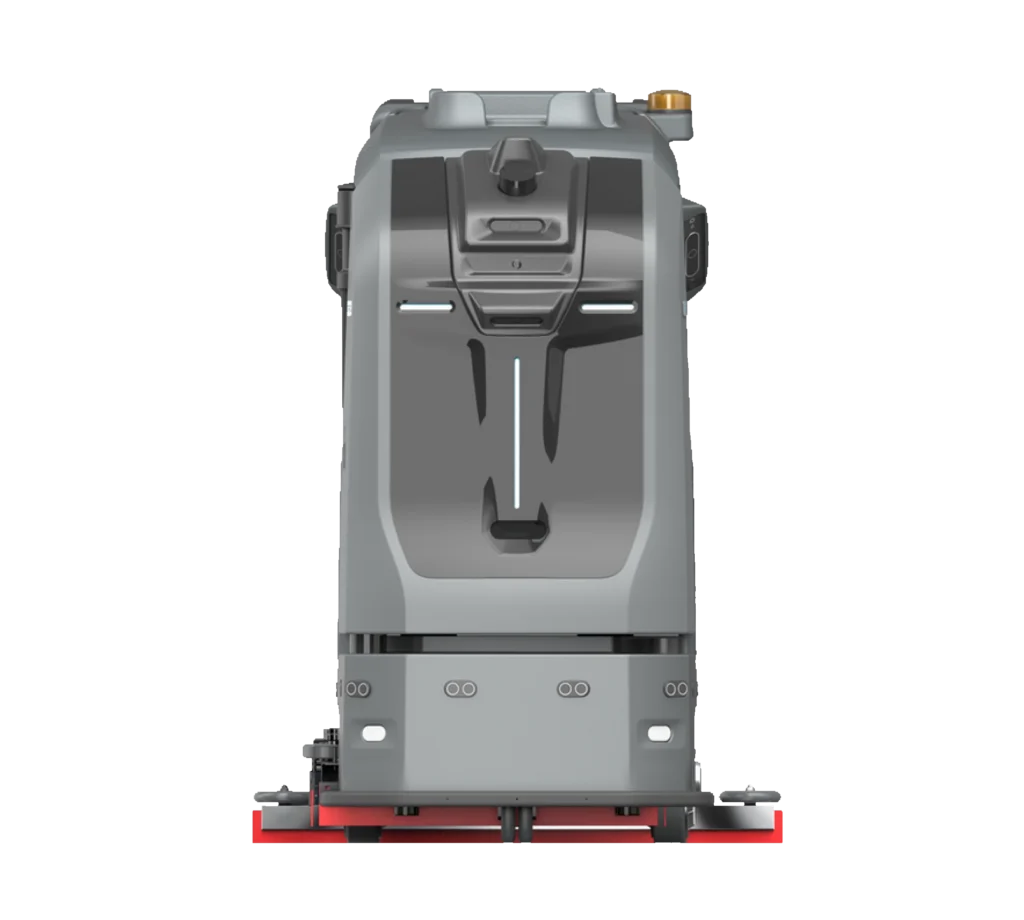
Minfu’s LT70 Pro heavy-duty floor cleaning robot lists a charging dock, workstation and manual charger as available charging options. Its published configuration also includes a 70 L clean-water tank and an 80 L recovery tank.
For a specific OEM/ODM project, the exact workstation functions, compatible infrastructure and available automation sequences should be confirmed against the engineering configuration.
We would not describe an LT70 Pro installation as automatically refilling, draining and resuming every mission without first verifying those functions.
A Robot That Can Return to Its Dock May Still Need an Operator
Think about the work that takes place between two cleaning missions.
The robot may finish a corridor and return to a charging area. But if its brushes contain trapped debris, the recovery tank needs cleaning or the squeegee has been damaged, charging alone will not prepare the machine for the next task.
A workstation can reduce some recurring service requirements, but it cannot necessarily eliminate all maintenance.
The distinction is particularly important in facilities that expect several cleaning missions during a long operating window.
A machine may be capable of performing the cleaning route autonomously yet still require manual preparation between runs.
That is not necessarily a poor product design. Some facilities have dedicated cleaning teams available to service machines between shifts, and adding a sophisticated workstation may not be economically justified.
Other facilities may benefit from greater resource automation because their cleaning windows are long, staffing is limited or several robots need to be managed across a large property.
The right level of automation depends on the operating model.
When the Robot Stops, Who Is Responsible for the Next Decision?
Unsupervised operation needs more than a successful navigation system. It needs a clear procedure for exceptions.
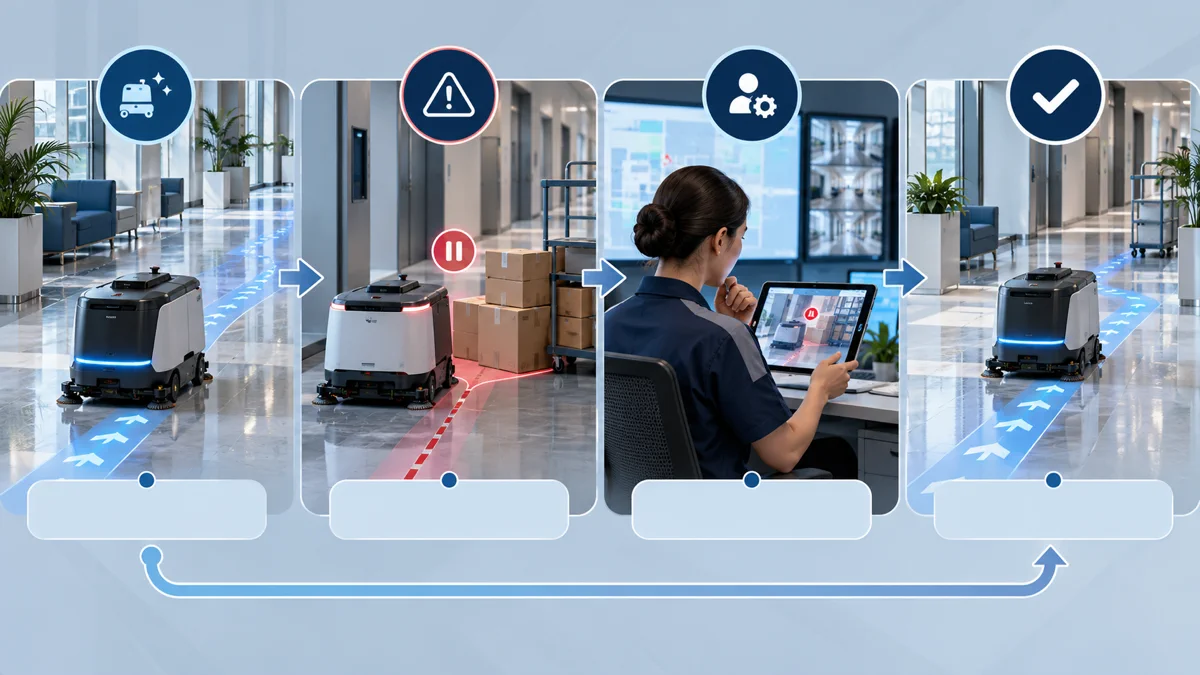
Suppose a robot encounters a blocked aisle and cannot identify a suitable way to continue. It stops and records an interruption.
Who receives the notification?
Who decides whether the obstruction can be removed?
Who confirms that the robot can restart safely?
If the machine stops in an area used by pedestrians or other equipment, who is responsible for the site while the problem is being resolved?
These questions are operational rather than purely technical.
A cloud dashboard can help make a problem visible. It cannot necessarily resolve the physical cause of the problem.
That distinction is often missing from discussions of unattended cleaning.
Different Problems Require Different Responses
| Situation During a Mission | What an Autonomous System May Handle | Where Human Involvement May Be Required |
|---|---|---|
| A person temporarily crosses the route | Slow, stop, yield or continue when appropriate | Normally not needed if the system resolves the situation safely |
| A trolley temporarily blocks a corridor | Wait, reroute or interrupt the affected task | Remove the obstruction or approve a revised task if necessary |
| Battery reaches a configured operating threshold | Return to a compatible charging point, where supported | Resolve docking or charging failures |
| Clean-water supply becomes insufficient | Warn, pause or initiate an available resource-handling routine | Refill the tank if automatic refill is unavailable |
| Recovery tank reaches its limit | Stop or begin a supported service procedure | Empty or inspect the tank if required |
| Sensor or cleaning-system fault | Trigger the documented protective or fault response | Diagnose and service the equipment |
| Mission reports completion | Save task status and available operating records | Verify cleaning quality according to site requirements |
These are representative operating scenarios. The behavior of any particular robot must be confirmed through its technical documentation and testing.
What matters is that the facility has defined both sides of the response: what the machine is allowed to do and what people must do when the machine cannot proceed.
Remote Monitoring Is Not the Same as Remote Safety Control
Cloud connectivity is a useful part of many autonomous cleaning systems.
It can help facility teams organize missions, review task records and monitor the operating status of connected equipment.
The Minfu LT10 platform includes cloud management and supports different mission types, including area coverage, route cleaning and combined cleaning tasks.
However, the existence of a cloud-management platform does not automatically establish which remote commands are available, how they are authorized or whether any particular command can be relied upon as a safety function.
A network connection may be delayed or unavailable. Safety-related behavior should therefore be assessed through the machine’s documented control architecture and applicable safety requirements, rather than assuming that a remote dashboard replaces local protective systems.
For example, IEC 63327:2021 addresses particular safety requirements for automatic floor-treatment machines intended for indoor commercial use.
Buyers should request evidence of applicable conformity for the selected model and target market. Referencing a standard is not the same as demonstrating that a product has been tested or certified to it.
A useful remote-management system improves operational visibility. The machine and the facility still need an appropriate safety strategy.
A Completed Mission Is Not the Same as a Clean Floor
There is another part of unattended cleaning that deserves attention: what happens after the robot finishes its assigned route.
The software may report that the task is complete because the planned mission has reached its end condition.
That information is valuable, but it should not be confused with an independent assessment of the cleaned floor.
A worn squeegee could leave moisture behind. A cleaning head may fail to remove a particular type of soil. An area temporarily bypassed because of an obstruction may still require attention.
For this reason, cleaning records and cleaning-quality verification serve different purposes.
A facility manager may use mission data to confirm that a scheduled task was attempted or completed according to the system’s reporting rules. The actual floor condition can then be assessed through an appropriate inspection procedure.
This is especially important where cleaning performance is part of a service contract.
The facility does not ultimately need proof that a robot drove around the building.
It needs confidence that the contracted cleaning work was completed to an acceptable standard.
How Much Human Attention Does Unsupervised Cleaning Really Remove?
The strongest operational benefit of autonomous cleaning is not a robot’s ability to operate for an impressive number of hours on paper.
It is the amount of useful cleaning work completed without requiring someone to continuously operate the machine.
Those are not always the same thing.
A robot may run for a long period but spend part of that time waiting for assistance. Another machine may have a shorter operating window but complete its assigned work with very few interruptions.
For this reason, we recommend evaluating unattended performance through actual shift records.
Several measurements are especially useful.
Productive autonomous cleaning time records how long the machine performs useful floor-cleaning work without manual driving.
Human intervention time records how long staff spend preparing, rescuing, restarting or servicing the robot during the evaluated period.
Mission completion rate identifies how frequently assigned tasks reach their defined completion criteria.
Accepted cleaned area records how much floor area meets the facility’s cleaning requirements after any necessary inspection.
Service turnaround time captures the work required to prepare the robot for another mission.
These figures reveal much more than a theoretical maximum runtime.
They also help buyers avoid an important mistake: comparing two robots solely by how long they can remain powered on.
A machine that is powered on but waiting for assistance is not delivering the same value as a machine actively cleaning.
One Shift, Not One Perfect Demonstration
If we were evaluating a robot for a large commercial site, we would observe an entire representative operating period rather than only the first successful cleaning route.
The evaluation should include normal traffic, realistic floor conditions and the resource-management process that the customer will actually use.
We would also record how often staff needed to intervene and why.
Was the interruption caused by an obstacle? A depleted resource? A maintenance condition? An unsuitable task setup?
Those distinctions matter because they lead to different improvements.
A route-planning problem may require changes to the mission. A repeated tank-service interruption may indicate that the machine or workstation configuration is poorly matched to the workload.
Without this information, a buyer may conclude that the robot is unreliable when the underlying issue is actually an unsuitable operating process.
What Does This Mean for LT10 and LT70 Pro Buyers?
For Minfu’s commercial cleaning robot partners, the difference between autonomous movement and unattended operation should be considered during product selection.
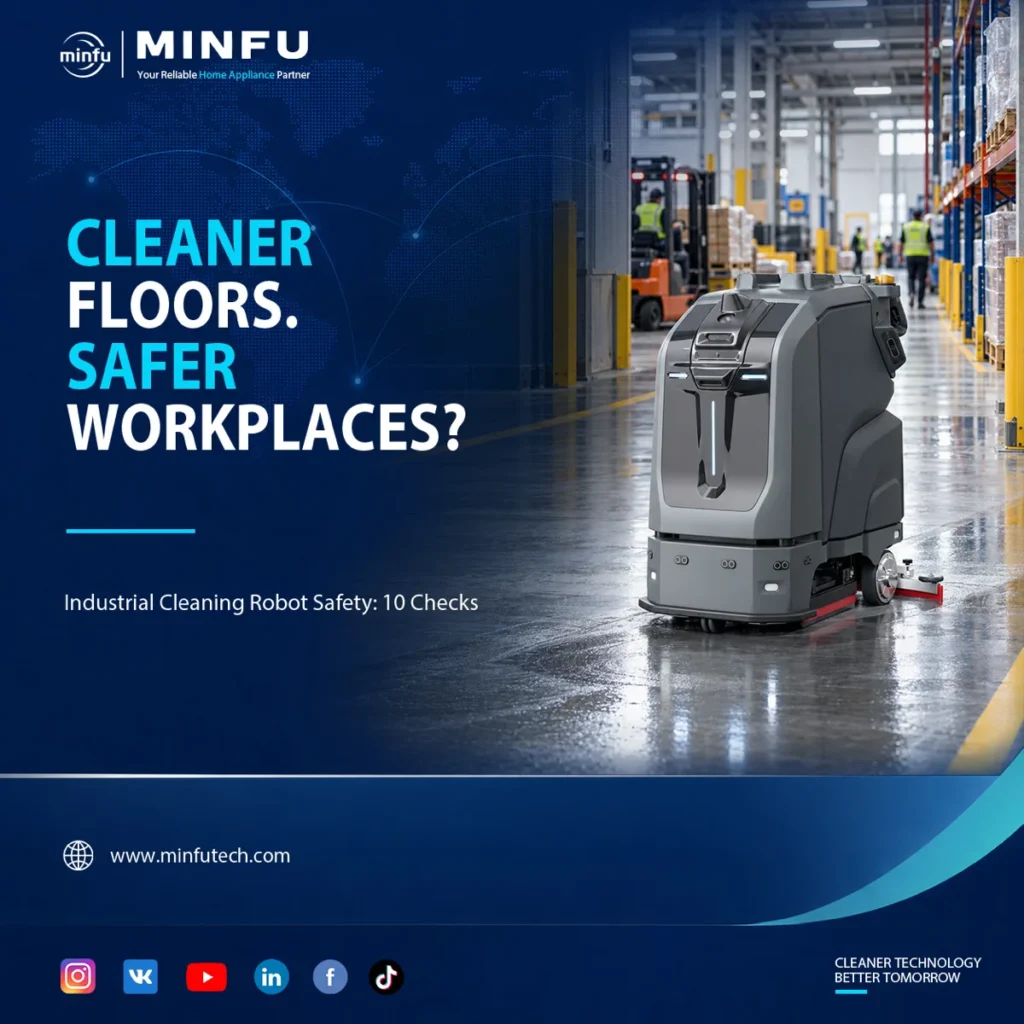
The LT10 is a compact platform intended for more constrained commercial spaces. It combines sweeping, vacuuming and scrubbing with autonomous mission functions and cloud management. Its published mission system supports area coverage, repeatable route cleaning and combined tasks.
For sites where the cleaning workload is organized around defined zones and corridors, these features provide a basis for evaluating hands-off floor care.
The LT70 Pro uses a larger industrial cleaning platform, with a 51 cm brush-cleaning width, 70 L clean-water tank, 80 L recovery tank and multiple charging options.
These characteristics can be relevant to larger floor-cleaning tasks where water capacity, operating infrastructure and equipment turnaround time become significant considerations.
Neither platform should be promoted as universally capable of unlimited 24-hour unattended wet cleaning.
Real autonomy depends on the approved configuration and operating environment.
For distributors and OEM buyers, we recommend establishing which automatic functions are included in the selected hardware and software package, what staff must do between missions, and which performance claims can be supported by testing.
This prevents the term fully autonomous from creating expectations that the actual product configuration was never designed to meet.
Before You Deploy: Define the Boundary of Unattended Operation
A dependable autonomous cleaning program should make its operating boundaries clear.
Which areas can the robot clean independently? When may it operate? What should happen if someone enters its path? Which conditions require the machine to stop? Who receives alerts? Who is authorized to restart it?
Those decisions should be documented during commissioning and reviewed when the layout, traffic or cleaning requirements change.
The same applies to routine maintenance. Someone needs to be responsible for preparing the machine, inspecting wear components and confirming that the robot is ready for another operating period.
If the facility uses a charging dock or workstation, the service infrastructure also needs its own inspection and maintenance procedures.
This does not diminish the value of autonomous cleaning.
It is what allows autonomy to become a dependable part of a professional cleaning operation.
Conclusion
Commercial cleaning robots can work without continuous manual driving, and that capability can significantly change the way repetitive floor-care tasks are managed.
But unsupervised operation is not simply a navigation feature.
It involves mission preparation, environmental response, cleaning-system performance, battery and water management, interruption handling, maintenance and verification of the finished work.
Some of these activities can be automated. Others remain dependent on the selected product configuration, the facility and trained personnel.
The most important purchasing question is therefore not whether a robot can run without an operator standing beside it.
It is:
How much useful cleaning can this robot complete on its own, and what happens when it needs help?
A supplier who can answer that question with a clear operating process and real test evidence is offering something more valuable than a promise of uninterrupted autonomy.
FAQ
Can commercial cleaning robots operate without supervision?
Commercial cleaning robots can perform assigned floor-cleaning missions without continuous manual steering. However, they may still require human oversight, maintenance, exception handling and cleaning-result verification. The degree of unattended operation depends on the equipment and facility.
Can autonomous floor scrubbers work overnight?
Some autonomous floor scrubbers can perform scheduled cleaning during overnight or low-traffic periods. Whether a particular site can use them this way depends on safety assessments, access conditions, cleaning requirements, the robot configuration and available support procedures.
Do commercial cleaning robots automatically return to their charging stations?
Some models support automatic docking and charging. These functions must be verified for the selected configuration. Automatic charging does not necessarily include automatic water handling or restarting an unfinished task.
Can robotic floor scrubbers automatically refill clean water and empty wastewater?
Some industry systems support automated water exchange through dedicated workstations. These functions are not universal. Buyers should confirm whether the supplied workstation includes water refilling, wastewater disposal, tank cleaning or other services.
What happens when a cleaning robot encounters an obstacle it cannot avoid?
Depending on its control system and operating conditions, the robot may stop, wait, interrupt the mission or request assistance. It should not be assumed that every obstruction can be resolved autonomously.
Can a robot resume cleaning after charging?
Some platforms support mission resumption after charging or interruptions. However, automatic docking, charging and task resumption are separate capabilities. The exact sequence should be confirmed through the model’s technical documentation and a practical demonstration.
Does cloud management make a cleaning robot fully autonomous?
No. Cloud management may support scheduling, monitoring and task reporting, but it does not automatically provide autonomous water handling, maintenance, fault recovery or cleaning-result verification.
How should buyers evaluate unattended cleaning performance?
Buyers should measure productive autonomous cleaning time, human intervention time, mission completion, resource interruptions, service turnaround and accepted cleaning results during representative shifts.
Work With Minfu
Minfu provides commercial cleaning robot OEM/ODM manufacturing and development support for equipment brands, distributors, Building Service Contractors and commercial cleaning solution providers.
Our commercial portfolio includes the LT10 compact autonomous cleaning robot and the LT70 Pro heavy-duty floor-cleaning platform. We support project-specific product configuration, customization, sample evaluation, quality control and manufacturing coordination.
If your project requires automatic charging, workstation integration, specific cleaning schedules or defined unattended operating capabilities, our team can help review the available platform configurations and identify the technical requirements that need validation.
Explore Minfu Commercial Cleaning Robots
LT10 Compact Commercial Cleaning Robot
LT70 Pro Heavy-Duty Commercial Cleaning Robot
OEM/ODM Manufacturing Solutions
Website: https://minfutech.com/
Email: info@minfutech.com
WhatsApp / Phone: +86 13760255781
Contact Minfu to discuss your autonomous commercial cleaning robot project.
Explore More Commercial Cleaning Robot Guides
How Autonomous Cleaning Robots Work
Learn how mapping, route planning, obstacle avoidance and floor-care systems work together during an autonomous cleaning mission.
Commercial Cleaning Robot Capabilities: Beyond the Feature List
Understand how to evaluate real robot capabilities through practical demonstrations rather than relying entirely on technical specifications.
Commercial Floor Scrubber Sensors: Beyond LiDAR
Explore how water monitoring, operating feedback and cleaning-system diagnostics relate to autonomous cleaning reliability.