
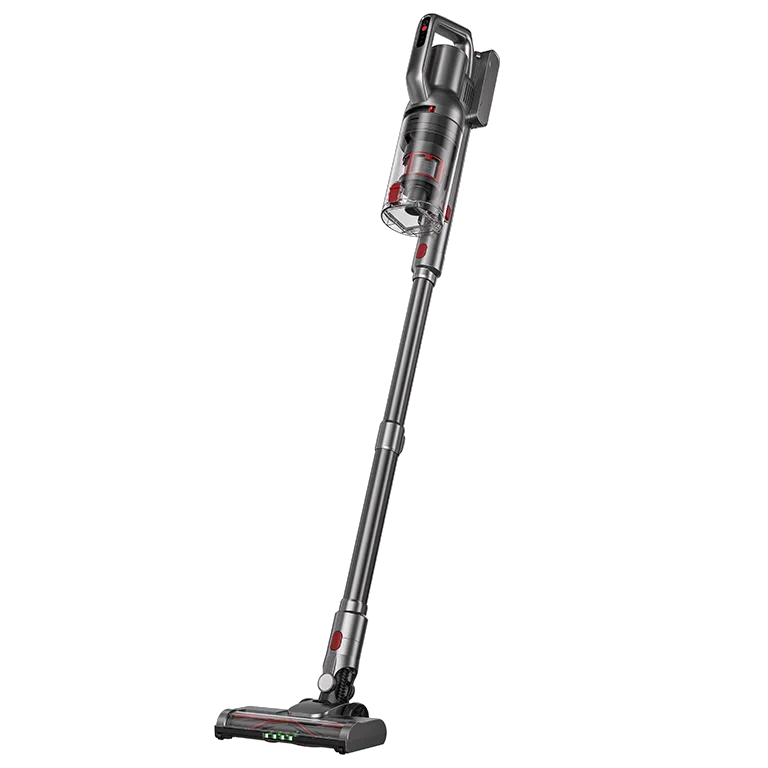
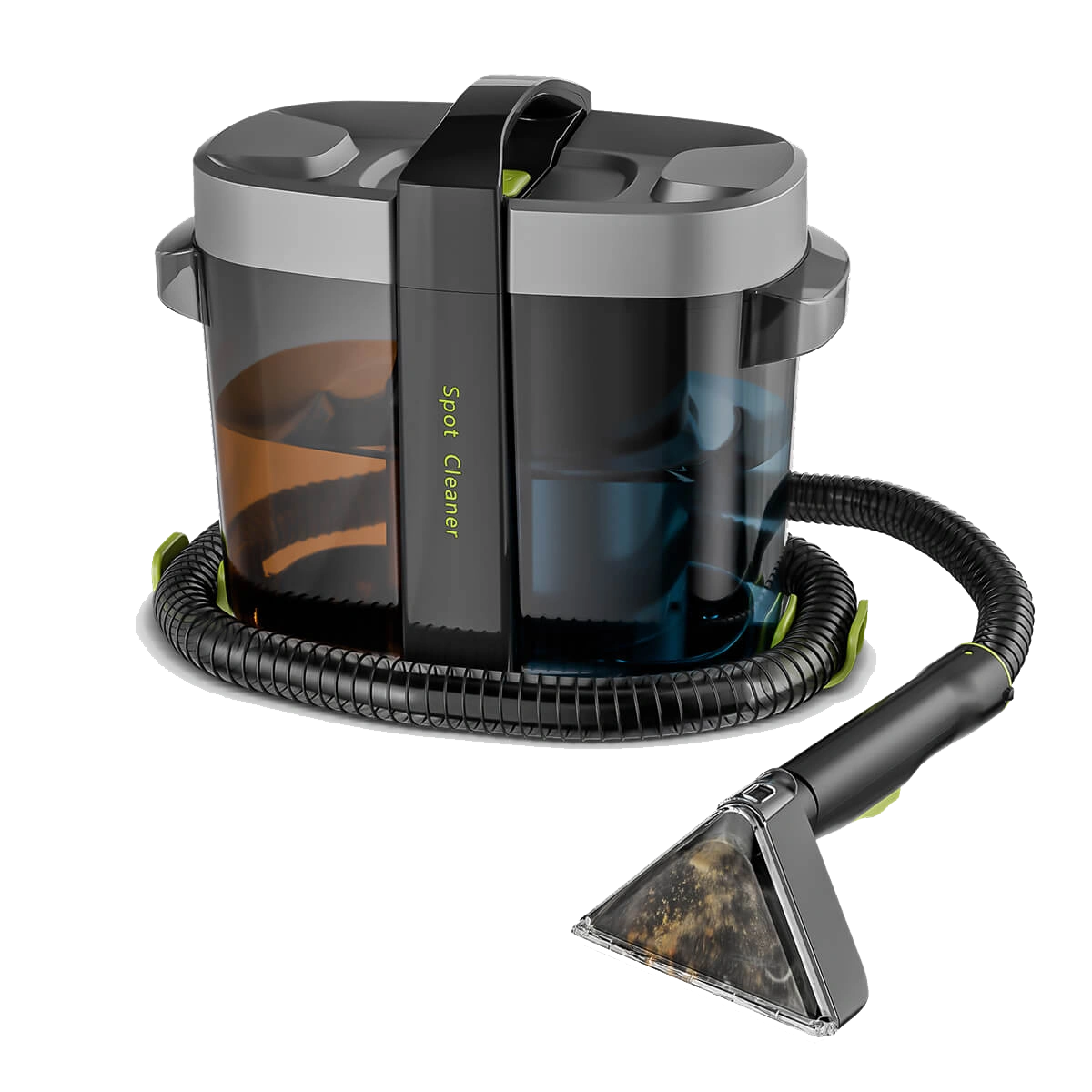



A buyer searching for a “wet dry vacuum cleaner manufacturer” can easily end up comparing completely different products.
Some suppliers use the term for large canister vacuums designed for workshops and construction sites. Others use it for cordless household machines that vacuum dry debris, wash hard floors and recover dirty water in a single pass. The products may share a category name, but their motors, water systems, brush structures, test methods and target customers are not the same.
For importers planning a private-label floor-care line, the correct sourcing category is usually a cordless wet dry vacuum cleaner, also described as a floor washer, vacuum mop or hard-floor washer.
The five companies below were selected using publicly available information reviewed in August 2026. The evaluation considered whether each company has a visible wet-and-dry floor-care range, manufacturing or development capability, international-market experience and a realistic role in a B2B sourcing project.
This is not an audited ranking by global sales volume. A large branded manufacturer may be an excellent technology benchmark but a poor fit for a small private-label order. A smaller specialist factory may offer more flexibility but require much deeper verification of quality systems and certification documents.
The right choice depends on what the buyer is actually trying to build.
A Quick Comparison of the Five Manufacturers
| Manufacturer | Best suited to | Main strength | Important point to verify |
|---|---|---|---|
| Minfu | Private-label brands and flexible market-entry projects | Lightweight Y20 platform, flat-reach design and OEM flexibility | Final weight, battery version and customization MOQ |
| KingClean | Larger-volume programs requiring established engineering resources | Long manufacturing history, motor technology and global production experience | Project entry requirements and floor-washer platform availability |
| Deerma | Premium feature benchmarking, distribution and technology-led product planning | Broad wet-dry product portfolio and fast feature development | Whether private-label cooperation is available for the target market |
| Dibea | Importers seeking an experienced international household-appliance partner | Overseas channel experience and existing wet-dry models | Current model availability and level of structural customization |
| Suzhou Weitek | Buyers looking for a specialist vacuum and floor-washer factory | Focused category portfolio and direct factory communication | Factory scale, certificate scope and production consistency |
1. Minfu — Best for Flexible Private-Label Floor Washer Projects
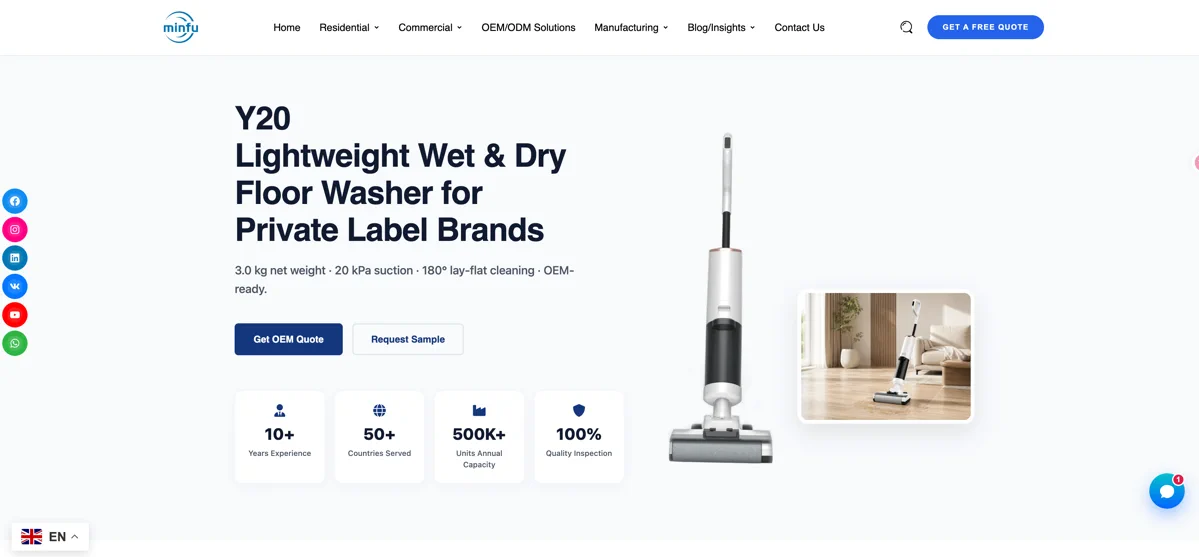
Minfu is a Shenzhen-based cleaning-appliance manufacturer serving overseas importers, wholesalers and private-label brands. Its current wet-and-dry floor-care platform is represented by the Y20, a cordless floor washer positioned around lightweight handling, 180-degree flat reach, wet-and-dry debris pickup and flexible OEM configuration.
The Y20 landing page presents the machine as an alternative to heavier traditional floor washers. Its visible product features include a 20kPa BLDC suction system, dual water tanks, independently controlled water spray, a quick-release brush cover and a lay-flat structure designed for cleaning beneath beds and sofas. The more detailed specification page also lists configurable battery capacities, localized plugs, housing colors, packaging and multilingual documentation.
Minfu’s strongest position is not simply the suction figure. It is the ability to use an existing floor-washer platform as the starting point for a private-label project.
For a distributor entering the category, this can be more practical than funding a new machine from the beginning. The buyer can first evaluate the core structure, cleaning performance and user experience, then decide how much customization is commercially justified.
A basic project may only require a logo, color, packaging and localized manual. A more developed project may involve battery selection, market-specific power accessories, voice prompts, spare-parts planning or changes to the product presentation.
The current Minfu pages also show why specifications must be confirmed before purchase orders are signed. The promotional landing page presents the Y20 as a 3kg machine, while the detailed technical page lists a 3.5kg machine weight. The technical page also presents more than one battery configuration and different runtimes according to capacity. These variations are not necessarily a problem—OEM products often have several configurations—but the final quotation, approved sample, packaging and certification documents must all refer to the same version.
The same principle applies to MOQ. Public information currently references a 500-piece project level, while the FAQ gives a higher standard threshold for customized logo and packaging, with smaller trial quantities considered separately. Buyers should therefore request a written quotation showing the exact MOQ for the selected level of customization rather than relying on a single general number.
Minfu is a suitable candidate for buyers who want a relatively accessible private-label starting point and who value lightweight design, flat-reach cleaning and direct factory communication.
It is still essential to test the final configuration. Turning off water spray, for example, does not automatically prove that the machine is suitable for every carpet or rug. Carpet use should be evaluated separately for moisture recovery, brush resistance, fibre interaction and drying time.
Best fit: importers, regional distributors, e-commerce brands and new private-label floor-care projects.
2. KingClean — Best for Established Engineering and Manufacturing Scale
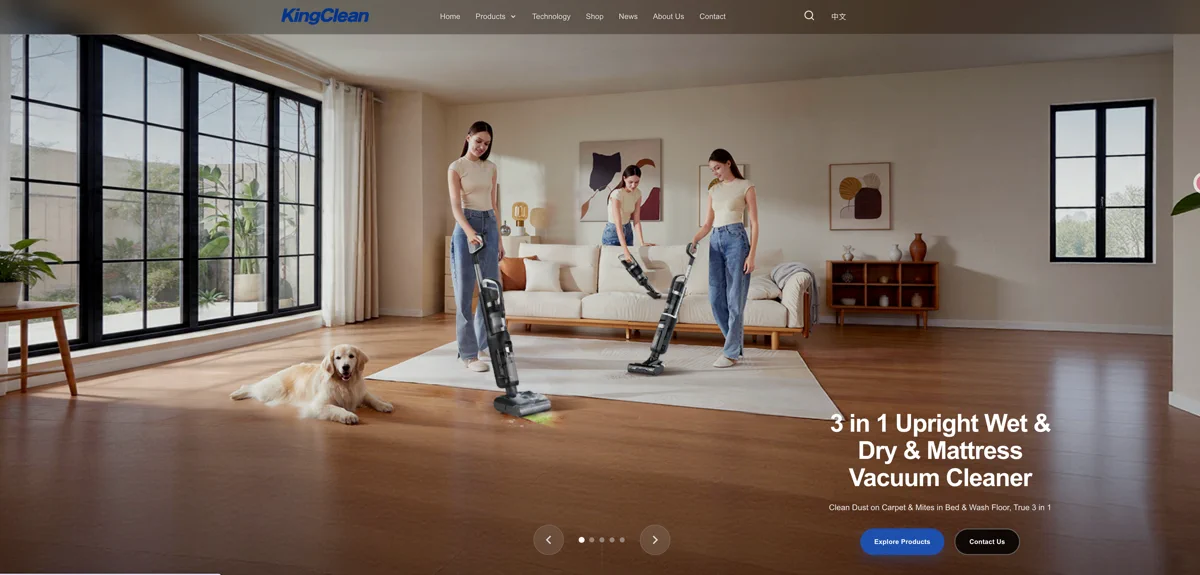
KingClean is one of the most established companies in China’s vacuum-cleaner manufacturing sector.
The company states that it was founded in 1994 and develops cleaning appliances around its motor technology. Its official product structure includes stick vacuums, handheld vacuums, wet-and-dry vacuum cleaners and other household appliances. KingClean also reports exports to more than 100 countries and positions itself as both an R&D manufacturer and an international appliance supplier.
For B2B buyers, KingClean’s main attraction is manufacturing depth.
A floor washer combines several systems that must operate together: a suction motor, water delivery, dirty-water recovery, brush drive, battery management, temperature protection and electronic control. A manufacturer with experience in motors and different vacuum-cleaner architectures may be better equipped to diagnose problems that appear only after repeated use or mass production.
This does not mean that the largest manufacturer is automatically the right supplier for every project.
A large company often has more formal product-selection, forecast and project-approval procedures. Smaller buyers may find that their requested quantity, exclusivity expectations or structural customization do not fit the manufacturer’s commercial priorities. This is an inference from KingClean’s publicly described scale rather than a published MOQ, so buyers should discuss the actual entry requirements directly with the company.
KingClean is particularly relevant when a buyer is planning a substantial retail program and values established engineering, motor development, international production experience and a broad floor-care portfolio.
Before moving forward, the buyer should ask which wet-dry platforms are currently available for OEM or ODM cooperation. A category shown on a corporate website does not necessarily mean that every product is open to private-label orders in every region.
Best fit: established brands, larger retail programs and buyers prioritizing engineering resources and production scale.
3. Deerma — Best for Product Innovation and Premium Feature Benchmarking
Deerma has developed one of the broadest visible wet-and-dry floor-cleaner portfolios among Chinese consumer-appliance companies.
Its official product range includes 180-degree lie-flat machines, dual-roller designs, self-cleaning systems, hot-water washing, hot-air drying, anti-tangle structures and base stations with automatic water supply and drainage. Deerma’s current wet-dry category includes several product families rather than a single experimental model, showing that floor washers are a meaningful part of its cleaning-appliance strategy.
One example is the P60 Max, which combines a wet-dry floor washer with an all-in-one base station. The official page describes automatic clean-water addition, wastewater discharge, full-cycle self-cleaning and 70°C hot-air drying. Other visible Deerma platforms focus on lie-flat access, high-temperature cleaning, dual rollers, edge cleaning and anti-tangle systems.
This makes Deerma valuable to buyers in two different ways.
First, it can be considered as a branded product or distribution partner where that cooperation model is available. Second, it is a useful benchmark for understanding where the upper end of the floor-washer category is moving.
Buyers can study how the company combines cleaning performance with maintenance automation, product appearance and docking-station design. This is especially useful when defining the requirements for a premium private-label product.
However, Deerma should not automatically be treated as an open contract manufacturer.
Its public international website primarily presents branded products rather than a detailed private-label service program. A buyer interested in cooperation should verify whether Deerma offers OEM, ODM, regional distribution or only branded-sales arrangements for the intended market.
The commercial model matters. A strong consumer brand may have excellent products but limited interest in placing another company’s logo on the same platform.
Best fit: distributors, premium-channel buyers and product teams researching advanced wet-dry floor-care features.

4. Dibea — Best for International Channel Experience and Mid-Sized Cooperation
Dibea was founded in 2007 and describes itself as an R&D, manufacturing and marketing company for household appliances. Its official information states that the company operates in more than 80 countries and regions and works with importers, distributors and OEM/ODM partners.
The company has also developed wet-dry vacuum cleaner products, including the HC26 and H8, and maintains a dedicated wet-dry product collection. Dibea has publicly identified smart wet-dry vacuums as one of its cleaning-appliance categories, alongside cordless vacuums and other household products.
Dibea’s international experience may be particularly relevant for buyers that need more than a product sample.
Export projects require packaging that survives transport, clear multilingual manuals, spare accessories, replacement parts and communication across different markets. A manufacturer that has already sold household appliances internationally is more likely to understand these practical requirements, although the quality of support still needs to be verified for the specific project.
Dibea may occupy a useful middle ground between a very large industrial manufacturer and a smaller specialist factory.
It has a visible consumer brand and international presence, while also publicly inviting importers and OEM/ODM partners. This can be attractive to buyers that want an established product-development base without entering the largest possible supply organization.
The main question is whether its current wet-dry platforms match the buyer’s 2026 product plan.
The presence of older models on a website does not confirm current component availability, tooling status or production priority. Buyers should request the latest catalogue and confirm whether the proposed machine is an active mass-production platform, a model available only in certain markets or a product approaching replacement.
Best fit: established importers and distributors seeking a manufacturer with international channel experience and existing wet-dry product knowledge.
5. Suzhou Weitek — Best for Direct Specialist-Factory Sourcing
Suzhou Weitek is a more specialized and less consumer-brand-oriented option.
The company states that it focuses on the design, manufacturing and sale of vacuum cleaners and floor washers, with more than 30 models across these categories. Its official site presents floor washers and cordless wet-dry vacuum cleaners and refers to CE, GS and RoHS-related product compliance.
For some buyers, a specialist factory can offer advantages.
Communication may be more direct, product selection may be less restricted by an established retail brand, and private-label discussion can focus quickly on the available platform, price and customization. This can be useful for wholesalers that already understand the category and do not require a supplier to provide a complete brand strategy.
However, the public website contains less detailed manufacturing and quality information than the larger companies in this list.
That does not mean the factory is unsuitable. It means the buyer’s own verification process becomes more important. Production capacity, factory ownership, testing equipment, certificate authenticity, critical-component suppliers and defect-handling procedures should be confirmed through documentation, video inspection or an on-site audit.
The buyer should also verify whether the certificates apply to the exact proposed model. A general statement that products meet CE or RoHS requirements is not the same as receiving a valid report and declaration that match the model number, electrical configuration and applicant.
Weitek may be a good candidate for buyers who prefer direct sourcing and are prepared to conduct deeper supplier qualification themselves.
Best fit: experienced wholesalers, sourcing companies and buyers seeking a focused vacuum and floor-washer supplier.

What Buyers Should Test Before Comparing Quotations
Price comparisons are useful only when the proposed machines are genuinely comparable.
Two floor washers may both claim 20kPa suction, but one may have a larger battery, stronger brush contact and better dirty-water recovery. Another may be lighter and less expensive to ship but use smaller tanks. A third may have impressive self-cleaning graphics while leaving the centre of the roller wet after the drying cycle.
The first comparison should therefore happen on the floor, not in a spreadsheet.
A useful sample test includes dry debris, mixed wet waste and sticky stains. Rice, noodles, cereal, pet food, coffee, sauce and muddy water reveal different parts of the machine’s behaviour. The buyer should record how much material is collected in one pass, whether debris is pushed forward, how much water remains on the floor and whether dirty water leaks when the machine turns or stops.
Edge cleaning should be tested along walls and cabinet bases rather than judged from the width of the roller alone. The distance between the roller, housing and wall determines the uncleaned strip.
For a 180-degree flat-reach model, the buyer should test more than whether the handle can physically lower.
The machine should be operated beneath furniture with different amounts of wastewater in the tank. Suction stability, tank sealing, water-air separation, steering resistance and the lowest practical clearance should all be observed. A machine that works when its tank is empty may behave differently after recovering a substantial quantity of liquid.
Self-cleaning and drying should also be evaluated after realistic use. The roller may look clean after a short demonstration but retain food particles near the edges or inside the cover. After drying, moisture should be checked at the centre and both ends of the roller. Odour after overnight storage is often more meaningful than how the machine smells immediately after the cycle.
The results of these tests will tell the buyer more than a long feature list.
A deeper explanation of category terminology should be added through the supporting article Wet Dry Vacuum vs Floor Washer vs Vacuum Mop: What Is the Difference?
The supporting article Does Higher Suction Mean Better Cleaning in a Wet Dry Vacuum? should explain why suction, brush design, water control and recovery performance must be evaluated together.
Factory Capability Matters After the Sample Is Approved
Many sourcing problems appear after a good sample has already been approved.
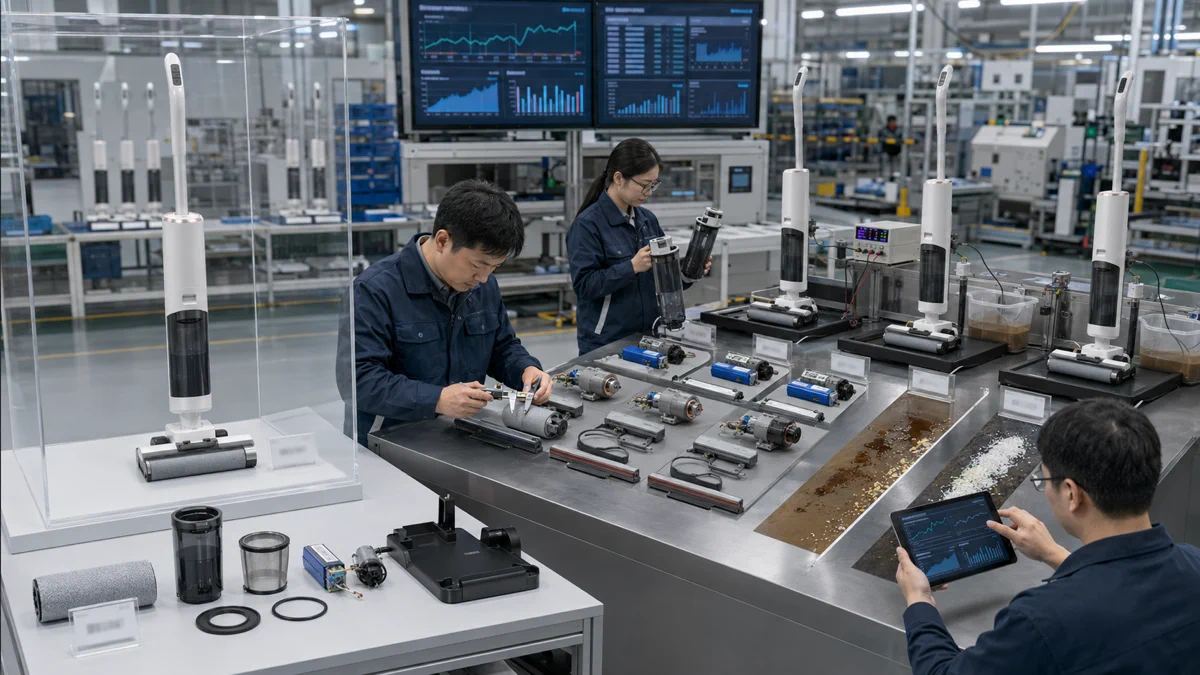
A manually assembled sample may use carefully selected components and receive more adjustment time than a normal production unit. The real question is whether the factory can reproduce the same brush pressure, water flow, suction, battery runtime and sealing performance across hundreds or thousands of machines.
The approved sample should therefore become a controlled golden sample.
Its motor, battery cells, pump, control board, water tanks, seals, roller, scraper and firmware version should be recorded. If one of these components changes, the supplier should explain why it changed and which performance or compliance tests must be repeated.
Buyers should pay particular attention to water-related assembly.
A small variation in a tank seal, hose connection or scraper alignment can create leakage, poor water recovery or streaking. These defects may not appear during a brief end-of-line power check. Production inspection needs to include functional testing that reflects how the machine actually handles water.
Battery consistency is equally important.
A quoted cell capacity does not prove real runtime. Sample units from the production batch should be tested under the same mode, floor condition and water load. Charging temperature, protection behaviour and battery replacement strategy should also be agreed before launch.
Certifications must correspond to the final product.
The model number, voltage, power configuration, charger, plug, battery and applicant information should match the product being shipped. Buyers should not rely on a certificate belonging to a similar-looking model.
Do Not Ignore Packaging, Spare Parts and Returns
A floor washer creates a more demanding after-sales environment than a basic dry vacuum.
It contains clean-water and dirty-water systems, a wet roller, filters, scrapers, seals, a battery and electronic controls. Some components are normal consumables; others may be damaged by incorrect use or repeated exposure to dirty water.
Before launch, the buyer should know which parts can be replaced locally.
Rollers, filters, tank lids, seals, brush covers, chargers and complete tanks are common candidates. The supplier should provide part numbers, prices, packaging dimensions and expected availability. A machine cannot deliver a good long-term user experience if the replacement roller disappears six months after launch.
Packaging also needs more than an attractive design.
The product, base, handle, tanks and accessories must remain protected during international transport and parcel delivery. Drop tests should be performed with the final retail package rather than a temporary sample carton.
Weight must be controlled carefully because it affects both the user and the commercial model.
The relevant figure is not only the empty machine weight. Buyers should understand the complete package weight, the machine’s operating weight after adding clean water and the number of units that fit into each shipping container.
This is where a lightweight platform such as the Y20 may create real B2B value. The benefit should be demonstrated through confirmed packaging and loading data, not only through a comparison with an unspecified heavier machine.
The supporting article Lightweight Floor Washers: Balancing Weight, Runtime and Tank Capacity should explore this trade-off in greater detail.
Which Manufacturer Is the Best Choice?
There is no single answer for every buyer.
KingClean is the strongest candidate in this shortlist for companies that value long manufacturing history, motor engineering and large-scale industrial resources.
Deerma provides one of the clearest views of premium feature development and the direction of high-end wet-dry floor care, but buyers must first clarify whether their intended cooperation is private label, distribution or another model.
Dibea offers an established international household-appliance background and publicly welcomes OEM/ODM cooperation, making it relevant to importers that want both product development and overseas-market experience.
Suzhou Weitek offers a more focused factory profile and may suit experienced sourcing teams willing to perform a detailed audit.
Minfu is particularly relevant to brands looking for a flexible OEM platform built around lightweight handling, 180-degree flat reach and private-label customization. Its Y20 platform should be evaluated using one confirmed specification sheet, because battery, weight and order requirements may vary according to the final project configuration.
A good shortlist usually contains more than one type of supplier.
The buyer can compare one large established manufacturer, one technology-led branded manufacturer and one or two flexible OEM factories. This provides a clearer view of what is available at different levels of cost, customization, scale and commercial commitment.
Final Thoughts
Choosing a cordless wet dry vacuum cleaner manufacturer is not about finding the longest feature list.
The supplier must be able to translate the approved cleaning experience into repeatable mass production, correct certification documents, reliable spare-parts supply and a product that customers can maintain without constant support.
The best sourcing decision begins with a clear target.
A lightweight e-commerce model has different requirements from a premium machine with hot-water self-cleaning and an automatic base station. A buyer entering one country with a trial order needs a different partner from a global retailer ordering several regional versions.
Start by defining the target consumer, retail price, floor types, acceptable operating weight, runtime, tank capacity and maintenance level. Then compare samples using the same debris, stains, test area and operating procedure.
Only after that should the quotation become the deciding factor.
For buyers evaluating a lightweight private-label platform, the Minfu Y20 cordless wet dry vacuum cleaner provides a starting point built around 180-degree flat reach, 20kPa suction, dual tanks and configurable OEM options. Final specifications, testing conditions, customization scope and compliance requirements should be confirmed against the approved project sample.
The next supporting article in this cluster should explain the category itself:
Wet Dry Vacuum vs Floor Washer vs Vacuum Mop: What Is the Difference?