



A floor washer can make a dirty kitchen look clean in ten minutes.
Then the user puts the machine back on its dock.
Inside the machine, however, the cleaning job may not be finished.
The roller is wet. Dirty water has passed through the recovery path. Small pieces of food may remain around the scraper or brush chamber. Hair can stay trapped around the roller ends. If the machine is stored in that condition, the next problem the customer notices may have nothing to do with suction power or stain removal.
It may simply smell unpleasant when they use it again.
This is why self-cleaning and roller drying have moved from secondary convenience features to important parts of the modern floor-washer experience. Tineco has long used automatic brush-and-tube flushing on its floor washers, while newer products from Roborock combine roller washing with automated drying. Current Roborock F25 variants, for example, are marketed with self-cleaning and hot-air self-drying systems, while Tineco’s FLOOR ONE S6 uses self-cleaning with centrifugal roller drying rather than relying on exactly the same drying architecture.
That variety is useful for buyers because it makes one point very clear:
“Self-cleaning” is not one standardized function.
Neither is “drying.”
Two machines can put almost identical icons on the product page while giving the customer a very different experience after cleaning.
For an OEM buyer, the feature therefore needs to be tested as a process—not accepted as a button.
The Floor Is Clean. The Machine May Not Be.
A conventional mop tells the user when it is dirty.
You can see the dirty cloth. You rinse it, wring it out and leave it to dry.
A cordless floor washer hides much more of that mess inside the product.
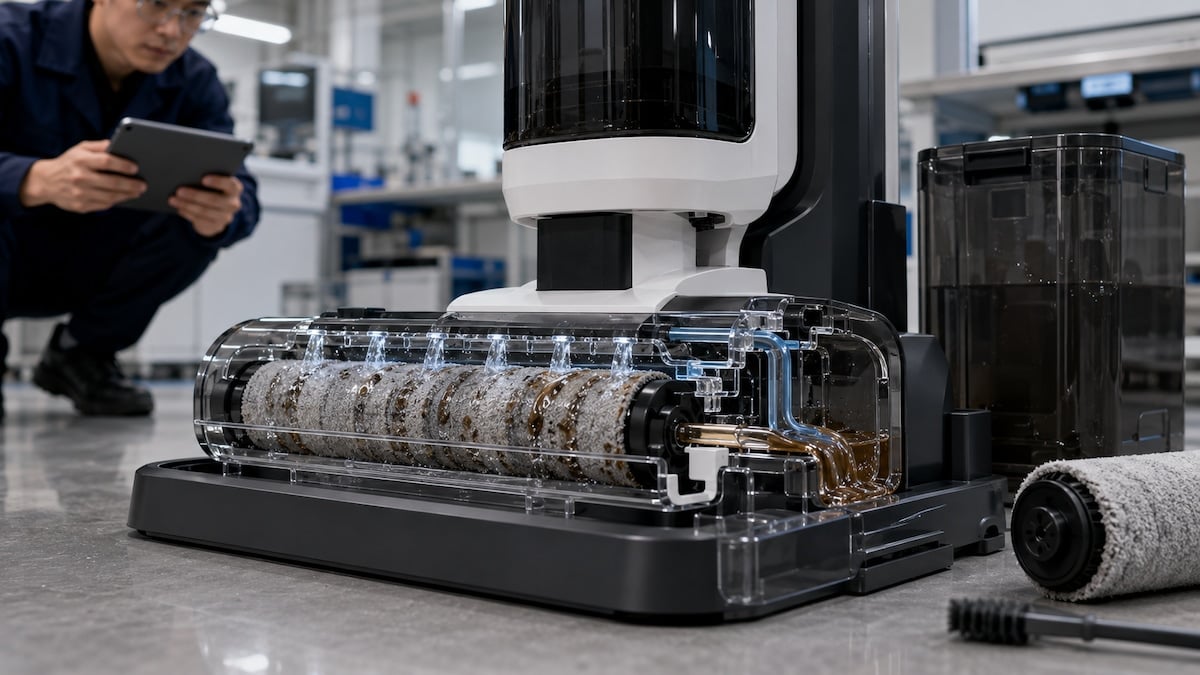
During cleaning, wastewater, crumbs, hair and fine particles travel through the roller area and recovery system. The dirty-water tank catches most of that material, but the roller, scraper, brush chamber and nearby passages can still remain wet or contaminated after use.
That is why pressing a self-cleaning button can be genuinely useful.
Tineco describes the iFloor 3 self-cleaning cycle as automatically washing the brush roller and internal tubes with fresh water and detergent. Its current support guidance for other floor washers also shows that self-cleaning still involves a user workflow: the machine is returned to its dock, the dirty-water tank is emptied and enough clean water must be available before the cycle begins.
That distinction matters.
A self-cleaning floor washer is not necessarily a maintenance-free floor washer.
The system can reduce how much dirty equipment the customer has to handle, but the customer may still need to empty the recovery tank, remove hair, rinse filters and periodically clean areas the automatic cycle cannot reach.
For buyers, this is actually a better way to evaluate the feature.
Instead of asking:
“Does it have one-touch self-cleaning?”
ask:
“What still needs to be cleaned by hand after the automatic cycle finishes?”
The second question reveals much more about the ownership experience.
Self-Cleaning Should Be Judged by What Is Left Behind
A showroom demonstration can make almost any self-cleaning cycle look good.
The roller begins fairly clean. The salesperson pours a little coffee onto the floor. The machine picks it up. It returns to the dock, runs its cleaning cycle and the roller looks clean again.
That proves the function operates.
It does not prove the function performs well after realistic use.
A much more revealing test begins with the kind of mess that actually creates maintenance problems: rice starch, sauce, hair, muddy water, fine dust and food residue.
Clean those materials first.
Then run the normal self-cleaning program exactly as a consumer would.
After the cycle finishes, remove the roller.
Do not only look at the visible surface.
Check both ends of the roller, the scraper edge, the brush chamber, the intake opening and the inside surface where wet debris tends to accumulate. Then inspect the wastewater produced by the cleaning cycle itself.
A good automatic wash should noticeably reduce residue without requiring the user to dismantle half the machine every evening.
This is also why the cleaning path matters.
Tineco describes its current floor-washer system as continuously rinsing the roller with fresh water, wringing dirty water from it and immediately recovering the contamination through suction. A different manufacturer may achieve the same user goal with another roller, scraper or water-delivery structure.
The engineering solution can vary.
The buyer should judge the result.
Drying Solves a Different Problem
Self-cleaning removes contamination.
Drying deals with the moisture that remains afterward.
The two functions are connected, but they should not be treated as the same feature.
Imagine washing a kitchen towel thoroughly and then leaving it folded while still wet.
The towel may be clean, but its storage condition is poor.
A floor-washer roller faces a similar practical issue. It is thick, absorbent and normally stored inside or very close to an enclosed brush chamber. Simply rinsing it does not necessarily mean it will be dry when the customer uses the machine the following day.
Manufacturers have taken different approaches to this problem.
Tineco’s FLOOR ONE S6 uses a centrifugal drying process after self-cleaning. Roborock’s current F25 line includes models with high-temperature self-washing and hot-air self-drying, while the company’s comparison information shows that drying temperature and drying time can differ between variants.
Neither design should be judged only by the phrase printed on the box.
Centrifugal drying can remove a substantial amount of retained water mechanically. Heated airflow can continue removing moisture while the machine sits on the dock. Some platforms combine several approaches.
What matters to the buyer is much simpler:
How wet is the roller when the drying process finishes?
That can be measured.
Weigh a dry roller before the test. Use the machine normally, complete self-cleaning and then run the advertised drying cycle. Remove the roller immediately and weigh it again.
Repeat the measurement after several identical cycles.
The absolute number is less important than consistency.
If one area of the roller is nearly dry while another remains heavily saturated, the airflow may not be distributed evenly. If drying performance changes significantly as the filter or air path becomes dirty, that matters too.
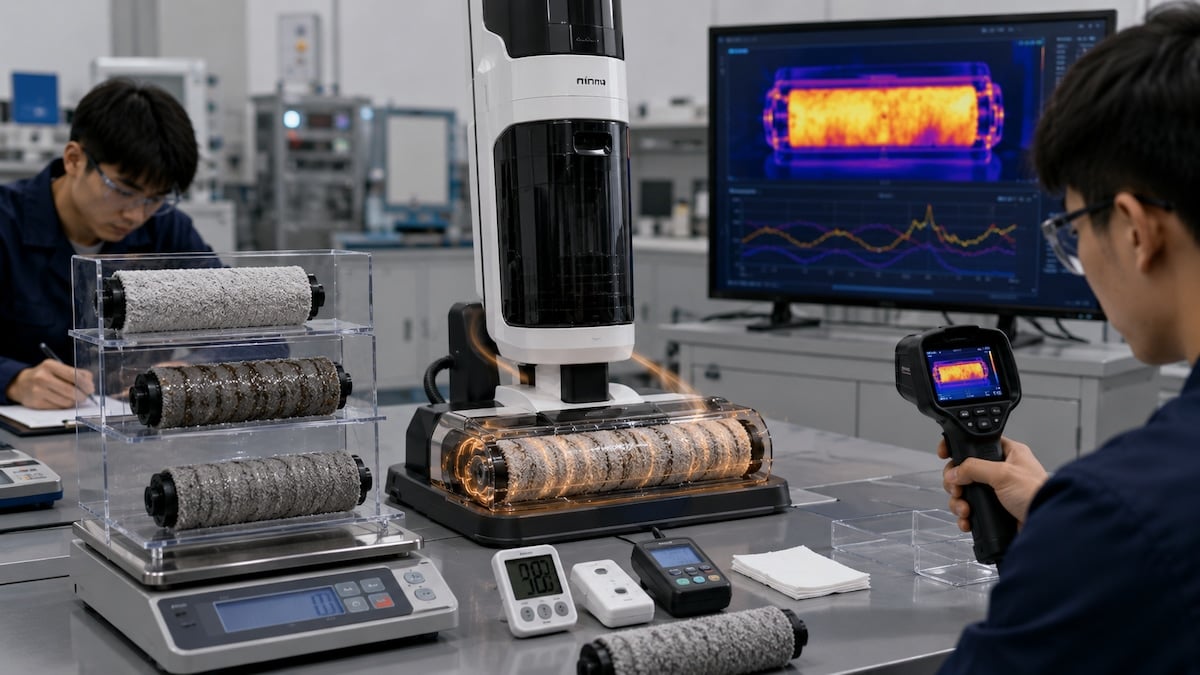
A Higher Drying Temperature Is Not Automatically Better
This is another place where floor-washer marketing can become overly numerical.
One machine may advertise warm-air drying. Another may advertise 70°C, 80°C or 90°C. It is tempting to turn the temperature into another ranking system.
But the same problem appears that we discussed with suction in the previous article:
a larger number is not automatically a better finished experience.
The drying result depends on air temperature, airflow volume, roller rotation, distance from the heat source, drying time, ambient conditions and how much water remained after self-cleaning.
A high temperature applied unevenly may still leave part of the roller wet.
A lower temperature with well-distributed airflow and sufficient time may produce a more uniform result.
There is also the question of material durability. Repeated heating affects the roller, adhesives, plastics, seals and nearby components over the life of the product. An OEM buyer should therefore care about repeated-cycle stability, not just the temperature measured during the first sample demonstration.
This is one reason I would be cautious with statements such as:
“High-temperature drying guarantees a completely dry roller.”
A more defensible claim is:
“Hot-air drying helps reduce residual moisture after self-cleaning.”
The first statement promises a result under almost every condition.
The second explains what the system is designed to do.
The same caution applies to antibacterial or sterilization claims. Some premium manufacturers publish specific sterilization claims for particular products, but those claims should only be carried into a private-label product when the final configuration and the relevant test evidence support them. For example, Dreame currently markets some wet-dry models with high-temperature washing and specific sterilization claims; that evidence belongs to those tested products and should not automatically be transferred to another OEM model simply because both use hot water or warm air.
For a private-label brand, conservative wording is usually safer than borrowing the strongest phrase seen on a competitor’s page.
The Best Test Happens After Repeated Use
A new roller is forgiving.
So is a clean filter.
So is a machine that has processed nothing more difficult than water and a few crumbs.
The maintenance system becomes more interesting after repeated cycles.
This is where I would change the typical supplier demonstration.
Instead of running one self-cleaning cycle, run the machine through several realistic cleaning sessions over multiple days. Use different types of contamination. Allow the roller to become genuinely dirty. Use the normal clean-water and dirty-water handling procedure rather than manually washing components between every trial.
Then observe what changes.
Does the roller become progressively darker?
Does residue accumulate beneath the removable brush cover?
Does hair gather around the roller shaft?
Does the scraper remain clean?
Does the dirty-water tank become difficult to rinse?
Does drying take longer after repeated use?
And most importantly, when the machine is opened after storage, is there a noticeable difference from the first day?
You do not need to convert every observation into a dramatic laboratory score.
A simple repeated-use record is already valuable.
| Test point | What it can reveal |
|---|---|
| Roller weight after drying | Remaining moisture and drying consistency |
| Roller ends and shaft | Hair and debris accumulation |
| Brush chamber | Areas the automatic wash does not reach well |
| Scraper | Residue buildup that may affect later cleaning |
| Dirty-water tank | Ease of rinsing and odor management |
| Filter and airflow path | Moisture or contamination reaching unintended areas |
| Repeated drying cycles | Stability of airflow, heat and roller condition |
One table like this is enough.
The rest should come from actually using the machine.
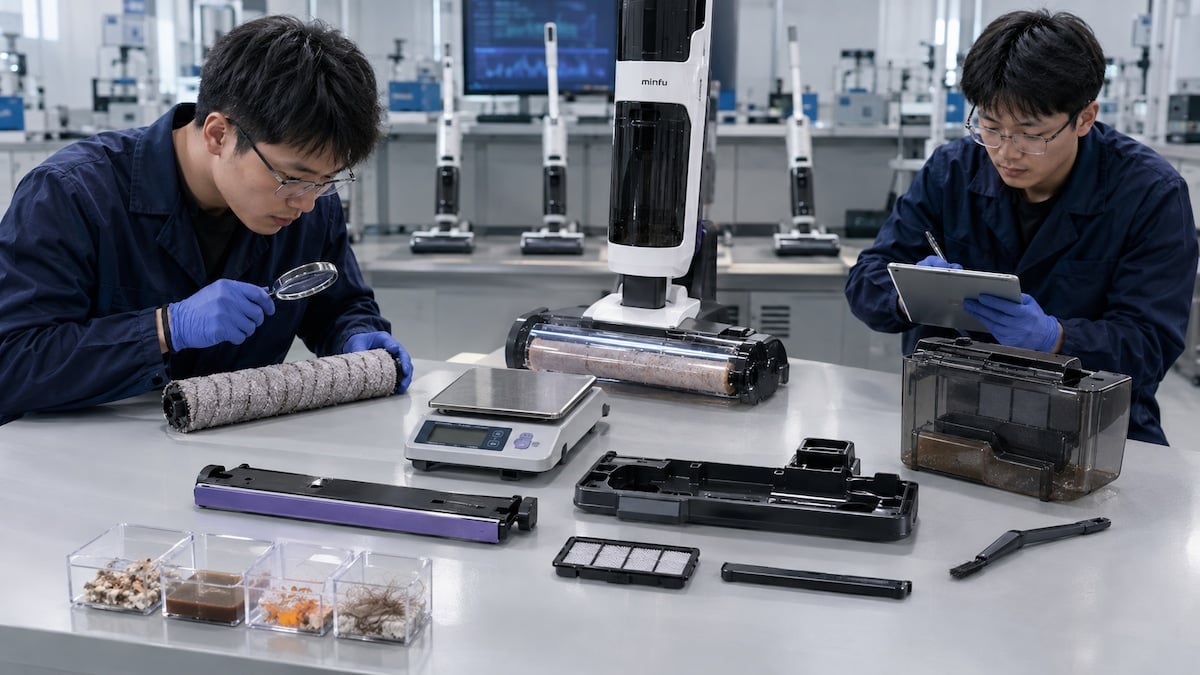
What I Would Test on the Minfu Y20
The current Y20 platform is positioned as a lightweight cordless wet-dry floor washer with separate clean- and dirty-water tanks, a powered roller, flat-reach cleaning and self-maintenance features. Minfu’s current content for the platform describes one-touch self-cleaning and hot-air roller drying as part of the product positioning.
For an OEM project, I would not approve those features from a video.
I would start by making the machine dirty.
Use the Y20 to clean a normal mixture of dry and wet household messes. The previous article in this series already explains why the overall result should be judged beyond its 20kPa suction specification:
Does Higher Suction Mean Better Cleaning in a Wet Dry Vacuum?
After the cleaning test, return the machine to its dock without manually washing the roller.
Run the standard self-cleaning program.
When it finishes, inspect the roller surface first, then remove the roller and check the areas the customer normally does not see. Photograph the roller ends, scraper and brush chamber before and after the cycle.
The next step is drying.
Here I would record the roller weight before cleaning, immediately after self-cleaning and after the complete drying program.
That gives the buyer something more useful than “the roller feels dry.”
It creates a repeatable comparison between samples.
The test should also be performed with the machine used under different conditions. A roller that has only cleaned water may behave differently from one loaded with fine starch, sauce or hair.
Noise during the drying process matters as well.
A drying system may work perfectly in a laboratory but become annoying if it runs loudly for an extended period in a kitchen or apartment. That becomes particularly relevant in markets where consumers commonly dock the floor washer in an open living area rather than a separate utility room.
Energy use is another practical consideration. Buyers do not necessarily need an ultra-low-power drying system, but they should understand the drying duration and electrical consumption before deciding how to position the feature.
And finally, leave the machine alone.
Do not open the roller immediately after every test.
Complete the normal cleaning and drying process, then store the machine as a customer would. Inspect it again the following day.
That simple step turns the test from an engineering demonstration into something closer to real ownership.
A Good Self-Cleaning System Should Make Maintenance Easier, Not Invisible
There is a marketing temptation around this category.
The more automated the machine becomes, the more brands want to say the user never needs to touch anything dirty.
That is rarely the best expectation to create.
Even Tineco’s own self-cleaning instructions still tell users to empty the dirty-water tank and ensure sufficient clean water is available before starting the cycle on applicable models.
That does not make the feature weak.
It makes the product understandable.
For private-label brands, the instruction manual and product page should clearly show which maintenance tasks are automatic and which remain the responsibility of the user.
The difference is important because a customer who knows to empty the dirty-water tank after every cleaning session is much less likely to interpret a later smell as a product failure.
The same applies to rollers and filters.
If a roller is a wear item, the replacement method should be obvious.
If the filter needs regular rinsing or replacement, the brand should make the replacement part easy to obtain.
If hair needs to be removed from the roller ends occasionally, include a cleaning tool and show the user where to look.
These are small details at the factory stage.
They become much larger when thousands of units are in customers’ homes.
Self-Cleaning Also Has an After-Sales Cost
This is where the topic becomes especially relevant to B2B buyers.
A self-cleaning feature adds more than another selling point.
It creates expectations.
Once the packaging says the machine cleans and dries its own roller, customer-service teams will receive questions when the roller remains damp, when the cycle does not start, when the tank is empty or when the customer believes an unusual smell means something has failed.
The OEM project therefore needs more than a functional sample.
It needs a support plan.
Replacement rollers should be available.
Filters should have a clear part number.
The cleaning tool should be included where appropriate.
The manual should explain how much water is required for the self-cleaning cycle, when the dirty-water tank should be emptied and what normal drying noise sounds like.
For international projects, those instructions also need to survive translation.
A poorly translated phrase such as “automatic sterilization complete” can create a much stronger claim than the engineering team intended.
This is one reason OEM development should connect product specifications, packaging, manual content and after-sales preparation before mass production.
Buyers still comparing suppliers can return to the cluster’s main sourcing guide:
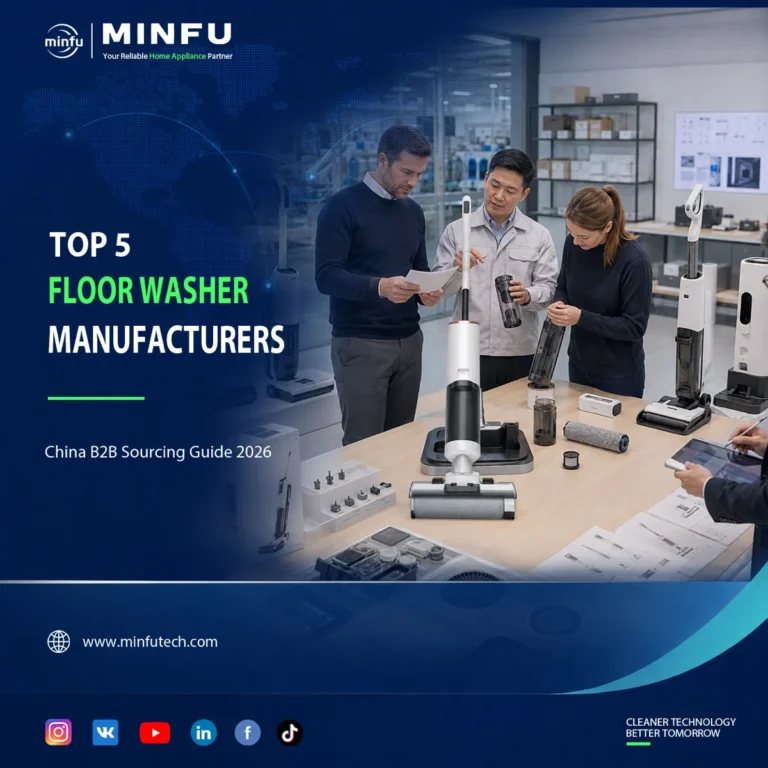
Top 5 Cordless Wet Dry Vacuum Cleaner Manufacturers in China for 2026.
For buyers who are still clarifying the product category itself:
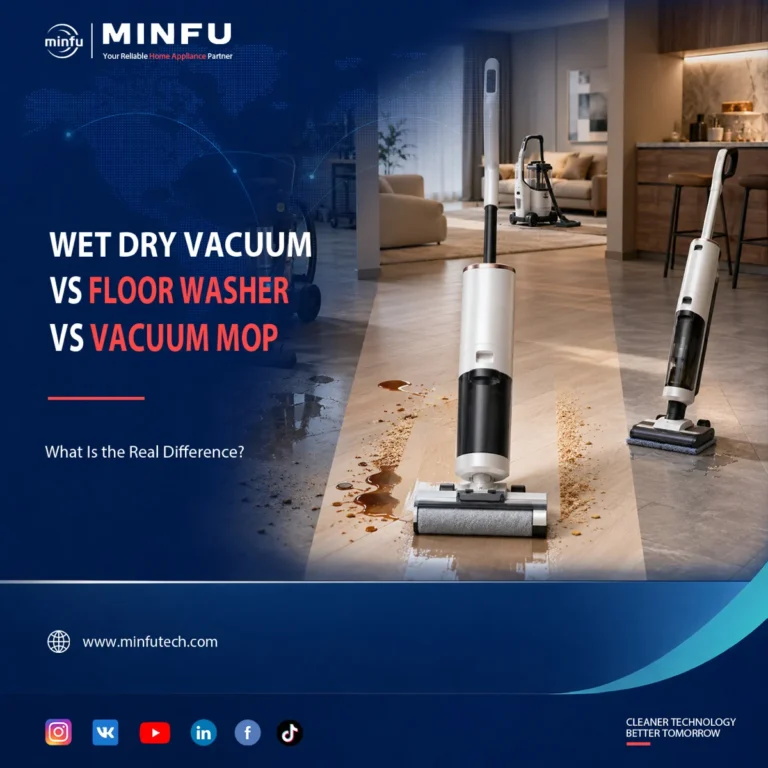
Wet Dry Vacuum vs Floor Washer vs Vacuum Mop: What Is the Difference?.
And the current Minfu Y20 wet and dry floor washer can be used as the platform for sample evaluation and OEM configuration.
Do Not Forget What Happens Before Self-Cleaning
There is one final point that is easy to miss.
A good self-cleaning system cannot completely compensate for a poorly designed cleaning head.
If too much hair wraps around the roller during use, the washing cycle may not remove it.
If large debris becomes trapped behind the scraper, flushing more water through the system may not solve the blockage.
If the floor washer recovers too much foam, the wastewater system may need attention before the machine even returns to its dock.
That is why these articles should be read as one product-development story rather than isolated features.
The previous suction article explained that cleaning performance comes from the relationship between roller contact, water delivery, scraping and recovery—not the Pa number alone.
The 180° article showed that a machine must continue controlling wastewater when its orientation changes.
Self-cleaning begins with whatever those systems leave behind.
A well-designed floor washer should therefore move naturally from:
cleaning the floor → recovering the dirt → cleaning its own roller → removing retained moisture → being ready for the next use.
The customer experiences all of those stages as one product.
The engineering team should too.
Final Thoughts
Self-cleaning is easy to demonstrate.
Good self-cleaning is harder to prove.
The difference appears after the roller has handled real food residue, hair and dirty water. It appears in the places the automatic cycle cannot easily reach. It appears when the customer opens the machine the next morning.
Hot-air drying deserves the same treatment.
A high temperature sounds impressive, but buyers should care more about whether moisture is actually removed evenly from the roller, how long the process takes, how loud it is and whether performance remains stable after repeated use.
That is the standard I would use for an OEM sample.
Do not ask only:
“Does the floor washer have self-cleaning and hot-air drying?”
Put the machine through several realistic cleaning cycles.
Let it clean itself.
Let it dry.
Then open it.
What remains inside tells you much more about the product than the feature icon on the box.