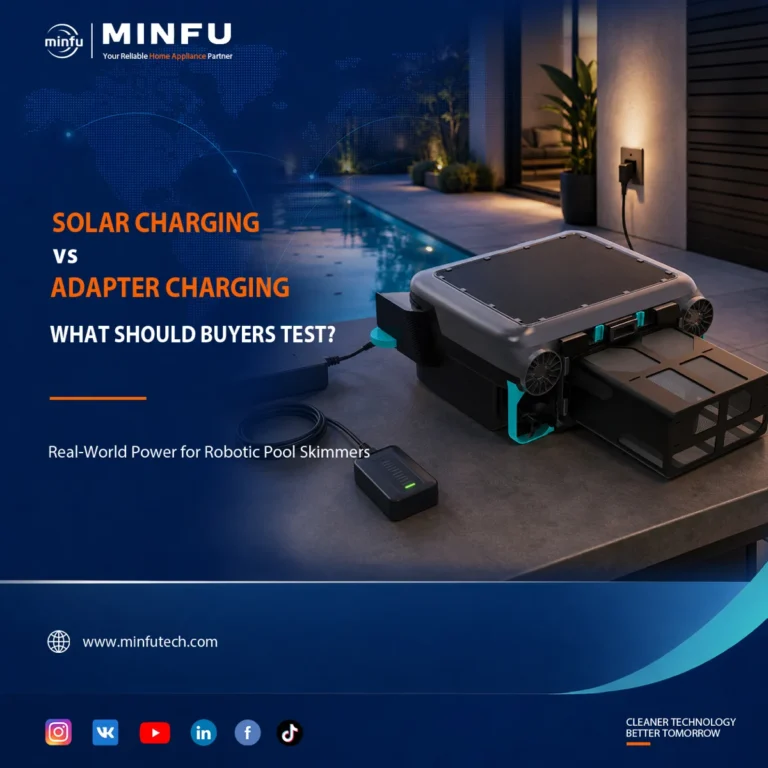


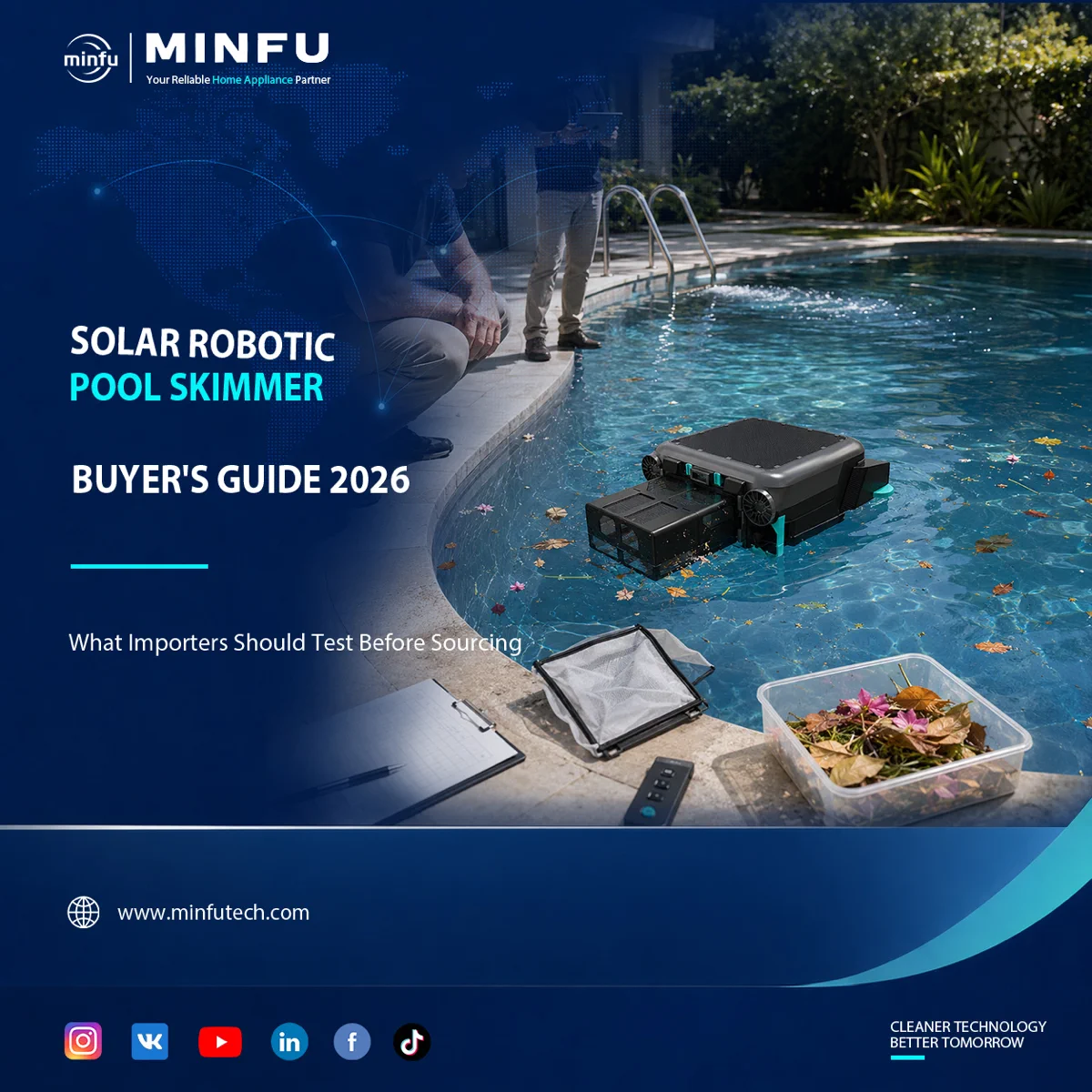

A robotic pool skimmer looks like a relatively simple product when it is sitting on a supplier’s sample table. There is a solar panel on top, a collection basket underneath, a pair of motors to move it around the pool, and perhaps a remote control. Put it in clean blue water during a short demonstration and almost any competent sample can make a good first impression.
An outdoor swimming pool is much less cooperative.
Leaves tend to collect where wind pushes them. Return jets create currents that can help a robot in one direction and fight it in another. Part of the pool may spend the afternoon in shade. Wet leaves behave very differently from dry ones once they begin filling the filter. Ladders, floating hoses, steps and unusual pool shapes introduce places where a robot may hesitate or become trapped. A product that will eventually spend hours exposed to chlorinated water and sunlight also needs to be judged differently from one that only runs for twenty minutes during a showroom demonstration.
For an importer or private-label brand, this changes the way a solar robotic pool skimmer should be sourced. The most important questions are not whether the product has solar charging or how large the filter looks in a brochure. Buyers need to understand what job the machine is actually designed to perform, how its energy system behaves throughout a real day, how debris affects performance as the filter fills, and whether it can continue moving through the awkward parts of a normal swimming pool.
This guide focuses on those questions.
First, Make Sure You Are Actually Buying a Pool Skimmer
The terminology around pool robots is still inconsistent enough to cause problems in sourcing conversations. “Pool robot,” “robotic pool cleaner” and “pool skimmer” are sometimes used interchangeably in listings, even though the machines may perform very different jobs.
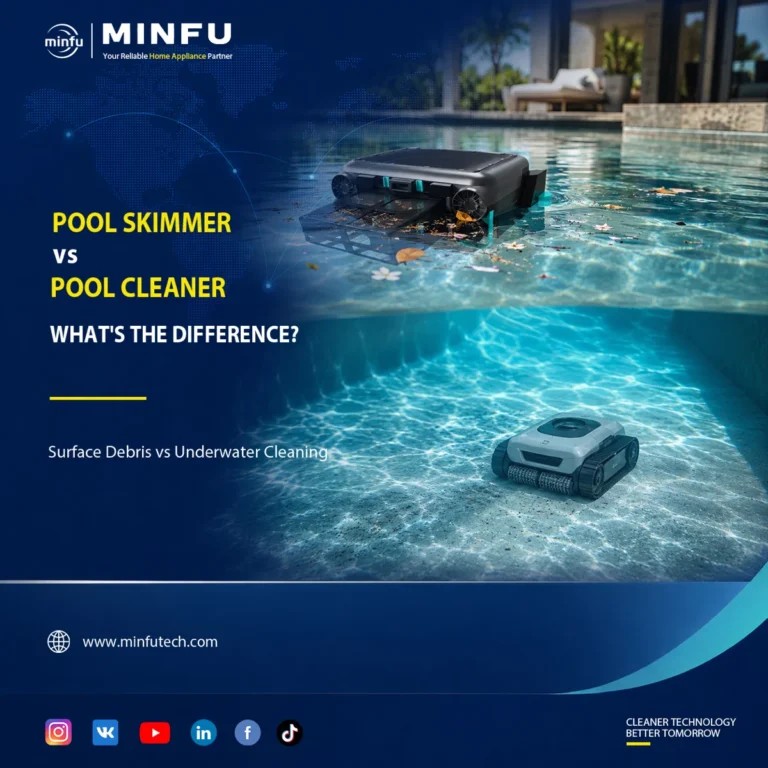
A robotic pool skimmer operates on the water surface. Its job is to collect floating material such as leaves, insects and pollen before that debris becomes waterlogged and sinks. A conventional robotic pool cleaner or pool vacuum normally works below the surface, cleaning the pool floor and, depending on the model, walls and the waterline. Maytronics describes the distinction in much the same way: its dedicated Skimmi product handles floating surface debris, while its underwater Dolphin cleaners are designed for pool surfaces below the water.
This distinction may sound obvious, but it affects almost every part of the buyer’s evaluation. A surface skimmer does not need the traction system required to climb a tiled wall. It does need to remain stable while floating, collect debris efficiently at the waterline and continue navigating while currents and wind act on the body. Its operating pattern is also different. An underwater cleaner may complete a defined cleaning cycle and then be removed; a surface skimmer is more useful when it can remain available for long periods because new leaves and insects keep arriving throughout the day.
That is why I would avoid positioning a dedicated surface skimmer as a replacement for every other pool-cleaning device. In many outdoor pools, the two categories complement each other. The surface robot removes material before it sinks, while the underwater cleaner deals with dirt that has already reached the floor, walls or waterline.
Minfu’s MFS01 belongs to the first category. Although its existing URL still contains the broader wording “robotic pool cleaner,” the current product itself is presented as a solar-powered robotic pool skimmer with surface-cleaning functionality.
For buyers, getting that definition right at the beginning also prevents problems later in packaging and advertising. A retailer should not discover after launch that consumers expected wall climbing simply because the words “robotic pool cleaner” were used too broadly.
Solar Charging Is Only Useful When the Energy System Works as a Whole
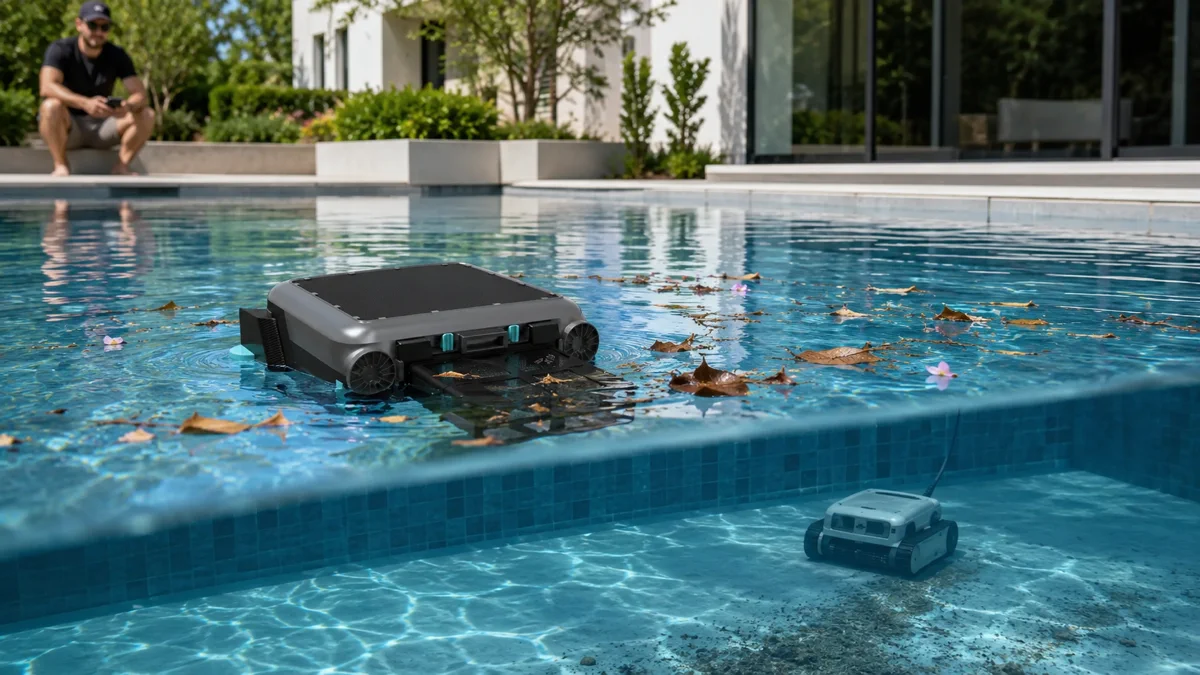
Solar power is the feature buyers notice first because it is visible. A large panel covering the top of a floating robot immediately communicates a simple idea: put the machine in the sun and let it take care of itself.
Real-world operation is more complicated. Solar output changes with the time of day, cloud cover, season, latitude, shade and the angle at which light reaches the panel. A robot can also move repeatedly between sunny and shaded portions of the same pool. Surface contamination on the panel introduces another variable after the product has spent weeks outdoors.
This is why the best question is not “Does it have solar charging?”
The better question is how the solar input, onboard battery and secondary charging method work together when sunlight is not ideal.
Current products in the category show different approaches to this problem. Maytronics promotes solar recharge on its Skimmi line while also offering external charging on relevant configurations, and Beatbot’s iSkim Ultra combines a solar panel with a large onboard battery as part of its 24/7 operating concept. The engineering details vary by product, but the direction is useful for importers: solar generation and stored energy should be evaluated as one system rather than two unrelated specification bullets.
MFS01 follows a hybrid approach. Minfu currently specifies both solar and power-adapter charging, a 4–5 hour charging time and more than 15 hours of battery-only working time under its published operating conditions.
For sample evaluation, I would deliberately make the solar conditions imperfect. Begin with a fully charged battery and run the unit through a normal day in an outdoor pool. Record how much of the pool is actually exposed to direct sunlight at different times. Repeat the test when the afternoon is cloudy or when part of the water is shaded by a building, fence or vegetation. Then test the battery-only condition separately instead of assuming the solar panel will always compensate for energy use.
This gives the buyer a much more useful understanding of the product. A 15-hour battery claim and a solar panel may both be true, but what matters commercially is whether the combination keeps the robot available during the period when the target customer actually needs surface cleaning.
That period can vary substantially between markets. A tree-lined residential pool in Florida is not the same environment as a hotel pool surrounded by open paving in southern Spain. If the target market includes strong seasonal differences, testing only at noon on a clear summer day gives the sourcing team an incomplete picture.
Runtime Should Be Tested as Availability, Not Just Hours on a Stopwatch
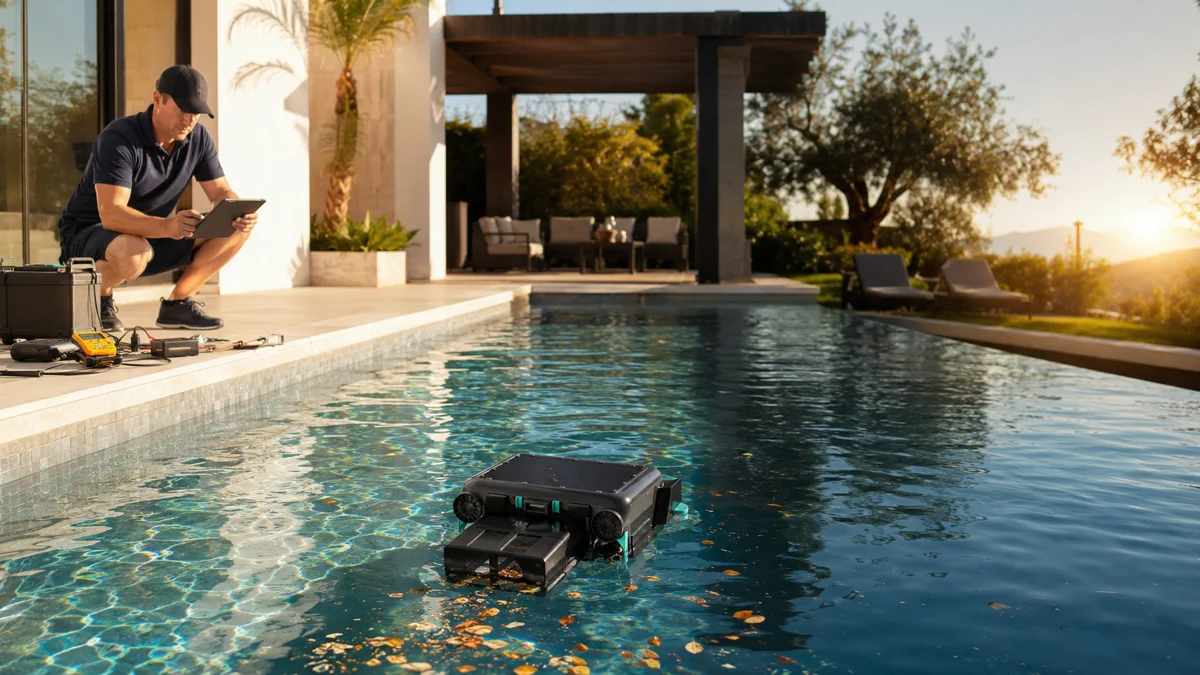
Battery runtime matters more to a surface skimmer than a specification-sheet comparison might suggest. Floating debris does not arrive according to a cleaning schedule. Wind can bring a new layer of leaves across the water half an hour after the pool looked perfectly clean.
That makes a skimmer somewhat different from a floor-cleaning robot that finishes a specific area and returns to its dock. The useful measure is not simply how long the motors can run from a full battery. Buyers should think about how much of the day the product remains capable of collecting new debris without the owner needing to intervene.
MFS01’s currently published figure is 15+ hours on battery alone. I would treat that as a starting specification for sample testing rather than the end of the discussion.
Run the machine with a nearly empty filter and then repeat the test after it has collected a realistic amount of wet debris. Observe the difference between calm water and a pool with stronger return-jet flow. Use the remote-control function for part of one test if that is how consumers are expected to use the product. Most importantly, repeat the same routine rather than relying on one unusually good run.
The sourcing team does not necessarily need the longest runtime available in the market. It needs enough operating availability for the product’s intended use case. If the machine comfortably covers the debris cycle of a typical residential pool and solar input extends that availability during the day, adding more battery may contribute less value than improving navigation, filter access or long-term durability.
This is the same mistake buyers make in many cordless categories: one easy-to-compare number starts controlling a product decision that should really be based on the complete user experience.
A 6-Liter Filter Is Useful Only If the Robot Still Works as It Fills
Filter capacity is another specification that looks straightforward until the robot enters a real pool.
MFS01 currently uses a removable, washable 6-liter filter bag. That is a meaningful amount of collection volume for a relatively compact 2.8 kg surface robot, but liters alone do not tell a buyer whether the debris system is well matched to the target environment.
Start with the material itself. A container filled with dry leaves may look impressive in a product photograph, yet leaves taken from a pool quickly become wet, fold together and pack differently. Pine needles behave differently from broad leaves. Flower petals can form a soft layer. Insects and pollen introduce finer material, while small twigs can interfere mechanically even though they occupy little total volume.
There is also a difference between capacity and filtration performance. A larger basket or bag gives the robot more room for collected debris, but it does not automatically mean the filter is suitable for every particle size. Beatbot’s current iSkim Ultra, for example, uses a 9-liter basket as part of a different product architecture. That demonstrates how seriously manufacturers are treating debris capacity, but it does not establish that 9 liters is inherently better than 6 liters for every pool or robot size.
A more useful sample test starts with a known mixture of debris and checks performance at several fill levels. Does the intake continue drawing in leaves when the bag is half full? Do wet leaves block the water path? Does debris fall back into the pool when the machine turns? Can the customer remove the filter without spilling everything they just collected back into the water?
The last question is easy to overlook during supplier selection. Consumers handle the filter frequently, so removal, emptying and rinsing are part of the product experience. A large filter that is awkward to carry when full of wet leaves may not feel as convenient as its capacity number suggests.
For importers selling into different regions, local vegetation should also influence the test. A pool surrounded by palm trees, an area with small dry leaves and a garden that produces large broad leaves may place very different demands on the same intake and filter design.
Anti-Stuck Performance Is Better Tested in a Difficult Pool Than on a Spec Sheet
Navigation is one of the areas where short promotional videos can be particularly misleading.
A rectangular test pool with clear water and no obstacles tells you whether the robot can move. It does not tell you how well the machine handles the places where real pool owners become frustrated.
Ladders are an obvious example, but they are not the only one. Buyers should also look at return jets, skimmer openings, floating hoses, corners, curved walls, steps close to the surface, shallow ledges and places where wind repeatedly pushes debris against one side of the pool. Even a robot that technically continues moving may waste long periods repeatedly approaching the same obstacle.
Minfu currently describes MFS01 as having an anti-stuck design based on physical anti-absorption foam, and the supplied accessory list includes both anti-grounding and anti-stuck components. That is useful information, but I would keep the sourcing claim conservative until the exact sample has been tested in the pool geometries relevant to the project.
In particular, I would not automatically turn “anti-stuck design” into “intelligent obstacle avoidance” or “advanced navigation” in private-label packaging unless the final product configuration and test evidence support those terms. Those phrases imply more than a physical feature that reduces the chance of becoming trapped.
A practical test is easy to understand. Put the robot into a deliberately inconvenient pool and watch it for long enough that you become bored.
That last part matters. Many navigation problems do not appear in the first five minutes. A machine may free itself from a ladder nine times and fail on the tenth. A return jet may only become problematic when the battery is lower or the filter is heavier. The purpose of the trial is not to create an impressive video; it is to find the situations that would eventually become customer-service tickets.
Current premium skimmers show how much attention the category is giving to this problem. Maytronics equips its Skimmi line with above- and below-water infrared sensing, while Beatbot’s iSkim Ultra uses multiple sensors and powered obstacle handling. Buyers do not necessarily need the most complex navigation system in the market, but they should understand what their chosen product actually uses and make sure the marketing language matches it.
IPX8 Is Important, but It Is Not the Whole Durability Story
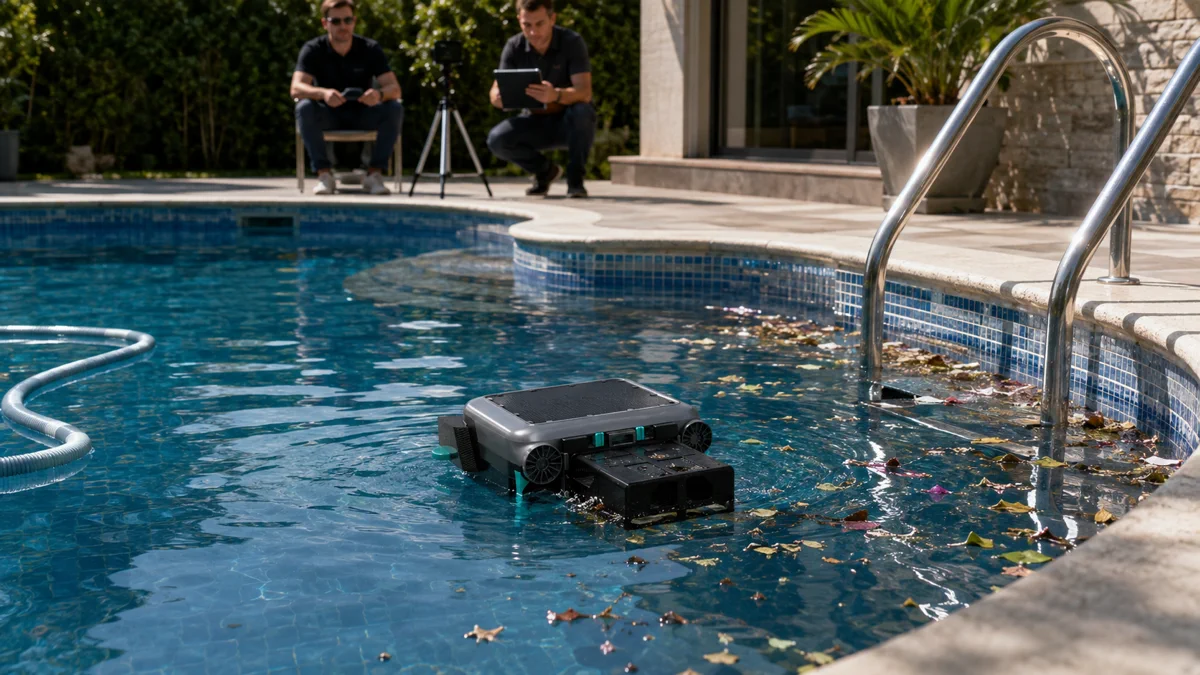
A pool skimmer spends its life in an unusually demanding environment for a consumer electronic product. Water exposure is obvious, but outdoor use also means sunlight, heat, chlorine or salt, repeated wet-dry cycles and contamination from whatever falls into the pool.
MFS01 is currently specified as IPX8. IEC 60529, the standard behind IP codes, classifies the protection provided by electrical enclosures against intrusion, including water. That makes the IP rating important, but buyers should not interpret it as a universal statement about every form of outdoor durability.
An IP rating does not by itself tell you how the housing color will age after prolonged UV exposure, how a particular metal part behaves after repeated contact with chlorinated or salt water, how the solar-panel surface changes over time, or whether seals retain their performance after repeated thermal cycling. Those are separate durability questions.
For a sample intended for a serious private-label project, I would therefore look beyond the initial waterproof test. Inspect fasteners and shafts after repeated pool use. Check whether the solar-panel surface becomes cloudy or difficult to clean. Look for water trapped in places where it does not create an electrical failure but may still create an unpleasant ownership experience. Confirm the appropriate water-chemistry limits for the final product rather than assuming compatibility with every saltwater or heavily chlorinated pool.
This is particularly important when a product will be marketed across multiple countries. “Outdoor pool” describes a use case, not one standardized environment.
Weight and Maintenance Matter More Than They Appear to
A robotic pool skimmer may spend most of its operating life floating, so weight can appear relatively unimportant. The customer experiences the machine differently.
Someone still has to lift it out of the pool.
They need to remove a wet debris bag, rinse it, clean leaves from the intake and occasionally inspect components. A machine that is easy to handle during these moments can feel much more convenient than one whose extra mass only becomes obvious after it has collected water and debris.
MFS01 is currently specified at 2.8 kg, with a modular design and removable filtration system. For an importer, this is less useful as a “lighter is always better” claim than as part of the maintenance evaluation.
Ask someone who has not been involved in the product development to remove the robot from a pool after a normal cleaning session. Watch where water drains. See whether they naturally understand how to access the filter. Ask them to empty wet leaves, rinse the bag and put the machine back together without verbal instructions.
That ten-minute observation often reveals more about consumer usability than another page of specifications.
The same principle applies to spare parts. A removable filter is useful only if replacement filters can be supplied. Anti-stuck or anti-grounding accessories should be clearly identified. Chargers, remote controls and other project-specific parts need a replacement strategy before the distributor begins selling units, not after the first customer loses one.
How I Would Evaluate MFS01 Before a Private-Label Order
For the current MFS01 configuration, Minfu publishes a useful starting set of specifications: solar and adapter charging, 15+ hours of battery-only runtime, a 6-liter removable filter bag, IPX8 rating, 2.8 kg product weight, physical-button and remote-control startup, and a 419 × 324 × 161 mm body. The product page currently lists an OEM/wholesale MOQ of 1,000 units and supports customization including logo, color, packaging, plug type, manuals, labels and accessories.
I would not begin the sample approval by checking those numbers off one by one. I would build a small outdoor test around the way the product is actually expected to live.
Use a pool with real sunlight changes rather than a controlled indoor tank. Add a realistic mixture of leaves, flowers, insects or substitute debris instead of a handful of perfectly dry sample leaves. Let the filter accumulate material instead of emptying it every time the camera stops. Run the robot near the places where it is most likely to struggle and leave it there long enough to observe repeated behavior.
Afterward, inspect the machine rather than simply putting it back in its carton. Look at the filter, intake, motors, accessible seals, solar surface and any area where debris collects. Charge it with the adapter and then repeat part of the test under solar conditions.
The purpose is not to prove that a sample is perfect. A useful sourcing test should expose its limits. Once the buyer understands those limits, the product can be positioned accurately and the private-label documentation can be written around what the final configuration genuinely does.
For current technical and OEM information, buyers can review the MFS01 solar-powered robotic pool skimmer or the broader pool cleaning robot manufacturing platform.
That is a much stronger basis for an OEM project than approving a robot because it collected a few leaves during a fifteen-minute demonstration.
What Importers Should Take Away from the First Sample
The robotic pool-skimmer category is becoming more sophisticated. Established pool-equipment brands now offer dedicated surface robots with solar charging, obstacle sensing, large debris systems and connected controls, which means consumer expectations are rising alongside the technology.
For importers, however, copying the longest feature list is not necessarily the right response.
A successful private-label skimmer needs a clear job. It should remain available long enough for the target pool environment, collect the type of debris customers actually encounter, recover sensibly from common obstacles and remain easy to empty and maintain. Its waterproofing and outdoor construction need to suit the conditions in which it will spend most of its life.
Solar charging, battery runtime and filter capacity are important parts of that equation, but they should be tested as parts of a system rather than celebrated as isolated numbers.
That is also the reason the first sample should be treated as a test unit rather than a sales sample. Put it somewhere difficult. Leave it running. Let it get dirty. Observe what changes when sunlight disappears, the filter begins to fill and the robot encounters the same awkward corner for the twentieth time.
Those are the moments that tell an importer whether the product is ready for the next stage of an OEM project.
Frequently Asked Questions
What is the difference between a robotic pool skimmer and a robotic pool cleaner?
A robotic pool skimmer floats on the water surface and collects floating debris such as leaves, insects and pollen before it sinks. A robotic pool cleaner or pool vacuum normally operates underwater and cleans the pool floor, walls or waterline depending on its design. The two products can therefore perform complementary rather than identical jobs.
Does a solar robotic pool skimmer still need a charger?
That depends on the product architecture. Solar charging can extend operating availability when sufficient sunlight is available, but an external charging option is useful when weather, shade or seasonal conditions reduce solar input. MFS01 currently supports both solar and power-adapter charging, which allows buyers to evaluate the product under both operating conditions.
How much runtime does a pool skimmer really need?
There is no universal number because the answer depends on pool size, debris load, sunlight, water movement and how the robot is expected to be used. For a surface skimmer, buyers should evaluate how long the machine remains available throughout a normal day rather than comparing battery hours in isolation. MFS01 currently publishes more than 15 hours of battery-only working time under its specified conditions.
Is a larger pool-skimmer filter always better?
Not necessarily. Higher capacity can reduce how often the customer empties the filter, but intake design, filtration characteristics, water flow and ease of removing wet debris are also important. Buyers should test the filter with the types of leaves and floating material common in the target market and observe whether performance changes as the filter fills.
What should I test before ordering a private-label robotic pool skimmer?
At minimum, the sample should be tested for realistic debris collection, battery and solar behavior, obstacle recovery, filter handling, water resistance and routine maintenance. Outdoor testing is especially valuable because sunlight, shade, wind, return jets and pool geometry are difficult to reproduce accurately in a short indoor demonstration.
Can MFS01 be customized for private-label brands?
Minfu currently lists customization for logo, product color, packaging, plug type, manuals, labels and accessories, with a standard OEM/wholesale MOQ of 1,000 units on the MFS01 page. The final scope should still be confirmed against the exact configuration being quoted, particularly when hardware or regional compliance requirements are involved.
Ready to Start Your OEM/ODM Project?
Whether you are sourcing a new product, developing a private-label line, or looking for a reliable OEM/ODM manufacturing partner, Minfu can support your project from product evaluation and customization to packaging, production and long-term cooperation.
Shenzhen Minfutech Industrial Co., Ltd.
Website:
https://minfutech.com/
Email:
info@minfutech.com
WhatsApp / Tel:
+86 137 6025 5781
Contact Us:
https://minfutech.com/contact-minfu/
OEM / ODM • Private Label • Product Customization • Wholesale
Send us your sourcing requirements, target market and project details. Our team will help you evaluate the suitable solution and discuss the next steps for your OEM/ODM project.