
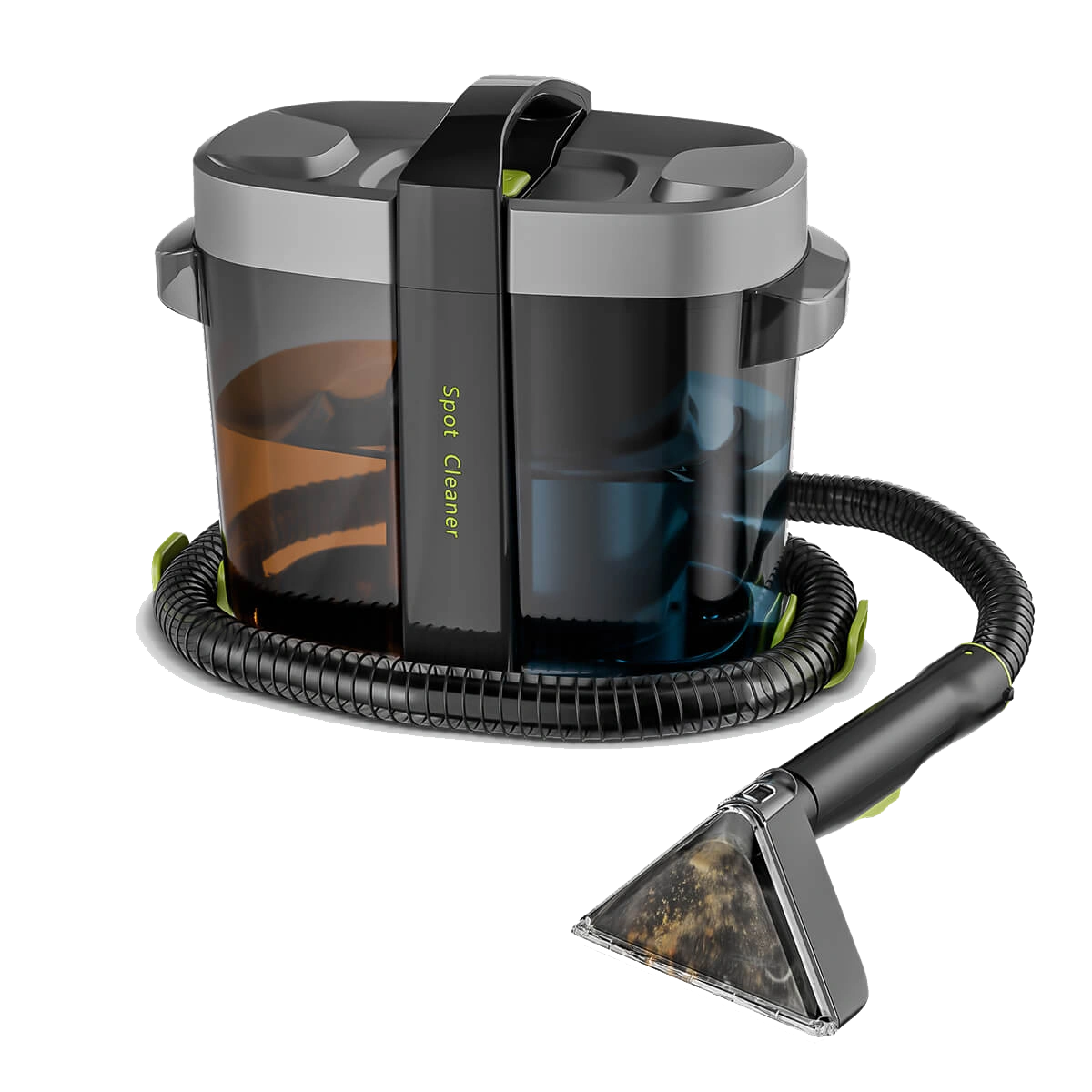



Put two cordless floor washers side by side and one number often attracts attention before anything else: suction power.
One machine says 18,000Pa. Another says 20,000Pa. A newer flagship model says 22,000Pa or even 25,000Pa.
It is easy to assume the ranking is already clear.
More suction must mean more dirt removed, more water recovered and a cleaner floor.
That logic works reasonably well when comparing some conventional vacuum cleaners. A wet dry floor washer, however, is doing something more complicated. It is not simply pulling dust through an air channel. It is applying water, agitating the floor with a powered roller, loosening sticky contamination, separating solids and liquids, scraping moisture from the roller and then recovering wastewater.
Suction matters.
It just does not work alone.
The current market actually makes this point quite well. Roborock publishes 20,000Pa suction for its F25 Series, but the same cleaning system is also described with a 450 RPM cleaning frequency and more than 20N of downward cleaning pressure. Tineco’s FLOOR ONE S5 automatically changes suction, water flow and roller speed together according to detected dirt. Dreame’s H15 Pro Heat combines 22,000Pa suction with a high-absorption roller, scraper design, dirt detection and hot-water floor cleaning. These products are marketed as systems rather than as suction motors with wheels attached.
For a B2B buyer, that leads to a better question:
Not “Which floor washer has the highest Pa?” but “Which machine leaves the floor cleaner after the same pass?”

Suction Solves Only Part of the Cleaning Problem
Suction becomes important after dirt and liquid are in a position where the machine can recover them.
Loose rice, cereal, dust and small crumbs are relatively straightforward. Airflow helps move those particles toward the recovery channel. Spilled water also depends heavily on the suction path and the seal created around the floor head.
Sticky contamination behaves differently.
Dried coffee, sauce, footprints or kitchen residue may still be attached to the floor even when a powerful suction motor is running directly above them. Before the vacuum system can recover that material, the roller and water system have to soften and mechanically loosen it.
This is one of the reasons a floor washer cannot be judged like a cordless stick vacuum.
Imagine pouring a small patch of dried sauce onto a tile and allowing it to set.
A machine with very high suction but poor roller contact may pass over it and recover the loose moisture without fully removing the mark. A machine with slightly lower suction but better roller pressure, appropriate water delivery and a well-designed scraper may leave a visibly cleaner surface.
The second machine does not necessarily have the stronger motor.
It has the better-balanced cleaning system.
This does not mean suction specifications are meaningless. If recovery airflow is too weak, dirty water remains on the floor or inside the roller. Loose debris may also escape the cleaning head.
The mistake is using suction power as a substitute for cleaning-performance testing.
Look at How Premium Brands Describe Cleaning Performance
It is useful to look at how established floor-washer brands present their own products.
Roborock’s F25 Series does not describe 20,000Pa in isolation. The company publishes that number alongside 450 cleaning strokes per minute, more than 20N of downward cleaning pressure, scraper technology and sub-1mm edge cleaning.
Tineco takes another approach. Its FLOOR ONE S5 detects the level of dirt and adjusts suction, roller speed and water flow together, while also using separate clean- and dirty-water tanks.
Dreame’s H15 Pro Heat is rated at 22,000Pa, but the product description also emphasizes hot-water floor washing, a high-absorption roller, scraper design and automatic dirt detection that changes cleaning behaviour according to the mess.
These are competing manufacturers with different engineering approaches, but they point toward the same conclusion:
floor-washing performance is multi-variable.
If Pa alone determined performance, brands would have little reason to invest so heavily in roller geometry, scrapers, water control, edge structures and dirt sensors.
For importers, this is useful because it changes how samples should be compared.
Do not ask only:
What is the suction power?
Ask what that suction achieves after the entire cleaning system has done its work.
Water Delivery Can Improve Cleaning — or Make Recovery More Difficult
A floor washer needs enough water to loosen dirt and keep the roller working with relatively clean moisture.
Too little water can create poor stain removal.
Too much water creates a different problem: the suction and scraper system now have more liquid to recover.
This is why water flow and suction should be tuned together.
If a supplier increases water delivery to make a demonstration look more powerful, the roller may remove sticky contamination more quickly, but the floor can remain noticeably wetter behind the machine.
On the other hand, reducing water excessively can make the floor appear dry immediately while allowing more dried residue to remain.
The best setting depends on the intended cleaning task.
A light daily pass across dust and footprints does not need the same water behaviour as dried kitchen stains. Some premium machines therefore automatically vary water and suction according to detected dirt rather than operating at maximum output all the time. Tineco, for example, explicitly describes this coordinated adjustment on the FLOOR ONE S5.
For an OEM buyer, the lesson is not that every product needs expensive smart sensors.
The lesson is that the factory must have considered the relationship between water delivery and recovery.
Even a simpler two-mode floor washer should produce predictable results.
What Happens Behind the Roller Matters More Than the Number on the Box
One of the best places to judge a floor washer is not in front of the machine.
It is directly behind it.
After a normal cleaning pass, look at the floor.
Is there a thin even film of moisture, or obvious pools of water?
Are there parallel streaks matching the roller or scraper?
Has coffee been removed, or simply diluted into a larger wet area?
Did rice disappear into the machine, or was some of it pushed forward?
Has hair been collected, or wrapped around the roller?
These observations combine the effects of suction, roller contact, water flow and scraper pressure into something the customer actually experiences.
Residual moisture is particularly useful.
A powerful vacuum system should contribute to good liquid recovery, but suction alone does not guarantee a dry floor. Air leakage around the cleaning head, scraper geometry, roller saturation and movement speed can all change how much water remains.
This is why “one-pass result” is usually a more meaningful purchasing metric than Pa alone.

A Simple Test Can Reveal More Than a Specification Sheet
You do not need a complicated laboratory to identify major differences between floor-washer samples.
What matters more is keeping the test conditions consistent.
Take the same floor surface and prepare equal amounts of contamination for each machine. A useful mixture might include a small quantity of rice, crumbs, hair, coffee and a controlled amount of muddy water.
Then clean each lane at approximately the same walking speed with one normal forward pass.
The results can be recorded in a relatively simple way:
| What to observe | Why it matters |
|---|---|
| Dry debris remaining | Shows pickup performance and floor-head control |
| Liquid remaining on the floor | Indicates wastewater recovery effectiveness |
| Sticky stain remaining | Reflects roller agitation, water and contact |
| Debris pushed forward | Can reveal poor intake or roller behaviour |
| Hair left or wrapped on roller | Indicates real maintenance performance |
| Streaks behind the machine | Often relates to roller, scraper and water recovery |
The point is not to create a fake laboratory score such as “Cleaning Efficiency: 97.6%” without a repeatable method.
The value comes from comparing machines under the same conditions.
If a 20kPa machine consistently leaves less residual water and less visible contamination than a 25kPa sample, then the higher suction number has not translated into the better floor result in that test.
That is commercially meaningful.
Higher Suction Can Also Create Trade-Offs
There is another reason buyers should avoid chasing the largest number available.
Every engineering decision affects something else.
Running a motor at higher output can affect energy consumption, noise and battery runtime. The actual relationship depends on motor efficiency, airflow design, operating mode and control logic, so a simple “higher Pa always means shorter runtime” rule would also be misleading.
But the trade-off should be measured.
If one model delivers a higher maximum suction level only in a turbo mode that consumers rarely use because of noise or battery drain, that maximum figure may contribute more to the product listing than to the everyday cleaning experience.
A B2B buyer should therefore ask for performance by mode.
For example, compare normal mode and maximum mode using the same contamination.
Does maximum mode significantly improve debris pickup?
Does it noticeably improve liquid recovery?
How much louder does it become?
How much runtime is lost?
If the cleaning result changes only slightly while noise and energy demand increase substantially, the brand may decide that normal-mode performance is the more important retail story.
This becomes particularly important when comparing floor washers with different battery sizes.
A machine cannot be optimized independently for maximum suction, lowest weight, largest tanks and longest runtime without making compromises somewhere.
The product brief should decide which compromises are acceptable.
Suction Numbers Are Not Always Directly Comparable
There is another technical issue that buyers sometimes overlook.
A Pa value describes pressure difference, but it does not by itself describe total airflow or the complete suction performance at the floor.
Different manufacturers may measure suction at different locations in the air path or under different test conditions.
This means two identical-looking “20,000Pa” specifications should not automatically be treated as identical real-world performance unless the measurement methods are comparable.
Tineco provides an interesting example of a different reporting convention: the company lists the suction power of its Stretch S6 floor washer in Air Watts rather than Pa, stating a range of 10–18 AW depending on dirt level.
That does not make Tineco’s figure better or worse.
It illustrates why buyers should be careful when turning one published number into a cross-brand ranking.
For an OEM project, ask where the suction figure is measured, under what operating state and with what equipment.
Better still, verify the cleaning result directly.
How the Minfu Y20 Should Be Evaluated
The current Minfu Y20 platform is rated at 20kPa suction and uses a BLDC motor. Its public specifications also list a 680ml clean-water tank, 450ml dirty-water tank, 180° lay-flat structure and configurable 2600–4000mAh battery options. The landing page further includes one-touch self-cleaning, hot-air roller drying and power-assisted wheels as platform features.
Twenty kilopascals is a useful specification.
But I would not make it the centre of a buyer’s sample approval.
Instead, use 20kPa as a reference point and test what happens on the floor.
Start with dry debris.
Spread an equal quantity of rice and crumbs across a hard-floor lane. Run the Y20 through once and observe what enters the dirty-water system versus what is pushed outside the head.
Then move to liquid recovery.
Apply a measured amount of water or coffee. After a single pass, inspect the remaining surface moisture and measure how much liquid reached the recovery tank.
Next comes the more revealing test: a sticky stain.
A small amount of sauce or coffee residue should be allowed to sit long enough to require roller action rather than simple liquid pickup. This test tells you much more about the relationship between roller contact, water delivery and suction.
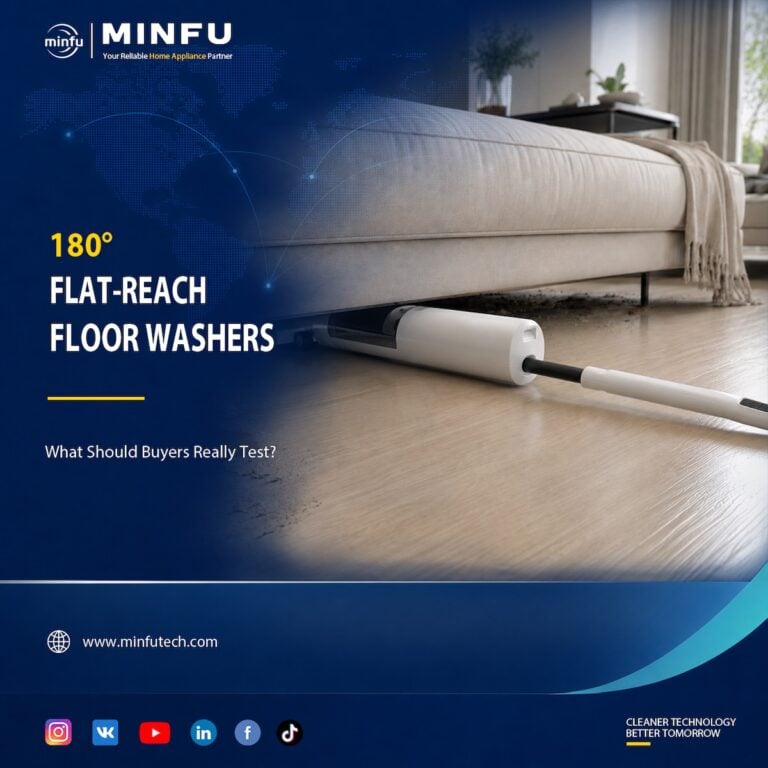
Finally, repeat at the 180° lay-flat position.
The previous article in this series explains why full-recline performance deserves its own test:
180° Flat-Reach Floor Washers: What Buyers Should Verify.
A strong upright result does not automatically prove the same water-recovery behaviour beneath a sofa.

The Better Question Is “How Much Work Does One Pass Finish?”
This is probably the most useful way to think about floor-washer performance.
Consumers do not care how much pressure difference exists inside an air channel.
They care whether they have to clean the same patch three times.
A successful one-pass result means several things happened correctly at once.
The roller contacted the contamination.
Enough water reached the surface.
The stain was loosened.
Debris entered the cleaning head rather than being pushed away.
The scraper controlled the saturated roller.
The vacuum system recovered enough dirty water.
And the floor behind the machine was left in an acceptable condition.
That is a much tougher standard than achieving a high number on a suction meter.
It is also closer to how product reviews are written.
A consumer is more likely to say:
“it picked up cereal and coffee in one pass”
than:
“the pressure differential was excellent.”
B2B product development should ultimately work backward from that user experience.
Suction Still Matters — Especially for Certain Messes
The argument here should not be misunderstood.
Higher suction can absolutely be useful.
Liquid pickup is one obvious example. Coarse debris and heavier particles may also benefit from stronger airflow and pressure difference, particularly when the intake path is well designed.
Suction can also help keep the roller and recovery path from becoming overloaded during messy cleaning.
The problem starts when marketers turn a useful engineering parameter into a universal cleaning score.
A 25kPa machine is not automatically a better floor washer than a 20kPa machine.
Likewise, a 20kPa machine is not automatically better than a 15kPa machine.
The systems need to be tested.
Current premium products themselves demonstrate this. Roborock combines suction with roller frequency, downward pressure and scraper design. Tineco coordinates suction with water flow and roller speed. Dreame pairs suction with hot-water washing, roller absorption, dirt sensing and scraper technology.
The industry is already telling buyers that cleaning is more complicated than Pa.
Procurement specifications should reflect that.
What Should Go Into an OEM Performance Requirement?
When a private-label brand approves a floor washer, the final specification should contain the suction target.
But it should not stop there.
A better purchase specification connects the suction requirement to observable performance.
For example, instead of relying only on:
Suction: 20kPa
the project file can also define a standard test floor, representative debris, liquid quantity and expected one-pass outcome.
This becomes particularly useful during mass production.
If a supplier changes the motor, control board, roller material, scraper hardness or water pump, the Pa figure might still look acceptable while the actual floor result changes.
A golden sample provides a useful physical reference.
Production units can be compared with that sample not only for suction but for water recovery, roller behaviour, noise and cleaning consistency.
That connects directly to the main article in this cluster:
Top 5 Cordless Wet Dry Vacuum Cleaner Manufacturers in China for 2026.
The manufacturer should be selected not simply because it can build a prototype with impressive specifications, but because it can reproduce the approved cleaning result in mass production.
Where Suction Fits in Product Positioning
Different buyers may still want different suction stories.
A marketplace seller often needs easily understood numerical features because consumers compare product listings quickly. A strong Pa figure can be useful there.
A specialist appliance brand may prefer to communicate performance through cleaning demonstrations, edge results, roller maintenance and low residual water.
A distributor selling through retail stores may care more about the product feeling powerful when demonstrated on cereal, coffee and common household spills.
None of these approaches is wrong.
The problem is allowing the marketing number to drive engineering decisions backward.
Choose the target cleaning experience first.
Then determine how much suction, water flow, roller speed, battery and mechanical contact are required to achieve it.
For buyers who are still deciding what kind of product they are sourcing, the previous guide explains the terminology:
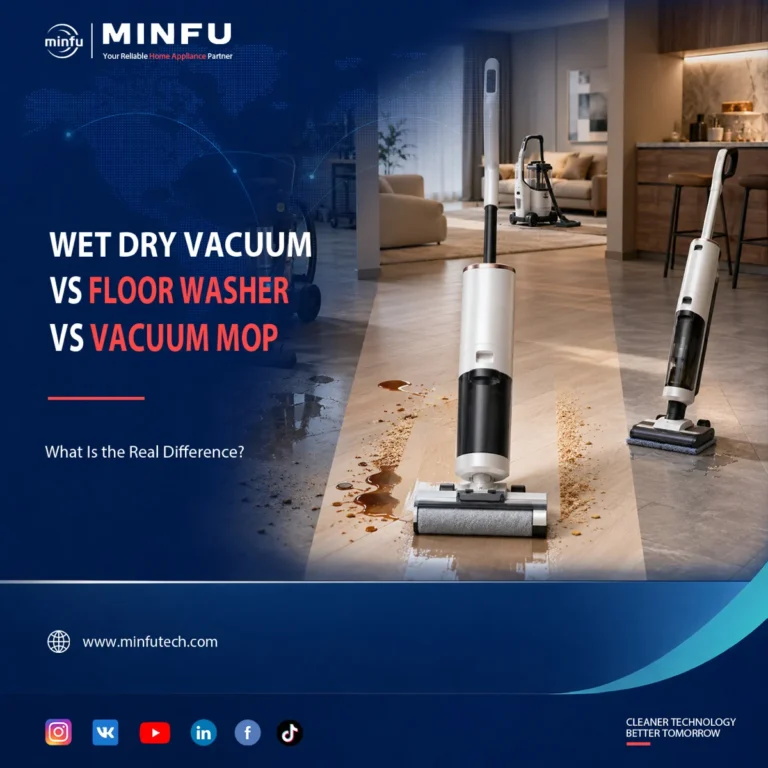
Wet Dry Vacuum vs Floor Washer vs Vacuum Mop: What Is the Difference?.
For a current lightweight OEM platform, the Minfu Y20 cordless wet dry floor washer is rated at 20kPa and combines that suction system with dual water tanks, flat-reach cleaning and floor-washing functions.
Final Thoughts
So, does higher suction mean better cleaning in a wet dry vacuum?
Sometimes it helps.
But higher suction alone does not prove better floor-washing performance.
A wet dry floor washer has to do several jobs in sequence. Water has to reach the contamination. The roller has to loosen it. The cleaning head has to control the debris. Dirty liquid has to be separated from the floor and recovered into the tank. The scraper has to manage the roller, and the system has to leave an acceptable amount of moisture behind.
If one of those steps is weak, increasing the Pa number may not solve the problem.
That is why buyers should treat suction as one specification inside a larger cleaning system.
When two samples arrive at your office, record the numbers on the specification sheets.
Then put both machines on the same floor.
Use the same rice, the same coffee, the same sauce and the same amount of water.
One pass each.
The cleaner floor is usually a better answer than the larger number.