



A floor washer looks impressive when it is standing upright in a showroom.
The more revealing moment often comes when someone lowers the handle, pushes the machine beneath a sofa and fills the dirty-water tank halfway.
That is where a “180° lay-flat” claim begins to mean something.
Can the machine actually travel far enough under the furniture to clean the area the user cannot reach by hand? Does suction remain stable? Does wastewater stay inside the recovery system when the body is almost horizontal? Can the user steer it without lifting or twisting the machine? And after several minutes of cleaning, does the roller still maintain proper contact with the floor?
These questions matter because lay-flat cleaning has become a visible feature in the cordless floor-washer market. Tineco markets the FLOOR ONE Stretch S6 around a 180° lay-flat structure and a 5.1-inch low-profile body. Roborock’s F25 platform uses a 12.5 cm flat profile and states that suction is maintained while the machine is fully reclined. Dreame’s H14 series also promotes 180° lie-flat cleaning as a core feature.
For B2B buyers, however, the angle printed on the box should be the beginning of the evaluation—not the conclusion.
The real product is the complete system working at that angle.
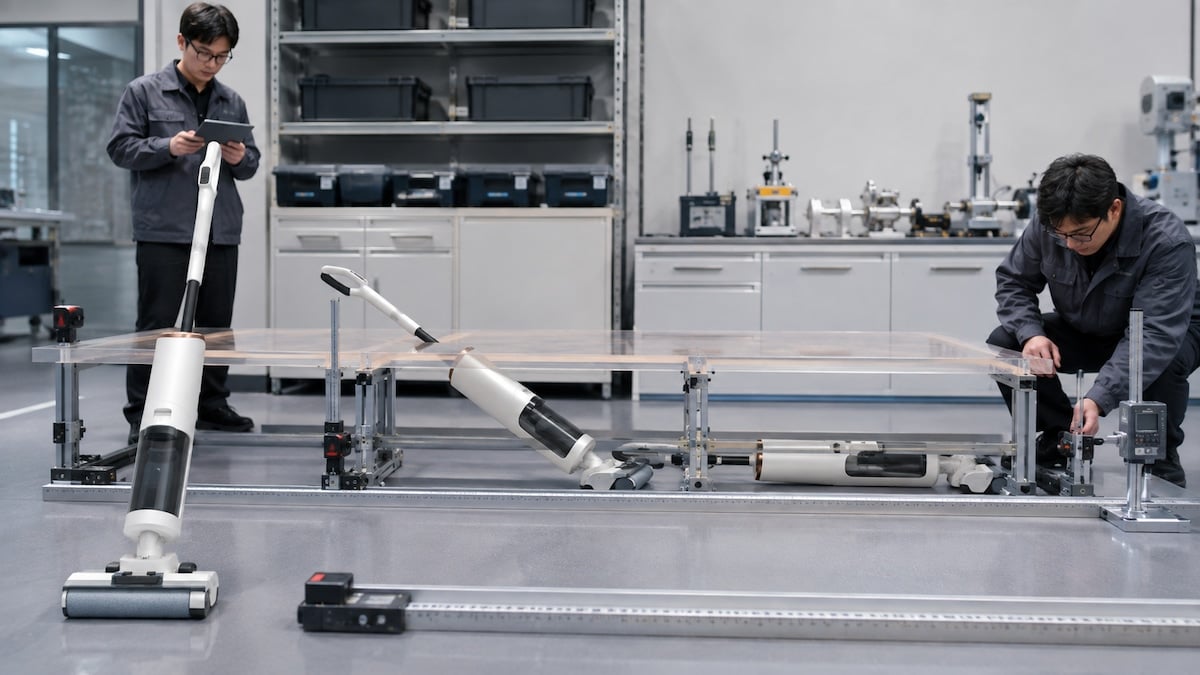
“180°” Does Not Tell You How Low the Machine Really Goes
There is an interesting problem with the way this feature is marketed: even the angle itself is not always described in the same way.
Tineco describes the Stretch S6 as a 180° lay-flat floor washer. Roborock describes comparable fully reclined cleaning as a machine operating at 0°, because the body is effectively parallel to the floor. Both expressions can refer to a similar physical position.
That is why an OEM specification should never stop at:
Lay-flat angle: 180°.
A much more useful number is the maximum body height when fully reclined.
Tineco publishes a 5.1-inch compact height for the Stretch S6. Roborock publishes a 12.5 cm flat profile for the F25 series. Those numbers tell a buyer much more about whether the machine can fit beneath a 13 cm sofa than the angle alone.
The current Minfu Y20 specification lists a 180° lay-flat angle, but the public page does not state a dedicated fully reclined body-height measurement. It lists overall machine dimensions of 1100 × 270 × 220 mm, but that should not automatically be treated as the clearance required under furniture because the orientation and highest point of the machine change when it lies flat.
For Y20—and for any OEM platform—this is a measurement worth adding to the sample report.
Put the machine flat on the floor. Measure from the floor to the highest structural point that actually enters beneath the furniture. Then test it against several real clearance heights.
A machine measuring 13 cm at its highest point does not necessarily clean everything under a 13 cm sofa. The user still needs a little working clearance, the floor may not be perfectly level, and the machine needs enough room to change direction.
There is also a second measurement that is often overlooked: cleaning reach.
A floor washer may physically enter beneath a bed, but the body may stop against the furniture frame long before the roller reaches the centre. The useful question is therefore not only “How low can it go?” but “How far can the roller travel beneath a real piece of furniture?”
That is a more meaningful retail claim.
A Flat Floor Washer Is Also a Moving Tank of Dirty Water
The engineering challenge becomes more interesting once the machine has collected wastewater.
When a conventional upright floor washer is standing at a normal cleaning angle, gravity naturally keeps dirty water toward the bottom of the recovery tank. Once the machine is nearly horizontal, the orientation of the liquid changes.
That means the dirty-water tank, internal air channel, float or separation structure, seals and suction path all have to function in a different position.
This is one reason why a serious lay-flat evaluation should never be performed only with an empty machine.
The Minfu Y20 uses separate 680 ml clean-water and 450 ml dirty-water tanks and is designed for 180° lay-flat cleaning. Its product page also positions the machine around wet-and-dry pickup, dual-water-tank separation and furniture-underreach cleaning.
For a buyer, the important question is what happens when that 450 ml recovery tank contains real wastewater.
Consider two sample tests.
In the first, the machine begins with an empty recovery tank and is immediately pushed under a sofa. Everything appears normal.
In the second, the floor washer first collects coffee, dirty water and food debris for ten minutes. The buyer then reclines it completely and continues cleaning beneath the same sofa.
The second test is much closer to actual use.
If liquid reaches an air channel, filter or motor-protection area that remains dry during the first test, the difference may show up as unstable suction, unusual noise, droplets inside the air path or an automatic shutdown.
That does not mean every flat-reach design will have such a problem. It means the design should be evaluated in the state in which consumers will actually use it.
A useful OEM test should therefore define not only the angle but also the tank condition.
For example:
| Test condition | What the buyer is really checking |
|---|---|
| Empty dirty-water tank | Basic lay-flat function and clearance |
| Partially filled tank | Water-air separation and seal behaviour |
| Near recommended maximum level | Worst-case practical recovery condition |
| Repeated upright-to-flat transitions | Liquid movement and long-term sealing consistency |
This is much more informative than a promotional photograph of a machine lying flat under a bed.
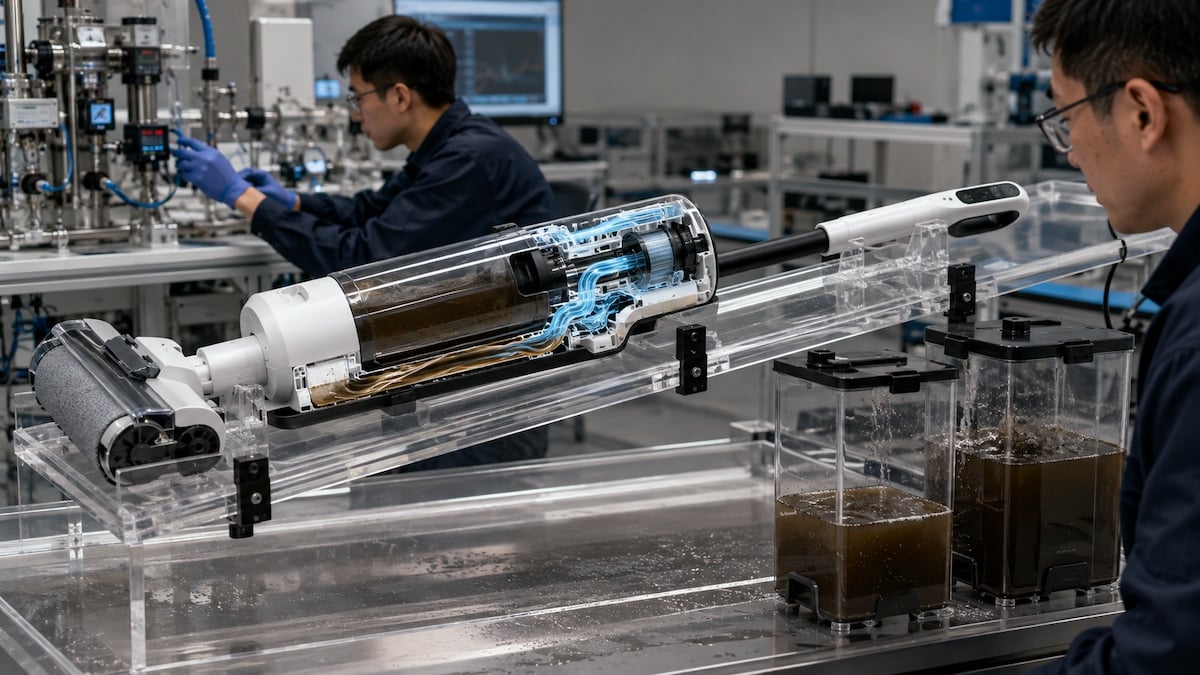
Suction at 180° Matters More Than Suction on the Specification Sheet
A floor washer may have strong suction when upright and behave differently when fully reclined.
Roborock specifically markets its F25 flat-reach system around maintaining suction in the fully reclined position, which is a useful example of why buyers should consider operating orientation rather than judging the product only by its headline Pa figure.
The Y20 is currently specified at 20 kPa suction with a BLDC motor.
That number is useful, but it does not answer the flat-reach question on its own.
The buyer should compare the machine in two positions using the same test debris:
normal cleaning angle and fully reclined.
A simple sample area can include rice, crumbs, hair, coffee and a measured amount of muddy water. The purpose is not to create an artificial torture test. It is to see whether the machine’s behaviour changes when the body goes flat.
Watch the floor behind the roller.
Does the machine recover roughly the same amount of liquid? Does it begin leaving wetter streaks? Does debris remain near the scraper? Does the sound of the suction system change?
If a supplier says the machine “maintains full suction at 180°,” that is a much stronger claim than simply stating that the machine can physically lie flat. The buyer should ask how that statement was measured.
The same applies in the opposite direction.
If the supplier does not claim identical suction performance at every angle, that does not automatically make the machine unsuitable. What matters is whether the cleaning result remains acceptable in the intended under-furniture application.
A brand does not need the strongest claim.
It needs a claim it can prove.
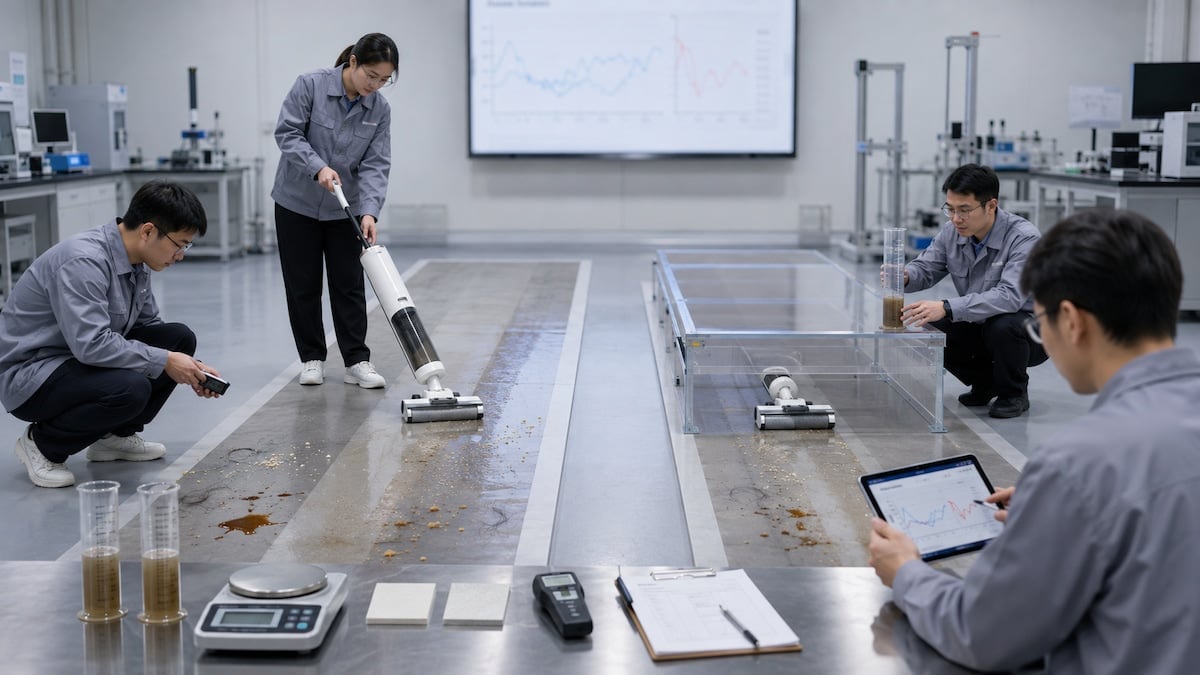
The Roller Still Has to Touch the Floor Properly
Flat reach is often presented as a handle-design feature.
In practice, the cleaning head may be more important.
A floor washer removes dirt through a combination of roller contact, water delivery, scraping and suction recovery. If lowering the body changes the angle or pressure of the cleaning head, the machine may still fit beneath the sofa while cleaning less effectively.
This is especially noticeable with dried stains.
Loose crumbs may disappear even with weak roller contact because the suction system can pull them in. Dried sauce or footprints require mechanical agitation. If the roller pressure becomes uneven when the handle is flat, the difference appears immediately.
One practical method is to apply three identical strips of a washable test substance to the same hard-floor panel.
Clean one strip at the normal handle angle, one at a low angle and one with the machine fully reclined. Use the same speed and number of passes.
The goal is not to produce a laboratory-grade cleaning score.
It is to determine whether the user experience changes enough to matter.
This is also where edge cleaning becomes relevant. A product may reach deep beneath furniture but still leave an obvious untreated strip along the skirting board or furniture leg.
The current Y20 page describes a zero-gap roller edge-cleaning structure.
For an OEM buyer, the safer approach is to measure the actual uncleaned distance rather than simply repeating “zero gap” in every market.
Place the machine beside a straight wall, apply a visible test stain to the edge and measure what remains after a normal pass.
That number can later support a much more credible product claim.
A Machine That Fits Under the Sofa Still Needs to Come Back Out
This sounds obvious until someone actually tests it.
A floor washer can have excellent flat clearance and still feel awkward underneath furniture.
When the user pushes a fully reclined machine forward, the handle is low and much of the product mass is farther away from the body. Changing direction may require wrist movement, sideways force or pulling against the rolling resistance of the machine.
That is one reason modern premium floor washers increasingly combine flat reach with some form of assisted movement or improved steering. Tineco pairs the lay-flat design of its Stretch S6 with assistive wheels and a swivel structure, while Roborock describes lowered-tank geometry and powered movement on current F25 models.
Minfu’s current Y20 landing page also lists power-assisted wheels as one of its core usability features.
This is where buyers should stop testing the machine in an empty showroom.
Put it under:
- a bed with limited side access;
- a three-seat sofa;
- a dining cabinet;
- a low TV unit.
Then ask someone who has not used the machine before to clean beneath them.
The movement should feel understandable without a demonstration from the engineer.
If the machine moves easily forward but becomes difficult to pull backward, that matters.
If the user must raise the handle before changing direction, that matters.
If the power-assisted wheels suddenly feel too aggressive when the machine is flat, that matters too.
These are not specification-sheet problems.
They are the kinds of details that eventually appear in reviews, return reasons and customer-service tickets.
Weight Changes the Lay-Flat Experience
This is particularly relevant to Y20 because lightweight design is one of the platform’s main positioning points.
The current Y20 page specifies a machine net weight of 3.0 kg, with battery options from 2600 to 4000 mAh.
Weight matters differently when a floor washer is flat.
In upright use, wheels and the handle geometry carry much of the load. When the product is extended horizontally under a bed, the user may feel more of the machine’s resistance through the handle.
A lighter machine can therefore have a practical advantage beyond the marketing headline.
But lower weight always comes with engineering decisions.
A manufacturer may reduce weight through a smaller battery, thinner structural components, smaller tanks or a different centre-of-gravity arrangement. None of these is automatically good or bad.
The question is whether the trade-off suits the target customer.
A compact apartment product may benefit from lower weight and moderate tank capacity. A larger-family floor washer may prioritize longer runtime and larger tanks even if the machine becomes heavier.
This is why the later article in this cluster, Lightweight Floor Washers: Balancing Weight, Runtime and Tank Capacity, should evaluate weight as a system rather than simply declaring that lighter is always better.
For the lay-flat test, buyers should run the machine both with an empty clean-water tank and with the tank filled to the normal operating level.
The handling can feel different.
That difference is part of the real user experience.
Do Not Test Flat Reach Only on Clean Water
One of the easiest mistakes during a supplier visit is to perform a beautifully controlled demonstration.
Fresh water goes into the tank. A small amount of coffee is poured onto a clean tile. The machine runs under a display sofa for twenty seconds.
Everything works.
Real homes are less cooperative.
Hair enters the roller. Rice and food residue enter the recovery path. Dirty water begins to foam. The filter gets damp. The roller becomes loaded with fine particles.
That is why a more useful sample test has stages.
Start with normal cleaning and allow the machine to accumulate real dirt. Then test the flat position. Afterward, return the machine upright and inspect the dirty-water tank, filter area, air passage and brush cover.
Repeat the process several times.
What you are trying to discover is not whether the prototype can survive one demonstration. You are trying to see whether the system remains predictable as the cleaning cycle becomes less ideal.
This type of test also reveals maintenance issues.
If the dirty-water tank becomes difficult to remove after the machine has been used flat, or wastewater reaches a part of the tank that is awkward to rinse, the user notices.
A product can pass a cleaning test and still create an unpleasant ownership experience.
That distinction is important for private-label brands because the factory sells the machine once.
The brand deals with the consumer afterward.
How I Would Evaluate a Y20 Sample
For a buyer considering the Minfu Y20 as a private-label platform, I would not begin by asking the supplier to demonstrate 180° lay-flat cleaning.
I would begin by measuring it.
First, record the actual maximum body height when fully reclined and the usable forward cleaning reach beneath a fixed-height furniture test rig. The current page confirms 180° capability, but a dedicated low-profile clearance figure is not publicly listed, so this measurement would add useful data to the product file.
Then use the machine normally.
Fill the 680 ml clean-water tank to a realistic operating level, clean mixed dry and wet debris, and allow the 450 ml recovery tank to collect wastewater.
Only then lower it flat.
Run the machine beneath the same test rig while observing water recovery, suction sound, steering resistance and the floor behind the roller.
After several upright-to-flat cycles, inspect the recovery tank and air path.
The final stage should be less technical and more human.
Give the machine to several people who have not seen the engineering demonstration.
Ask them to clean beneath a bed.
Do not tell them how to hold it.
Watch what happens.
That test often exposes issues a specification sheet never will.
A buyer may discover that the product is extremely easy to push but difficult to reverse. Another tester may naturally rotate the handle in a way the engineer never expected. Someone may try to lift the product by the wrong point when pulling it from beneath the furniture.
These observations can lead to changes in the manual, packaging illustrations or even product design before mass production.
That is the real value of sample testing.
What Should Go Into the Purchase Specification?
After the sample is approved, the phrase “180° lay-flat” should not be the only record of the feature.
The buyer and supplier should agree on a small group of measurable requirements.
A practical specification might record:
Lay-flat geometry — the defined handle/body position used for the claim.
Maximum flat body height — measured from the floor to the highest point entering beneath furniture.
Usable under-furniture reach — how far the cleaning roller can travel into a defined clearance.
Permitted dirty-water level during flat use — based on the supplier’s actual recovery-system design.
Cleaning performance in the flat position — using an agreed test method.
Leakage and shutdown behaviour — including repeated transitions between upright and flat operation.
Steering and assisted-drive behaviour — if the model uses powered wheels.
This does not need to become a 30-page engineering standard.
The purpose is simply to prevent a later situation where the approved sample performs one way but mass production is judged only against the words “180° lay-flat.”
A measurable requirement is easier for both sides.
Where Flat Reach Fits in a B2B Product Strategy
Not every market needs to lead with this feature.
For a premium appliance brand, 180° flat reach can be a strong visual selling point because it solves a familiar problem: cleaning beneath furniture without moving it.
For e-commerce, the feature also works well in short videos because the benefit is immediately visible.
For a price-sensitive wholesale project, however, the buyer should still ask what the feature costs in terms of structure, tank design and components.
If adding flat-reach capability makes the product significantly more complex while the target retailer competes mainly on entry price, the feature may not create enough commercial value.
Conversely, a private-label brand targeting urban apartments may find it highly relevant. Beds, sofas and cabinets occupy a large percentage of the available floor area, and moving them during routine cleaning is inconvenient.
The decision should therefore come from the target user rather than from the competitor checklist.
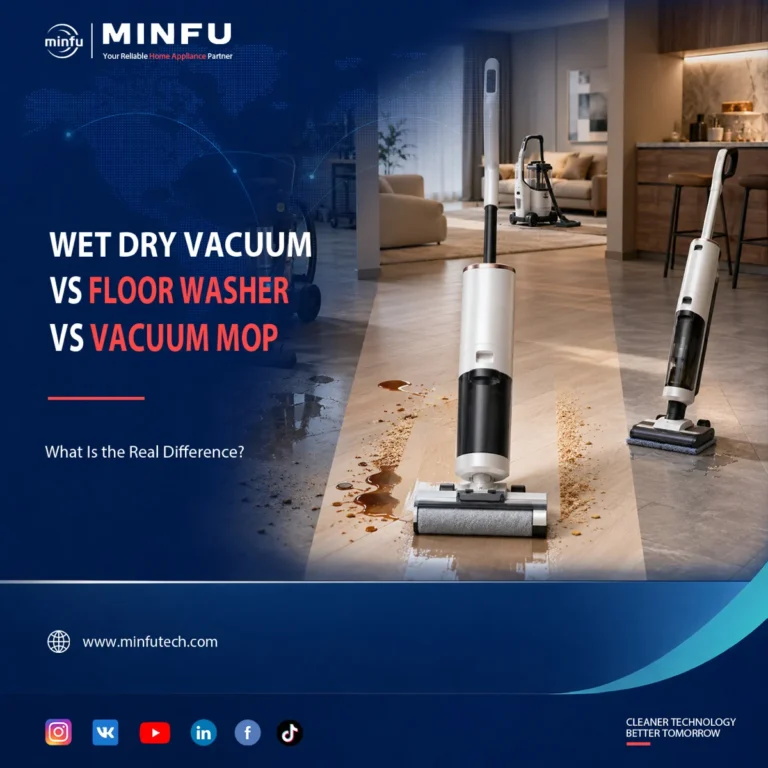
The broader category differences between wet dry vacuums, floor washers and vacuum mops are explained in:
Wet Dry Vacuum vs Floor Washer vs Vacuum Mop: What Is the Difference?
For buyers still comparing Chinese suppliers, the cluster’s main sourcing article is:
Top 5 Cordless Wet Dry Vacuum Cleaner Manufacturers in China for 2026.
The current 180° Y20 platform can be reviewed through the Minfu Y20 cordless floor washer page. Its published specification includes a 3.0 kg machine weight, 20 kPa suction, 680 ml clean-water tank, 450 ml dirty-water tank and 2600–4000 mAh battery options.
Final Thoughts
A floor washer does not become a good flat-reach machine simply because the handle can move through 180 degrees.
The feature only works when the entire product follows the handle.
The body must fit beneath the furniture. The dirty-water system must remain controlled. The roller must keep cleaning. Suction recovery must remain usable. Steering must still feel natural. And the machine has to perform these tasks after it has collected real dirt and wastewater—not just when it is clean and empty.
That is the difference between a mechanical angle and a finished user experience.
For buyers evaluating OEM floor washers, the most useful question is therefore not:
“Does this machine have 180° lay-flat cleaning?”
It is:
“What happens to the machine when it actually cleans at 180°?”
The answer is much harder to fit on a product poster.
It is also much more valuable when deciding which sample should move into mass production.