



A pool can look dirty in two completely different ways.
After a windy afternoon, the surface may be covered with leaves, insects and flower petals while the floor underneath still looks relatively clean. In another pool, the water surface may appear almost perfect even though fine sand, dust and settled debris have accumulated along the bottom.
Both pools need cleaning, but they do not present the same mechanical problem.
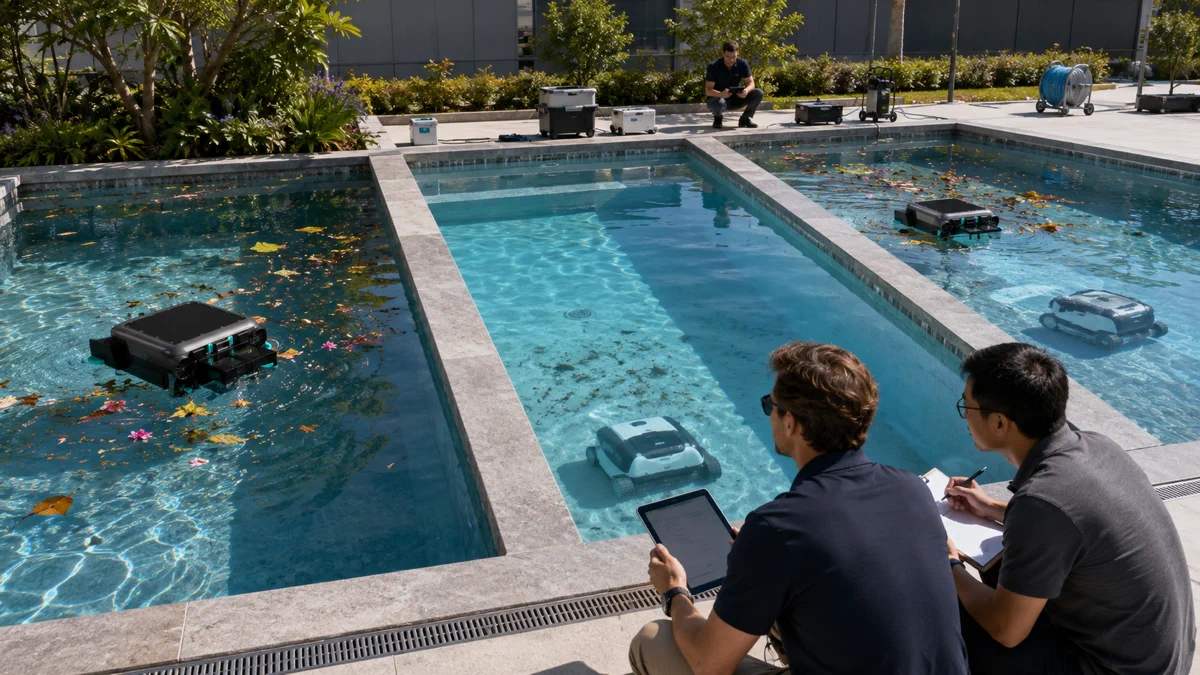
That distinction explains why the terms robotic pool skimmer and robotic pool cleaner should not be treated as interchangeable, even though product listings and supplier conversations sometimes use them loosely. A dedicated robotic pool skimmer spends its working life at the water surface, intercepting floating debris before it becomes waterlogged and sinks. A conventional robotic pool cleaner operates underwater, where brushes, suction systems and traction mechanisms are used to remove material from the floor and, on more capable models, walls and the waterline.
The difference matters to consumers, but it matters even more to importers. A buyer who expects one machine to perform the other machine’s job can approve the wrong sample, write misleading packaging claims and end up with customer complaints that are really the result of poor product positioning rather than defective hardware.
In 2026, the distinction is becoming slightly more complicated because some new pool robots combine several cleaning zones in one machine. The basic cleaning tasks, however, remain different. Understanding those tasks first makes it much easier to compare dedicated skimmers, underwater cleaners and newer all-in-one designs.
The Simplest Difference Is Where the Debris Is
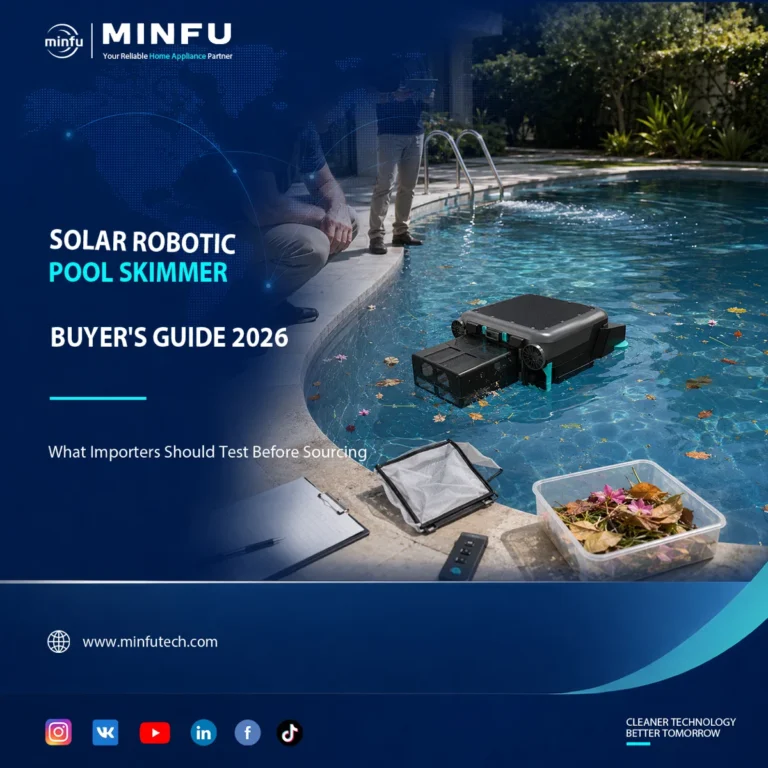
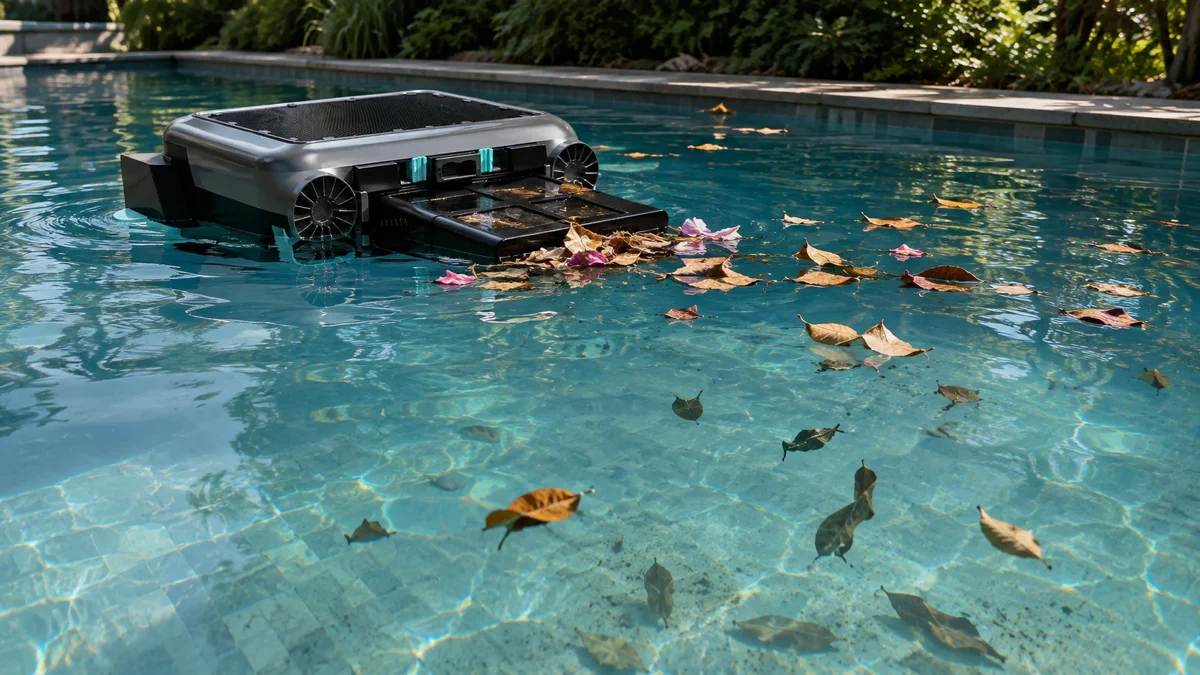
A robotic pool skimmer works at the air-water interface. Its intake meets debris while leaves, bugs, petals and other lightweight material are still floating. The robot moves across the water and directs that material into a basket, tray or filter system without needing to travel along the pool floor.
Maytronics describes its Skimmi in essentially this way: it floats around the pool collecting leaves, bugs and other surface debris, while its Dolphin robotic pool cleaners are designed to scrub underwater surfaces such as floors, walls and, depending on the model, the waterline.
An underwater robotic pool cleaner solves another problem. It has to remain submerged, maintain contact with the pool surface, move over tile or liner and pull settled material into its filtration system. Wall-climbing models add another challenge because the machine has to maintain traction while changing from a horizontal floor to a vertical surface.
That difference changes the kind of debris each product naturally encounters.
A surface skimmer is likely to meet broad leaves before they fold and sink, insects that are still floating, pollen, flower petals and lightweight garden debris. An underwater cleaner is more likely to encounter sand, sediment, dirt that has settled between cleaning cycles and heavier debris already sitting on the pool floor.
For a buyer, the useful distinction is therefore not simply:
Skimmer = surface. Cleaner = bottom.
It is better to think in terms of when and where the robot meets the debris.
A skimmer tries to intercept contamination early, while it is still moving across the water surface. An underwater robot handles what has already entered the submerged part of the pool.
The Debris Does Not Stay on the Surface Forever
This is the part of the distinction that matters most in real outdoor pools.
A dry leaf landing on water may float for quite a while, but its condition changes. It absorbs water, gets pushed into corners, becomes mixed with other debris and may eventually sink. Once that happens, a surface robot is no longer the right tool to retrieve it.
This means surface skimming is partly a matter of timing.
Removing debris while it is still floating can reduce the amount of larger organic material that eventually reaches the bottom. It does not eliminate the need to clean the floor because dust, sand, fine particles and material that has already sunk still have to be removed.
The reverse is also true. A capable underwater robot can leave the pool floor looking excellent and still finish its cycle beneath a layer of newly fallen leaves on the surface.
Beatbot currently makes this distinction quite clearly in its own product range. Its AquaSense 2 is positioned for floors, walls and the waterline, while the iSkim Ultra is paired with it to maintain the water surface. The company markets the combination as a broader pool-cleaning system rather than treating both machines as duplicates.
This is useful for importers because it changes the question from:
“Which one replaces the other?”
to:
“What type of debris causes the biggest maintenance problem for our target customer?”
A distributor selling into areas with heavily landscaped backyards may find surface debris particularly visible. Leaves can return to the pool throughout the day even after a conventional cleaner finishes its cycle. In another market, customers may have fewer overhanging trees but regularly deal with sand or fine dirt entering the pool. Their priorities can be very different.
The right category is therefore partly determined by the environment around the pool, not only by the dimensions of the pool itself.
Their Mechanical Designs Reflect Different Jobs
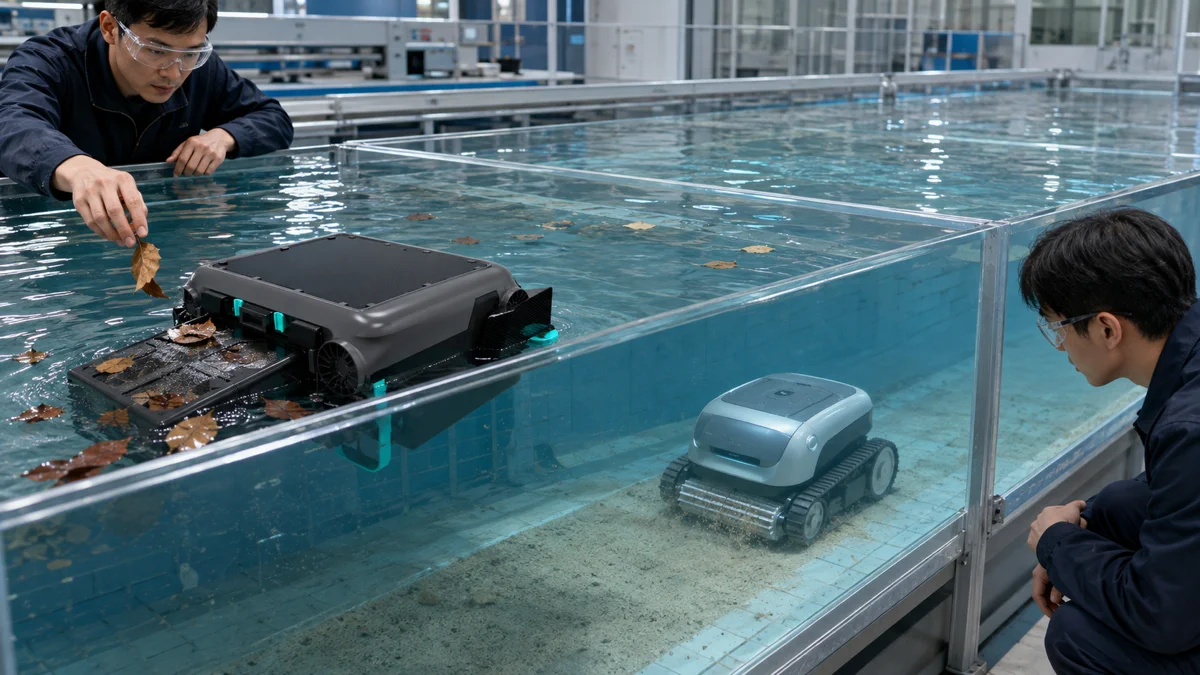
Put a dedicated robotic skimmer and an underwater pool cleaner next to each other and the design differences begin to make sense.
A surface skimmer needs buoyancy and stability first. Its body has to sit at an appropriate height relative to the water so that floating debris can enter the collection area without the machine becoming unstable as the basket fills. Propulsion has to work at or close to the water surface, and the product needs to deal with wind, current and the awkward geometry around pool edges.
The filter is also arranged around surface intake. Large leaves may enter one after another, so the collection opening and debris path have to avoid turning every broad leaf into a blockage.
An underwater cleaner has a different mechanical priority. Brushes or rollers need to contact the floor. The suction inlet has to remain close enough to settled dirt to recover it efficiently. Wheels or tracks have to move across submerged surfaces, and a wall-cleaning model needs enough traction and water-flow control to climb without repeatedly falling away.
This is why simply comparing suction figures between the two categories is rarely useful. The number is being used in a completely different cleaning geometry.
The same applies to navigation. A floor cleaner may need to map or systematically cover a large submerged area. A surface skimmer has to spend more of its effort dealing with water movement, floating debris distribution and obstacles that intersect the waterline.
That includes ladders, pool edges, floating hoses and return jets.
Maytronics, for example, equips Skimmi with obstacle-detection capabilities intended for surface navigation, while its underwater Dolphin products use cleaning/navigation systems designed around floor and wall coverage.
Neither architecture is inherently more advanced.
They are solving different physical problems.
Their Operating Rhythm Is Different Too
Another difference becomes obvious when you watch the machines over an entire day rather than during a ten-minute demonstration.
An underwater pool cleaner is often designed around a cleaning cycle. The user places it in the pool, the robot covers its intended cleaning zones, and the machine eventually finishes or parks for retrieval. Exact behavior varies by model, but the basic idea is familiar: clean a defined pool area during a defined session.
A robotic surface skimmer benefits from a more continuous operating pattern because new debris can arrive at any time.
That makes availability particularly important.
A surface that looked clean at 10 a.m. can be covered again after the wind changes at 2 p.m. A skimmer that remains in the pool has the opportunity to collect those leaves as they arrive instead of waiting for the homeowner to start another cleaning cycle.
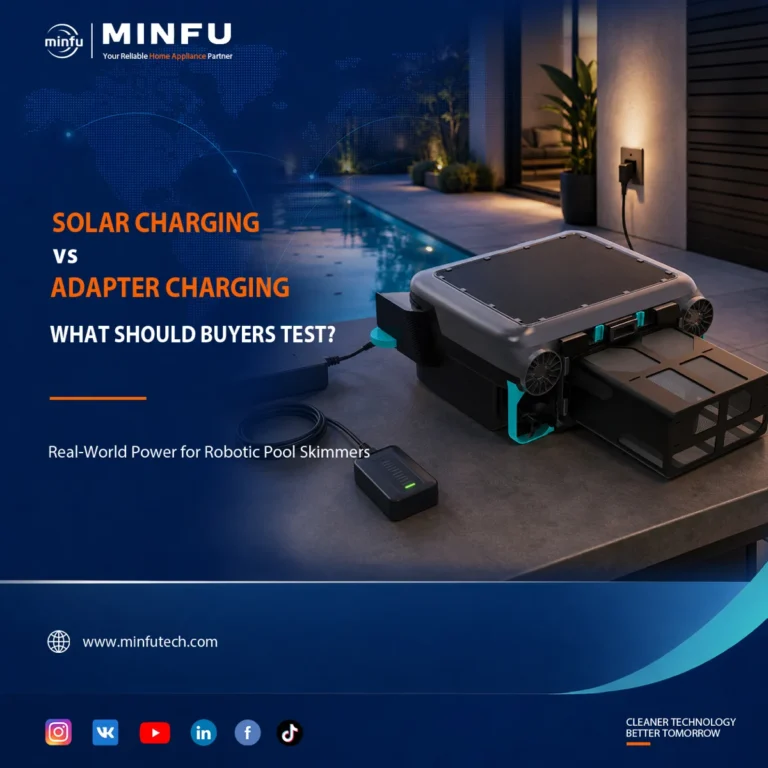
This is one reason solar charging has become so closely associated with the robotic skimmer category. The top surface of the machine naturally receives sunlight when conditions are suitable, which allows manufacturers to use solar energy as part of a longer-duration operating strategy.
Minfu’s MFS01, for example, combines solar charging with adapter charging and currently publishes more than 15 hours of battery-only operation under its specified conditions. It also uses a 6-liter removable filtration system and is designed specifically around water-surface debris collection.
The runtime comparison with an underwater robot should still be handled carefully. A five-hour underwater cleaning cycle and fifteen hours of skimmer availability are not competing numbers in the same task. One machine may be actively scrubbing floors and climbing walls, while the other is patrolling the surface and waiting for debris to enter its path.
For sourcing purposes, runtime only makes sense when it is attached to a use case.
The Category Is No Longer Completely Black and White
If this article had been written several years ago, it would have been easy to stop here and say that skimmers clean the top while robotic cleaners clean everything underneath.
In 2026, the market is beginning to blur that boundary.
Some manufacturers now offer machines with broader cleaning coverage. Beatbot’s current Sora 70, for example, is marketed with water-surface cleaning alongside shallow-area, waterline, wall and floor coverage. Its other products still preserve the dedicated-category approach: the company continues to sell iSkim surface skimmers separately and also bundles them with underwater cleaners.
This tells buyers something important.
The cleaning task and the hardware category are no longer always one-to-one.
A dedicated robotic skimmer still exists because there are advantages to designing a machine specifically for long-duration surface work. A conventional underwater cleaner remains common because floor, wall and waterline cleaning require their own mechanical systems. At the same time, more capable robots are starting to combine several zones.
That creates a third category for procurement teams to consider: the hybrid or multi-zone pool robot.
The advantage is obvious. One machine may reduce the need for several separate devices.
The trade-off deserves more thought.
A product trying to operate on the surface, floor, walls, steps and waterline needs considerably more mechanical and control complexity than a dedicated surface skimmer. Buyers should evaluate whether the additional cleaning zones actually perform well enough for the target price point rather than assuming that “5-in-1” or “all-area cleaning” automatically creates the better product.
This is particularly important for private-label programs where reliability, support and replacement cost may matter as much as the feature list.
A focused product can be commercially strong when the problem it solves is common and easy for consumers to understand.
So Which Type Should an Importer Source?
There is no useful answer based only on the robot specification.
Start with the pool environment and the customer problem.
A market with tree-lined residential pools, frequent insects and constant floating organic debris is a natural environment for a robotic skimmer. The benefit is visible: the robot keeps working on the part of the pool customers see first.
A customer whose biggest complaint is sand and sediment on the floor needs an underwater cleaner. If wall algae, waterline buildup or complex submerged geometry are also important, the buyer should look closely at the cleaning zones supported by the exact model.
For some retailers, the strongest product strategy may be to sell both.
That approach is not unusual in the current market. Beatbot explicitly bundles surface skimmers with underwater cleaners, while Maytronics maintains dedicated Skimmi and Dolphin lines for the two roles.
For another distributor, adding two robots to the same catalog may be unnecessary. A dedicated skimmer could make more sense if the brand already has an underwater pool-cleaning product and wants to expand into surface maintenance. Conversely, a business entering pool robotics for the first time may decide that underwater floor cleaning has broader initial demand in its market.
This is where B2B sourcing differs from consumer shopping.
The question is not simply which product is “better.”
The better sourcing decision is the one that fills a clear position in the distributor’s existing range.
A simple comparison helps keep that positioning clear:
| Buying Question | Robotic Pool Skimmer | Underwater Robotic Pool Cleaner |
|---|---|---|
| Primary cleaning zone | Water surface | Pool floor; some models also clean walls and waterline |
| Typical debris | Leaves, insects, petals, floating organic debris | Sand, sediment, dirt and submerged debris |
| Main operating challenge | Wind, currents, obstacles at water level, long availability | Floor coverage, traction, suction, wall/waterline access |
| Typical product posture | Floating | Fully submerged |
| Surface debris before it sinks | Strong fit | Usually not the primary task |
| Settled floor debris | Not designed for this task | Core use case |
| Best procurement question | How well does it stay available and collect real floating debris? | How thoroughly does it cover and clean the intended submerged surfaces? |
The table is intentionally about tasks rather than specific specifications. That keeps the comparison useful even as new motors, batteries and navigation systems enter the market.
Where MFS01 Fits in This Picture
MFS01 should be positioned clearly as a dedicated robotic pool skimmer, not as an underwater floor-cleaning robot.
Its current platform is built around solar-assisted surface operation, more than 15 hours of published battery-only runtime, a 6-liter removable filter bag, IPX8 protection and a 2.8 kg body. Minfu also lists physical-button and remote-control operation for the current configuration.
Those specifications make more sense when viewed through the correct category.
The 6-liter filtration capacity is there to receive floating debris over an extended surface-cleaning session. The solar panel matters because a skimmer spends its life at the top of the water, where solar energy can contribute to operating availability. Anti-stuck features matter because ladders and waterline obstacles are more relevant than wall traction.
None of those features should be turned into claims that the machine cleans the pool floor or climbs the walls.
For a private-label importer, clear positioning is beneficial rather than restrictive. A customer who buys a surface skimmer because they are tired of removing leaves every afternoon can immediately understand the product’s purpose. Problems arise when packaging tries to broaden that purpose so far that the product appears to promise complete pool cleaning.
The first article in this series, Solar Robotic Pool Skimmer Buyer’s Guide 2026, looks at the broader sourcing questions around solar charging, runtime, filtration, anti-stuck behavior and outdoor durability.
Buyers evaluating the current product platform can also review the MFS01 solar-powered robotic pool skimmer for the latest product and OEM information.
Final Thoughts
The easiest way to understand the difference between a robotic pool skimmer and a robotic pool cleaner is to stop looking at the robots for a moment and look at the debris.
If the problem is still floating on the surface, a dedicated skimmer is designed to meet it there. If the dirt has settled on the pool floor or needs to be scrubbed from underwater surfaces, a conventional robotic pool cleaner is the more appropriate tool.
Modern products are beginning to combine those zones, so buyers should no longer assume that every robot belongs neatly in only one category. What still matters is whether the machine performs the cleaning task it is being purchased to solve.
For importers, this distinction should be settled before discussing housing color, battery size or packaging. Once the product’s real job is clear, the rest of the specification becomes much easier to evaluate. A surface skimmer can then be judged on long-duration availability, debris collection, navigation and maintenance, while an underwater cleaner can be judged on floor coverage, traction, brushing, filtration and access to walls or the waterline.
Good sourcing starts with the right problem.
The machine comes after that.
Frequently Asked Questions
Can a robotic pool skimmer clean the bottom of a swimming pool?
A dedicated robotic pool skimmer is designed to remain at the water surface, so it does not replace an underwater cleaner for sand, sediment or debris that has already settled on the pool floor. Some newer multi-zone robots can perform both surface and underwater cleaning, but that capability needs to be confirmed for the exact model rather than assumed from the general term “pool robot.”
Do I still need a pool skimmer if I already have a robotic pool cleaner?
It depends on the amount of floating debris around the pool and the capabilities of the cleaner you already use. A conventional underwater robot may keep the floor and walls clean while leaves and insects continue accumulating on the surface. In a tree-lined outdoor environment, a dedicated skimmer can therefore complement rather than duplicate the underwater robot.
Is a robotic pool skimmer the same as the pool’s built-in skimmer?
No. A built-in pool skimmer is part of the circulation and filtration system and draws surface water toward a fixed opening. A robotic pool skimmer moves independently across the water surface and collects debris into its own filter or basket. The two systems can operate toward a similar surface-maintenance goal but do so in different ways.
Are solar robotic pool skimmers better than battery-only models?
Solar charging can be useful because a surface robot is naturally exposed to sunlight, but its value depends on the available light, battery system and intended operating schedule. Buyers should evaluate the complete energy system rather than treating the presence of a solar panel as proof of continuous operation.
What type of pool has the most to gain from a robotic surface skimmer?
Outdoor pools exposed to trees, flowers, insects and wind-blown debris are strong candidates because new material can arrive throughout the day. The decision should still consider pool geometry, water movement and the amount of submerged dirt because surface skimming does not eliminate the need for underwater cleaning.
Ready to Start Your OEM/ODM Project?
Whether you are sourcing a new product, developing a private-label line, or looking for a reliable OEM/ODM manufacturing partner, Minfu can support your project from product evaluation and customization to packaging, production and long-term cooperation.
Shenzhen Minfutech Industrial Co., Ltd.
Website:
https://minfutech.com/
Email:
info@minfutech.com
WhatsApp / Tel:
+86 137 6025 5781
Contact Us:
https://minfutech.com/contact-minfu/
OEM / ODM • Private Label • Product Customization • Wholesale
Send us your sourcing requirements, target market and project details. Our team will help you evaluate the suitable solution and discuss the next steps for your OEM/ODM project.