

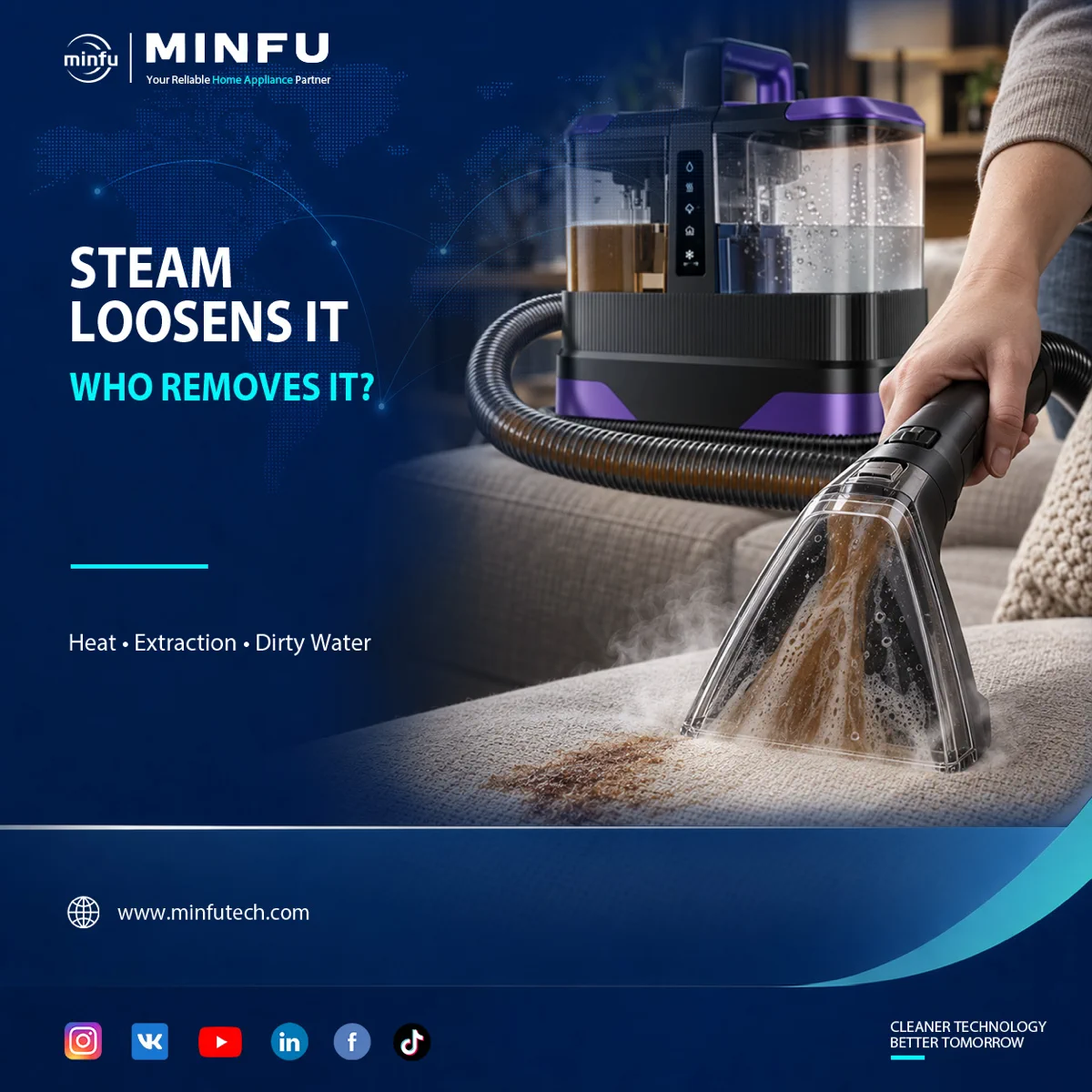

Steam is easy to sell.
Show a cloud of hot vapor hitting an old stain and the cleaning process immediately looks powerful. The customer can see the heat, the moisture and the reaction on the surface.
But after the steam loosens the dirt, there is another question that matters just as much:
Where does the dirty material go?
This is where the difference between a conventional steam cleaner and a portable spot cleaner becomes important.
A steam cleaner primarily uses heat and moisture to soften or loosen soil on suitable surfaces. A spot cleaner works differently: it applies water or cleaning solution and then uses suction to recover liquid, dissolved soil and loosened debris into a dirty-water tank. BISSELL’s own operating instructions describe this sequence clearly—spray the cleaning solution, work the stain, then use the suction channel to pull the liquid back into the machine.
Neither method is automatically better for every job. They are solving different parts of the cleaning problem.
That is also why a newer category of spot cleaner with steam is interesting. Instead of asking customers to choose between heat and extraction, these machines try to combine both.
First, We Need to Define What “Steam Cleaner” Means
The term steam cleaner is used rather loosely in the appliance market.
Some products are true vapor steam cleaners. They heat water and deliver hot vapor through a nozzle or cleaning head. Their main strengths are heat, surface cleaning and loosening greasy or attached soil.
Other products called “steam carpet cleaners” are actually extraction machines using hot water rather than true steam.
That distinction matters.
For this article, when we say steam cleaner, we mean a machine whose primary cleaning mechanism is hot steam or vapor and that does not rely on a dirty-water extraction system as its main method of removing loosened soil.
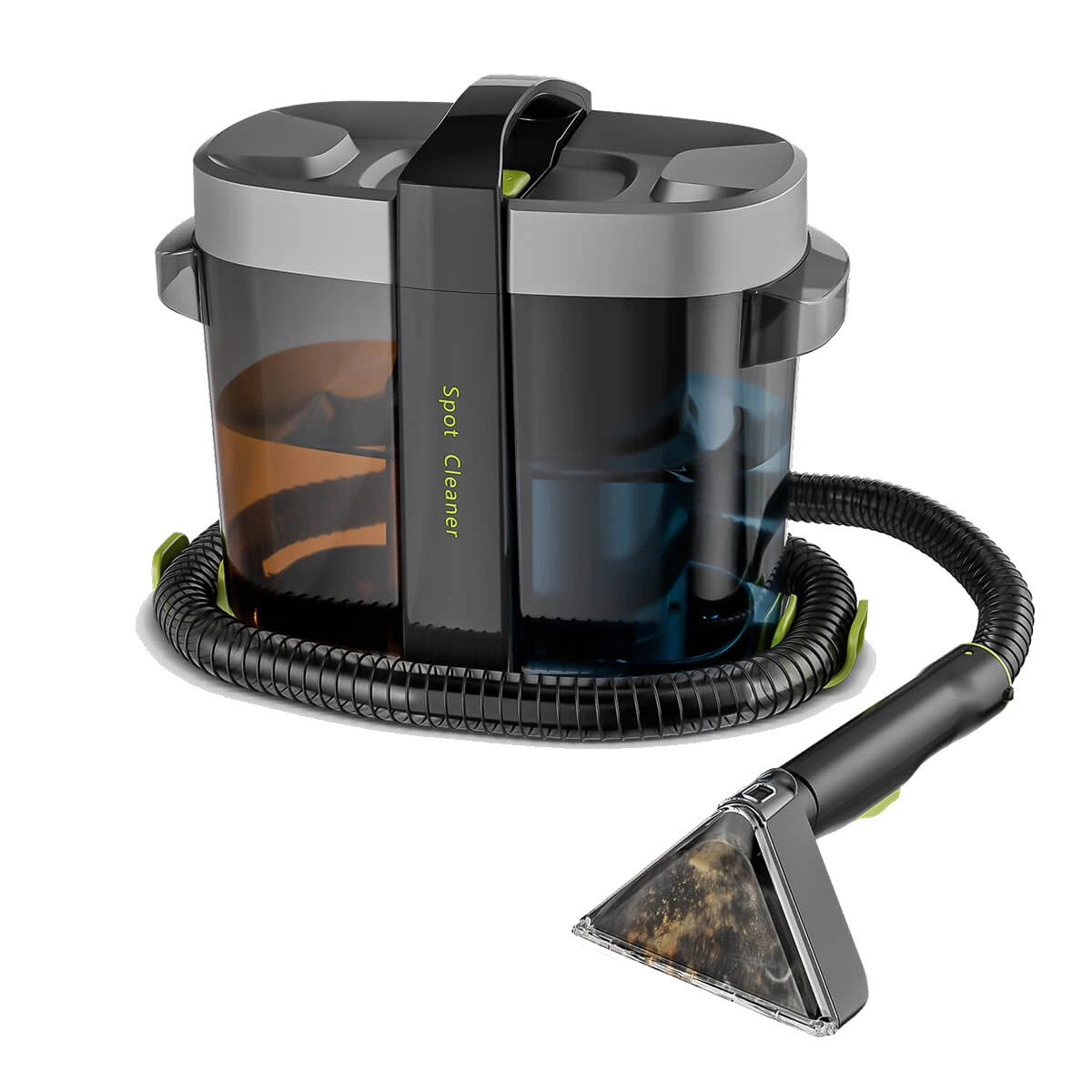
When we say spot cleaner, we mean a portable extraction cleaner that applies liquid to carpet or upholstery and then uses suction to recover dirty moisture into a separate tank.
Once those definitions are clear, the biggest difference becomes obvious.
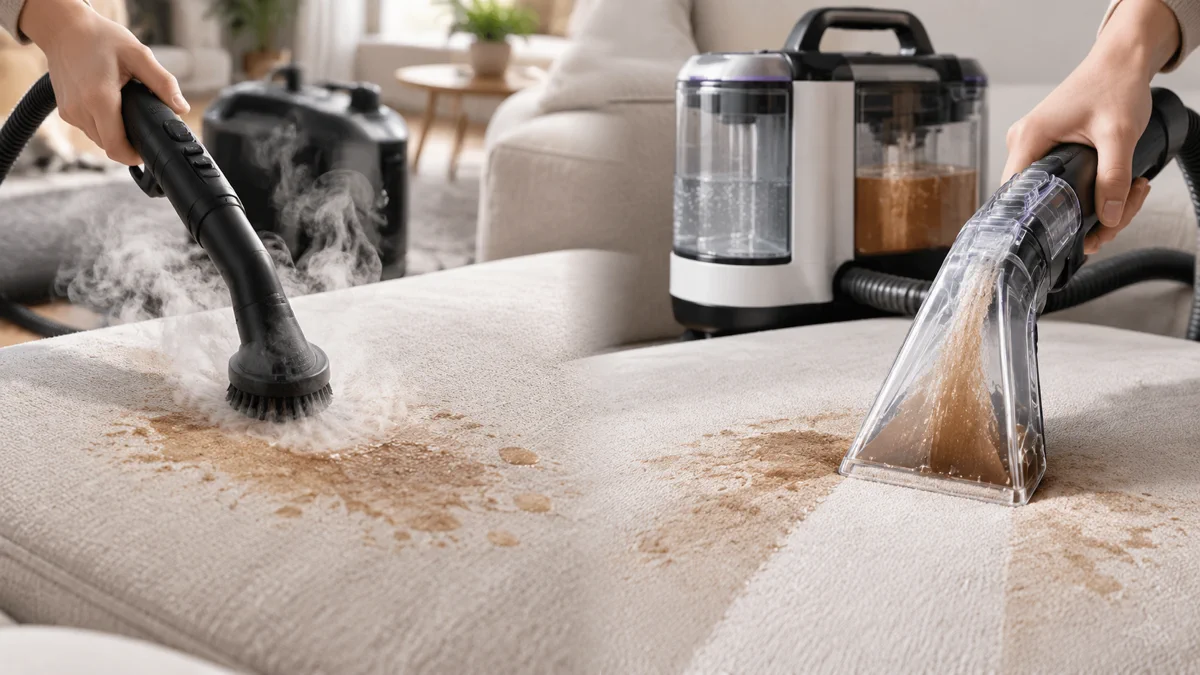
A steam cleaner mainly helps release the contamination.
A spot extractor is designed to remove and recover it.
What a Spot Cleaner Actually Does
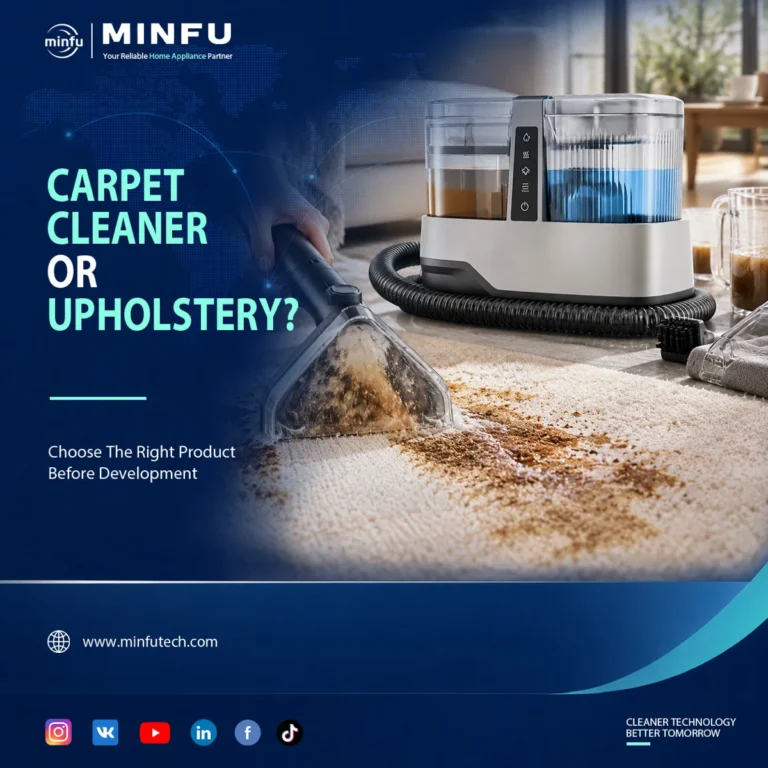
Look at the cleaning head of a typical portable spot cleaner and the process is easier to understand.
The machine applies water or cleaning solution to the stained area. The user may then agitate the area using the tool or brush. Finally, the cleaning head seals against the fabric and suction pulls dirty liquid away from the surface.
BISSELL describes essentially this process for its SpotClean machines and specifically instructs users to continue suction passes until little or no more water can be seen entering the nozzle. The recovered liquid then goes into the dirty-water tank.
That recovery step is one of the biggest differences between a spot extractor and a basic steam tool.
If coffee, pet mess, muddy water or another contaminant has penetrated into a washable carpet or upholstery surface, loosening it is only part of the job. Some of that loosened material still needs to be physically removed.
This is why suction matters.

Steam and Extraction Solve Different Problems
One reason these two categories are frequently confused is that both can make a dirty fabric look cleaner.
But the physics of the process are different.
A steam cleaner introduces thermal energy and moisture. Depending on the soil and surface, that can help soften residues, loosen grime and reduce the need for aggressive mechanical scrubbing.
A spot cleaner introduces cleaning liquid and relies heavily on extraction. It is designed so that the contaminated liquid does not simply remain in the fabric.
A simple way to think about the two systems is:
| Cleaning Function | Steam Cleaner | Spot Cleaner |
|---|---|---|
| Heat | Strong | Usually limited or moderate |
| Applies moisture | Yes | Yes |
| Cleaning solution | Often optional/not required | Common |
| Agitation | Depends on attachment | Usually built into tool/use process |
| Suction extraction | Usually not the main function | Core function |
| Dirty-water tank | Often no | Yes |
| Targeted stain recovery | Limited by architecture | Core use case |
This is why the question should not simply be:
Which machine has stronger cleaning power?
A more useful question is:
What part of the cleaning process does the machine actually perform?
Steam Can Loosen Dirt Without Removing All of It
Imagine dried food residue on a sofa that is suitable for this type of cleaning.
Heat and moisture may help soften the residue and make it easier to release from the fabric.
But once that contamination has been loosened, it still exists somewhere.
Depending on the steam-cleaner design, the user may need to wipe the area using a cloth or pad, or otherwise remove the loosened material manually. Current steam-cleaner comparisons make the same distinction between steam-based loosening and extraction-based dirty-water recovery.
For tiles or other hard surfaces, wiping loosened material away can be straightforward.
For thick carpet or upholstery, however, the situation is different because moisture and contamination can move into fibers and padding.
That is where extraction becomes especially useful.
The transparent head on many portable spot cleaners exists for a reason: users can actually see dirty liquid being recovered from the material.
That visual feedback is also extremely easy for retailers to demonstrate.
But Suction Alone Does Not Solve Every Stain Either
It would be equally misleading to say that extraction alone guarantees perfect stain removal.
A spot cleaner still depends on several factors:
- how effectively the cleaning liquid reaches the stain;
- chemistry or detergent compatibility;
- agitation;
- suction;
- tool sealing;
- water recovery;
- the type and age of the stain;
- and the material being cleaned.
This is also why simply comparing suction numbers between spot cleaners can be misleading.
A machine claiming a higher kPa number may not necessarily recover more water from an upholstery surface if its cleaning head seals poorly, the airflow path is inefficient or the user cannot maintain good contact with the fabric.
The complete system matters.
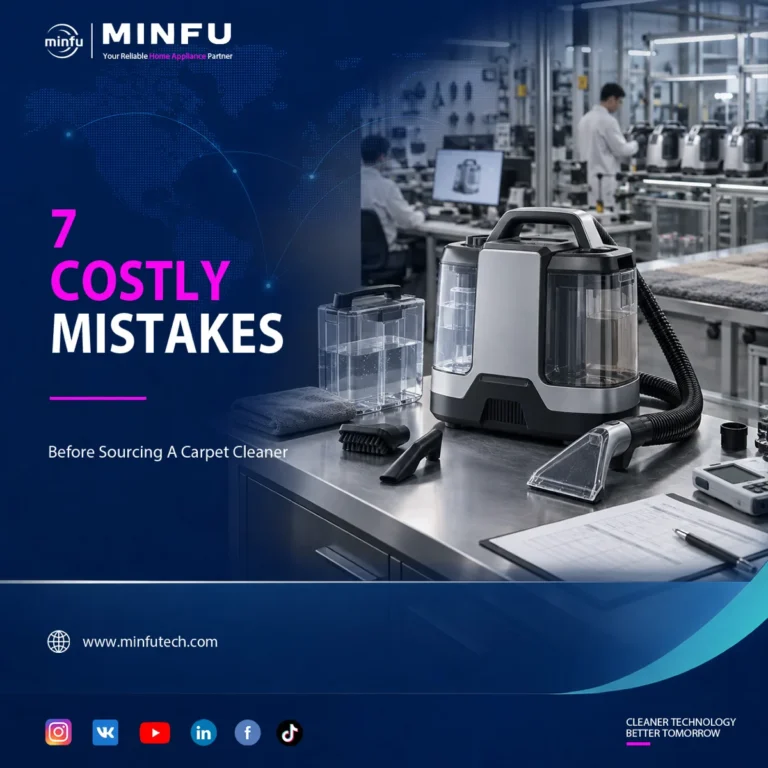
For our C888 platform, for example, the current specification includes 16 kPa suction, but we would not tell an OEM buyer to approve the machine from that number alone. The cleaning head, steam delivery, spray pattern, water recovery and fabric result all need to be evaluated together. The current C888 platform also uses separate 2200 ml clean-water and 1200 ml dirty-water tanks, which makes the extraction side of the product architecture explicit.
The Interesting Part Is What Happens When Steam and Extraction Meet
This is where the category gets more interesting.
Instead of building a machine that only applies steam or only performs liquid extraction, manufacturers are increasingly combining the two processes.
Ariete’s current Spot Cleaner Steam PRO, for example, combines steam, hot water and cold-water modes with suction and separate clean/dirty-water management.
BISSELL’s Little Green HydroSteam follows the same broad direction: steam is added to a portable carpet and upholstery cleaner that still includes a dirty-water recovery tank and suction-based tools.
That tells us something important about the product category.
The industry is not necessarily choosing:
Steam OR Extraction.
In some products, it is moving toward:
Steam + Extraction.
The product-development question then becomes whether the additional complexity actually improves the experience enough to justify the heater, steam system, thermal controls, extra safety requirements and higher cost.
Why Add Steam to a Spot Cleaner?
The most obvious reason is stubborn soil.
A conventional portable extractor may rely on water, detergent and mechanical agitation to loosen the contamination before suction removes it.
Adding controlled heat or steam creates another way of attacking the bond between the soil and the surface before extraction.
That can make the product story easier to understand as well:
Loosen → Extract → Recover
rather than simply:
Spray → Suction
But from our side as a manufacturer, the heater is not valuable just because it creates visible steam.
The real question is whether it contributes to a better cleaning process on the surfaces and stain types for which the product is intended.
This is why comparative sample testing matters.
Take the same stain, the same fabric, the same cleaning procedure and compare:
cold-water extraction,
hot-water extraction,
and steam-assisted extraction.
Then evaluate not only visible stain reduction but also moisture recovery, fabric appearance and drying behaviour.
That is far more useful than simply showing a dramatic cloud of steam in a marketing video.
C888 Uses Heat and Extraction for Different Jobs
Our current 100°C steam spot cleaner platform follows this combined architecture.
The C888 provides a hot-water mode rated at 60±5°C, a steam mode specified at 100°C, approximately 15 seconds for hot water and 30 seconds for steam preparation, alongside 16 kPa suction and separate clean- and dirty-water tanks.
Those specifications are not all doing the same job.
The heating system provides thermal assistance.
The liquid system delivers the cleaning medium.
The cleaning head works the target area.
The suction system recovers dirty moisture.
The dirty-water tank gives that recovered contamination somewhere to go.
That last point is easy to underestimate.
A product that releases soil without effectively recovering dirty liquid can produce a very different user experience from one designed around extraction.
Where Does the Dirty Water Actually Go?
For a spot extractor, the answer should be simple:
into the dirty-water tank.
But for a B2B buyer, there are several deeper questions behind that answer.
How much of the applied liquid is actually recovered?
How easily can the tank be removed?
Can the customer empty it without spilling dirty water?
Can hair or debris block the recovery path?
Is the tank easy to rinse?
Does foam affect suction?
Does the machine lose suction as the dirty tank fills?
Does moisture remain in the hose after use?
Those details have a major effect on customer satisfaction.
BISSELL’s own SpotClean instructions, for example, warn that a full dirty-water tank can cause a change in machine sound and a loss of suction.
That is the type of detail buyers should examine during sample testing, because customers will experience the product as a complete system rather than a specification sheet.
More Steam Is Not Automatically Better
Steam creates an obvious visual signal of power, which makes it attractive in product demonstrations.
But more heat is not universally better for every cleaning surface.
Different fabrics, coatings, adhesives, dyes and upholstery constructions can respond differently to heat and moisture. Recent upholstery-cleaning guidance continues to emphasize checking material compatibility rather than assuming every sofa or textile is suitable for steam.
For a brand, this means the instruction manual and market claims matter almost as much as the heating specification.
A steam-assisted spot cleaner should have clearly defined intended surfaces, operating instructions and warnings.
The message should not be:
100°C means use it on everything.
It should be:
The product provides steam as one cleaning mode for compatible applications.
That distinction makes the product more credible and reduces misuse.
More Water Is Not Automatically Better Either
The same principle applies to spot extraction.
Flooding a stain with liquid can make the surface look thoroughly treated, but excessive moisture is not necessarily good cleaning.
The machine then has more liquid to recover, the material takes longer to dry, and moisture may penetrate further into thick cushioning or carpet backing.
This is one reason tool design and recovery efficiency matter.
A good spot-cleaning process needs enough liquid to work the contaminated area without unnecessarily soaking everything underneath it.
For B2B buyers comparing samples, one useful test is therefore not simply:
Which machine sprays more water?
It is:
Which machine leaves less unnecessary moisture after achieving a similar cleaning result?
That is a much more meaningful product comparison.
Drying Time Is Part of Cleaning Performance
A sofa can look clean immediately after treatment and still create a poor customer experience if it remains excessively wet for hours.
Drying depends on many variables, including how much liquid was applied, how much was extracted, fabric thickness, room airflow and environmental humidity.
This is another reason extraction matters.
After the wet cleaning passes, users can normally make additional suction-only or drying passes to recover more residual liquid. BISSELL explicitly recommends additional suction strokes after cleaning to remove as much moisture as possible.
For an OEM project, this gives buyers another practical test:
Apply the same controlled amount of liquid to equivalent fabric samples, follow the same cleaning procedure, then compare residual moisture after a defined number of extraction passes.
That converts “powerful suction” into something much closer to the customer’s actual experience.
Steam Cleaner vs Spot Cleaner: Which Should a Customer Choose?
For many applications, there is no universal winner.
A conventional steam cleaner may make more sense when the cleaning job depends heavily on heat and the surface can be cleaned by wiping away loosened soil.
A portable spot extractor makes more sense when the primary job is removing spills, stains and dirty moisture from suitable carpets, sofas, car seats or other washable textile surfaces.
A hybrid steam spot cleaner becomes interesting when the customer wants both thermal assistance and extraction in the same cleaning process.
The distinction can be summarized this way:
| Customer Need | More Suitable Architecture |
|---|---|
| Heat-based surface cleaning | Steam cleaner |
| Recovering spilled liquid | Spot cleaner |
| Sofa/carpet stain extraction | Spot cleaner |
| Dirty-water collection | Spot cleaner |
| Steam-assisted stain treatment + recovery | Steam spot cleaner |
| One machine combining heat and extraction | Hybrid steam spot cleaner |
That is why we do not think the right question is simply:
Is steam better?
The more interesting question is:
Does the machine only loosen the contamination, or can it also remove and recover it?
For Retailers, the Dirty-Water Tank Is Actually a Strong Sales Tool
From a marketing perspective, this is one of the most underused parts of the product.
Steam is visually attractive.
But dirty-water recovery is visual proof.
A retailer can demonstrate a cleaner on an apparently ordinary sofa, carpet section or car seat and then show the customer the water collected afterward.
That creates a very simple product story:
This is what was inside the fabric.
For social media and e-commerce video, that kind of demonstration can be more convincing than a page filled with technical specifications.
This is also why transparent cleaning heads work so well in this category. Customers can watch contamination leave the fabric.
For distributors looking for a product that is easy to demonstrate on TikTok, Instagram, retail floors or trade-show booths, extraction provides a strong visual hook.
B2B Buyers Should Test More Than the Stain Result
A stain disappearing during one demonstration is useful, but it is not enough for OEM approval.
A buyer should also evaluate steam preparation time, steam consistency, temperature control, suction stability, water recovery, hose drainage, tank sealing, cleaning-head durability and long-term heater performance.
This connects with our existing steam upholstery cleaner sourcing guide, where we look more closely at what B2B buyers should validate before ordering this category.
For a hybrid system, there is another challenge: more functions mean more components.
A conventional extractor may contain a pump, motor, tanks, hoses and controls.
Add steam and the system now also includes heating elements, thermal control, steam channels and additional protection requirements.
That does not make the product worse.
It simply means the product deserves more serious validation.
What We Would Test on a Steam Spot Cleaner Sample
For a new OEM project, we would use controlled stain samples rather than random dirty furniture.
For example, prepare equivalent pieces of approved upholstery fabric and apply repeatable amounts of common stains such as coffee, mud or food residue. Allow them to sit under the same conditions.
Then compare several cleaning modes.
One sample can use normal extraction.
Another can use hot-water extraction.
Another can use steam-assisted extraction.
Record the number of cleaning passes, the amount of water applied, the volume recovered, visible stain reduction and residual moisture afterward.
The aim is not to create a dramatic laboratory video.
It is to answer practical questions:
Does steam reduce the number of passes?
Does the extraction system recover enough moisture?
Does the fabric appearance remain acceptable?
Is there any visible discoloration or distortion?
Does the machine maintain performance after repeated cycles?
Those answers are much more useful to a buyer than simply knowing that the heater can reach a particular temperature.

Why This Matters for OEM Product Positioning
There is another commercial reason to understand the difference.
If the final product is positioned simply as:
Steam Cleaner
customers may expect a general-purpose steam appliance.
If it is positioned as:
Spot Cleaner
customers may expect a compact carpet and upholstery extractor.
If it is positioned as:
Steam Spot Cleaner
then the product needs to make the combination obvious.
The customer should understand why both systems exist.
For us, the cleanest message is:
Heat helps loosen. Extraction helps remove.
That is much easier to explain than filling the carton with individual motor, temperature and pump specifications.
It also gives distributors something differentiated from a standard portable extractor without turning the product into an unfamiliar category.
Our View: Cleaning Is Not Finished When the Stain Is Loose
Steam is valuable because heat can change how stubborn contamination responds to cleaning.
Extraction is valuable because loosened soil and moisture still need somewhere to go.
That is why we think these technologies are more interesting together than when they are treated as competing marketing labels.
The best product is not automatically the one with the hottest steam or the largest suction number.
It is the one that delivers a complete cleaning process for its intended surfaces:
apply the right treatment, loosen the contamination, extract dirty moisture and leave the material in a condition the customer is happy with.
For brands and distributors considering a steam-assisted spot cleaner, that complete process is what should be evaluated.
Because loosening the stain is only half the story.
The dirty water still has to go somewhere.
FAQ
What is the difference between a steam cleaner and a spot cleaner?
A steam cleaner primarily uses heated vapor to loosen soil on suitable surfaces. A spot cleaner typically applies water or cleaning solution and then uses suction to extract dirty liquid into a separate recovery tank.
Does a steam cleaner suck up dirty water?
Many traditional steam cleaners do not use dirty-water extraction as their main cleaning mechanism. Some newer hybrid machines combine steam with suction and dirty-water recovery, so the exact architecture should be checked.
Is a spot cleaner better for upholstery stains?
For washable upholstery where the goal is to remove spills and dirty moisture, extraction is often useful because the machine physically pulls contaminated liquid from the fabric. Material-care instructions should still be checked before wet cleaning.
What is a steam spot cleaner?
A steam spot cleaner combines steam or heated cleaning with the liquid-application and suction-recovery functions of a portable spot extractor.
Is higher steam temperature always better?
No. The correct temperature depends on the product design and the material being cleaned. Heat-sensitive fabrics, coatings, adhesives and dyes may require additional care.
Why does a spot cleaner need a dirty-water tank?
The dirty-water tank stores liquid recovered from the cleaned surface. It separates contaminated recovery water from the clean water or cleaning solution supplied to the tool.
Is suction power the most important spot-cleaner specification?
No. Suction is important, but cleaning performance also depends on airflow, nozzle sealing, spray pattern, agitation, liquid recovery, cleaning chemistry and the material being cleaned.
Work With Minfu
Minfu provides one-stop OEM/ODM manufacturing, product development, customization, quality control and mass-production support for brands, importers, distributors and retailers worldwide.
Our steam spot-cleaner platforms combine heated cleaning, stain treatment and dirty-water extraction for upholstery, carpet, stairs and other suitable fabric-cleaning applications.
Website: minfutech.com
OEM/ODM Solutions
Email: info@minfutech.com
WhatsApp / Phone: +86 13760255781
Contact Us
Contact Minfu to discuss your target market, samples, product configuration and private-label requirements.