

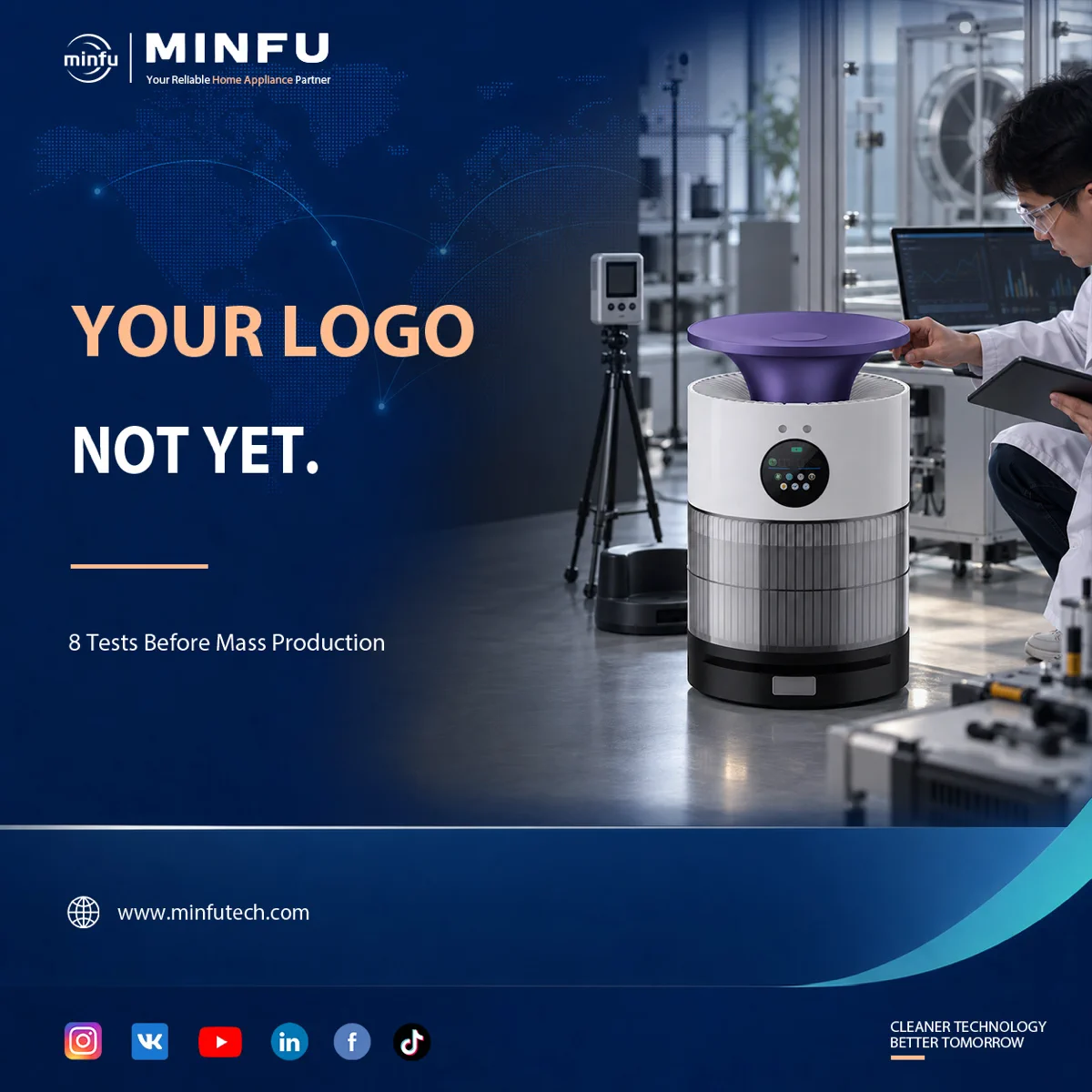

An impressive sample can be dangerous.
Not because the product is necessarily bad, but because one good demonstration can create a false sense of confidence.
A mobile air purifier may map a showroom perfectly, respond to a pollution hotspot during one demo, return to its charger and display beautiful air-quality data on an app. For a distributor or private-label brand, that can make the product feel ready.
But OEM approval is not about whether the sample can work once.
It is about whether the product can deliver the same performance repeatedly, under defined conditions, and whether the factory can reproduce that result during mass production.
This is especially important for an AI mobile air purifier, because buyers are not evaluating one system. They are evaluating several systems working together: purification, sensing, navigation, battery management, software, filtration and electrical safety.
At Minfu, we therefore think sample approval should answer a simple question:
Can we turn every important marketing claim into something that can actually be tested?
For this type of product, we would start with the following eight areas.
1. Verify the Purification Performance Before Testing the “AI”
The first test should have nothing to do with artificial intelligence.
Before evaluating navigation, algorithms or mobile behaviour, buyers need to confirm that the product performs its primary job as an air purifier.
For particle removal, CADR is one of the most useful performance indicators because it describes the amount of cleaned air the purifier delivers under the applicable test conditions. EPA guidance also recommends selecting portable air cleaners with CADR appropriate to the room size being served.
Our current Minfu AI mobile air purifier platform publishes a particle CADR of 698.3 m³/h, a gas CADR of 560 m³/h and H13 HEPA filtration. Those figures define the platform, but for an OEM project the relevant test reports, operating modes and agreed performance limits should become part of the approval package rather than remaining only on a marketing page.
A buyer should confirm which pollutant was used for the test, which mode produced the result, whether the value is repeatable across samples and whether the test method matches the intended sales market.
This also prevents a common sourcing mistake: approving a highly intelligent robot that is only an average air purifier.

2. Test the Air-Quality Sensor Against an Independent Reference
If the product claims to make decisions based on air quality, the sensor becomes part of the control system rather than a decorative display.
That means the buyer should not simply check whether the PM2.5 number changes when smoke or particles are introduced. The more useful question is whether the onboard sensor responds consistently compared with an independent reference instrument.
A practical sample test can expose several units to the same controlled environmental change and compare response time, trend direction and unit-to-unit variation.
The goal is not necessarily to force every low-cost sensor to match laboratory equipment digit for digit. The goal is to determine whether the sensor provides information that is stable enough for the product’s decision logic.
For a mobile purifier this becomes especially important because the sensor changes location with the machine. The robot may enter a bedroom while its fan is already running, so the sensing strategy has to distinguish useful ambient information from air influenced by the purifier’s own circulation.
Industry quality-control services for air purifiers commonly include sensor accuracy alongside CADR, noise, filtration and functional checks, which reflects how central this parameter has become in modern purifier evaluation.
For an AI platform, inaccurate sensing does more than display the wrong number.
It can cause the product to make the wrong decision.
3. Do Not Test Navigation Only in an Empty Showroom
A mobile purifier also has to function as a robot.
One of the easiest ways to make a navigation system look excellent is to test it in a large, empty room with flat floors and no real obstacles. That environment is useful during engineering development, but it does not tell a buyer enough about the customer experience.
A realistic navigation test should include hallways, furniture, different floor surfaces, rugs, thresholds, narrow passages, table legs and partially obstructed routes.
The questions are straightforward. Does the robot build a usable map? Can it identify and revisit rooms? Does it repeatedly take sensible routes? Can it enter and leave the same bedroom without getting trapped? Does it recognise obstacles without becoming so conservative that it refuses to pass through normal residential spaces?
Our previous can one air purifier clean multiple rooms discussion showed why this matters. Mobility creates value only when the purifier can reliably reach the room where its purification capacity is needed.
One successful trip proves very little.
A good validation test repeats the same route many times under slightly different conditions.
4. Create a Controlled Pollution Hotspot and See What the Robot Actually Does
This is one of the most important tests for an AI mobile purifier because it connects the sensor system with the navigation system.
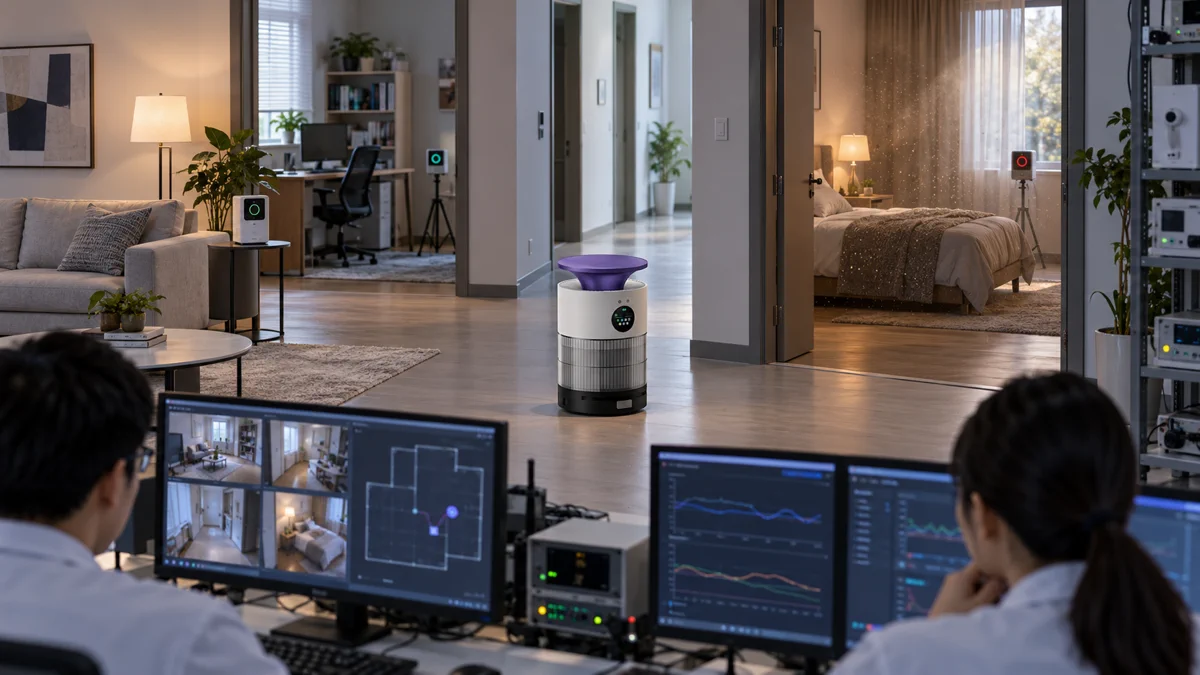
A buyer can create a controlled multi-room environment with independent reference monitors in each room. The purifier begins from a defined starting position, and a controlled particulate change is introduced into one area.
Then observe the full chain of behaviour.
Does the system detect a meaningful difference? Does it identify the intended room? Does the robot move there? Does it position itself sensibly? Does it remain long enough to perform useful purification? Does the independent monitor in that room show the expected improvement?
After that, repeat the test.
This is where marketing language such as “targeted purification” becomes measurable.
If the product always follows a fixed patrol path regardless of air quality, that may still be a useful feature, but it should not be confused with adaptive environmental decision-making.
If air-quality information genuinely changes where the machine goes and how long it stays, the buyer should be able to demonstrate that behaviour repeatedly.
5. Test Battery Runtime Together With Purification Load
Battery specifications are easy to compare and easy to misunderstand.
A 10000mAh battery sounds better than a 5000mAh battery, but battery capacity alone does not tell buyers how long the finished machine will operate under a particular purification and navigation workload.
Our current platform offers 5000mAh and 10000mAh configurations, so the correct SKU depends on how the target customer is expected to use the product.
A useful test should therefore include several realistic operating conditions rather than one ideal runtime figure. Buyers can compare low fan speed with limited movement, normal purification with periodic room-to-room navigation, and higher fan output combined with frequent movement.
The buyer should also test what happens near low battery. Does the machine abandon the task and return immediately? Does it finish a defined routine first? Can it reliably locate the dock from another room? After charging, does it resume anything that was interrupted?
The charging cycle itself should also be repeated.
Auto-docking that works nine times out of ten is not a minor inconvenience once thousands of units are in customer homes.
6. Measure Noise in the Modes Customers Will Actually Use
A low noise number on a specification sheet can be accurate and still tell only part of the story.
Our current mobile purifier platform lists 35 dB operation at Level 3–4, but buyers should define exactly which mode, distance and test conditions they want to validate for their market.
The most useful sample review is usually not just:
What is the minimum noise level?
It is:
What does the customer hear while the machine is doing the job we are advertising?
That means checking several conditions: low purification mode, normal everyday mode, maximum fan speed, movement over hard floor, transitions between surfaces and docking.
A mobile product can also generate mechanical noise that a stationary air purifier does not have, including wheel motors, turns, obstacle manoeuvres and docking contact.
For a bedroom-focused SKU, these differences matter.
For a commercial lobby product, the acceptable balance may be completely different.
This is why noise should be evaluated as part of product positioning rather than treated as a single universal number.
7. Test the Filter After It Has Collected Dust, Not Only When It Is New
A brand-new purifier is operating under its easiest filtration condition.
The filter is clean, airflow resistance is low and the machine has not accumulated real dust.
Customers do not use the product that way forever.
As the filter loads, resistance changes. Airflow may change. Fan behaviour may change. Noise may change. The onboard filter-life estimate also needs to remain meaningful.
EPA guidance notes that overloaded filters do not work well and require regular replacement, which is one reason filter maintenance remains part of actual purifier performance rather than simply an accessory issue.
For OEM sample approval, buyers should inspect filter fit, sealing, installation direction, pre-filter accessibility and the replacement procedure. They should also understand how the product calculates filter life. Is it only a timer? Does it consider fan runtime? Does it incorporate operating mode or other data?
If the product uses a washable pre-filter, test what happens after repeated removal, cleaning and reinstallation.
For private-label projects, there is also a commercial question: can the factory reliably supply replacement filters after the first production order?
A great purifier with an unavailable replacement filter creates a poor ownership experience.
8. Test the Software, Safety and Long-Term Behaviour Before Freezing the Sample
The final test area is broader because this is where a prototype becomes a product.
An AI mobile purifier depends on firmware, connectivity and control logic. If the platform supports Tuya or another app environment, buyers should verify pairing, reconnection, remote controls, map retention, room settings and recovery after Wi-Fi interruptions.
Core behaviour should also be checked when the internet is unavailable. Buyers should know which functions run locally and which depend on cloud services.
Firmware version control matters as well. A change in thresholds, fan logic, navigation or docking behaviour can alter the customer experience even when every hardware component remains identical. This is why software configuration should be treated as part of the approved product specification, not something separate from the BOM.
Electrical and product safety then sit above all of this. IEC 60335-2-65:2023 covers safety requirements for household and similar electric air-cleaning appliances and explicitly includes battery-operated appliances within its scope. A 2026 IECEE test-report form is also available for IEC 60335-2-65:2023 in conjunction with the applicable general household-appliance safety standard.
The exact certification route still depends on the target country, configuration and claims, so buyers should confirm market-specific requirements before production rather than assuming one certificate works everywhere.
Finally, run aging and repeated-function tests. The important question is no longer whether the sample can complete one successful cycle. It is whether navigation, charging, fans, sensors, wheels, buttons and software remain stable after repeated use.
One Good Sample Is Not Enough
There is another issue buyers should not overlook.
Suppose Sample A passes every test above.
That does not automatically prove that 2,000 production units will behave the same way.
This is where product validation meets manufacturing control.
Critical parameters need to be frozen. That may include the fan and motor, filter media, sensors, battery cells, PCB, firmware version, wheel motors and other components that affect approved behaviour.
If a sensor supplier changes, the air-quality response may change.
If the battery changes, runtime may change.
If the motor or filter resistance changes, CADR and noise may change.
If firmware changes, navigation may change even though the physical product looks identical.
This is why our earlier OEM BOM approval discussion matters here as well. The approved sample should be supported by an approved specification, not simply placed on a shelf and treated as the only source of truth.
For a sophisticated smart appliance, quality control is increasingly about preserving behaviour, not only preserving appearance.
Sample Approval and Mass Production Should Use the Same Critical Criteria
One of the more practical improvements a buyer can make is to decide during sample approval which tests need to be repeated later.
Not every production unit needs to go through a full CADR chamber or multi-room robot laboratory.
That would be impractical.
Instead, the engineering team can separate tests into two levels.
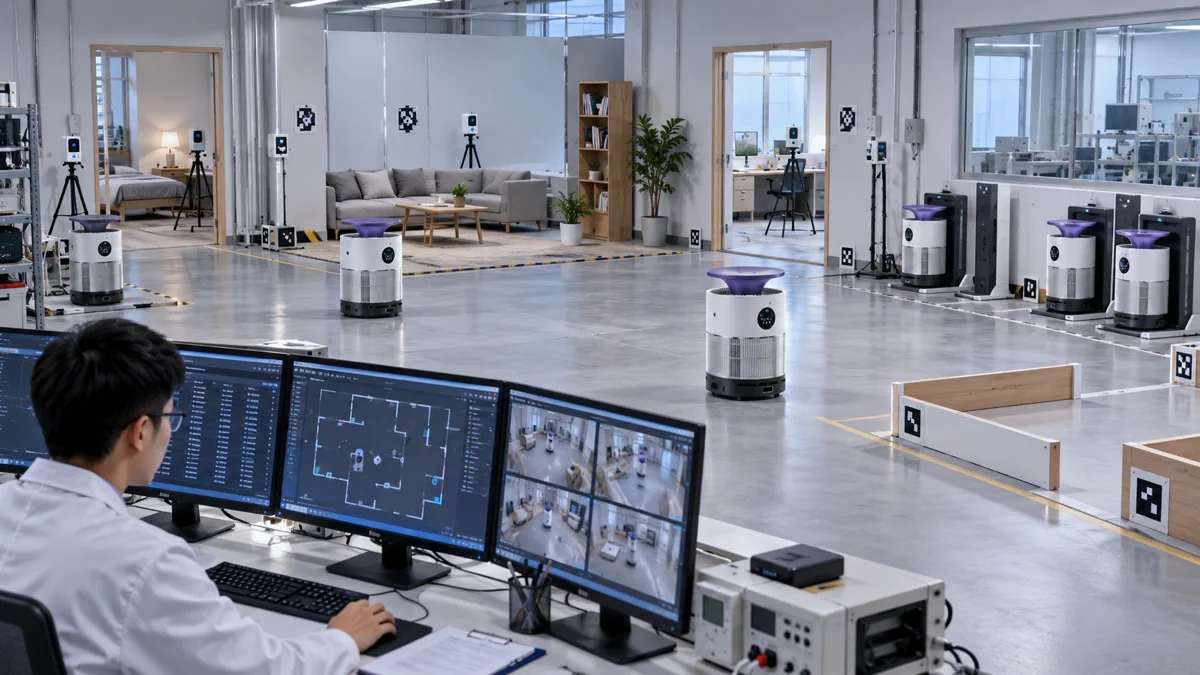
The first level contains deeper validation during development and sample approval: CADR, sensor correlation, navigation behaviour, battery performance, filtration, safety and durability.
The second level contains production-line or batch-level checks that confirm critical characteristics have not drifted. These might include functional operation, sensor response checks, charging, wheel movement, fan mode, software version, noise screening, appearance and final configuration verification.
Third-party air-purifier inspection services follow a similar lifecycle approach, separating sample checks, production monitoring, in-process inspection and pre-shipment inspection rather than assuming one final inspection can detect every possible problem.
For B2B buyers, that distinction is important.
Quality is easier to control when the test plan is designed before production starts.
What We Would Put on an AI Air Purifier Sample Approval Sheet
The approval sheet does not need to become a hundred-page engineering document.
But it should contain enough information that six months later, a new engineer can understand what was approved.
For this type of product, we would expect the file to record at least the approved product configuration, key purification performance, operating modes, sensor behaviour, navigation and docking requirements, battery configuration, filter configuration, app and firmware version, packaging configuration and the critical compliance documentation relevant to the target market.
It should also document any claims the brand intends to put on the website, carton or marketplace listing.
This is important because marketing sometimes moves faster than engineering.
A product may have been tested for a particular particle CADR, yet the eventual sales page begins making much broader claims about gases, allergens, pathogens or whole-home purification.
The sample approval process is a good point to stop that gap from developing.
If a claim cannot be connected to a test, specification or defined product behaviour, it should be reviewed before it reaches the carton.
The Most Expensive Failure Often Happens After Launch
OEM buyers naturally focus on factory cost.
But one of the highest costs is discovering a problem after thousands of customers have already received the product.
A navigation bug becomes returns.
An inaccurate sensor becomes negative reviews.
Unreliable docking becomes customer-support tickets.
A filter that is difficult to replace becomes poor repeat purchase.
A noise problem becomes a bedroom product customers refuse to use.
A firmware change that alters behaviour can create complaints even when the factory believes the hardware is unchanged.
This is why an additional week of disciplined sample validation can sometimes be more valuable than negotiating another dollar off the unit price.
The purpose of testing is not to prove that the supplier is wrong.
It is to define what “right” actually means before mass production begins.
Our View: Turn Every Important Selling Point Into a Test
For a conventional air purifier, buyers already know to ask about filtration, CADR and noise.
For an AI mobile air purifier, that is no longer enough.
The product may also claim that it senses, decides, maps, navigates, targets areas, returns to charge and manages purification across different spaces.
Each additional selling point creates another engineering requirement.
That is why our preferred approach at Minfu is straightforward: if a feature matters enough to appear in the sales presentation, it should matter enough to appear in the validation plan.
“High CADR” should have a performance test.
“Smart sensing” should have a reference comparison.
“Targeted purification” should have a controlled hotspot test.
“Autonomous mobility” should have a repeatable navigation test.
“Automatic recharge” should survive repeated docking cycles.
“Quiet operation” should be measured in the relevant operating mode.
“Long filter life” should have a defined basis.
“AI” should describe observable, repeatable behaviour rather than a label.
Once those questions have clear answers, putting a brand logo on the product becomes a much more defensible decision.
FAQ
What should buyers test before approving an OEM air purifier?
At minimum, buyers should verify purification performance, sensor behaviour, noise, filtration, electrical safety and long-term reliability. Smart or mobile products should also be tested for navigation, docking, battery performance, connectivity and software behaviour.
How should an AI air purifier be tested?
The AI-related functions should be converted into repeatable scenarios. For example, if the purifier claims to move toward areas with poorer air quality, buyers should create a controlled air-quality difference between rooms and verify whether the product repeatedly detects and responds to it correctly.
Is CADR testing enough to approve an air purifier?
No. CADR is a critical purification-performance metric, but product approval should also consider filtration, sensor performance, noise, safety, durability and the user experience. Mobile purifiers add navigation, charging, battery and software requirements.
Why should air-quality sensors be checked independently?
The purifier’s control logic may depend on the sensor reading. Comparing the onboard sensor with an independent reference helps buyers determine whether its response is stable and useful enough for automated decisions.
Should buyers test the replacement filter?
Yes. Filter fit, sealing, pressure resistance, replacement procedure and long-term supply all affect product performance and ownership experience.
Do AI air purifiers need special safety testing?
They still need to meet the applicable electrical and appliance safety requirements for their target markets. IEC 60335-2-65 covers household and similar air-cleaning appliances, including battery-operated products, but the complete compliance route depends on the specific market and configuration.
Should firmware version be part of OEM sample approval?
For a smart appliance, yes. Firmware can affect sensing, fan behaviour, navigation, docking and app functions even when the hardware remains unchanged, so the approved software version should be controlled as part of the product specification.
Work With Minfu
Minfu provides one-stop OEM/ODM manufacturing, product development, customization, quality control and mass-production support for brands, importers, distributors and retailers worldwide.
Our AI mobile air purifier platform combines air purification, environmental sensing, autonomous navigation, targeted purification, smart control and automatic charging for brands looking for a differentiated air-care product.
Website: minfutech.com
Email: info@minfutech.com
WhatsApp / Phone: +86 13760255781
Contact Us
Contact Minfu to discuss product configuration, sample validation and OEM/ODM cooperation.