


Steam has become an increasingly visible feature in portable carpet and upholstery cleaners.
For buyers, that creates an attractive product story. A conventional spot cleaner already combines water application and extraction. Adding heated water or steam gives brands another way to position the product for stubborn stains, sofas, carpets, mattresses and vehicle interiors.
But it also makes the product more complicated.
Once a heater, steam path, temperature control and additional safety systems are added, buyers are no longer evaluating only suction power and tank capacity. Heating speed, steam stability, water recovery, fabric compatibility, internal sealing, maintenance and long-term reliability all become part of the sourcing decision.
At Minfu, we manufacture and develop several types of carpet and upholstery cleaning appliances. When a customer asks us whether a steam model is worth adding to a product line, our first response is usually not to compare the highest temperature or the largest wattage.
We first look at how the machine will actually be used and sold.
For a B2B buyer, a good steam upholstery cleaner is not simply a spot cleaner that produces hot vapor. The heating, spraying, brushing and extraction systems need to work together as one product.
Here are the areas we recommend testing before approving a sample for an OEM or wholesale project.
1. Decide Whether Your Market Actually Needs Steam
Steam is useful as a product differentiator, but it should have a clear role in the target market.
An entry-level portable spot cleaner may be purchased mainly for accidental spills, sofa cleaning, car interiors and occasional carpet stains. In this segment, compact size, simple operation, acceptable suction and a competitive retail price may matter more than adding another heating system.
A mid-range or premium product has more room for heated cleaning or steam functionality.
This can create a clearer distinction between standard spray-and-extract machines and more advanced models designed for deeper fabric-care applications.
Before comparing suppliers, define the channel first.
Are you selling through supermarkets, specialist appliance retailers, e-commerce platforms or professional distributors?
Is portability the main selling point?
Does the target customer expect a simple stain extractor or a more complete deep-cleaning appliance?
What retail price can the market realistically support?
These questions help determine whether a standard extraction model, heated spot cleaner or steam-equipped machine is the right starting point.
A good carpet cleaner factory should be able to offer different product levels instead of pushing every buyer toward the most expensive configuration.
2. Steam Temperature Is Only One Part of the System
Temperature is usually the first specification buyers ask about.
It is important, but the number alone tells you very little about real cleaning behavior.
Where is the temperature measured?
Is it measured inside the heater, inside the hose, or at the cleaning nozzle?
How long does the machine take to reach its working condition?
Can it maintain usable steam output during repeated operation?
Does the temperature fall significantly when water flow increases?
These questions matter because the temperature generated inside the machine is not necessarily the same as the temperature reaching the fabric.
Heating power, hose length, ambient conditions, water flow and nozzle design can all influence the result.
When testing a sample, do not simply switch the machine on and observe steam for a few seconds.
Run several cleaning cycles.
Allow the heating system to switch on and off normally.
Test again after the clean-water tank has been partially depleted.
The objective is to understand whether the heating system behaves consistently during realistic use.
For buyers considering a compact steam spot cleaner, this type of repeated test is more useful than selecting a supplier based on the highest temperature printed in a catalogue.
3. Steam and Extraction Need to Be Evaluated Together
Steam can help loosen certain types of dirt, but the machine still needs to remove the released moisture and residue from the fabric.
This is where extraction becomes important.
If the cleaning head applies too much water or steam while the suction system recovers too little, the surface may remain unnecessarily wet.
On the other hand, a strong suction motor cannot compensate for poor nozzle contact, weak sealing or an inefficient extraction path.
For this reason, we prefer to evaluate the complete cleaning head.
Look at how evenly liquid or steam reaches the surface.
Check whether the suction opening maintains close contact with the fabric.
Observe how quickly dirty water moves through the transparent nozzle or hose, if the design allows it to be seen.
Then inspect the cleaned area.
The goal is not to produce the largest possible cloud of steam.
It is to balance heat, moisture application and recovery.
That balance often determines whether the machine feels controlled and practical during real use.
4. Do Not Use Suction Power as the Only Extraction Metric
Like vacuum cleaners, spot cleaners are often compared using kPa values.
This is useful, but it can easily become the entire sales conversation.
Actual water recovery depends on more than the motor specification.
The nozzle opening, hose diameter, seals, filter condition, dirty-water path and cleaning-head contact all influence effective extraction.
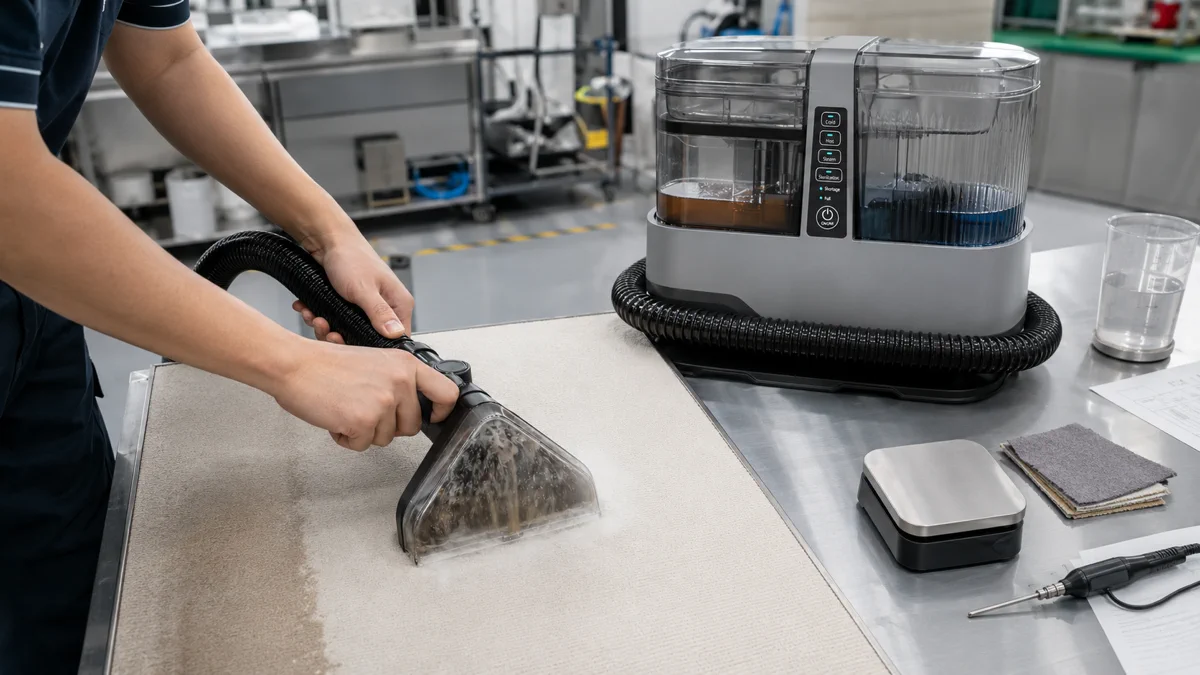
A useful sample comparison is to apply the same amount of water to the same type of test material and compare how much moisture each machine recovers under controlled conditions.
You do not necessarily need an elaborate laboratory setup for the first comparison.
What matters is using the same method for every sample.
This also helps buyers distinguish between two machines that appear similar on paper.
One may have a higher nominal suction specification while the other has a better-designed cleaning head and more efficient recovery path.
For distributors and private-label brands, the complete result is more important than one specification printed on the packaging.
5. Test More Than One Fabric
One of the biggest problems with upholstery-cleaner demonstrations is that the supplier controls the material.
A machine may look excellent on one piece of test fabric and behave differently on another.
Sofas, rugs, mattresses, car seats and upholstered furniture can contain different fiber types, backing materials, adhesives, dyes and surface treatments.
Steam also introduces heat into the process.
That means buyers should be careful with universal claims such as “safe for every fabric.”
We recommend creating a simple material test set during sample evaluation.
Include several common upholstery or carpet materials relevant to the target market.
Test an inconspicuous area first.
Observe color change, surface deformation, water marks and drying behavior.
For delicate materials, the end-user instructions should clearly state that care labels and fabric-manufacturer recommendations must be followed.
From a B2B perspective, this is not just a cleaning-performance issue.
It also affects product manuals, packaging claims and after-sales risk.
6. Tank Design Has a Bigger Impact Than It Appears
Clean-water and dirty-water tanks rarely receive as much attention as steam temperature or suction power.
But customers interact with them every time the product is used.
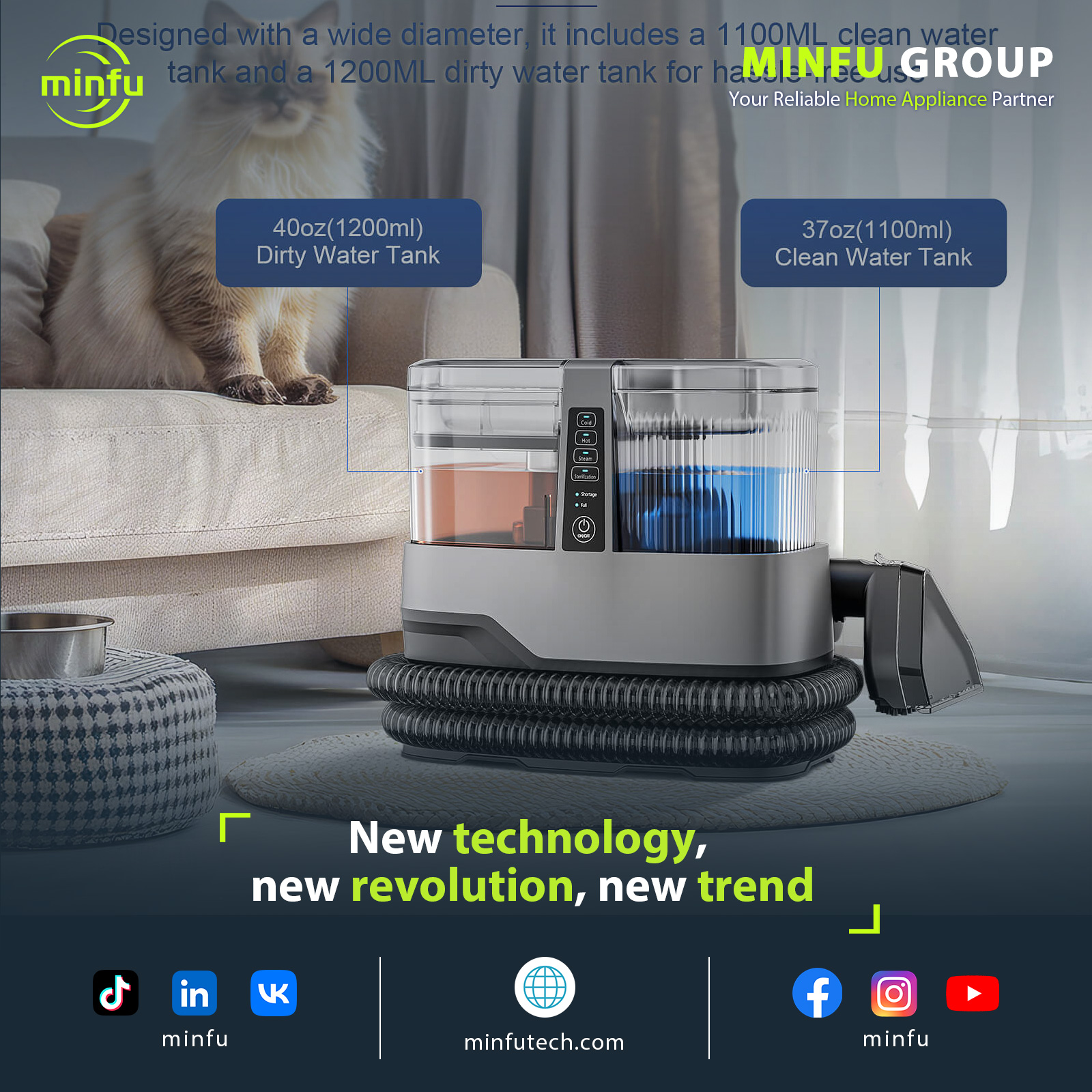
A good dual-tank system should make it easy to distinguish clean water from recovered wastewater.
The tanks should be easy to remove, carry, fill, empty and reinstall.
Check the seals around each tank.
Turn the machine through normal carrying angles and inspect for leakage.
Fill the clean-water tank to its intended working level and run the machine until it approaches empty.
Do the same with the dirty-water tank.
If the product includes a float, sensor or automatic stop function, verify how consistently it reacts as the wastewater reaches its limit.
Tank geometry matters as well.
A visually large tank may still be inconvenient if the opening is difficult to access or if dirty water becomes trapped around internal corners.
These details rarely appear in comparison charts, but they can strongly affect customer reviews.
7. Heating Introduces Additional Reliability Questions
A standard cold-water spot cleaner is already a combination of pump, motor, tanks, hoses, seals and electrical controls.
Adding heat introduces another subsystem.
Now the product may also include a heating element, thermal controls, temperature sensors, additional tubing and protection against abnormal heating conditions.
That means reliability testing should include more than one successful demonstration.
Run repeated heating cycles.
Test the machine from a cold start.
Allow it to cool and restart.
Check the hose and connection areas after repeated heating.
Observe whether seals change behavior as components become warm.
Test normal shutdown and restart procedures.
If the machine provides several temperature modes, verify each mode separately.
The purpose of this testing is not to create impressive laboratory footage.
It is to identify problems before they appear in mass production.
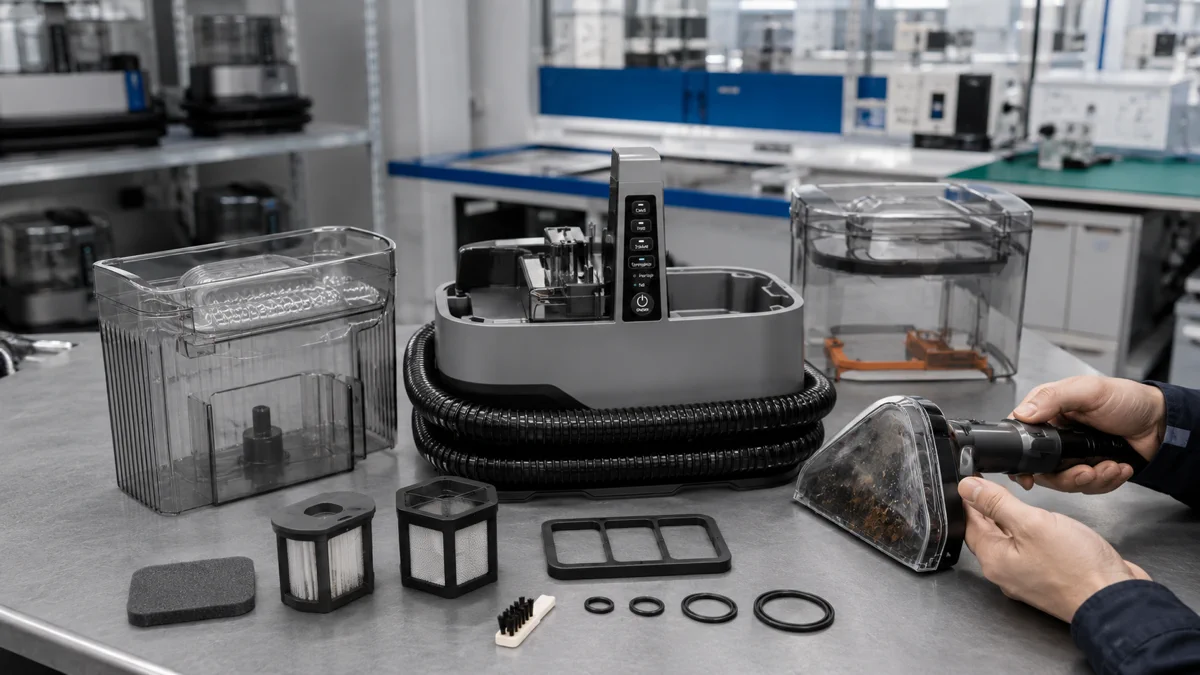
8. Maintenance Should Be Part of Product Selection
Steam and extraction cleaners deal with dirty water, hair, fibers and cleaning residue.
If these materials are difficult to remove from the product, the customer quickly notices.
During sample approval, clean the machine exactly as an end user would.
Remove the dirty-water tank.
Rinse the tank and lid.
Inspect the suction channel and cleaning head.
Check whether hair collects around narrow areas.
Look at the hose.
Remove any washable filter or screen.
Then ask one simple question:
Would a normal customer be willing to do this after every few uses?
Easy maintenance is becoming increasingly important in upholstery-cleaner design because convenience does not end when the stain disappears. Easy-to-clean upholstery cleaners reduce the amount of unpleasant manual work required after the cleaning session.
For OEM buyers, this should also lead to an after-sales discussion.
Which brushes, hoses, tanks, filters, seals and accessories can be supplied as spare parts?
Can they be ordered together with the first shipment?
How long will these parts remain available?
A product that is easy to sell but difficult to maintain can create unnecessary warranty pressure later.
9. Check Noise, Heat and Handling Together
Portable upholstery cleaners are often used close to the operator.
This makes ergonomics important.
A high-power motor may improve extraction but also increase noise, heat and machine weight.
A large tank may reduce refill frequency but make the product more difficult to carry.
A powerful heating system may improve warm-up performance while increasing electrical load and internal thermal management requirements.
These are engineering trade-offs rather than isolated advantages or disadvantages.
During sample testing, fill the tanks to normal operating levels and carry the product.
Use it on a sofa, carpet and vertical surface if the design supports those applications.
Pay attention to hose length, cleaning-head angle and where the power cable is positioned.
Listen for vibration or rattling as well as motor noise.
A well-balanced machine often feels better than a specification sheet suggests.
10. Understand Which Safety and Compliance Requirements Apply
Compliance should be discussed before a product configuration is finalized.
Steam and liquid-cleaning appliances can fall under different safety requirements depending on their construction, operating method and intended use.
For example, IEC 60335-2-54 covers certain household surface-cleaning appliances employing liquids or steam.
IEC 60335-2-2 covers vacuum cleaners and water-suction cleaning appliances and also addresses certain spray-extraction appliances within its defined scope.
That does not mean a buyer should select a standard simply by reading the product name.
The applicable requirements need to be confirmed according to the actual machine configuration and destination market.
Changing heating systems, pumps, plugs, electrical components or other key parts during an OEM project may also affect testing and documentation.
This is why we recommend discussing the intended sales countries before final sample approval rather than asking about certificates only after production is ready.
11. Compare Product Configurations, Not Just Suppliers
A supplier may offer several machines that appear to belong to the same category but target very different retail positions.
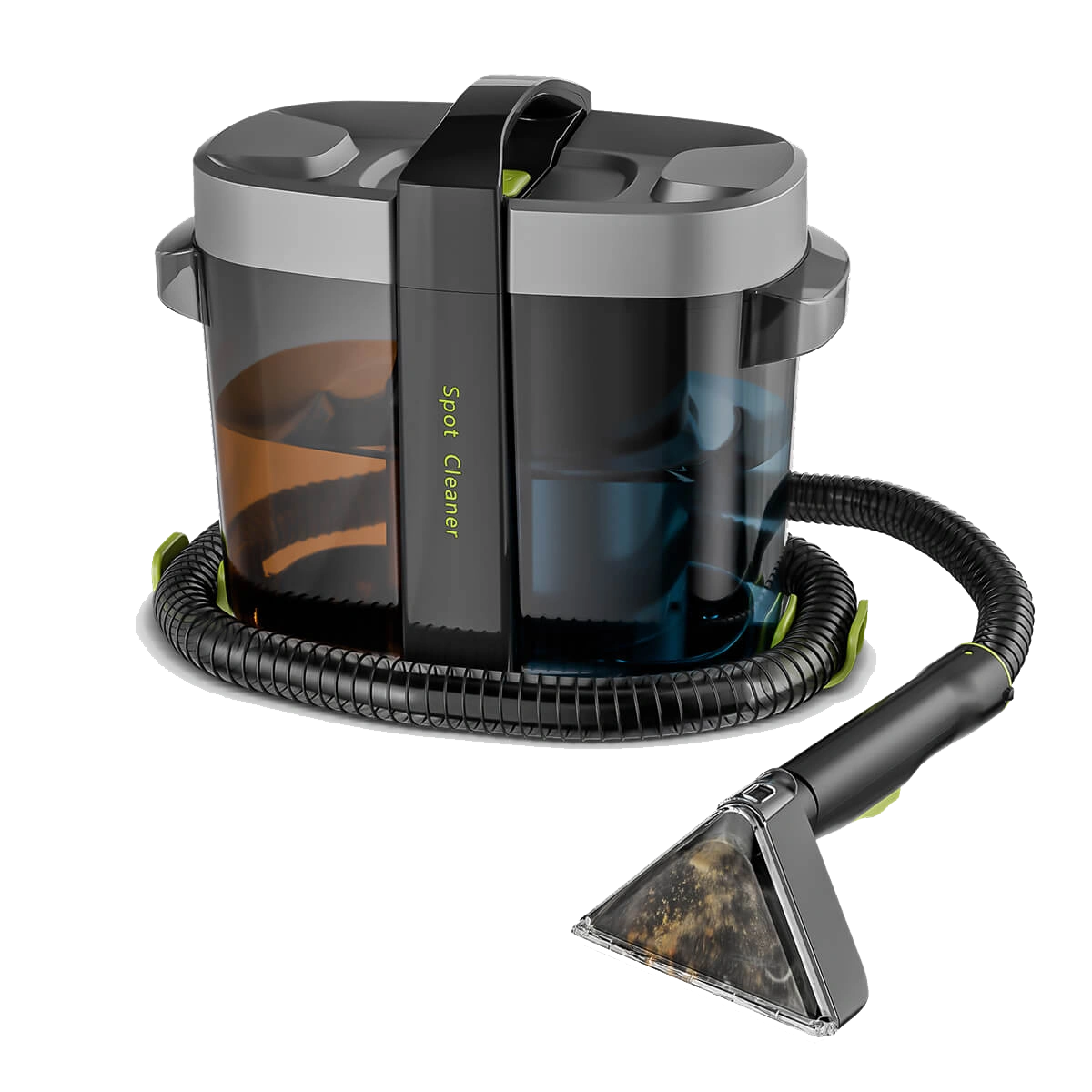
For example, Minfu’s current upholstery-cleaning range includes standard portable extraction machines as well as steam-equipped products.
A standard spot cleaner can offer a lower entry point for brands focused on price and portability.
A steam upholstery and carpet cleaner can support a more feature-driven positioning where heating, deeper fabric-care functions and larger systems are part of the retail story.
Neither configuration is automatically better.
The right choice depends on:
target retail price,
sales channel,
expected customer use,
shipping volume,
required accessories,
desired feature differentiation,
and after-sales strategy.
This is why we recommend comparing product platforms before discussing cosmetic customization.
Changing a logo or housing color is easy.
Choosing the wrong basic platform is much harder to fix after launch.
12. Evaluate Packaging and Shipping Before Approving the Housing
Portable cleaning appliances can be relatively bulky compared with their retail price.
For importers, carton size therefore matters.
Compare gross weight and carton dimensions rather than looking only at the dimensions of the machine.
Check how the hose, cleaning heads and accessories are stored inside the packaging.
Look for empty space.
Ask whether internal packaging can be optimized without reducing product protection.
Then calculate container or pallet loading.
A slightly more compact design can sometimes produce more commercial value than adding another minor feature, especially for high-volume shipments.
This is one area where product development and logistics should be considered together.
13. Define OEM Customization Before Asking for MOQ
MOQ depends heavily on what is being changed.
A standard product with a printed logo is very different from a project involving a custom housing color, new accessories, private packaging, heating-system changes or new tooling.
For a typical OEM/ODM cleaning appliance project, customization may include:
branding,
housing color,
packaging,
manuals and labels,
plug and voltage configuration,
accessory combinations,
and selected product specifications.
More substantial ODM work may involve structure, tooling, electronics or functional changes.
Before comparing MOQs from different suppliers, make sure they are quoting the same level of customization.
Otherwise, the numbers are not really comparable.
14. What We Recommend Testing Before a Bulk Order
By the time a steam upholstery cleaner reaches final sample approval, we want the buyer to understand more than how the product looks.
A practical approval should cover the complete user cycle.
Start the machine from cold.
Measure or verify the heating behavior.
Use the steam or heated-cleaning function repeatedly.
Test suction and water recovery.
Try more than one material.
Fill and empty both tanks.
Inspect for leakage.
Use every supplied accessory.
Clean the product afterward.
Then repeat the process.
Also inspect the power cable, hose connections, wheels, handles, tank locks and cleaning heads after repeated cycles.
A sample that works once is a demonstration.
A sample that continues behaving consistently after repeated realistic use is much more useful for a sourcing decision.
Practical Steam Upholstery Cleaner Evaluation Checklist
| Area | What B2B Buyers Should Check |
|---|---|
| Product positioning | Standard extraction, heated cleaning or steam |
| Heating | Warm-up time, output stability and repeated cycles |
| Steam delivery | Consistency at the cleaning head |
| Extraction | Water recovery and nozzle contact |
| Suction system | Motor, airflow path, hose and sealing |
| Fabric testing | Performance across relevant materials |
| Clean-water tank | Filling, sealing, removal and capacity |
| Dirty-water tank | Emptying, auto-stop and cleaning |
| Reliability | Repeated heat, pump and suction cycles |
| Maintenance | Tank, hose, filter and cleaning-head access |
| Ergonomics | Weight, hose reach, carrying and handling |
| Noise | Motor, pump and vibration behavior |
| Compliance | Requirements for actual configuration and market |
| Logistics | Carton dimensions, weight and loading quantity |
| Spare parts | Hoses, brushes, tanks, seals and accessories |
| OEM/ODM | Branding, packaging, color, plugs and configuration |
The objective is not to find the machine with the longest feature list.
It is to choose a configuration that can be produced consistently, shipped economically and supported after it reaches the market.
FAQ
What is the difference between a steam upholstery cleaner and a standard spot cleaner?
A standard spot cleaner generally applies cleaning liquid and extracts dirty water. A steam-equipped model adds a heating or steam system, which increases product complexity and creates additional considerations around temperature control, materials, safety and reliability.
Is a higher steam temperature always better?
No. Temperature needs to be considered together with steam delivery, heating stability, fabric compatibility and the intended cleaning application. Buyers should also verify where and how the quoted temperature is measured.
How important is suction power in an upholstery cleaner?
Suction is important for extraction, but effective water recovery also depends on the cleaning head, nozzle contact, hose, seals, airflow path and overall design.
Should every upholstery cleaner be marketed as suitable for all fabrics?
No. Material compatibility can vary. Brands should provide appropriate usage guidance and customers should follow the care instructions for the surface being cleaned.
What should buyers test before ordering a steam spot cleaner in bulk?
Buyers should evaluate heating, steam output, extraction, tanks, leakage, fabric behavior, noise, maintenance, accessories and repeated-use reliability rather than relying only on catalogue specifications.
Can steam upholstery cleaners be customized for private-label projects?
Yes. Depending on the platform and order volume, OEM customization can include branding, housing color, packaging, manuals, plugs, accessories and selected configurations. More extensive ODM changes require separate engineering evaluation.
Work With Minfu on Your Next Cleaning Appliance Project
Shenzhen Minfutech Industrial Co., Ltd. works with overseas brands, importers, wholesalers and distributors on OEM and ODM cleaning appliance projects.
Our product range covers multiple smart cleaning categories, while our OEM/ODM process supports projects from initial product selection and sample evaluation through customization, mass production and shipment.
If you are evaluating a new cleaning appliance project, send us your target product, market, expected quantity and customization requirements. Our team can help you evaluate the available options before moving into sampling and production.
Website: https://minfutech.com/
OEM/ODM Solutions: https://minfutech.com/oem-odm-solutions/
Email: info@minfutech.com
WhatsApp / Phone: +86 137 6025 5781
Contact: https://minfutech.com/contact-minfu/