

Introduction
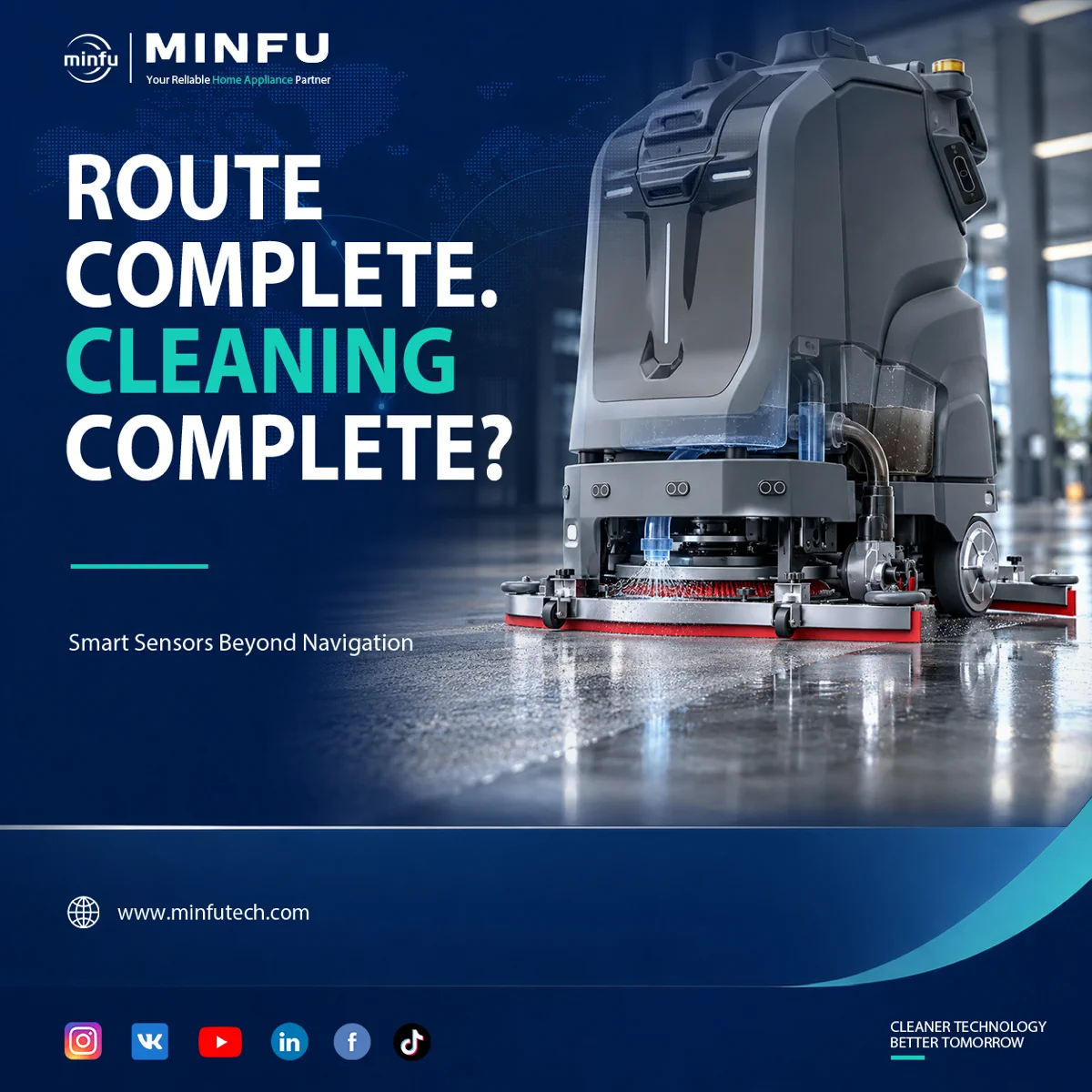
The robot has completed its route. The map shows full coverage, the task history records a successful mission, and the machine is back at its charging station. From a distance, everything looks exactly as it should.
There is just one problem: halfway through the job, the cleaning solution stopped reaching the floor.
The robot continued navigating. Its brushes may even have continued rotating. But the second half of the cleaning route received little or no effective wet scrubbing.
A navigation system cannot necessarily recognize this problem, because navigation and floor cleaning are different engineering tasks.
This is an important distinction in commercial cleaning robotics. Manufacturers have made substantial progress in mapping, obstacle detection and autonomous movement, but the reliability of the cleaning process also depends on what the machine knows about its own operating condition.
At Minfu, we believe this deserves as much attention as navigation technology. A floor scrubber must not only reach the right locations; it must also deliver cleaning solution, operate its brushes, recover dirty water and complete the task without allowing an equipment fault to go unnoticed.
Smart sensors can help achieve that objective. The challenge is understanding what different sensors actually measure, what conclusions the control system can reasonably draw, and which cleaning outcomes still require independent verification.
What Can Smart Sensors Actually Tell a Floor Scrubber?
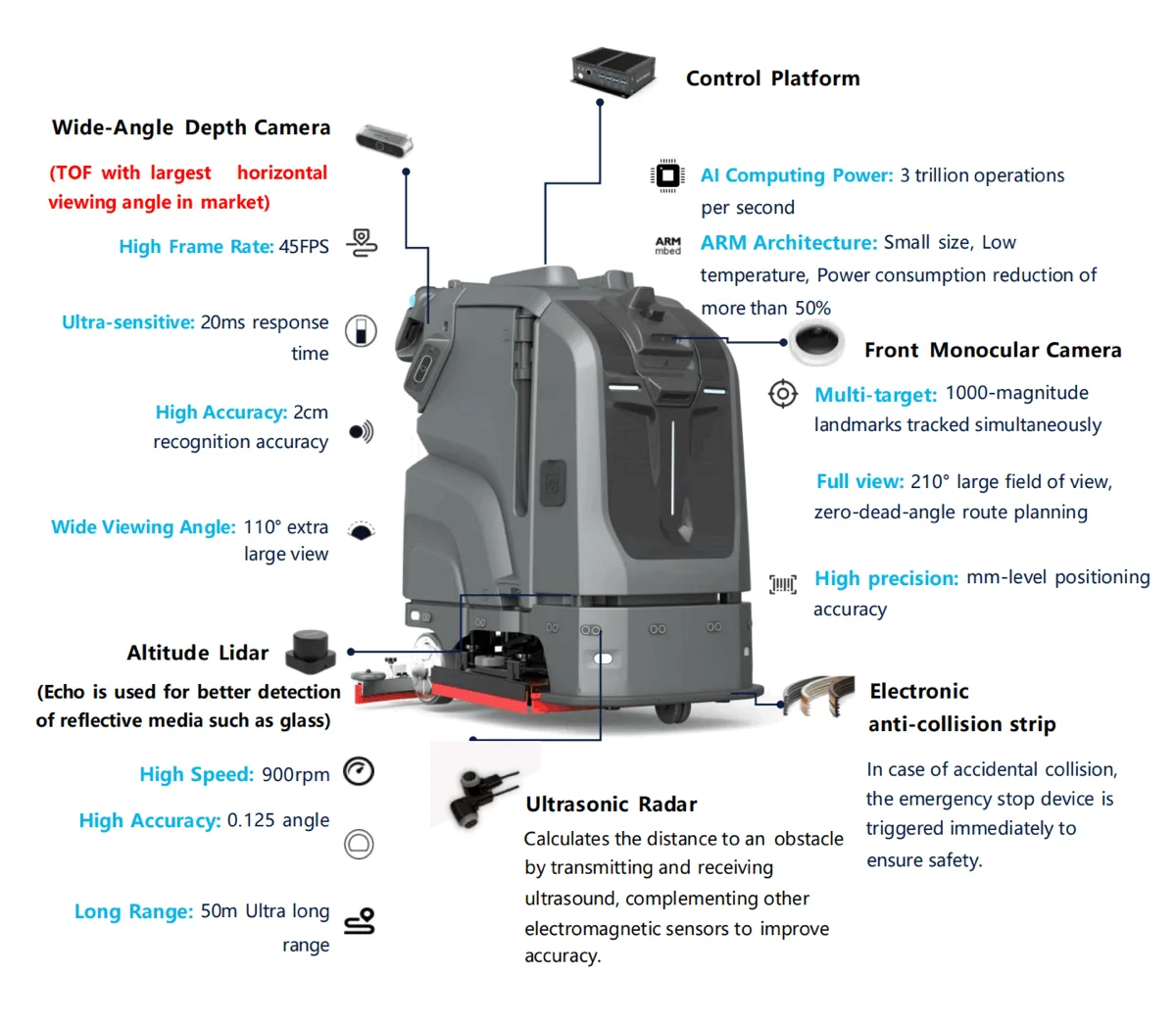
A commercial floor scrubber can use sensors and internal control signals to monitor parts of its cleaning system, including liquid levels, motor conditions, operating speed, battery status and, when the necessary hardware is installed, water flow or recovery-system performance.
This information can support warnings, protective actions, maintenance decisions or automatic adjustments.
However, monitoring machine operation is not the same as directly measuring cleaning quality.
A full recovery tank does not prove that the floor was cleaned correctly. A running brush motor does not confirm that all visible soil was removed. A completed navigation route does not establish that the correct amount of cleaning solution reached every section of the floor.
This is why smart sensor technology should be evaluated in layers.
The first layer detects operating conditions. The second allows the controller to respond. A third, more demanding layer involves verifying that the intended cleaning result was achieved.
Not every floor scrubber supports all three.
Navigation Sensors and Cleaning-System Sensors Have Different Jobs
A robotic scrubber needs to understand both the world around it and the condition of the machine itself.
Navigation sensors help answer questions such as: Where am I? Is something blocking the route? Is there enough space to turn safely?
Cleaning-system monitoring addresses a different set of questions: Is there sufficient water to continue? Is the recovery tank approaching capacity? Is the cleaning mechanism operating within its expected range? Has a component condition changed enough to require attention?
The difference is easy to overlook because both systems may appear under a broad marketing label such as intelligent sensor technology.
Yet a robot equipped with sophisticated LiDAR and depth cameras can still experience a blocked water line, worn squeegee or overloaded brush motor. Those problems require cleaning-system information and appropriate operating procedures.
Our previous article, Commercial Cleaning Robot Sensor Fusion, examines how different perception technologies contribute to navigation. This guide focuses on the equally important systems involved in carrying out the physical cleaning task.
Water-Level Monitoring: A Simple Measurement With Important Consequences
Water management is one of the clearest applications of sensors in a floor scrubber.
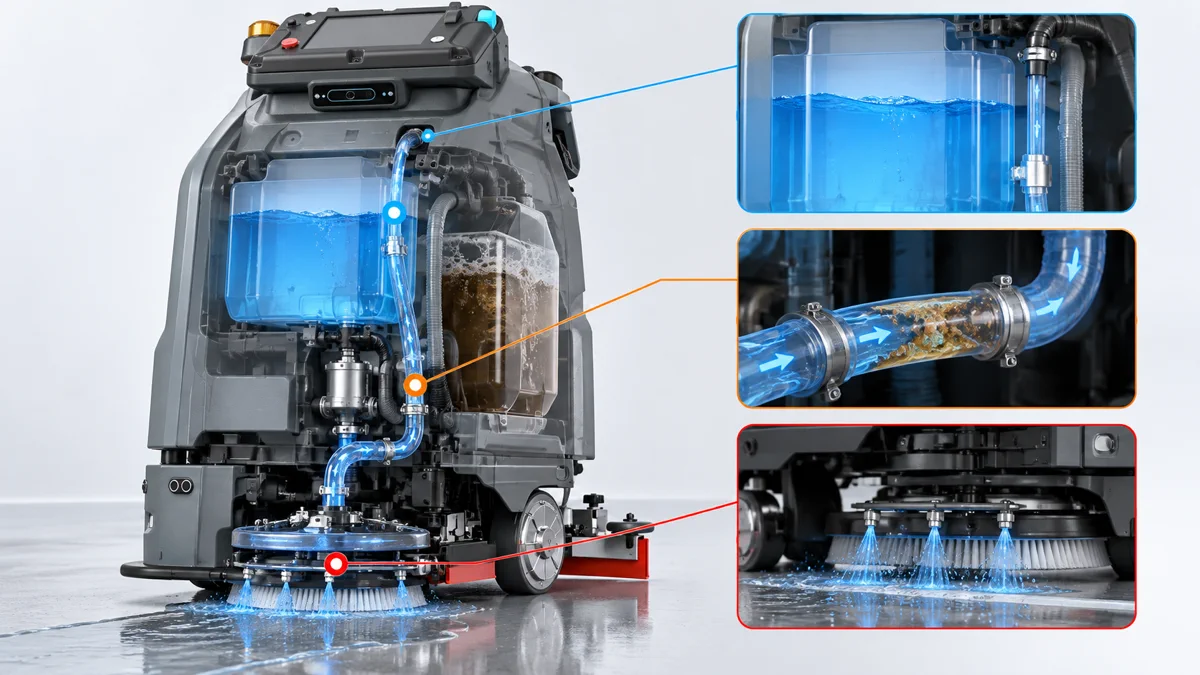
During wet cleaning, the machine consumes clean water or cleaning solution and collects dirty liquid in a separate recovery tank.
The levels of these two tanks change throughout a mission. If the supply tank becomes empty, the scrubber may no longer deliver the intended amount of liquid. If the recovery tank becomes full, continuing to operate the recovery system without suitable protection can create equipment and overflow risks.
Liquid-level monitoring can help the controller recognize these conditions.
Depending on the machine’s design, the sensor may indicate a threshold, detect several discrete levels or provide a more continuous measurement. These implementations are not equivalent.
A basic threshold switch may tell the controller that a tank has reached a critical level. It does not necessarily measure the exact number of litres remaining.
That distinction matters when evaluating claims about resource optimization.
A floor scrubber can have a liquid-level sensor without having a precise real-time estimate of how much cleaning solution has been applied to the floor.
What Minfu’s Published Specifications Confirm
Both the Minfu LT10 commercial cleaning robot and the LT70 Pro industrial cleaning robot list liquid-level sensing among their published sensor configurations.
The LT70 Pro also specifies a 70 L clean-water tank and an 80 L recovery tank, reflecting the higher-capacity operating requirements of larger commercial and industrial cleaning applications.
The public specifications establish that liquid-level sensing is part of the listed equipment configuration. They do not fully describe each sensor’s measurement range, resolution, warning logic or automatic response.
Those functions should be confirmed in the relevant technical documentation or demonstrated during equipment evaluation.
A Water Tank Can Be Full While the Floor Receives No Water
This is where the discussion becomes more interesting.
Imagine a scrubber starting a cleaning mission with a full solution tank. The system correctly reports that water is available.
Several minutes later, the supply line becomes restricted.
The tank still contains liquid, but the cleaning head may not receive the intended flow.
A tank-level measurement alone cannot necessarily distinguish between normal operation and this type of delivery problem.
Detecting it may require a different form of monitoring, such as an appropriately positioned flow sensor, pressure measurement, pump diagnostic or another validated method.
Even these signals need interpretation.
A controller commanding a pump to run does not prove that water is flowing. The pump may be operating against a blockage, the inlet may be restricted, or the delivery system may have another fault.
In engineering terms, this is the difference between knowing what the machine was instructed to do and knowing what physically happened.
For a commercial cleaning robot expected to work without continuous supervision, that difference can determine whether a fault is noticed immediately or only after the cleaning shift ends.
Why Travel Speed and Water Flow Should Be Considered Together
Water delivery is not simply a matter of selecting a pump setting.
The amount of cleaning liquid applied to a given floor area also depends on how quickly the machine travels and the width of the cleaning path.
Under simplified, uniform operating conditions, the relationship can be expressed as:
Liquid applied per nominal floor area ≈ Liquid flow rate ÷ (Travel speed × Cleaning width)
This is a useful engineering relationship, although actual distribution also depends on overlap, turning behavior, pump response and the physical cleaning system.
Consider what happens if a robot slows to half its previous travel speed while the liquid flow rate remains unchanged.
The nominal amount of liquid applied per unit area approximately doubles.
That does not automatically improve cleaning. Depending on the floor and the recovery system, the extra liquid may be unnecessary or leave more moisture behind.
This is why speed-dependent water control is a meaningful design approach in commercial floor scrubbers.
For example, Kärcher publicly lists water delivery linked to travel speed among the functions of its KIRA B 50 cleaning robot.
However, a speed-dependent control strategy is not the same as directly detecting how dirty the floor is.
A machine may adjust water delivery because it changes speed, not because it has measured the contamination level.
The distinction is important. Automatic adjustment can improve process control without implying that the robot understands every floor condition.
For Minfu’s LT10 and LT70 Pro, the currently available public product pages do not provide enough detail to confirm a specific closed-loop water-flow control architecture. That should be established through engineering documentation rather than inferred from the presence of smart sensors.
Brush Operation: Rotation Does Not Prove Effective Scrubbing
The brush system presents another monitoring challenge.
A rotating brush generates the mechanical action required to loosen and remove soil. But its operation depends on several interacting factors, including brush type, contact pressure, rotational speed, floor texture and the contamination being removed.
The motor may be running normally while the chosen brush is unsuitable for a particular surface.
Conversely, excessive resistance can overload a brush motor or indicate that a component is obstructed.
Motor-current or load monitoring, where implemented, can help identify abnormal operating conditions. A significant increase in current may indicate higher mechanical load, although the exact interpretation depends on the motor, controller and operating state.
It would be misleading, however, to conclude that a motor-current measurement alone tells the robot whether the floor is clean.
Higher motor load does not necessarily mean more effective soil removal. It may reflect friction, an obstruction, a worn component or a change in operating conditions.
Similarly, lower motor load does not prove that the brush has lost contact with the floor.
Meaningful diagnosis often requires several measurements or additional checks.
For buyers, the useful questions are whether the system can recognize a stalled or overloaded cleaning mechanism, what response follows an abnormal condition and whether operators receive enough information to identify the likely cause.
This is much more useful than a general claim that the robot has intelligent brush control.
Recovery-System Problems Can Be Harder to Detect Than They Appear
The recovery system is responsible for removing dirty liquid after scrubbing.
Its performance depends on components such as the suction assembly, hoses, squeegee blades, tank seals and the condition of the floor.
A machine may experience reduced recovery performance for several reasons:
- The recovery tank reaches its operating limit.
- A suction hose becomes restricted.
- A squeegee blade is worn, damaged or incorrectly positioned.
- An air leak reduces effective suction.
- The machine encounters a floor profile that is difficult for the recovery assembly to follow.
These faults do not all produce the same sensor signal.
A recovery-tank level sensor can help identify a full tank. It does not necessarily detect a damaged squeegee.
A suction motor operating normally does not prove that the liquid is being collected effectively at the floor.
Additional diagnostic information may help, but actual water-recovery performance still needs to be validated.
An instructive industry example appears in the official Kärcher KIRA B 50 operating manual, which describes separate fault conditions for a full wastewater tank, interrupted fresh-water delivery and brush-motor overload.
Those are different failures requiring different responses.
This is what a useful commercial cleaning diagnostic system should help operators understand: not merely that something has gone wrong, but which part of the cleaning process needs attention.
Monitoring, Control and Verification: Three Different Levels
Not every sensor-equipped scrubber is capable of closed-loop cleaning control, and not every controlled process verifies its own result.
For B2B buyers, separating the three concepts makes technical specifications easier to understand.
| Level | Example | What It Establishes | What It Does Not Establish |
|---|---|---|---|
| Monitoring | Liquid-level sensor indicates a low-water condition | A measured operating condition has reached a defined state | That the floor received the correct liquid quantity |
| Control | A supported system adjusts water delivery according to travel speed | The machine changes an operating output in response to a control input | That the floor’s contamination has been removed |
| Protection | A controller responds to a full recovery tank or motor overload | An abnormal operating condition triggers a defined response | That the entire cleaning task was successful |
| Verification | A separate inspection or validated measurement assesses the cleaned surface | Evidence about the actual cleaning result | Universal performance on every floor or soil type |
A sophisticated cleaning system may combine several of these functions.
But marketing language should not blur them together.
For example, automatic pump control does not necessarily imply actual-flow measurement. An automated maintenance reminder does not necessarily imply a predictive model of component wear.
The correct description depends on the signals the machine measures and the actions its software can demonstrably perform.
Predictive Maintenance Needs More Than a Dashboard
Predictive maintenance is another term that frequently appears in discussions about smart sensors.
The concept is valuable: instead of waiting for a component to fail, a system uses available operating data to identify signs that maintenance may be required.
But there are several levels of sophistication.
A basic maintenance counter may recommend brush replacement after a predefined number of operating hours. That is scheduled maintenance, even if the reminder is displayed through a cloud dashboard.
A fault-monitoring system may notify the operator when a motor exceeds a specified operating limit. That is condition monitoring or fault detection.
Predictive maintenance goes further. It attempts to estimate developing problems or future failure risk from patterns in operating data.
Doing that reliably requires suitable measurements, sufficient historical information and validation against real failures.
A commercial scrubber collecting operating hours and mission records should not automatically be described as having predictive maintenance.
For an OEM buyer, we would ask a supplier to explain exactly what is being measured, which fault conditions are recognized and whether any claimed prediction has been validated.
That conversation often reveals much more than the word AI in the software description.
Can a Floor Scrubber Automatically Detect Dirt?
Some advanced floor-cleaning concepts include optical sensing, recovered-water monitoring or other methods intended to estimate contamination.
These approaches can be useful in specific circumstances. However, direct soil detection is a more difficult problem than simply identifying obstacles or measuring tank levels.
Dirt can appear as fine dust, grease, liquid residue, embedded marks or particles trapped in textured flooring. Different floor colors and finishes can also change the appearance of contamination.
Even detecting dirty wastewater does not, by itself, prove that the floor has reached a specified cleanliness standard.
A sensor might indicate a change in the recovered liquid. Interpreting that signal as a reliable measure of cleaning quality requires an appropriate sensing method and validation procedure.
This is why we would not tell customers that an autonomous floor scrubber automatically identifies dirty areas or adjusts cleaning intensity to contamination unless that exact function has been demonstrated.
For practical commercial deployment, a controlled cleaning process with reliable monitoring is more valuable than an unsupported claim of automatic dirt intelligence.
How to Evaluate Smart Cleaning-System Sensors During a Product Demonstration
When testing a robotic scrubber, buyers often focus on navigation because obstacle avoidance is easy to observe.
Cleaning-system faults deserve their own evaluation.
We would approach the demonstration as a sequence of cause-and-effect questions.
First, inspect how the machine reports clean-water and recovery-water conditions. Establish whether the displayed status comes from a sensor reading or an estimated value. Confirm the expected behavior when the water supply or recovery capacity reaches a defined limit.
Next, ask the supplier to demonstrate documented fault handling for the cleaning system. This may include approved tests for water-delivery interruptions, brush overload conditions or other available diagnostics. Faults should be simulated only through the manufacturer’s approved procedures; deliberately blocking hoses or forcing mechanical overloads can damage equipment.
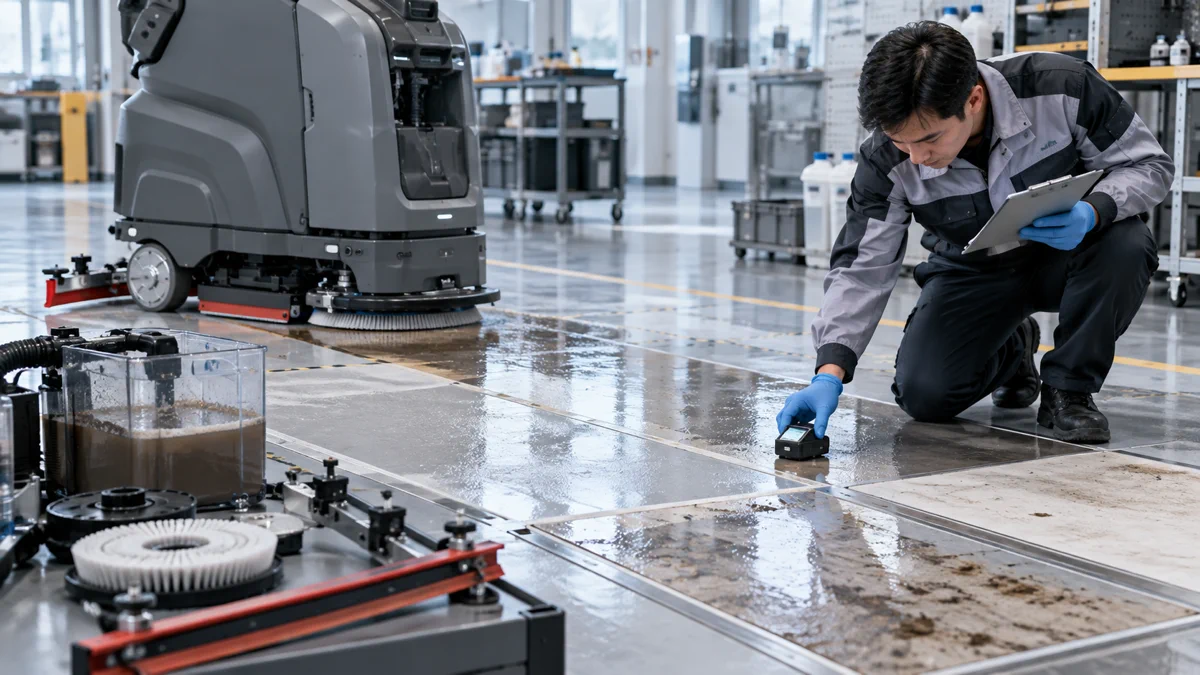
Then evaluate the physical result. Run the machine over a representative floor using its normal cleaning mode and inspect water distribution, soil removal and recovery performance. A machine-status display should be assessed alongside the actual floor—not instead of it.
Finally, review the records available after the mission. Can the operator identify what happened? Is there enough information to decide whether the task should be repeated or the machine requires service?
These tests answer a much more useful question than simply asking how many sensors are installed.
Can the machine recognize an operating problem, respond appropriately and give the cleaning team information they can act on?
What We Can Confirm About Minfu’s Commercial Cleaning Platforms
At Minfu, our LT10 and LT70 Pro platforms serve different commercial cleaning requirements.
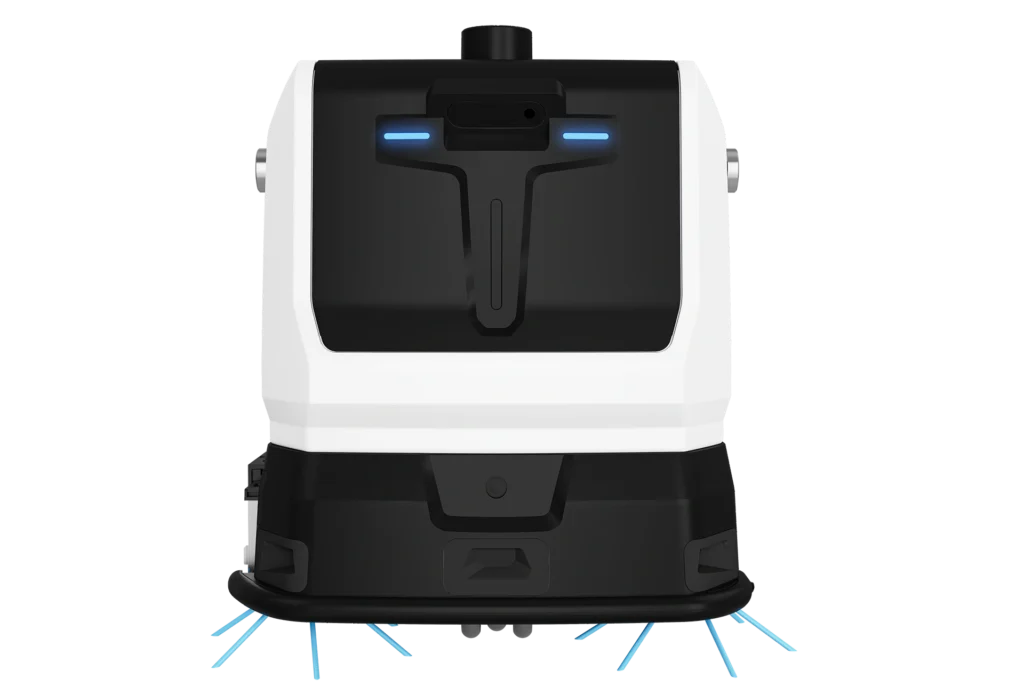
The LT10 compact autonomous cleaning robot combines sweeping, vacuuming and scrubbing in a smaller operating format. Its published specifications list liquid-level sensing alongside navigation and motion-related sensors, and the platform supports digital task management.
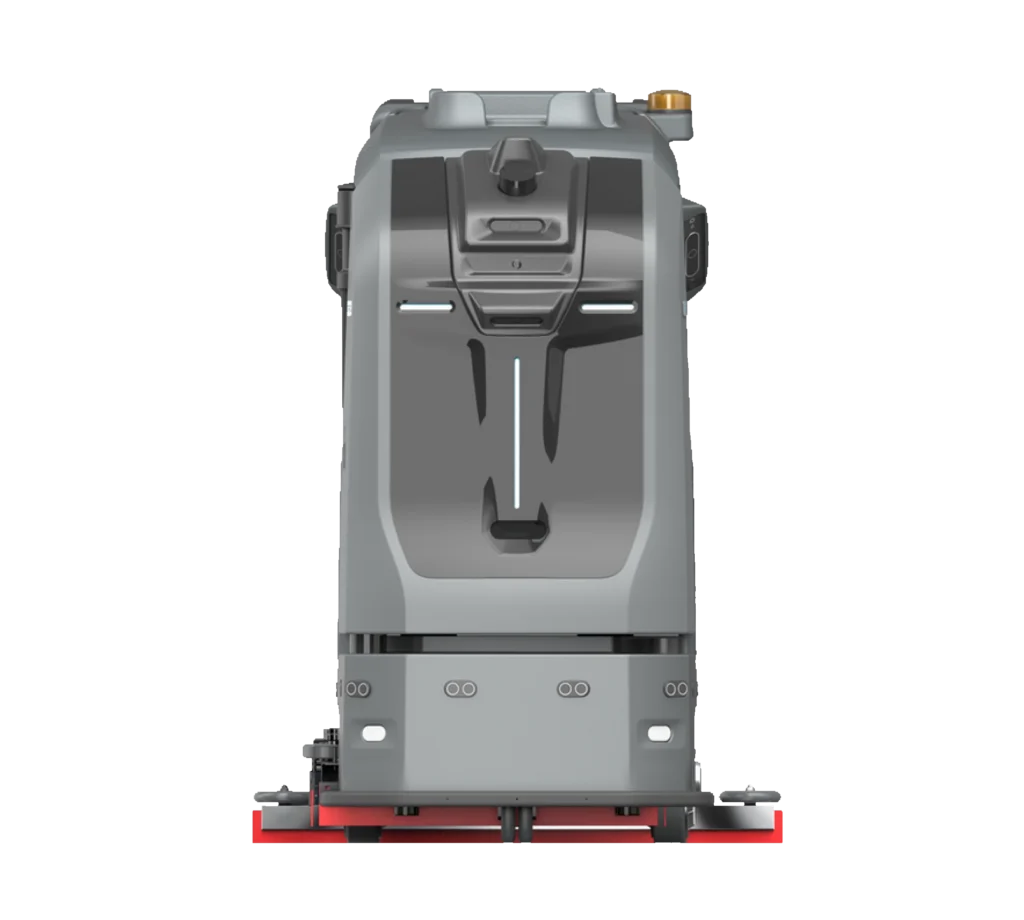
The LT70 Pro heavy-duty commercial cleaning robot is designed around larger-scale floor-care operations, with a 51 cm brush-cleaning width, 70 L clean-water tank and 80 L recovery tank. Its published sensor configuration also includes liquid-level sensing.
These are confirmed platform characteristics.
They should not be expanded into claims that every LT10 or LT70 Pro configuration automatically measures solution flow, recognizes wastewater contamination, predicts brush failure or independently verifies floor cleanliness.
Where a project requires more advanced condition monitoring or specific automated responses, the correct approach is to review the engineering configuration and determine what can be supported and validated.
For overseas equipment brands and distributors, this is especially important during OEM/ODM development. The functions described in marketing materials must match the hardware, software and test evidence of the product being supplied.
Conclusion: A Successful Route Is Only Part of a Successful Clean
Autonomous navigation allows a robot to travel through a facility without continuous manual steering. Smart cleaning-system monitoring addresses what happens while the machine is performing the work.
Both matter.
Liquid-level sensors can help a system recognize important tank conditions. Appropriate control systems can regulate cleaning outputs. Motor and recovery diagnostics, where implemented, can identify certain equipment problems before they go unnoticed for an entire shift.
But none of these functions should be confused with automatically verifying every square metre of cleaning quality.
The strongest commercial floor scrubber systems bring together reliable navigation, professional cleaning hardware, meaningful operating feedback and practical methods of checking the finished result.
For B2B buyers, that is the real value of smart sensor technology.
Not simply a machine that knows where it is going, but one that helps the operator understand whether the cleaning process is working as intended.
FAQ
What sensors are used in commercial floor scrubbers?
Commercial floor scrubbers may use navigation sensors such as LiDAR and depth cameras, along with operating-condition sensors for liquid levels, motor protection, battery status or other machine functions. The exact equipment varies by model and configuration.
What does a floor scrubber water-level sensor do?
A water-level sensor provides information about the condition of a solution or recovery tank. Depending on its design, it may detect a specific threshold or provide more detailed level information. It does not necessarily measure the actual rate of water delivery to the floor.
Can robotic floor scrubbers automatically adjust water flow?
Some commercial floor scrubbers support programmed or speed-dependent water control. More advanced control architectures may use additional feedback. However, automatic water adjustment is not universal and should be verified for the specific model.
Can a smart floor scrubber detect a blocked water line?
Only if the machine has a suitable diagnostic method. Tank-level sensing alone may not identify restricted water delivery. Depending on the design, actual-flow sensing or other validated fault-detection methods may be needed.
Do smart sensors tell a floor scrubber when the floor is clean?
Not necessarily. Sensors monitoring water levels, motors and navigation do not directly prove the cleaning result. Some specialized systems may estimate contamination, but claims of automatic cleanliness detection require evidence for the specific sensing method and operating conditions.
What is the difference between condition monitoring and predictive maintenance?
Condition monitoring identifies current operating states or abnormal measurements. Predictive maintenance uses suitable data and validated models to estimate developing problems or future failure risk. An operating-hours reminder is not, by itself, predictive maintenance.
Do Minfu LT10 and LT70 Pro robots have liquid-level sensors?
Yes. Both models list liquid-level sensing in their published specifications. The public product pages do not fully disclose every related control or diagnostic function, so project-specific requirements should be confirmed during technical evaluation.
Work With Minfu
Minfu provides commercial cleaning robot OEM/ODM manufacturing and product development support for equipment brands, distributors, wholesalers and commercial cleaning solution providers.
Our LT10 and LT70 Pro platforms address different commercial and industrial cleaning requirements, with available support for product configuration, customization, sample evaluation, quality control and manufacturing coordination.
For projects involving smart cleaning-system monitoring, water management or equipment diagnostics, we recommend discussing the exact required functions during the technical review and sample-validation stages.
Explore Our Commercial Cleaning Robots
LT10 Compact Commercial Cleaning Robot
LT70 Pro Heavy-Duty Commercial Cleaning Robot
Website: https://minfutech.com/
Email: info@minfutech.com
WhatsApp / Phone: +86 13760255781
Contact Minfu to discuss your commercial floor scrubber development or customization requirements.
Explore More Commercial Cleaning Robot Guides
Commercial Cleaning Robot Sensor Fusion
Understand how LiDAR, depth sensing, cameras, IMU and odometry contribute to environmental perception and autonomous navigation.
What Can Commercial Cleaning Robots Actually Do?
Learn how buyers can evaluate real robot capabilities through practical cleaning, navigation and operating tests.
Robotic Floor Scrubber Floor Compatibility
Explore how epoxy, concrete, tile, vinyl and natural stone surfaces influence the choice of cleaning method, brush and water-recovery process.