

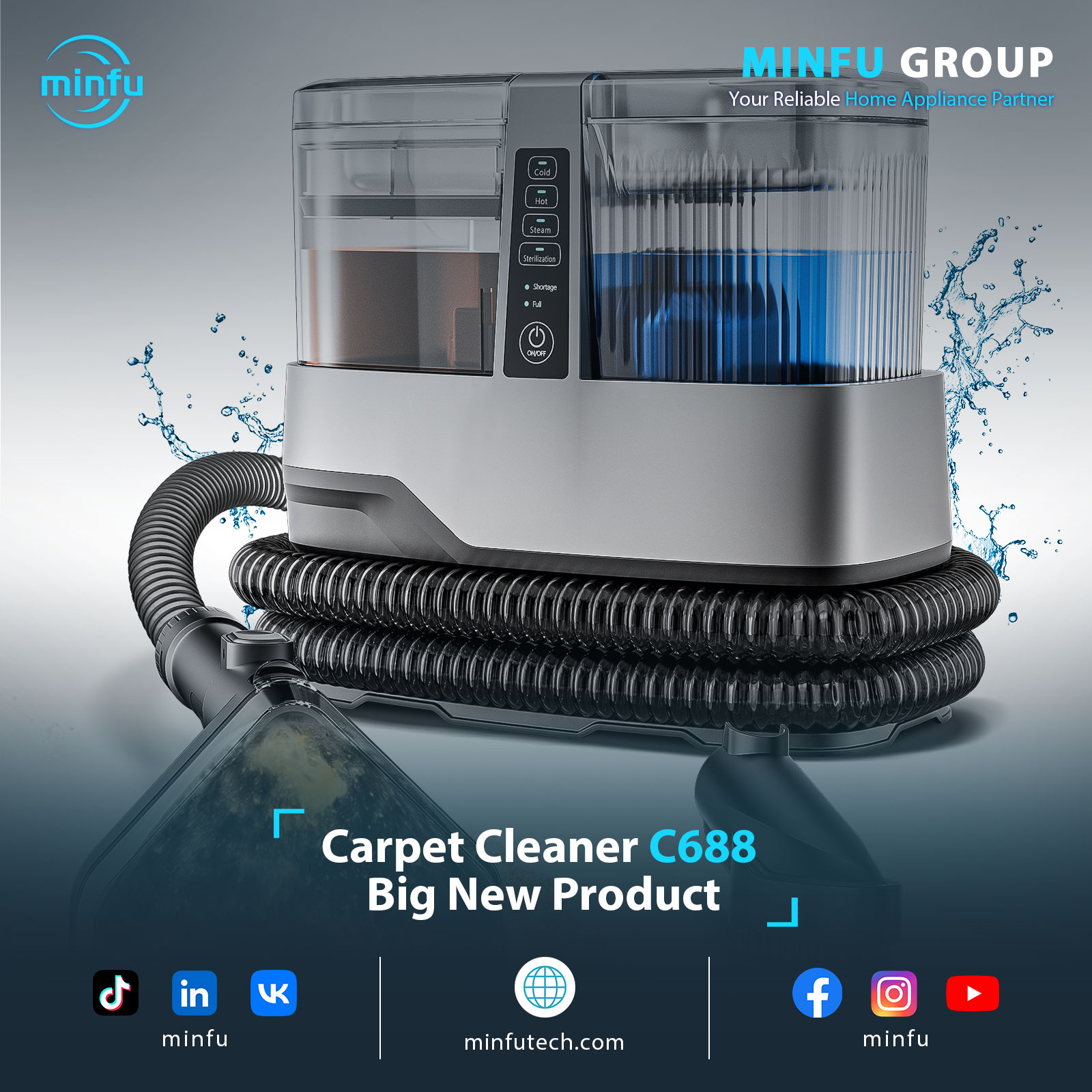

When buyers first look at the C688 series, the obvious question is usually:
Should we choose the standard extraction model or the steam version?
It sounds like a simple feature decision, but in practice it affects much more than the cleaning function.
Power consumption, product positioning, target retail price, sample testing, compliance planning and the way the product is marketed all change once a heating system is added.
That is why we no longer think of the C688 as one product with a “better” and “worse” version.
The C688A and C688B serve different projects.
At Minfu, when we discuss these models with importers and private-label brands, we normally start with the target market and sales channel rather than asking which machine has more features.
For some buyers, adding steam creates exactly the differentiation they need.
For others, the simpler C688A makes more commercial sense.
This guide explains how we look at that decision from an OEM sourcing perspective.
C688A and C688B Are Built for Different Product Positions
Both models belong to our portable carpet and upholstery-cleaning range, but they should not be positioned in exactly the same way.
The current configurations can be compared like this:
| Specification | C688A | C688B |
|---|---|---|
| Cleaning type | Wet cleaning and extraction | Wet cleaning, extraction and steam |
| Suction | ≥17kPa | 17kPa |
| Rated power | 600W | 1800W |
| Clean-water tank | 1100ml | 1100ml |
| Dirty-water tank | 1200ml | 1200ml |
| Standard MOQ | 500 pcs | 500 pcs |
| Main positioning | Mainstream portable spot cleaning | Feature-led steam fabric cleaning |
The interesting point is that both products have similar extraction specifications.
The biggest difference is not suction.
It is what happens before extraction.
The C688A focuses on a relatively straightforward spray-and-extract cleaning process. The C688B introduces a steam system and significantly higher electrical power, creating a different product proposition.
That distinction matters much more than simply putting both machines into the same specification table.
When the C688A Makes More Sense
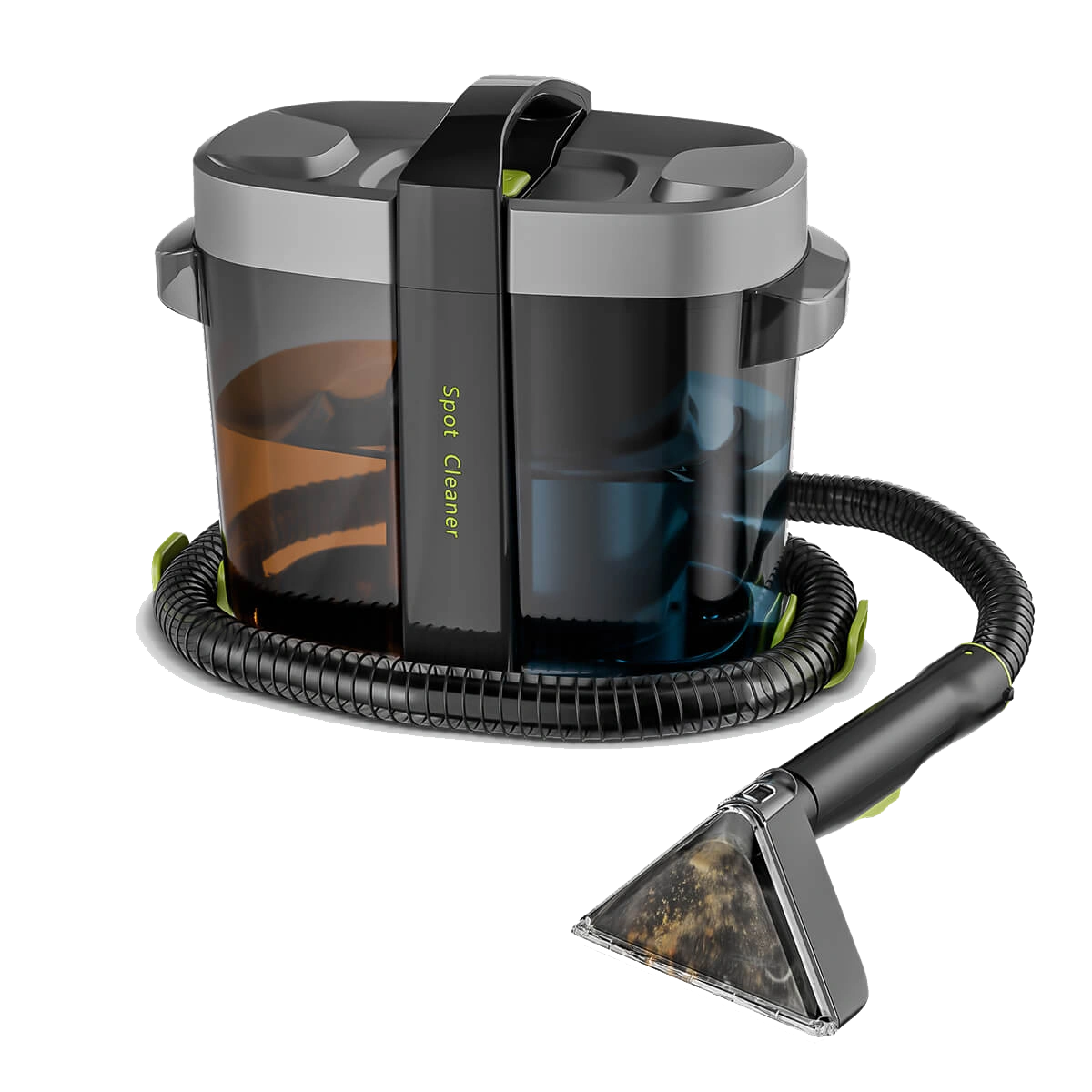
The C688A lightweight spot cleaner is the more straightforward of the two platforms.
For buyers entering the upholstery-cleaner category, that can be an advantage.
A standard spot-cleaning machine is relatively easy for customers to understand:
apply water or cleaning solution,
agitate the stained area,
and extract the dirty water.
There is no additional steam system that needs to be explained in the retail message.
This makes the C688A worth considering for projects where the priorities are:
competitive retail positioning,
portable sofa and carpet cleaning,
car interior cleaning,
straightforward operation,
lower electrical power,
and a relatively simple product story.
That does not mean it should automatically be treated as the “budget model.”
A well-positioned standard extractor can still be a strong mainstream product, particularly in markets where consumers are already familiar with portable spot cleaners.
From an OEM perspective, it can also give brands more room to compete through packaging, accessories, appearance and channel strategy instead of building the entire marketing message around one premium feature.
When the C688B Becomes the Better Choice
The C688B compact steam spot cleaner is aimed at a different type of project.
Adding steam gives the brand another cleaning mode to demonstrate and another reason for the customer to move above a basic extraction machine.
This can be useful when a distributor wants to build a higher-specification upholstery-cleaning line or when a retailer needs clearer separation between an entry product and an upgraded model.
However, steam should not be added simply because it sounds more advanced.
The heating system changes the machine.
The current C688B configuration uses considerably more electrical power than the C688A, and that difference needs to be considered when planning voltage, plug specifications, product testing and market positioning.
The product also creates additional questions during sample approval:
How quickly does the heating system become ready?
How stable is steam output during repeated use?
How does the machine behave after several heating and cooling cycles?
How much moisture remains in the fabric after steam and extraction?
How hot do accessible components become during normal use?
These questions do not make the C688B a worse sourcing choice.
They simply mean it needs to be evaluated as a steam-equipped appliance rather than as a standard spot cleaner with one extra button.
Do Not Choose Between Them Based on Suction Alone
This is one reason we do not recommend deciding between the two models based on a kPa comparison.
Both current configurations are around the same suction level.
If a buyer only compares suction, the two machines can look almost identical on paper.
They are not.
For upholstery cleaning, water recovery depends on several parts working together:
the suction motor,
cleaning-head contact,
nozzle geometry,
hose design,
air sealing,
dirty-water path,
and the amount of moisture applied to the surface.
Adding steam changes the moisture and heating side of that equation.
So the real sourcing question is not:
“Which model has stronger suction?”
It is:
“Which cleaning process fits the product we want to sell?”
For a mainstream spot cleaner, dependable extraction may be enough.
For a more differentiated steam upholstery cleaner, heating and steam delivery become part of the user experience alongside extraction.
That is a much more useful comparison.
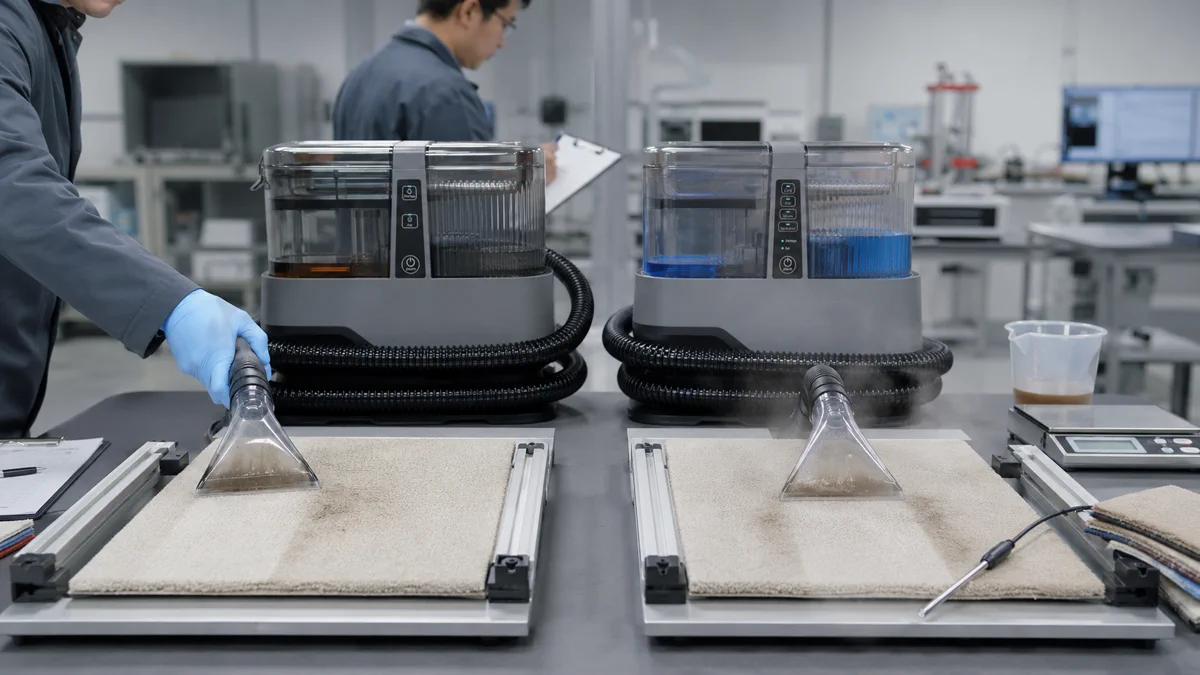
We Test the Two Models Differently
Although the two products share many basic components and applications, the sample-validation process should not be identical.
For the C688A, we pay particular attention to:
water application,
suction and recovery,
cleaning-head contact,
tank sealing,
dirty-water collection,
hose connections,
noise,
handling,
and repeated pump and motor operation.
For the C688B, those same areas still matter.
But the heating system adds another layer of testing.
We also want to see how the machine behaves through repeated heating cycles rather than watching a single steam demonstration.
A useful test is to start the machine from cold, run the heating function, complete a cleaning cycle, allow the system to operate normally, and then repeat the process several times.
This is more representative of actual customer use.
The purpose is not to make steam look dramatic.
In fact, a huge visible cloud of steam tells a buyer very little about whether the complete machine is working well.
What matters is whether steam delivery, cleaning and dirty-water recovery remain stable during normal use.
Fabric Compatibility Still Needs Real Testing
Steam creates an attractive retail message, but it also makes material testing more important.
An upholstery cleaner may be used on:
sofas,
rugs,
car seats,
fabric chairs,
carpeted stairs,
mattresses,
and other textile surfaces.
Those materials do not all respond to moisture and temperature in the same way.
This is why we would not recommend marketing either model with an unrestricted claim such as “safe for every fabric.”
The better approach is to build a small sample-validation set using materials that resemble what customers in the target market are likely to clean.
For a standard extraction model, observe water marks, color behavior, cleaning results and drying.
For a steam model, add temperature exposure to the evaluation.
A product manual should also make it clear that users need to follow the care instructions of the item being cleaned, especially for delicate materials.
For a private-label brand, this is as much a claims-management issue as it is a cleaning-performance issue.
The Same Tank Capacity Does Not Mean the Same User Experience
Both current C688 configurations use separate clean- and dirty-water tanks.
On paper, that makes this part of the comparison look simple.
But tank capacity is only one part of tank design.
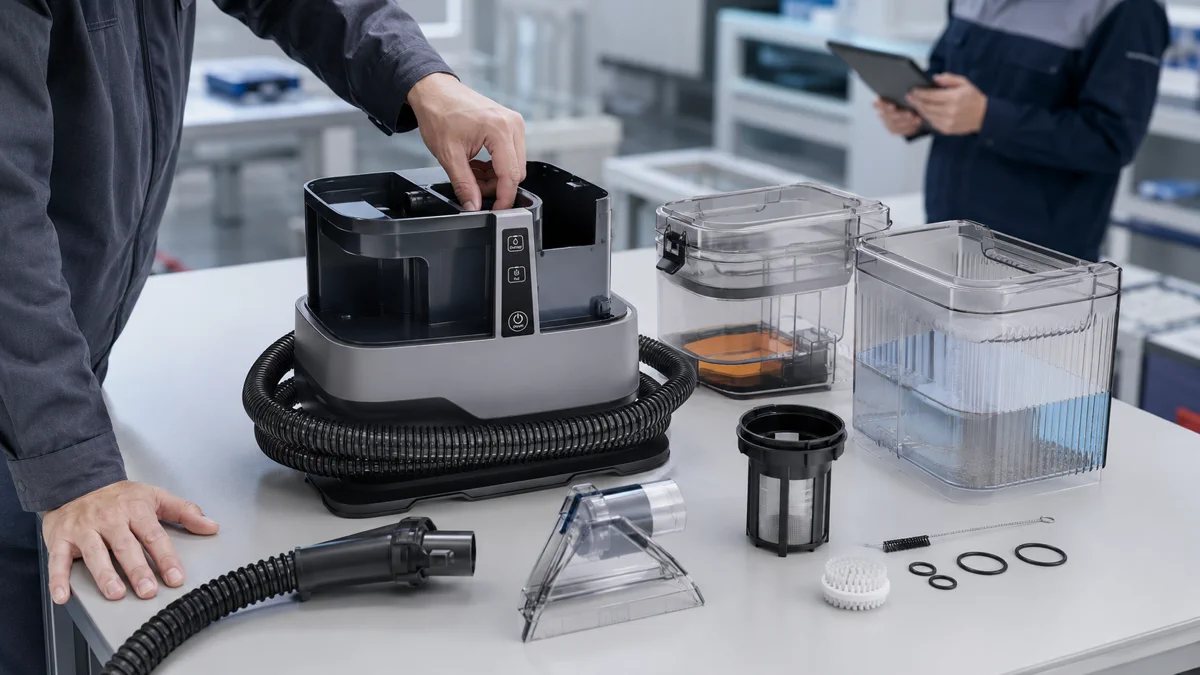
During sample testing, we look at how easily the tank can be:
removed,
filled,
carried,
emptied,
rinsed,
and reinstalled.
We also check the sealing areas after repeated use.
A tank can have adequate capacity and still frustrate customers if the opening is difficult to clean or if dirty water remains trapped around internal corners.
This becomes particularly important with carpet and upholstery cleaners because the machine collects more than water.
Hair, textile fibers, detergent residue and dirt may all enter the recovery system.
That is why the broader move toward easy-to-clean upholstery cleaners is relevant even when comparing two machines with similar tank specifications.
Maintenance has become part of product quality.
Steam Changes the Compliance Discussion
This is another area where the C688A and C688B should not simply be treated as the same product with different accessories.
Once heating and steam are introduced, the applicable safety evaluation can change according to the final product configuration.
For household cleaning appliances, standards such as IEC 60335-2-2 address vacuum cleaners and water-suction cleaning appliances, including certain spray-extraction appliances within the conditions defined by the standard.
IEC 60335-2-54 addresses household surface-cleaning appliances employing liquids or steam.
The correct standard cannot be chosen simply by looking at the marketing name of the machine.
The final construction, electrical system, temperatures, pressure, operating method and destination market all need to be considered.
For an OEM buyer, the practical lesson is simple:
Do not finish the product and then ask which certificate is needed.
Confirm the intended sales market before the final sample is approved.
This becomes particularly important when voltage, plug type, heating system or other electrical components are changed.
Think About Logistics Before Choosing the Higher-Spec Model
Buyers understandably spend a lot of time comparing product features.
We also recommend comparing the carton.
Portable upholstery cleaners are not extremely high-value products relative to the physical space they occupy, so shipping efficiency can have a meaningful effect on landed cost.
The current C688A and C688B product pages use similar loading references, but the final number should always be reconfirmed for the exact packaging configuration being ordered.
Custom gift boxes, extra tools, revised protective packaging and accessory sets can change carton dimensions.
Before approving packaging, calculate:
units per carton,
carton dimensions,
gross weight,
pallet requirements if applicable,
and expected container loading.
If the target channel is highly price-sensitive, this calculation may support the simpler product configuration.
If the retail margin is higher and steam is a major selling point, the additional feature may justify the different cost structure.
This is why product selection and logistics should not be treated as separate decisions.
OEM Customization Should Follow Product Selection
Both models can support private-label development, but the first decision should still be the product platform.
Branding comes after that.
Depending on the project, customization can include:
logo,
housing color,
retail packaging,
cartons,
manuals,
labels,
plug type,
accessories,
and market-specific product configurations.
For an OEM/ODM cleaning appliance project, we recommend confirming these items in stages.
First, approve the functional sample.
Then confirm the appearance and accessories.
Then approve packaging and labeling.
Finally, create a production reference that defines the version being manufactured.
This becomes particularly important when one customer purchases both the standard and steam versions.
Packaging, manuals and model identification need to make the difference between the two products obvious.
Otherwise, similar-looking machines can create unnecessary confusion during production, warehousing or after-sales service.
Do You Need Both Models in the Same Product Line?
Sometimes the answer is yes.
For a distributor with enough sales volume, the C688A and C688B can be positioned as two steps within one upholstery-cleaning range.
For example:
Mainstream model:
standard spray and extraction, simpler product positioning.
Upgraded model:
steam-assisted cleaning with a more feature-led retail message.
This creates an easier price ladder than trying to make one machine appeal to every type of customer.
But we would not recommend adding both automatically.
If the expected sales volume is limited, two similar models can divide inventory, increase spare-parts complexity and make marketing less focused.
One well-positioned machine may be the better first launch.
For a new market, we normally prefer to understand the channel, target retail price and customer expectations first.
Then the sample comparison becomes much easier.
A Practical C688A vs C688B Decision Table
| Buyer Priority | Better Starting Point |
|---|---|
| Straightforward spot cleaning | C688A |
| Lower-power configuration | C688A |
| Mainstream retail positioning | C688A |
| Feature-led premium positioning | C688B |
| Steam as a visible selling point | C688B |
| Need to differentiate two price tiers | Consider both |
| New market with uncertain demand | Test one platform first |
| Strong focus on simple operation | C688A |
| Strong focus on steam functionality | C688B |
This table is only a starting point.
The final choice should still be based on sample testing, destination market, compliance requirements, packaging and actual landed cost.
What we try to avoid is selecting the C688B simply because it has more features, or selecting the C688A simply because it has lower power.
Neither approach looks at the full project.
FAQ
What is the main difference between C688A and C688B?
The C688A is primarily a standard wet-cleaning and extraction spot cleaner, while the C688B adds steam functionality. Their current suction specifications are similar, so the main difference is the cleaning system and the product positioning created by the heating function.
Is C688B automatically better because it has steam?
No. The better model depends on the target market, retail price and intended product positioning. A simpler standard extractor can be a better commercial choice for some channels.
Is C688A suitable for private-label upholstery cleaner projects?
Yes. Depending on the project, customization can include logo, color, packaging, plug, manuals, labels and accessories.
What should buyers test on C688B before bulk production?
In addition to ordinary suction, water recovery, tank and leakage tests, buyers should evaluate heating behavior, repeated steam cycles, temperature-related performance and material compatibility.
Can C688A and C688B be sold as two tiers in the same range?
Yes. For distributors with enough volume, the two configurations can provide a mainstream and upgraded product structure. Buyers should still consider inventory, spare parts and marketing complexity before launching both.
What is the MOQ for the C688 series?
The current standard MOQ shown for both C688A and C688B is 500 units per model. Requirements can vary with customization, so the exact MOQ should be confirmed according to the final project.
Work With Minfu on Your Next Cleaning Appliance Project
Shenzhen Minfutech Industrial Co., Ltd. works with overseas brands, importers, wholesalers and distributors on OEM and ODM cleaning appliance projects.
Our product range covers multiple smart cleaning categories, while our OEM/ODM process supports projects from initial product selection and sample evaluation through customization, mass production and shipment.
If you are evaluating a new cleaning appliance project, send us your target product, market, expected quantity and customization requirements. Our team can help you evaluate the available options before moving into sampling and production.
Website: https://minfutech.com/
OEM/ODM Solutions: https://minfutech.com/oem-odm-solutions/
Email: info@minfutech.com
WhatsApp / Phone: +86 137 6025 5781
Contact: https://minfutech.com/contact-minfu/