

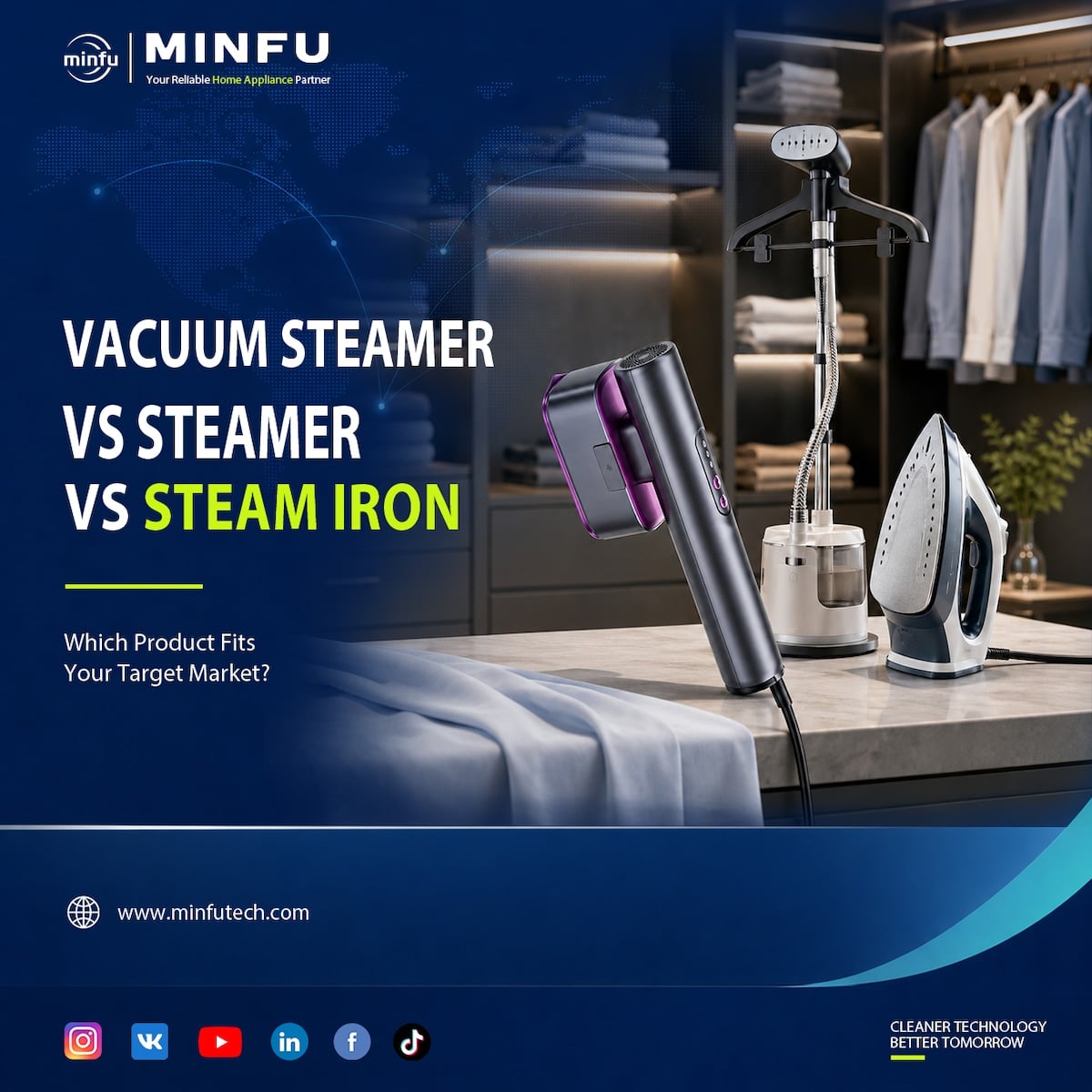

A traditional garment steamer, a vacuum garment steamer and a steam iron can all remove wrinkles, but they do not solve the problem in the same way.
A conventional handheld steamer prioritises speed and convenience. The garment remains on a hanger, steam relaxes the fibres, and the user avoids setting up an ironing board.
A steam iron takes the opposite approach. The garment is placed on a firm surface, allowing the user to apply heat, steam and downward pressure. It generally provides greater control over collars, cuffs, trouser creases and heavier wrinkles.
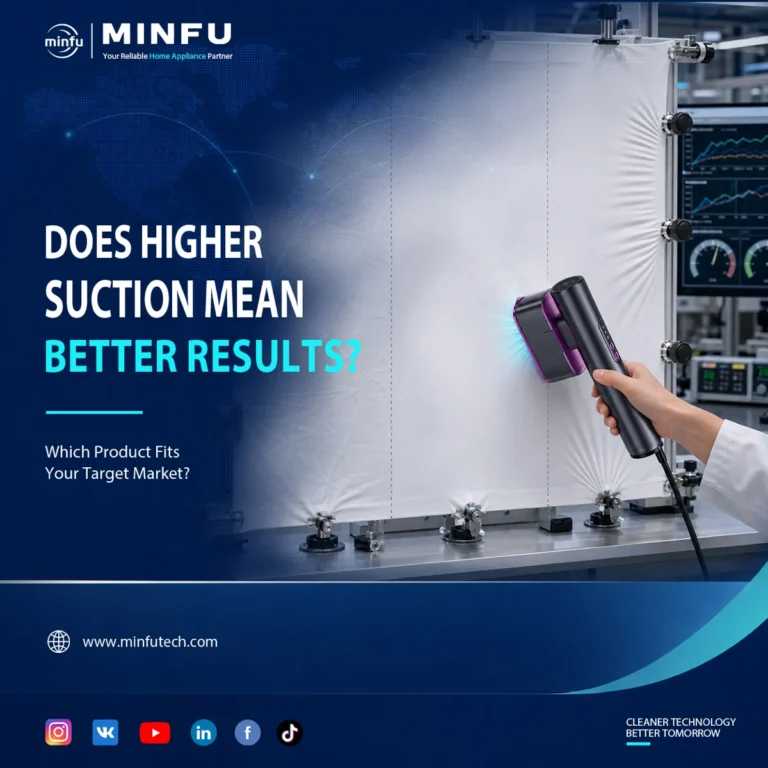
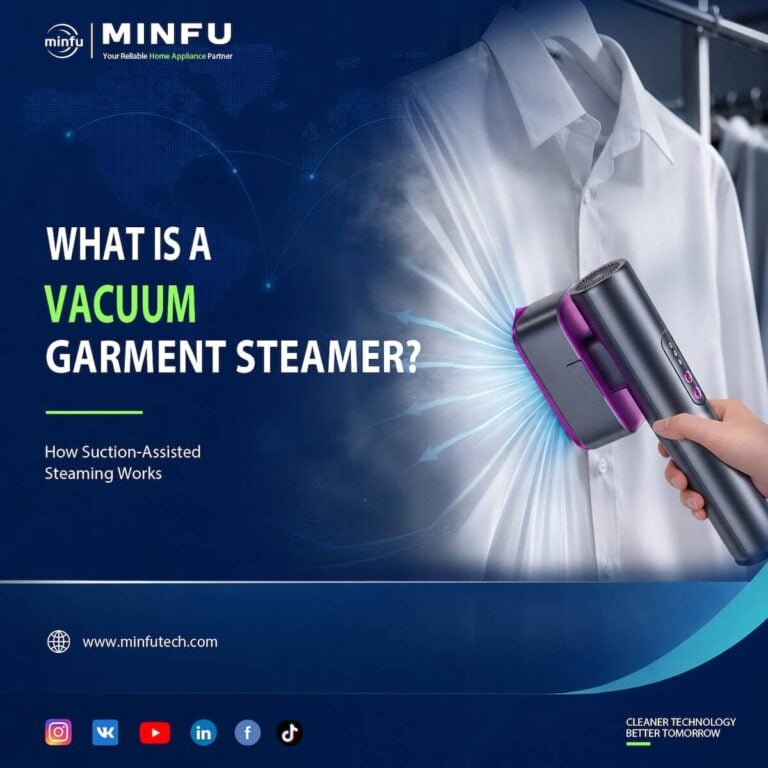
A vacuum garment steamer sits between these two formats. It keeps the board-free convenience of vertical steaming but adds suction to draw the fabric toward a heated plate. This creates temporary support behind the working area and makes the steaming movement more controlled.
For consumers, the choice may come down to convenience or finishing quality. For B2B buyers, the decision is more complicated. The product must also fit the intended sales channel, retail price, packaging size, logistics plan and customer expectations.
This article compares the three product types from a sourcing and market-positioning perspective.
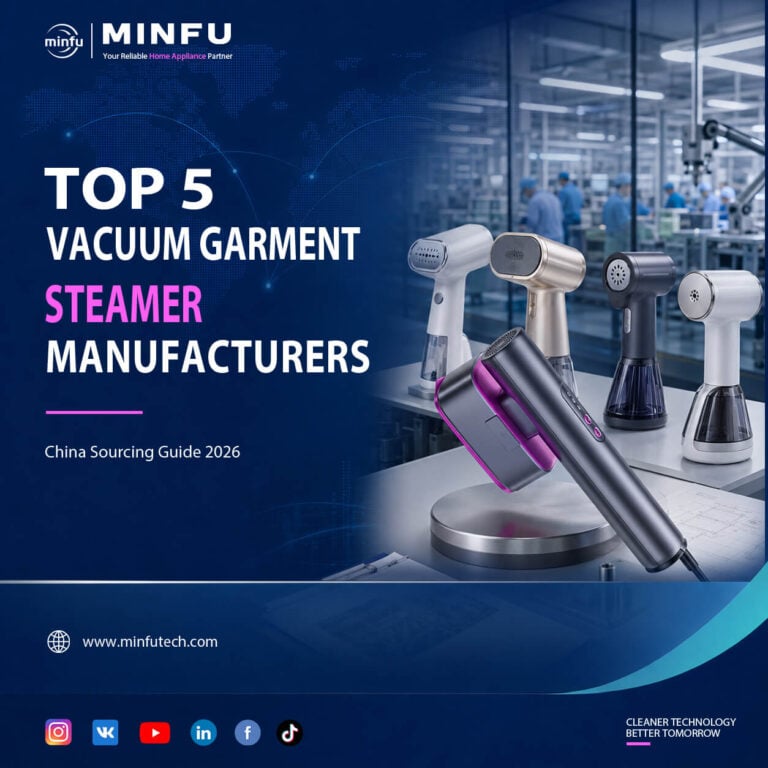
Readers who are unfamiliar with the suction system can first review What Is a Vacuum Garment Steamer?. Buyers researching Chinese suppliers can also return to the Top 5 Vacuum Garment Steamer Manufacturers in China for 2026.
Quick Comparison
| Comparison Area | Traditional Garment Steamer | Vacuum Garment Steamer | Steam Iron |
|---|---|---|---|
| Fabric support | Garment hangs freely | Suction draws fabric toward the plate | Ironing board supports the garment |
| Main working action | Steam | Suction, steam and heated contact | Heat, steam and downward pressure |
| Ironing board | Usually not required | Usually not required | Normally required |
| Setup time | Low | Low | Higher |
| Wrinkle control | Best for light and moderate wrinkles | More controlled than free-hanging steaming | Strongest on structured and stubborn areas |
| Delicate garments | Often well suited when instructions are followed | Depends on suction, plate temperature and mode | Requires closer temperature control |
| Collars and cuffs | Moderate | Moderate to good, depending on plate design | Usually strongest |
| Portability | Often high | Depends on motor, tank and plate size | Iron is compact, but a board may be needed |
| Noise | Usually relatively low | Fan and suction motor add noise | Generally relatively low |
| Product complexity | Lower | Highest of the three handheld formats | Mature and well understood |
| Retail education | Easy | Requires explanation and demonstration | Very familiar |
| Differentiation potential | Moderate | High | Lower in mature markets |
These are general design tendencies rather than guaranteed results. A high-quality conventional steamer may outperform a poorly designed vacuum model, while a compact iron may be more convenient than a large suction steamer in some homes.
The buyer still needs to test the exact production sample.
The Main Difference Is How the Fabric Is Supported
The three products do not differ only in steam output or heating power. Their most important difference is what happens behind the fabric while the wrinkle is being treated.
With a traditional steamer, there is normally no firm support. The garment hangs freely and can move away from the steam head. The user may pull the lower edge of the clothing with the other hand to create tension.
With a vacuum garment steamer, the appliance attempts to create that tension itself. Airflow draws the fabric toward the heated plate, stabilising the area being treated. Current suction-steamer platforms from Rowenta and Russell Hobbs are marketed around this combination of suction, steam and heated surface contact.
With a steam iron, support comes from the ironing board. The user can apply downward pressure while the fabric remains flat between the board and the soleplate.
This distinction explains why the three products feel different even when their published power and steam-output figures appear similar.
A steamer works mainly through moisture and heat.
A vacuum steamer adds temporary fabric tension.
An iron adds firm mechanical pressure.
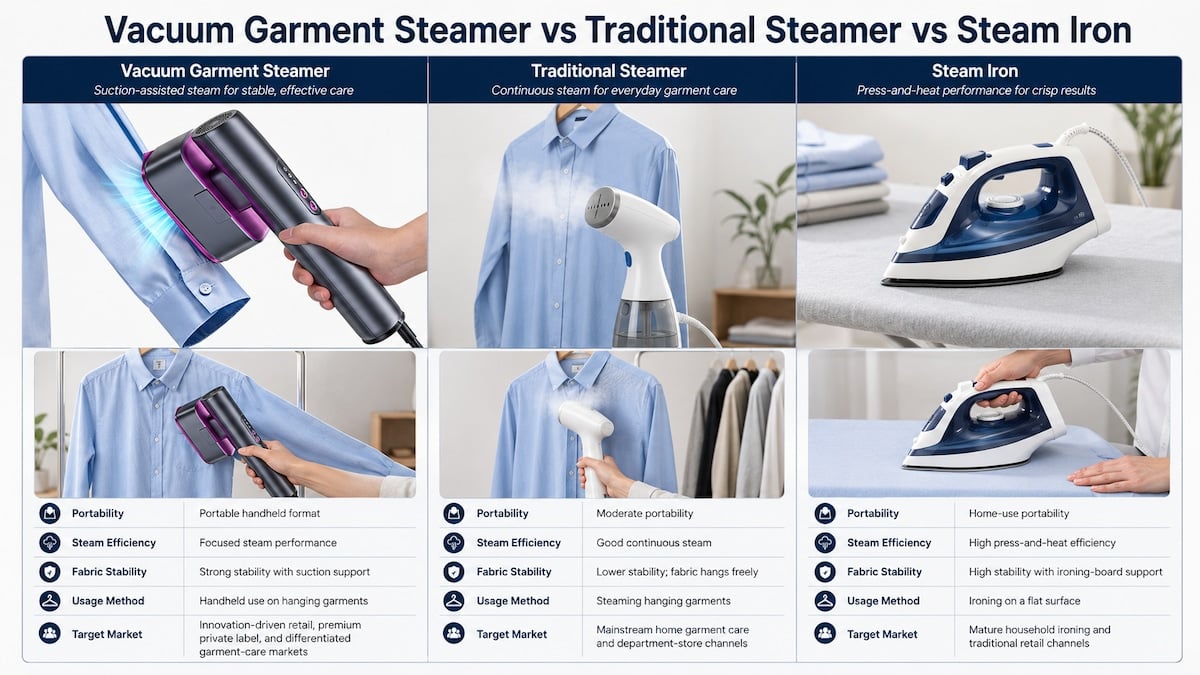
Traditional Garment Steamer: Convenience Is the Main Product
The main advantage of a traditional handheld steamer is not that it produces the sharpest possible finish. Its strength is that it removes many of the steps associated with ironing.
The user can leave the garment on a hanger, fill the water tank, wait for the unit to heat and begin steaming. There is usually no need to unfold an ironing board or reposition the garment several times.
This makes the category attractive for:
- Quick morning touch-ups;
- Travel and compact apartments;
- Delicate or difficult-to-position garments;
- Jackets, dresses and pleated clothing;
- Retail fitting rooms;
- Fabric refreshing between washes.
Philips describes handheld steaming as a board-free method suited to hanging garments, delicate fabrics and difficult-to-iron areas. The company also notes that a garment steamer does not necessarily provide the same result as an iron, particularly on thick cotton or linen shirts.
That limitation is important for B2B product positioning.
A traditional steamer should not be sold as a direct replacement for a high-performance iron in every situation. Its strongest message is convenience, portability and gentle garment refreshing.
When It Fits the Market
A traditional handheld steamer may be the most practical choice when the target customer:
- Has limited storage space;
- Primarily wears dresses, jackets or lighter garments;
- Wants quick preparation rather than a sharply pressed finish;
- Travels frequently;
- Prioritises low weight and simple operation;
- Is sensitive to noise;
- Expects an accessible retail price.
It is also easier for a new seller to explain. Most consumers already understand what a garment steamer does, so the product requires less education in marketplace listings and retail displays.
Commercial Limitations
The category is mature and crowded. Many models share similar claims:
- Fast heat-up;
- Compact body;
- Continuous steam;
- No ironing board;
- Safe for common ironable fabrics;
- Travel-friendly design.
This makes product differentiation difficult unless the supplier offers a distinctive industrial design, stronger steam performance, useful accessories or a clear price advantage.
A low-cost steamer may generate sales volume, but it may also compete mainly on price.
Vacuum Garment Steamer: A More Controlled Steaming Experience
A vacuum garment steamer attempts to improve one of the main weaknesses of free-hanging steaming: the garment moves while the user is trying to smooth it.
The suction system pulls the working area toward the plate. Steam relaxes the fibres, and the heated surface helps smooth the fabric as the appliance moves.
Rowenta describes suction steaming as drawing fabric flat against a heated soleplate, while Russell Hobbs describes its VacuSteam system as gently holding fabric against a ceramic-coated press plate. These are brand descriptions, but they illustrate the category’s intended value proposition.
The benefit is therefore not simply “more power.”
It is a more stable interaction between the garment and the appliance.
Where It Can Create a Stronger Product Story
Vacuum steaming is visually easy to demonstrate once the customer understands what to watch.
A product video can show:
- A shirt hanging freely;
- The fabric moving toward the suction plate;
- The garment remaining stable during the stroke;
- The treated section appearing smoother;
- The user operating the product without continuously pulling the fabric.
This gives importers and e-commerce brands a distinctive story that traditional steamers do not have.
It also supports a more premium position because the product combines:
- A steam generator;
- A heated plate;
- A suction fan;
- Airflow channels;
- Additional controls;
- More complex internal thermal management.
The Trade-Offs
The added system also introduces new compromises.
The fan increases noise. The motor and airflow structure add weight and take up internal space. The product may need a smaller water tank to remain compact, or a larger housing to support longer steaming sessions.
Fabric permeability also affects suction. Tightly woven material may remain more stable against the plate than open-knit or highly porous fabric. Seams, buttons and pockets can interrupt contact.
A vacuum garment steamer should therefore be positioned as a more controlled board-free solution—not as a product that guarantees identical performance on every textile.
The later article Does Higher Suction Mean Better Wrinkle Removal in a Vacuum Garment Steamer? will examine why Pa values alone do not represent final performance.
When It Fits the Market
A vacuum garment steamer may be the strongest option when the target customer:
- Wants better control than a conventional handheld steamer;
- Does not want to use an ironing board;
- Is willing to accept additional fan noise;
- Values visible product innovation;
- Shops through video-led e-commerce channels;
- Is interested in premium garment-care appliances;
- Needs a clear reason to upgrade from an ordinary steamer.
It may be especially relevant for brands that want a product positioned between a basic travel steamer and a full ironing system.
Steam Iron: Strongest Control, but More Setup
The traditional steam iron remains the most familiar choice for customers who prioritise precise pressing.
The ironing board supports the fabric while the soleplate applies heat, steam and downward pressure. This makes an iron particularly useful for:
- Thick cotton and linen;
- Collars and cuffs;
- Trouser creases;
- Shirt plackets;
- Structured garments;
- Deep storage wrinkles;
- Large flat fabric areas.
Philips explicitly notes that garment steamers may not provide the same result as an iron on thick cotton or linen. That does not make the steamer ineffective; it reflects the advantage of using a firm supporting surface and mechanical pressure.
Steam irons also belong to a highly mature category. Consumers understand the operation, retail expectations and basic price structure.
The Main Disadvantages
The ironing board creates both the iron’s strongest performance advantage and its main inconvenience.
The user needs:
- Enough floor or table space;
- Time to set up the board;
- Space to store it;
- Greater attention to fabric temperature;
- More garment repositioning.
For customers living in small apartments or preparing one shirt before work, the setup may feel disproportionate to the task.
This creates a clear market division:
The steam iron is often selected for finishing quality, while handheld steamers are selected for convenience.
A vacuum garment steamer tries to narrow the gap, but it does not completely eliminate the mechanical advantage of a firm ironing board.
Which Product Works Better on Different Garments?
No single product format is ideal for every garment.
| Garment or Task | Traditional Steamer | Vacuum Garment Steamer | Steam Iron |
|---|---|---|---|
| Light shirt touch-up | Good | Very good | Good, but setup may be excessive |
| Thick cotton shirt | Moderate | Good if steam and contact are strong | Very good |
| Linen | Moderate | Depends on product and wrinkle depth | Very good |
| Silk and delicate garments | Good with approved method | Good with suitable mode and temperature | Requires careful settings |
| Dresses and pleated clothing | Very good | Good, depending on plate access | Less convenient |
| Jackets and coats | Good for refreshing | Good for controlled surface treatment | Limited by shape and board |
| Collars and cuffs | Moderate | Good with suitable plate geometry | Very good |
| Trouser creases | Limited | Limited to moderate | Very good |
| Curtains | Good with sufficient cord and tank | Possible, but product weight matters | Usually inconvenient |
| Travel use | Very good for compact models | Depends on size and weight | Iron may be compact, but board access is uncertain |
| Several garments at once | Tank-dependent | Tank and weight become important | Good with suitable board and tank |
This table should be treated as a starting framework. Actual results depend on steam output, plate size, product weight, fabric and user technique.
Which Product Is Easier to Sell?
The answer depends heavily on the channel.
Online Marketplaces
A traditional steamer is familiar and easy to search for, but competition is intense. Sellers may need to compete through price, reviews, accessories and visual design.
A vacuum garment steamer requires more education, but it also provides stronger video content. The suction movement is visible, and the seller can demonstrate a specific problem that the product solves.
A steam iron benefits from established demand, but differentiation is difficult unless the model has strong steam performance, a premium soleplate or a recognisable brand.
For video-led platforms, the vacuum steamer may offer the strongest demonstration potential.
Department Stores and Appliance Retailers
Physical retail changes the decision.
A customer can hold the product, feel its weight and compare the tank size. A live demonstration can explain suction quickly, but noise may also become more noticeable.
Premium vacuum steamers can work well in department stores when staff are trained to explain the difference. Traditional steamers are easier to place at accessible price points, while steam irons remain suitable for established garment-care sections.
Travel and Compact-Living Channels
A lightweight traditional steamer normally has the clearest advantage.
A vacuum model may also fit this channel when the supplier can keep the product compact, but the additional motor, airflow structure and heated plate may make it larger or heavier.
The word “portable” should therefore be supported by actual:
- Product weight;
- Packaging dimensions;
- Water-tank size;
- Voltage compatibility;
- Storage design.
Private-Label Premium Products
Vacuum garment steamers offer more room for private-label differentiation.
Brands can position the product through:
- Suction strength;
- Plate size;
- Product weight;
- Operating modes;
- Water-tank design;
- Colour and surface treatment;
- Noise control;
- Retail demonstration;
- Packaging education.
The product is technically more demanding, but the market story is also more defensible than another generic handheld steamer.
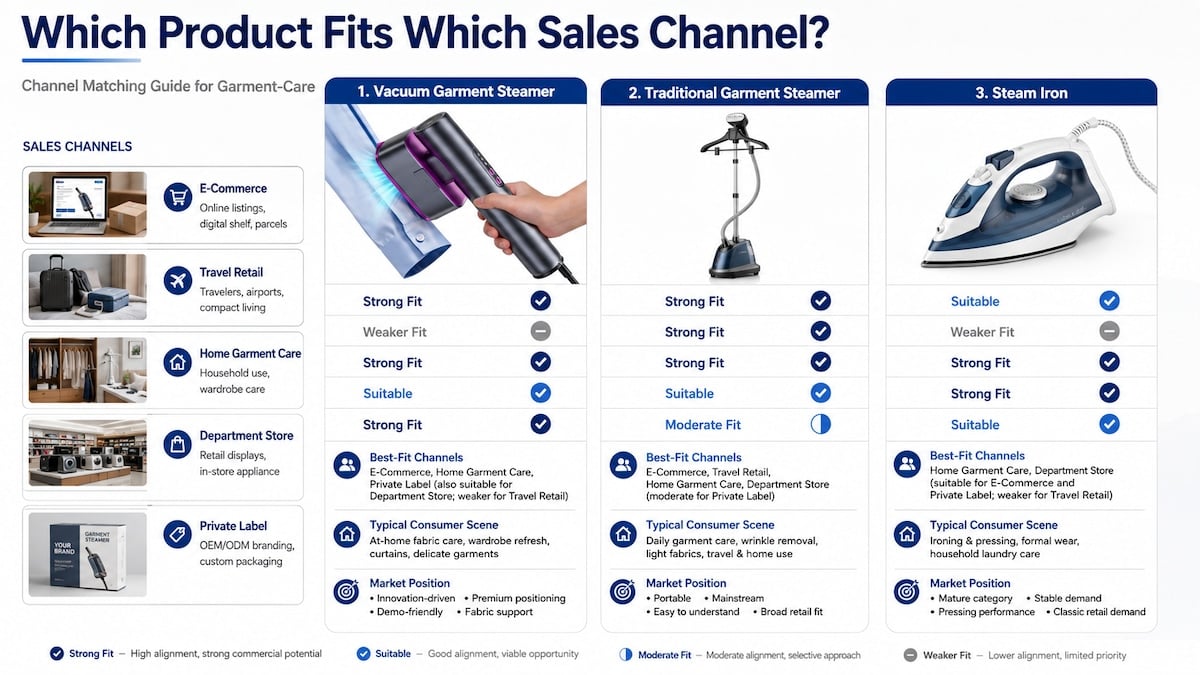
The Product Economics Are Also Different
B2B buyers should not compare only the factory unit price.
The three formats create different cost structures.
| Cost Factor | Traditional Steamer | Vacuum Garment Steamer | Steam Iron |
|---|---|---|---|
| Core component complexity | Lower | Higher | Mature and moderate |
| Suction motor | No | Yes | No |
| Airflow structure | Limited | Important | No |
| Heated plate | Optional on some models | Usually central to performance | Essential |
| Water and steam system | Yes | Yes | Yes |
| Noise-control requirement | Lower | Higher | Lower |
| Packaging education | Simple | More explanation required | Simple |
| Product testing | Steam, water and heat | Steam, water, heat, suction and noise | Steam, heat and soleplate |
| After-sales complexity | Moderate | Higher | Moderate |
| Market differentiation | Moderate | High | Lower in mature segments |
A vacuum garment steamer may cost more to manufacture and validate, but it can also support a higher-value retail story.
A basic handheld steamer may provide a lower entry price and wider consumer familiarity.
A steam iron may benefit from stable demand but face direct comparison with established models and brands.
The correct decision should be based on expected gross margin, return rate, logistics cost and retail positioning—not only the supplier’s quotation.
A Fair Sample Test for All Three Formats
Comparing the three categories requires more than using each appliance once on a different shirt.
The test should use the same:
- Fabric;
- Garment size;
- Wrinkle preparation;
- Test area;
- Operating time;
- Environmental conditions;
- Operator;
- Result-recording method.
A useful test can use three rounds.
Round One: Everyday Shirt Touch-Up
Use a cotton or cotton-blend shirt with moderate wrinkles.
Record:
- Setup time;
- Heat-up time;
- Time spent treating the shirt;
- Number of passes;
- Remaining wrinkles;
- Moisture;
- Ease of handling;
- Total time including board setup.
This test shows the real difference between appliance speed and total task speed.
An iron may treat the fabric quickly once ready, but the board adds setup time. A steamer may heat quickly, but require more repeated passes. A vacuum steamer may reduce movement while adding fan noise.
Round Two: Structured Areas
Test collars, cuffs, seams and pocket edges.
These areas reveal whether the vacuum steamer’s plate geometry can compete with an iron and whether a conventional steamer provides enough control.
Round Three: Delicate and Difficult Garments
Use pleats, decorated surfaces, thin textiles and garments that are awkward to place on an ironing board.
This is where the convenience of handheld steaming may outweigh the stronger pressure of an iron.
The test record should include both wrinkle results and user experience.
A product that performs well but feels heavy, loud or difficult to refill may not be the strongest commercial option.
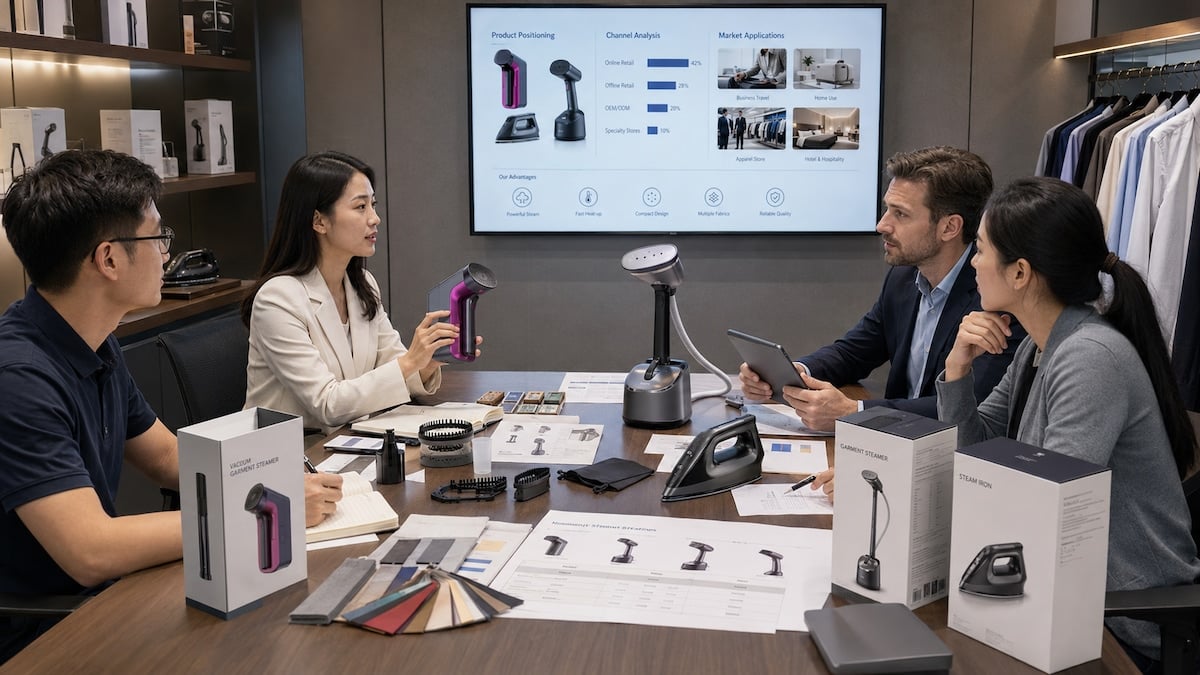
Where MFVS01 Fits in the Comparison
The Minfu MFVS01 represents the compact vacuum-assisted category.
The currently published configuration includes 4,500Pa stated suction, approximately 25-second heat-up, a 1,000W rating, an 85ml water tank, a ceramic soleplate and a weight of approximately 0.8–0.85kg. Minfu also lists 110V and 220–240V versions, a 90-degree rotating nozzle and OEM customisation for the product colour, logo, packaging, plug, manual and accessories.
This platform is not intended to compete with every large household iron or large-tank garment steamer through capacity alone.
Its stronger commercial position is:
- More fabric control than a basic free-hanging steamer;
- Board-free use;
- Relatively lightweight handling;
- Compact packaging;
- A distinctive suction demonstration;
- Private-label configuration for different markets.
The 85ml tank supports a compact body but also means the buyer should test whether the operating time matches the intended use case.
For quick shirt preparation, travel, small apartments or e-commerce demonstration, the compromise may be appropriate.
For households that expect to steam many garments continuously, a larger-tank vacuum platform or a standing steamer may be more suitable.
The product should therefore be sold according to its intended job rather than presented as a universal replacement for every garment-care appliance.
A Simple Decision Framework for Importers
Start with the customer’s most important problem.
Choose a Traditional Garment Steamer First When:
- Convenience matters more than a pressed finish;
- The target price needs to remain accessible;
- Low weight and compact storage are priorities;
- The customer mainly refreshes light or delicate garments;
- The channel prefers a familiar product requiring little education.
Evaluate a Vacuum Garment Steamer First When:
- The brand wants visible product innovation;
- Customers dislike pulling fabric during steaming;
- Board-free use remains important;
- More controlled garment contact is part of the value proposition;
- Video and marketplace demonstrations are central to the launch;
- The project can support higher product complexity and testing.
Choose a Steam Iron First When:
- Sharp collars, cuffs and creases are important;
- Thick cotton and linen are common;
- The target customer already owns or accepts an ironing board;
- Finishing control matters more than setup time;
- The market expects a traditional pressing result.
The word “first” is important.
A retailer may carry all three products because they serve different customer needs. The objective is not to replace one category completely, but to give each product a clear role.
Conclusion
Traditional garment steamers, vacuum garment steamers and steam irons are not three versions of the same appliance.
They represent three different methods of supporting and treating fabric.
A traditional steamer provides fast, board-free garment refreshing.
A vacuum garment steamer adds suction and heated contact to make vertical steaming more controlled.
A steam iron uses a firm board and downward pressure to provide greater precision on structured and stubborn areas.
For B2B buyers, the best product is the one whose compromises match the target market.
The decision should consider:
- Garment types;
- Desired finish;
- Product weight;
- Water capacity;
- Noise;
- Setup time;
- Retail price;
- Packaging size;
- Sales channel;
- Customer education;
- After-sales complexity.
A vacuum garment steamer should not be selected only because it is newer, just as a traditional steamer should not be rejected because it is simpler.
The right category is the one that delivers a clear customer benefit, a repeatable result and a commercially realistic product proposition.
To review potential suppliers, return to the Top 5 Vacuum Garment Steamer Manufacturers in China for 2026.
For MFVS01 samples, OEM configurations or private-label project evaluation, contact the Minfu team with the target market, sales channel and expected order quantity.