



Vacuum garment steamers are beginning to form a distinct category within the garment-care market.
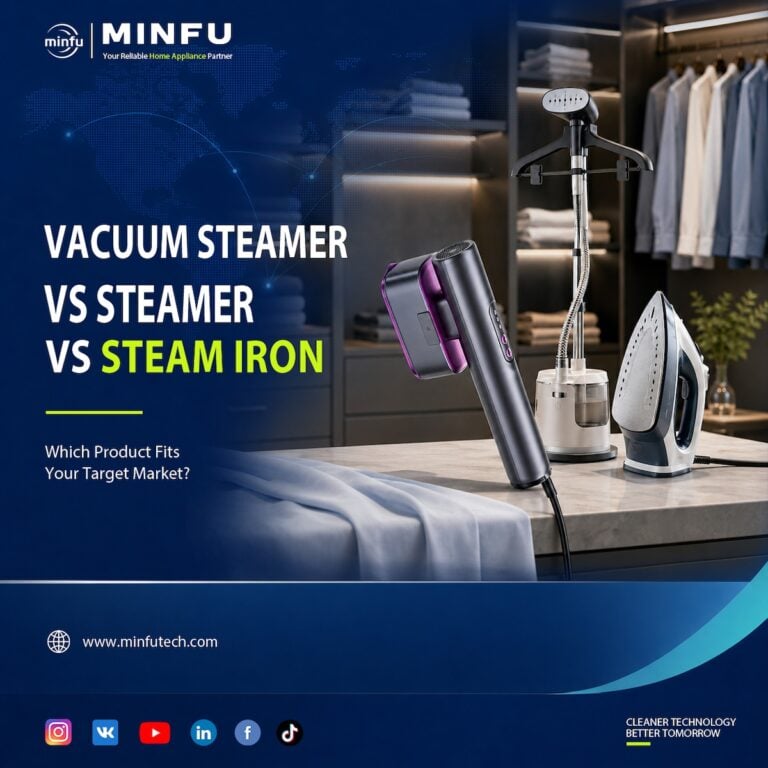
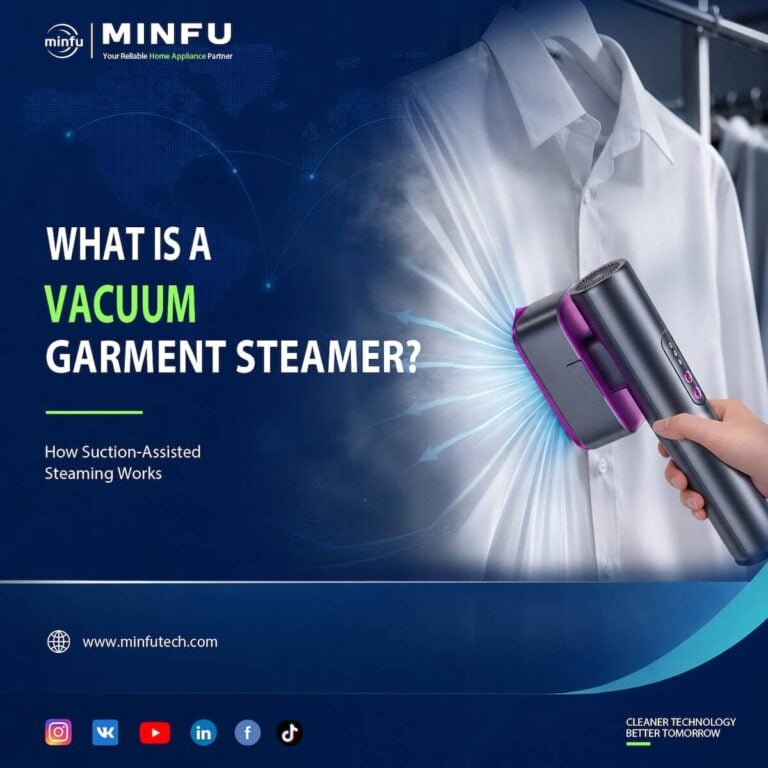
Unlike a conventional handheld steamer that directs steam toward freely hanging fabric, a vacuum garment steamer uses suction to draw the garment toward a heated plate or steaming surface. The fabric is held flatter during operation, helping the user apply steam and heat without constantly pulling the garment tight with the other hand.
For importers and private-label brands, however, sourcing this product is not as simple as finding a factory that already manufactures conventional garment steamers.
The addition of suction changes the product architecture. The manufacturer must manage airflow, steam output, heating temperature, noise, fabric contact, water control and electrical safety within one handheld appliance. A product may display a high suction figure on a catalogue while still producing an inconsistent result if the airflow path, soleplate, steam distribution or housing seal is poorly designed.
This guide introduces five Chinese manufacturers currently displaying vacuum, suction-assisted or adsorption garment steamer products for B2B buyers. The companies were selected because they have publicly available evidence of relevant products and provide some level of OEM, ODM or private-label support.
Editorial disclosure: This article is published by Minfu, one of the manufacturers included in the comparison. The list is based on publicly available company pages, product listings and supplier profiles. It is not an independent factory audit or a market-share ranking. Buyers should verify the legal entity, production facility, certification documents and approved product sample before placing an order.
Quick Comparison of the Five Manufacturers
| Manufacturer | Location | Relevant Product Positioning | OEM/ODM Evidence | Best Suited For |
|---|---|---|---|---|
| Minfu | Shenzhen, Guangdong | Lightweight 4,500Pa vacuum steam iron platform | Logo, colour, packaging, plug, manual and accessory customisation | Private-label brands seeking a compact product platform |
| Ningbo Richer | Ningbo, Zhejiang | Multiple vacuum steamers with up to 4.5kPa stated suction | OEM, package design and after-sales services | Buyers prioritising garment-care specialisation |
| Huaguang | Cixi, Zhejiang | Steam and suction garment-care products | Integrated design, moulding, assembly, testing and OEM/ODM | Larger appliance brands requiring broader development capacity |
| Baiyisen | Shenzhen/Dongguan, Guangdong | 3,000Pa and other suction garment steamer configurations | OEM, ODM and OBM listed on sourcing platforms | E-commerce and personal-care brands exploring new product formats |
| Ningbo Moyin | Ningbo, Zhejiang | 2026 self-suction vacuum garment steamer | OEM/ODM and garment-steamer manufacturing | Buyers seeking a focused steamer supplier and standard OEM orders |
The order above does not mean that the first company is automatically the best supplier for every project. Each manufacturer has a different product background, development capability, order structure and commercial focus.
A buyer looking for a lightweight private-label product may reach a different conclusion from a retailer that needs a large garment-care range or an established steam-appliance engineering team.
How the Manufacturers Were Selected
This list does not attempt to identify the five largest garment steamer companies in China. Company size alone does not prove that a supplier has experience with vacuum-assisted fabric handling.
Instead, the selection focused on six practical factors:
- A publicly visible vacuum, suction or adsorption garment steamer;
- A stated manufacturing or product-development role;
- OEM, ODM or private-label support;
- Relevance to overseas B2B buyers;
- Sufficient product or company information for preliminary comparison;
- A product platform that could reasonably be investigated through sample testing.
Public information remains only the beginning of supplier qualification. Statements made on company websites and B2B platforms are generally supplied by the companies themselves. Certification, production capacity, patents, export experience and technical specifications should be checked against original documents and an approved sample.
1. Minfu — Best for Lightweight Private-Label Vacuum Steamer Projects
Shenzhen Minfutech Industrial Co., Ltd. supplies cleaning and small household appliances for OEM, ODM and wholesale projects. Its current vacuum garment-care platform is the MFVS01, which Minfu markets under both Vacuum Steam Iron and vacuum-suction garment-care terminology.
The MFVS01 is positioned around a lightweight, compact structure rather than a large water tank or high-power household ironing format. Its published specifications include 4,500Pa stated suction, approximately 25 seconds of heating time, a ceramic plate, an 85ml water tank, 1,000W rated power and a body weight of approximately 0.8–0.85kg. The product page also lists 110V and 220–240V configurations and a rotatable nozzle.
This combination may suit importers that want to position the product around portability, quick garment preparation and easier one-handed steaming. The relatively low product weight may also be relevant to e-commerce sellers concerned about shipping, storage and prolonged handheld use.
From an OEM perspective, Minfu publicly lists customisation for the product logo, exterior colour, retail packaging, regional plug, manual and accessories. It also describes incoming-material inspection, assembly checks, performance testing and pre-shipment quality control as part of its broader OEM service.
Minfu should not be selected only because its published suction number is higher than some competing retail products. A buyer should verify how the 4,500Pa value is measured and then test the complete fabric-care result, including:
- Whether the garment remains attached during normal movement;
- How the suction changes on porous fabrics;
- Whether steam reaches the full plate area;
- Whether one pass produces a visible improvement;
- Noise during continuous suction;
- Water leakage at different operating angles;
- Heating and suction stability after repeated use.
Best suited for: importers, appliance brands and e-commerce sellers seeking a compact vacuum garment steamer that can be adapted for private-label packaging and regional electrical requirements.
Buyers should verify: approved suction test method, final steam rate, fabric compatibility, product noise, target-market compliance and the MOQ stated in the final quotation.

2. Ningbo Richer — Best for Garment-Care Product Specialisation
Ningbo Richer Electronic Technology Co., Ltd. is more narrowly focused on electric irons, steam stations and garment steamers than many diversified small-appliance suppliers.
The company states that it was established in 2014 and operates a 10,000-square-metre facility in Cixi, Ningbo. Its company page also reports more than 200 employees, an annual production volume of three million units and support for OEM and ODM orders. These figures are company-reported and should be checked during supplier qualification.
Richer currently displays several products under its vacuum-steamer category. One published model, FG-550-19, lists:
- 1,800–2,000W rated power;
- Approximately 25-second heat-up;
- A 400ml detachable water tank;
- Steam output up to 25g/min;
- Two suction levels;
- Maximum stated suction of 4.5kPa;
- A ceramic-coated panel;
- An automatic shut-off option;
- A self-cleaning airflow function.
The same page states a noise level of approximately 70dB. These values provide useful starting points, although buyers should confirm them through sample testing rather than treating the catalogue as a final test report.
Compared with Minfu’s lighter 1,000W platform, Richer’s displayed product represents a larger and more powerful household format. The 400ml tank and higher rated power may support longer steaming sessions, but they may also increase product weight, packaging dimensions and logistics costs.
That difference illustrates why importers should not ask every supplier to quote an apparently identical “vacuum steamer.” The commercial positioning can be very different:
- Lightweight, quick-touch-up appliance;
- Higher-power home ironing product;
- Travel-oriented steamer;
- Premium board-free ironing alternative;
- Large-tank garment-care appliance.
Richer’s website also lists package design, after-sales service, logistics support and e-commerce seller services, making it relevant to buyers that want a garment-care specialist rather than a supplier offering only one steamer among many unrelated products.
Best suited for: established garment-care brands and distributors seeking several vacuum-steamer configurations and a supplier specialised in irons and steam appliances.
Buyers should verify: the actual product weight, 110–120V version availability, certification coverage for the selected model, steam and suction consistency, noise measurement conditions and the commercial MOQ for customised packaging.

3. Huaguang — Best for Integrated Steam-Appliance Development
Huaguang Electrical Appliance Group Co., Ltd. has a longer history in steam appliances than the other companies in this list.
According to its official company history, the business began in 1985 and later expanded from electric irons and steam stations into garment steamers and other steam-based home appliances. Huaguang states that it integrates product design, mould manufacturing, injection moulding, assembly and testing, and reports more than 500 patents across its steam-appliance portfolio.
Its current product information includes a handheld steam-iron platform with an integrated suction system. The company describes the suction function as helping draw fabric toward the heated area for more stable contact, while also emphasising water-tank design and lower-noise operation.
For larger brands, the value of Huaguang may not be one particular suction specification. Its broader attraction is the possibility of working with a manufacturer that already has established capabilities in:
- Electric irons;
- Handheld garment steamers;
- Standing steamers;
- Steam stations;
- Mould development;
- Injection moulding;
- Product assembly;
- Testing and compliance support.
Huaguang states that it provides made-to-order OEM and ODM production rather than relying primarily on stock inventory. That model may be suitable for brands that already have a clear product brief, forecast and retail launch plan, but may be less appropriate for buyers looking for a very small stock order.
Its long garment-care history also means that buyers can evaluate suction-steamer development in the context of a broader ironing range. A distributor may be able to source a coordinated family of conventional steam irons, handheld steamers and suction-assisted products from the same manufacturer.
However, a large supplier is not automatically the right choice for every private-label project. Buyers should still establish whether the proposed vacuum-steamer model is already in stable production, newly developed or dependent on a future tooling project.
Best suited for: established appliance brands, large distributors and buyers seeking deeper product engineering or a wider garment-care range.
Buyers should verify: minimum project size, development charges, tooling ownership, exclusivity terms, production status of the suction model, specific certifications and the lead time between design approval and mass production.

4. Baiyisen — Best for New Product Formats and E-Commerce Positioning
Baiyisen appears on current sourcing platforms with several suction and adsorption garment steamer listings.
Global Sources presents Dongguan Baiyisen Technology Co., Ltd. as a manufacturer offering OEM, ODM and OBM services. Its displayed products include a handheld vacuum steamer with 3,000Pa stated suction, as well as additional steam and personal-care appliances. The supplier was also listed as an exhibitor for the 2026 Global Sources Lifestyle shows in Hong Kong.
Separate Made-in-China pages use the name Shenzhen Baiyisen Health Technology Co., Ltd. and display suction garment steamer products with different configurations, including products described with suction ranges around 3,000–5,000Pa and versions intended for 110–130V and 220–240V markets.
This supplier’s broader background appears to be in beauty, hair-care and personal-care electrical products rather than traditional garment ironing alone. Its company profile highlights high-speed hair dryers, styling appliances, private moulds and OEM/ODM customisation.
That background may be valuable for e-commerce brands that view a vacuum steamer as a lifestyle or personal-care product rather than simply another laundry appliance. Product appearance, colour, packaging and social-media demonstration may play a larger role in that type of project.
At the same time, the public supplier information uses both Shenzhen and Dongguan company names. This does not necessarily mean there is a problem, but buyers should clarify whether the companies are related and identify the precise legal entity that will:
- Sign the sales contract;
- Receive payment;
- Own the factory;
- Hold the certification;
- Produce the goods;
- Handle warranty claims.
This type of legal-entity check should be completed for every supplier, particularly when a brand name, sales company and factory use different registered names.
Best suited for: e-commerce brands and personal-care appliance sellers looking for visually distinctive suction-steamer products and flexible product presentation.
Buyers should verify: the contracting legal entity, factory address, ownership relationship between the Shenzhen and Dongguan listings, certification holder, mould ownership, voltage configuration and approved production sample.

5. Ningbo Moyin — Best for Focused Garment-Steamer OEM Orders
Ningbo Moyin Electrical Appliance Co., Ltd. is a garment-care manufacturer whose publicly listed range includes handheld steamers, travel steamers, steam irons and a 2026 self-suction vacuum garment steamer.
Its Made-in-China supplier profile identifies the company as a manufacturer and states that it provides OEM and ODM services. The profile reports two production lines, 11–20 R&D staff and a factory in the Hemudu Industrial Zone of Ningbo. These figures are platform and supplier-provided information and should be verified during a factory audit.
The company’s current vacuum-steamer listing describes a product with:
- 1,200–1,400W rated power;
- 110V and 220V options;
- Approximately 20±3g/min steam output;
- A 300ml removable water tank;
- 4.5kPa stated adsorption force;
- Continuous steam;
- Water-shortage protection;
- Automatic shut-off;
- Overheat protection.
The supplier page lists an MOQ of 1,000 units for the standard published version, although pricing and MOQ should always be reconfirmed for the final colour, plug, packaging and certification requirements.
Moyin may appeal to buyers who prefer to work with a focused garment-steamer manufacturer rather than a large diversified appliance group. Its public catalogue includes several traditional handheld steamer formats, allowing buyers to compare the vacuum product with more conventional models from the same supplier.
The main procurement question is whether the vacuum model has already passed through stable commercial production or is still a newly launched platform. A “2026 new model” may offer early-market differentiation, but a buyer should request additional validation data before approving a large order.
Useful evidence would include:
- Pilot production records;
- Continuous steam testing;
- Suction endurance;
- Water-leakage testing;
- Drop and packaging tests;
- Power-cord bending tests;
- Production-batch inspection reports;
- Certification linked to the exact model.
Best suited for: importers seeking a garment-steamer-focused supplier, conventional OEM configuration and a published 1,000-unit order starting point.
Buyers should verify: production maturity, certification status, sample-to-production consistency, actual noise, product weight, historical defect rate and availability of spare parts.
Which Manufacturer Fits Which Type of Buyer?
There is no universal winner because the five manufacturers are not offering the same commercial proposition.
| Buyer Profile | Manufacturer to Investigate First | Reason |
|---|---|---|
| New private-label brand seeking a compact platform | Minfu | Lightweight product positioning and broad packaging localisation |
| Established garment-care distributor | Ningbo Richer | Multiple vacuum models and garment-care specialisation |
| Large appliance brand needing deeper engineering | Huaguang | Integrated development, moulding and steam-appliance experience |
| E-commerce or personal-care brand | Baiyisen | Product styling and personal-care appliance background |
| Buyer seeking a focused steamer supplier | Ningbo Moyin | Garment-steamer catalogue and standard OEM positioning |
This is a starting point for investigation, not a substitute for comparison samples.
A supplier that appears strongest on paper may not perform best in the areas that matter to your target market. For example, a larger tank may improve working time but increase weight. Higher rated power may produce stronger steam but require a larger housing. A lightweight model may be easier to use but require more frequent refilling.
The right product depends on which compromises the target customer is most likely to accept.
What Buyers Should Test Before Selecting a Manufacturer
A good sample test should compare the complete ironing result rather than one isolated specification.
Fabric Holding
Test whether the appliance can hold cotton, linen, polyester and thinner fabric against the steaming surface without requiring excessive pressure from the user.
Suction will naturally behave differently on porous and tightly woven materials. The buyer should check whether the product remains useful when the fabric does not form a perfect seal.
Wrinkle Removal
Use the same fabric, wrinkle preparation and operating time for every sample.
Record:
- Result after one pass;
- Result after three passes;
- Time required for one garment;
- Performance on collars and seams;
- Remaining moisture;
- Fabric shine or marks;
- Ability to handle thicker sections.
Steam and Water Control
The product should be checked during startup, normal use, rotation and repeated use.
Watch for:
- Water droplets;
- Uneven steam;
- Delayed steam after startup;
- Pump noise;
- Steam reduction as the tank empties;
- Leakage when the head is rotated;
- Mineral buildup after repeated cycles.
Heat and Electrical Safety
The buyer should review:
- Surface temperature;
- Overheat protection;
- Automatic shut-off;
- Power-cord temperature;
- Cord bending;
- Plug and voltage configuration;
- Insulation and leakage-current testing;
- Applicable safety standard for the destination market.
Noise and Handling
The suction fan may make the product louder than a traditional handheld steamer.
Noise should be assessed together with product weight, balance, vibration and handle temperature. A strong technical result may still produce poor customer reviews if the machine is uncomfortable during normal use.
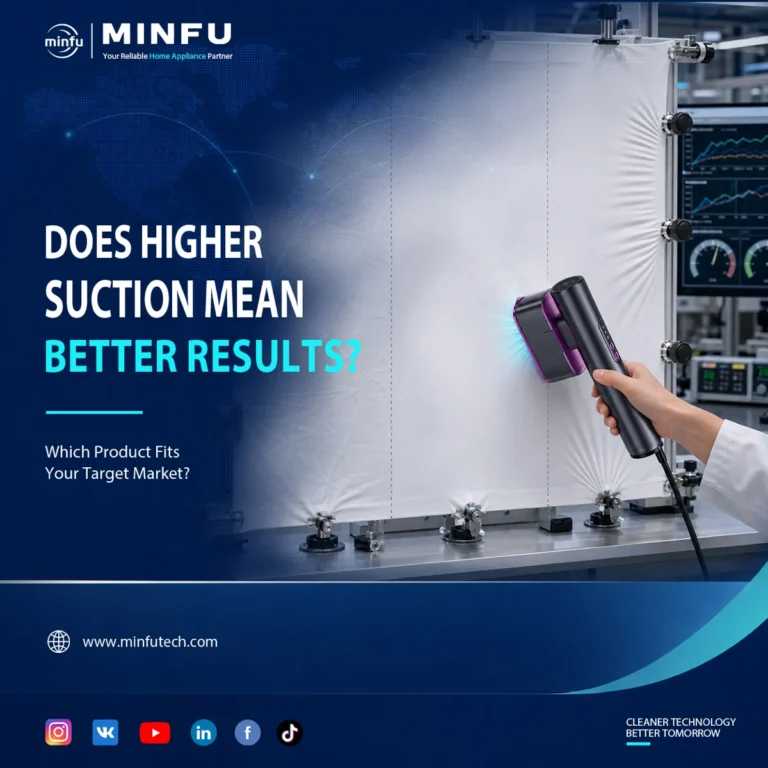
The dedicated suction-performance article in this cluster will explain why a larger Pa figure does not by itself prove better wrinkle removal.

How to Verify OEM and ODM Capability
Many supplier pages use OEM and ODM, but those terms can represent very different levels of service.
Basic OEM may include:
- Logo printing;
- Standard colour selection;
- Colour-box artwork;
- Plug selection;
- Manual translation.
Deeper ODM may involve:
- Housing modification;
- Water-tank changes;
- Air-duct redesign;
- Suction adjustment;
- Steam-path modification;
- Heating control;
- New accessories;
- New tooling;
- Firmware or control-mode changes.
Before approving a project, buyers should ask which changes are already available and which require engineering, tooling and new compliance testing.
A practical request should include:
- Destination countries;
- Target retail price;
- Expected order quantity;
- Sales channel;
- Voltage and plug;
- Required certifications;
- Target product weight;
- Water-tank expectation;
- Steam and suction positioning;
- Packaging languages;
- Warranty plan.
The factory can then recommend a realistic base platform rather than quoting an undefined customised product.
The later OEM/ODM Vacuum Garment Steamers article will cover the development process from the first product brief to the approved golden sample.
Common Sourcing Risks
Vacuum garment steamers are still developing as a category, which creates opportunities but also several recurring sourcing risks.
Comparing Only the Suction Number
A 4,500Pa product is not automatically more effective than a 3,000Pa product. The test method, airflow, contact area, fabric permeability and steam system all affect the final result.
Treating Every Product as the Same Category
Some suppliers use vacuum steamer, suction steam iron, adsorption garment steamer and vacuum garment steamer for products with different structures.
The buyer should confirm whether the product:
- Pulls fabric toward the plate;
- Extracts lint or debris;
- Blows air rather than creating suction;
- Supports flat ironing;
- Uses a heated plate;
- Has continuous steam.
Using Certification from a Different Model
A general CE, CB or ETL document does not necessarily apply to the exact vacuum-steamer configuration being purchased.
Confirm the model number, voltage, internal components, applicant, manufacturer and standard listed on the document.
Approving Packaging Before the Product Is Final
Product claims, warnings, steam specifications and fabric instructions should not be printed until the final sample is approved.
Ignoring After-Sales Preparation
The supplier and buyer should agree on the handling of pumps, heating elements, water tanks, power cords, suction fans and electronic controls before the first shipment.

Questions to Ask the Five Manufacturers
Before building a shortlist, send the same questions to every candidate:
- Is the quoted model already in mass production?
- Which suction value is stated, and how is it measured?
- What is the airflow under normal fabric contact?
- What is the continuous steam rate?
- How long does the product take to heat?
- What is the complete product weight with an empty tank?
- Which fabrics have been tested?
- What are the noise levels in each suction mode?
- Which safety standards apply to the exact model?
- Are both 110–120V and 220–240V versions available?
- Which parts are manufactured or assembled in-house?
- What is the MOQ for standard and customised versions?
- Does custom colour require a higher MOQ?
- Who owns the mould?
- Can the supplier provide a pilot-production report?
- Which parts are available for after-sales repair?
- What is the normal lead time after golden-sample approval?
- How are warranty claims documented and settled?
The quality of the answers may reveal as much as the sample.
A professional supplier should be willing to explain operating limitations, testing conditions and project-specific costs instead of giving a universal promise that the machine is suitable for every fabric and every market.
Conclusion
China currently offers several different sourcing routes for vacuum garment steamers.
Minfu provides a lightweight, private-label-oriented platform. Ningbo Richer offers a more specialised garment-care portfolio and several larger vacuum-steamer configurations. Huaguang brings longer steam-appliance experience and integrated product-development capabilities. Baiyisen combines suction-steamer products with personal-care and e-commerce product development. Ningbo Moyin offers a focused garment-steamer catalogue and a newly listed self-suction model.
The purpose of this list is not to declare one company universally superior.
It is to help buyers build a better shortlist.
Before selecting a supplier, compare the manufacturers using the same:
- Product brief;
- Fabric samples;
- Wrinkle test;
- Steam test;
- Noise measurement;
- Safety requirements;
- Packaging requirements;
- Warranty expectations.
The most suitable manufacturer is the one that can convert the approved sample into consistent mass production while supporting the compliance, packaging and after-sales requirements of the destination market.
For information about the MFVS01 platform, regional electrical configurations or private-label vacuum garment steamer projects, contact the Minfu team with your target market, expected quantity, plug standard and branding requirements.
【主文章内链备注:六篇辅助文章发布后,在结论前增加一个“Continue Your Sourcing Research”板块,链接全部六篇文章。】