


Most air purifiers have spent decades doing essentially the same thing:
they sit in one place and wait for polluted air to reach them.
The filters have improved. CADR has increased. Sensors have become smarter. Apps have appeared.
But the purifier itself usually stays beside the same wall.
That is what makes the emerging mobile air-purification category interesting to us.
When we started developing our own AI mobile air purifier platform at Minfu, one of the first things we wanted to understand was surprisingly simple:
Who else is actually making air purification move?
There are plenty of market reports listing companies in the “robotic air purifier” category. Once we narrowed the search to companies with a publicly documented product or platform that can actually move through an indoor space while supporting air purification, however, the list became much shorter.
That is why this article has five companies rather than ten.
We would rather show five relevant examples than fill half the list with conventional air-purifier brands simply to reach a bigger number.
What We Mean by an AI Mobile Air Purifier
There is already enough loose use of the word “AI” in consumer electronics, so we need to define what we are talking about.
For this article, putting an air-quality sensor and Wi-Fi connection into a tower purifier is not enough.
We looked for companies working with some combination of:
air purification + autonomous or robotic mobility + mapping/navigation + sensing or smart decision-making.
Not every company below markets its product using the exact phrase “AI air purifier.”
That is fine.
The interesting part is what the machine actually does.
Can it move without someone pushing it?
Can it understand an indoor environment?
Can it reach different areas?
Can it respond to air-quality information?
Can it return to charge?
Those capabilities are what separate an AI air purifier robot or mobile purification platform from a normal purifier sitting on caster wheels.
Why Only Five?
This turned out to be one of the more interesting parts of our research.
Recent market research treats robotic air purifiers as a growing category, with one 2026 analysis estimating a global market of about $430.5 million in 2025 and projecting continued growth through 2035.
But market-category lists and actual commercial products are not always the same thing.
Some reports include large electronics and robotics companies because they operate in adjacent smart-home, filtration or robotics markets. We chose a narrower standard:
We needed to be able to find a real mobile air-purification product or commercial platform publicly associated with the company.
That left us with a much more useful shortlist.
And the five companies below are interesting because they are not all trying to solve the problem in the same way.
Quick Comparison
| Company | Approach | Mobility Concept | Navigation / Smart Layer | Main Positioning |
|---|---|---|---|---|
| ECOVACS | Integrated purifier robot | Fully autonomous | Mapping, multi-sensor navigation, linked purification | Premium consumer robotics |
| Minfu | OEM/ODM mobile purifier platform | Fully autonomous | LDS, sensing, algorithmic targeted purification | Private label / distributor / OEM |
| SOTO | Integrated medical purifier robot | Fully autonomous | Laser mapping, SLAM, scheduled purification | Medical / commercial |
| Eriksen | Integrated purifier robot | Fully autonomous | SLAM, LiDAR, environmental sensing | Home / hospitality / commercial |
| SwitchBot | Modular mobile platform | Robot carries purifier | LiDAR, AI obstacle avoidance, smart-home ecosystem |
The most interesting difference is not CADR.
It is how each company thinks mobility should fit into the air-care product.
1. ECOVACS — Turning a Robotics Platform Into Air Care
ECOVACS is probably the clearest example of a major home-robotics company taking the idea of mobile air purification seriously.
Its AIRBOT line does not simply add wheels to a conventional purifier.
AIRBOT Z1 supports home mapping and mobile purification. ECOVACS’ support documentation also describes linked purification, where an air-quality monitor in a defined area can trigger AIRBOT to travel to that area and purify it before returning to the charging dock.
AIRBOT Z2 took that idea further. ECOVACS described it as an air-purification robot using a multi-sensor AIVI 3D obstacle-avoidance system, with the ability to purify while moving through the home.
This is important because ECOVACS approached the problem from the robotics side first.
The company already understood:
- mapping;
- autonomous navigation;
- obstacle avoidance;
- docking;
- app control;
- and mobile service robots.
It then applied that mobile platform to air management.
ECOVACS Group still lists AIRBOT as part of its household service-robot portfolio and describes its mobile platform as a way to overcome the limitations of static purifiers.
What buyers can learn from ECOVACS
The lesson is that mobility should not feel like an accessory.
If an air purifier is going to move, navigation becomes part of the user experience.
A purifier with excellent filtration but poor mapping is still a poor robot.
For distributors evaluating this category, those two engineering areas have to be considered together.

2. Minfu — Building Mobile Air Purification as an OEM/ODM Platform
Our position in this list is different from most of the companies above.
We are not trying to build only a Minfu-branded consumer ecosystem.
Our focus is developing an AI mobile air purifier robot platform that brands, importers and distributors can evaluate for OEM/ODM projects.
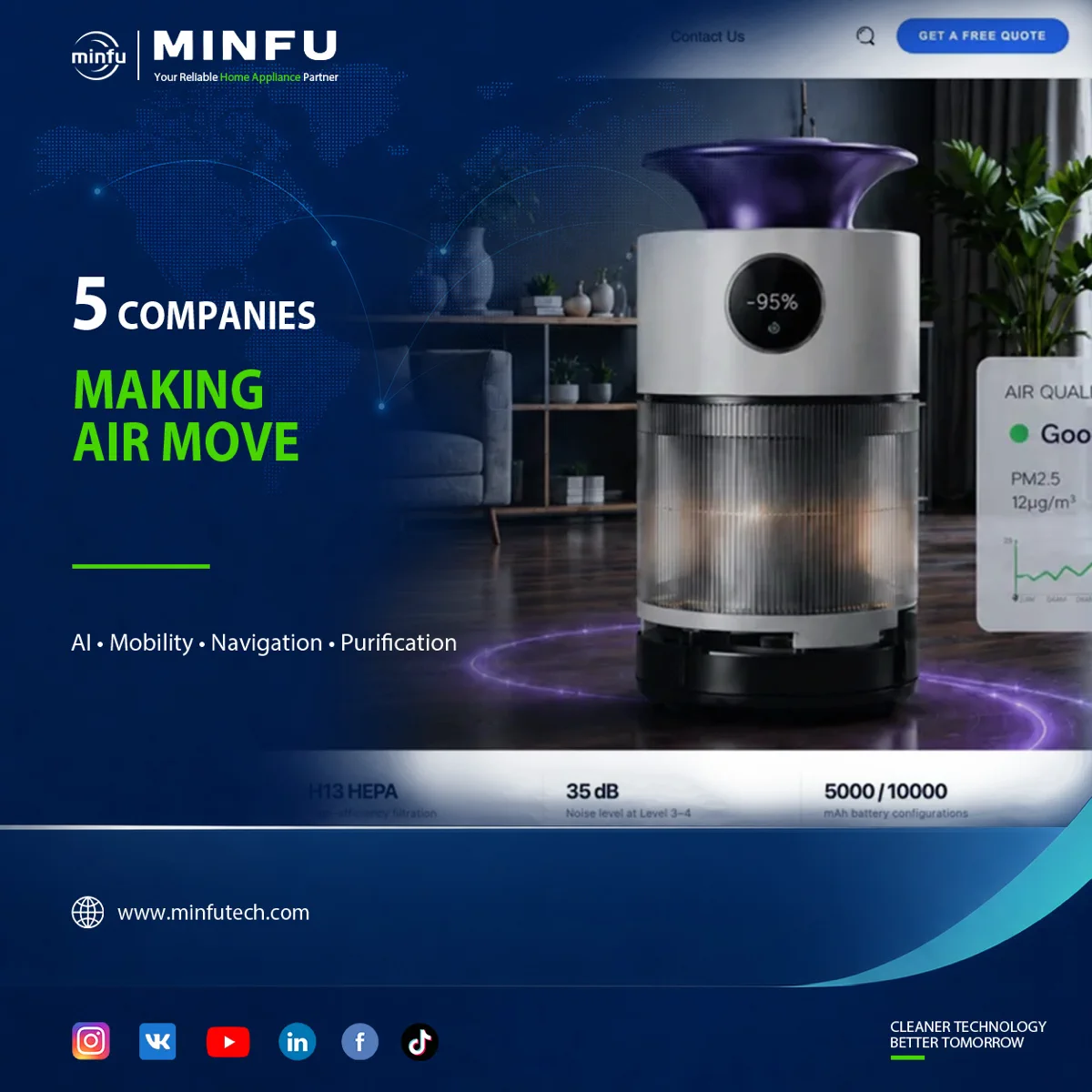
The current Minfu platform combines a particle CADR of 698.3 m³/h, H13 HEPA filtration, LDS mapping, obstacle avoidance, automatic recharge, room zoning, Tuya control and real-time air-quality sensing. It is also available with 5000mAh and 10000mAh battery configurations.
But we do not think the most important specification is any one of those numbers.
The part we find more interesting is the operating logic:
sense → decide → move → stay → purify → update.
A stationary smart purifier may detect changing air quality and adjust fan speed.
A mobile platform has another possible response:
change location.
That changes the role of the air-quality sensor.
It is no longer controlling only the fan.
It can become one of the inputs deciding where the purifier should work.
For private-label buyers, this also creates a different kind of product story.
Traditional air-purifier competition often becomes:
CADR vs CADR
HEPA vs HEPA
price vs price.
Mobility gives the brand something customers can actually see:
the purifier maps;
it moves;
it reaches another area;
it stops where attention is needed;
and it returns to charge.
That visible difference is one reason we think the category deserves attention from air-care brands, smart-home brands and home-robotics distributors.

3. SOTO — Mobile Purification Designed Around Medical and Commercial Use
SOTO approaches mobility from another angle again.
Its SOTO-RA is positioned as a medical air purifier robot rather than primarily as a lifestyle smart-home appliance.
The unit combines filtration and disinfection with autonomous movement. According to SOTO, it can construct maps using laser scanning, use a SLAM-based ultrasonic system for navigation and obstacle avoidance, operate in map-guided purification modes, and return to its charging station automatically.
It also monitors information including PM2.5 and TVOC and supports scheduled purification tasks.
This changes the product story considerably.
The consumer version of mobile air purification asks:
Can one purifier move around my home?
SOTO’s approach asks something closer to:
Can purification become an autonomous task inside a facility?
Those are different buying conversations.
For commercial environments, mobility can be valuable not because the robot looks futuristic, but because one machine may be scheduled to service different defined areas.
What buyers can learn from SOTO
The same underlying mobile-purification concept can be positioned very differently depending on the sales channel.
For consumer retail:
convenience and smart-home value matter.
For projects and facilities:
task scheduling, coverage, serviceability, reliability and operating records may matter more.
That is why we do not think there will be one universal “best” robotic air purifier design.

4. Eriksen — A Straightforward Integrated Air Purifier Robot
Eriksen’s O200 represents a more direct interpretation of the category.
The product is listed as an Air Purifier Robot combining an H13 HEPA filtration system with autonomous navigation.
Its published specification includes SLAM-based navigation, LiDAR, obstacle-avoidance sensors, automatic docking and environmental monitoring for PM2.5, VOCs, temperature and humidity.
The stated CADR is 300 m³/h, with positioning across homes, hospitality, healthcare and workspaces.
What makes this example useful is its simplicity.
It looks less like an experimental concept and more like a straightforward answer to the question:
What if we take a full-size purifier and give it autonomous mobility?
That is likely to become one of the recurring product architectures in this category.
Purification remains the primary job.
The robot exists to change where the purification happens.
What buyers can learn from Eriksen
Mobility does not automatically require turning the appliance into an all-purpose home robot.
For many distributors, that may actually be an advantage.
A product that can be explained in one sentence is easier to put into a catalogue:
It is an air purifier that moves between areas by itself.
Simple product stories often travel well across retail, exhibitions and distributor sales teams.

5. SwitchBot — What If the Purifier Does Not Need Its Own Robot?
SwitchBot took a completely different route.
Instead of building one integrated machine where the purifier and robot are permanently combined, the company created the K20+ Pro mobile platform.
The K20+ Pro can physically transport compatible SwitchBot devices, including its air purifier.
SwitchBot explicitly markets the K20+ Pro Air Purifier Kit around whole-home coverage, using AI navigation, 3D obstacle detection and LiDAR to move the system through the home.
The company even describes a scenario where poor air quality in one area can lead the K20+ Pro to bring the purifier into that room.
This is a fundamentally different product philosophy.
ECOVACS says:
The purifier is a robot.
SwitchBot says:
The robot is a mobile platform that can carry the purifier.
That distinction matters.
A modular system creates possibilities beyond purification. The same moving platform can potentially support cameras, fans, displays or other smart-home devices.
The trade-off is that the complete system becomes more visually and mechanically complex than an integrated purifier robot.
SwitchBot’s own support information also shows how the purifier affects mobile-base runtime depending on fan level, illustrating another challenge of this product category: moving and purifying both consume energy.
What buyers can learn from SwitchBot
There may not be one correct architecture for mobile purification.
A distributor or smart-home brand could eventually choose between:
integrated appliance
and
modular mobile platform.
That decision affects retail storytelling, price, service complexity and future ecosystem expansion.

Five Companies, Five Different Bets
After looking at these products, what stands out to us is how early the category still feels.
There is not yet one settled formula for an AI mobile air purifier.
ECOVACS is treating it as a dedicated home robot.
SwitchBot is treating mobility as a reusable platform.
SOTO is approaching it as an autonomous facility purification tool.
Eriksen presents it as a straightforward integrated mobile purifier.
We are approaching it as an OEM/ODM product platform that different brands can adapt to their channels.
That variety is actually a good sign.
Mature categories tend to converge.
Young categories experiment.
And right now, mobile air purification is still experimenting with what the product should become.
Is “AI” Really the Important Part?
We think buyers should be careful here.
Putting the letters AI on the carton is easy.
The useful question is:
What decision is the product making that a conventional purifier cannot?
If the answer is only:
It automatically changes fan speed when PM2.5 increases,
that is useful automation, but it does not require mobility.
For a robotic purifier, we think more interesting questions are:
- Can it understand room layout?
- Can it identify different areas?
- Can air-quality information affect where it goes?
- Can it decide where to stay longer?
- Can it avoid getting trapped?
- Can it reliably return to the charger?
- Does the air-quality reading remain consistent as the robot moves?
Those are the questions that separate a marketing label from an actual mobile air-management system.
We will look at that much more closely in a separate article about what the AI in an AI air purifier is actually doing, rather than turning this company list into another general AI explainer.
What Should Distributors Watch Next?
If we were evaluating this category for a retail or private-label launch, we would watch four areas.
1. Mobility That Actually Solves a Problem
Movement by itself is not value.
The purifier has to reach places where purification is useful.
That means navigation quality matters just as much as movement speed.
2. Air Sensing That Changes Behavior
A product becomes more interesting when sensor data affects what the robot does, not just what it displays.
That is where targeted purification starts becoming different from simply putting a purifier on wheels.
3. Battery Life Under Real Purification Load
A robot may have an impressive battery specification, but high fan speed and continuous movement both consume energy.
Buyers should evaluate usable patrol time under the actual purification mode they expect customers to use.
4. A Product Story Customers Understand Quickly
This matters more commercially than many engineers like to admit.
If a salesperson needs fifteen minutes to explain why the product exists, retail becomes difficult.
The strongest positioning is probably still the simplest:
Traditional purifiers stay in one place. This one can go where cleaner air is needed.
That is understandable in seconds.
Which Type of Company Should a Buyer Choose?
That depends on what the buyer is actually trying to do.
If you want an established consumer robotics ecosystem, a company like ECOVACS represents one approach.
If you want modular smart-home experimentation, SwitchBot represents another.
If the project is medical or facility-focused, SOTO’s positioning is particularly relevant.
If you are researching integrated commercial mobile purifiers, the O200 approach is worth studying.
And if you are a brand, importer or distributor looking for a mobile air purifier manufacturer that can discuss private labeling, battery configuration, branding, packaging, app configuration and project customization, that is the part of the market we are developing at Minfu.
The important thing is not to assume all five products compete for exactly the same customer.
They do not.
They are evidence that several industries are arriving at the same question from different directions:
Why should air purification remain stationary?
FAQ
What are the leading AI mobile air purifier companies?
The category is still relatively small. Companies with publicly documented mobile air-purification products or platforms include ECOVACS, SwitchBot, SOTO, Eriksen and Minfu. Their product architectures and target markets differ significantly.
What is a robotic air purifier?
A robotic air purifier combines air purification with autonomous mobility. Depending on the product, it may include mapping, navigation, obstacle avoidance, environmental sensors, room zoning and automatic charging.
Are all AI air purifiers robotic?
No. Most smart or AI-labelled air purifiers remain stationary. They may use sensors and algorithms to change fan speed or operating mode without physically moving between rooms.
What is the difference between a mobile air purifier and a normal purifier with wheels?
A normal purifier with caster wheels still requires a person to move it. A true mobile or robotic air purifier can navigate and relocate autonomously.
Are there many robotic air purifier brands?
There are fewer clearly documented commercial products than the broader “smart air purifier” category. This is one reason we limited this list to five companies with identifiable mobile-purification products or platforms.
Can robotic air purifiers be private labelled?
That depends on the supplier. Consumer brands generally sell within their own ecosystems. Minfu is developing its mobile purifier specifically as an OEM/ODM manufacturing platform for brands, distributors and importers.
Work With Minfu
Looking for a differentiated air-care product for your next private-label project?
Minfu provides OEM/ODM manufacturing, product development, customization, quality control and mass-production support for brands, importers, distributors and retailers.
Our new AI mobile air-purifier platform combines air purification with autonomous mobility, sensing, room mapping and smart control, creating a different product story from conventional stationary purifiers.
Contact Minfu to discuss your target market, sales channel, configuration, samples and OEM/ODM requirements.