

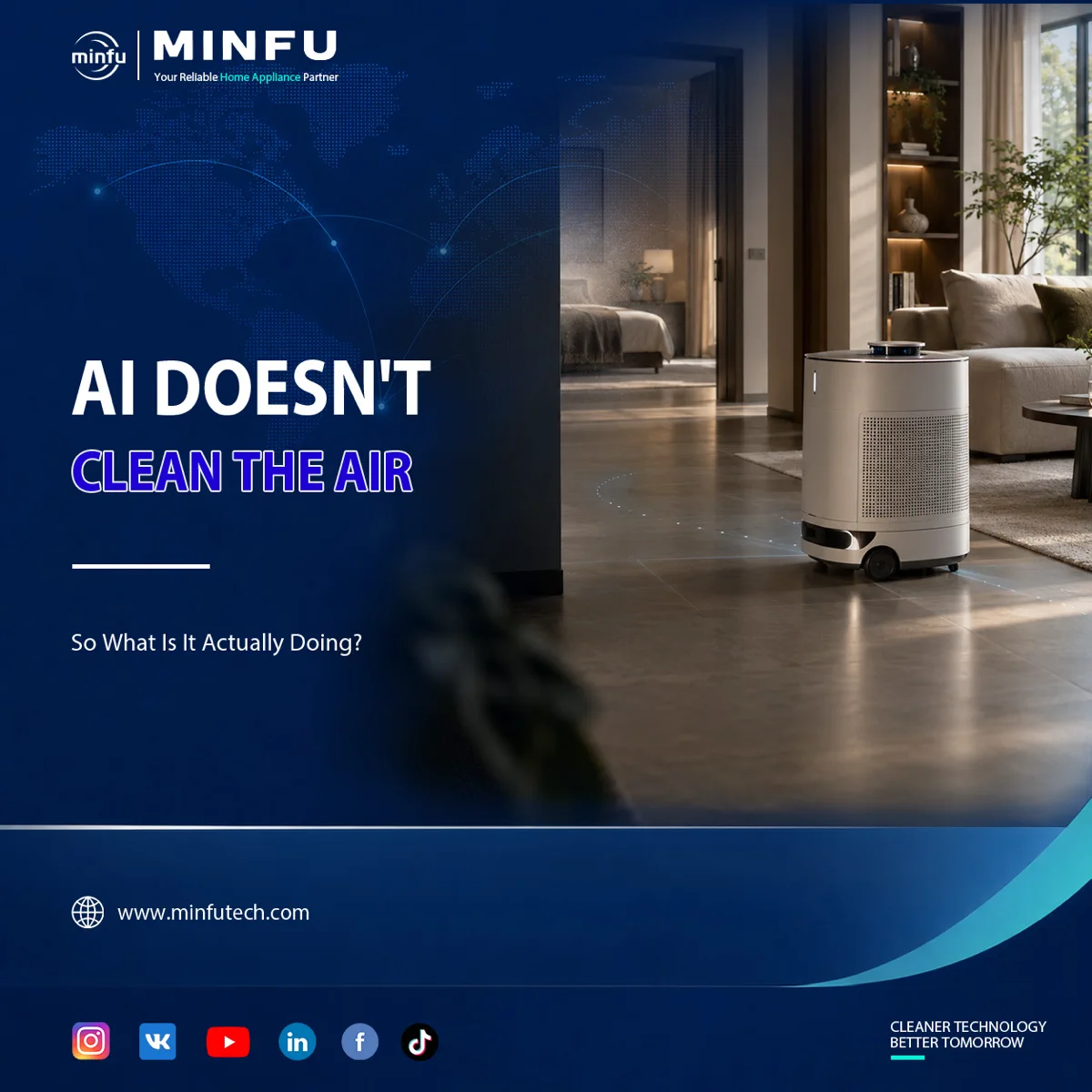

The AI does not clean the air.
That may sound like a strange way to begin an article about an AI air purifier, but it is probably the most useful place to start.
Air is still physically cleaned by airflow, filtration media, adsorption materials and other purification components.
A HEPA filter does not suddenly become more efficient because the product has “AI” printed on the carton.
A weak airflow system does not become powerful because an algorithm is running in the background.
So when buyers ask us at Minfu what the AI in an air purifier actually does, we think the better question is:
What decisions can the product make that a conventional purifier cannot?
That distinction matters more now because the term “AI air purifier” is being used for very different kinds of products.
Some automatically change fan speed.
Some learn or predict changes in indoor air quality.
Some combine several sensor inputs.
And a newer group of mobile air purifiers can add another decision entirely:
where should the purifier go?
That is where the conversation becomes much more interesting.
The First Thing to Understand: AI Is Not the Purification System
Before talking about algorithms, we need to separate two layers of the product.
The first is the physical purification system.
That includes things such as:
- fan and motor;
- airflow path;
- HEPA filtration;
- gas filtration;
- filter resistance;
- sealing;
- CADR;
- and filter condition.
The second is the decision layer.
That decides things such as:
- when the purifier should run;
- how fast it should run;
- which mode it should use;
- how long it should stay in that mode;
- and, in a mobile purifier, where it should operate.
The U.S. EPA makes the physical side quite clear: air-cleaner effectiveness depends on both how effectively pollutants are collected and how much air moves through the cleaner. A highly efficient filter with insufficient airflow is still limited.
AI cannot replace that engineering.
What it can potentially improve is how the hardware is used.
That distinction is important for OEM buyers because a sophisticated app and algorithm should never distract from basic questions such as CADR, filtration, noise, filter loading and product reliability.
A Sensor Is Not AI
This is probably where the most confusion begins.
Imagine a conventional air purifier with a PM2.5 sensor.
The logic could be:
PM2.5 below Level A → Low fan
PM2.5 reaches Level B → Medium fan
PM2.5 reaches Level C → High fan
That is useful.
But it is essentially a predefined control rule.
The sensor measures something.
The controller checks the value against a threshold.
The machine performs a predefined response.
Calling every version of that behavior “AI” does not tell a buyer very much.
The EPA itself describes a common use of indoor air sensors as triggering an appliance action—for example, switching on an air cleaner when certain conditions are detected.
So the existence of:
sensor → automatic response
alone does not explain what makes one product more intelligent than another.
The more useful question is:
How many inputs influence the decision, how is the information interpreted, and how many possible actions can the system choose from?
Smart Air Purifier vs AI Air Purifier: Where Is the Difference?
There is no single product architecture used by every company calling a purifier “AI.”
In fact, current products show just how broad the term has become.
Samsung’s Infinite AI Air Purifier uses its AI+ Clean function to learn from indoor and outdoor air-quality data, predict pollution levels and activate purification in advance.
LG describes AI functionality in its PuriCare air-purifier line that monitors real-time air quality and adjusts operation accordingly.
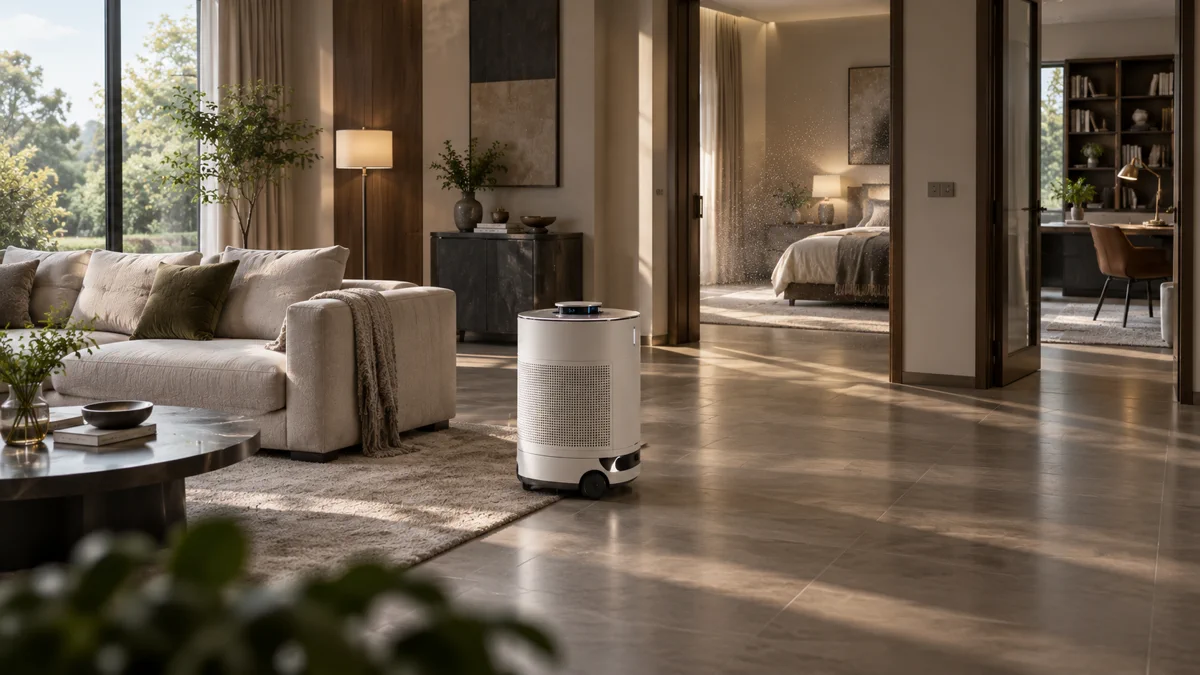
Then there are mobile products such as ECOVACS AIRBOT. ECOVACS documents a linked-purification function where air-quality data from a monitor can trigger AIRBOT to travel to a specified area, perform purification and later return to its charging dock.
These are very different levels of action.
A useful way for buyers to think about them is:
| Product Logic | What Changes |
|---|---|
| Connected purifier | User can control it through an app |
| Automatic purifier | Sensor value changes fan mode |
| Adaptive / predictive purifier | Several data inputs or learned patterns influence operation |
| AI mobile air purifier | Air-quality information can also influence where purification happens |
This is why we do not think the word “AI” itself is enough to evaluate a product.
The decision loop matters.
A Useful AI Air Purifier Needs Five Things to Happen
From an engineering and product-development perspective, we find it useful to break the process into five steps:
1. Sense
The purifier first needs information.
Depending on the platform, that could include:
- particulate concentration;
- gas or VOC information;
- temperature;
- humidity;
- location;
- room identity;
- operating mode;
- battery level;
- or other environmental inputs.
The exact sensor stack matters because an algorithm cannot respond to information the hardware never measures.
2. Interpret
A number appearing on a sensor does not automatically mean the machine should react immediately.
The control system may need to consider questions such as:
Is this change temporary?
Has the reading remained elevated long enough to matter?
Does another sensor support the same conclusion?
Is the purifier currently close to the source?
Is this reading different from another room?
This is where filtering, sensor fusion and decision logic start becoming important.
3. Decide
Once the system understands the inputs, it has to choose an action.
For a stationary purifier, that decision may be:
change fan speed.
For a more sophisticated product it could involve:
run longer;
change mode;
reduce power;
increase purification;
or potentially predict that purification will soon be needed.
For an AI mobile air purifier, the decision space becomes larger:
stay here or move somewhere else?
That one additional decision changes the entire product architecture.
4. Act
An intelligent decision is useless if the hardware cannot execute it reliably.
For a stationary machine:
Action = airflow control
For a mobile platform:
Action = airflow + navigation
That introduces another complete engineering system:
- mapping;
- route planning;
- localization;
- obstacle avoidance;
- room zoning;
- no-go areas;
- docking;
- battery management.
Now the purifier is no longer simply an air-care appliance.
It is also a robot.
5. Verify
After acting, the system should continue observing what happens.
Did air quality improve?
Should the purifier remain there?
Should the fan slow down?
Should it move again?
Does it need to recharge?
This creates a loop:
Sense → Interpret → Decide → Act → Measure Again
For us, that loop is much more meaningful than simply putting the letters “AI” on a specification sheet.
Mobility Changes What an Air-Quality Sensor Can Do
This is one reason we became interested in developing an AI mobile air purifier robot.
In a normal stationary purifier, a sensor can influence operation.
But the machine stays where someone originally placed it.
The sensor may say:
Air quality is bad.
The machine responds:
I will work harder here.
A mobile platform introduces another possibility:
Air quality is worse somewhere else.
And then:
I can go there.
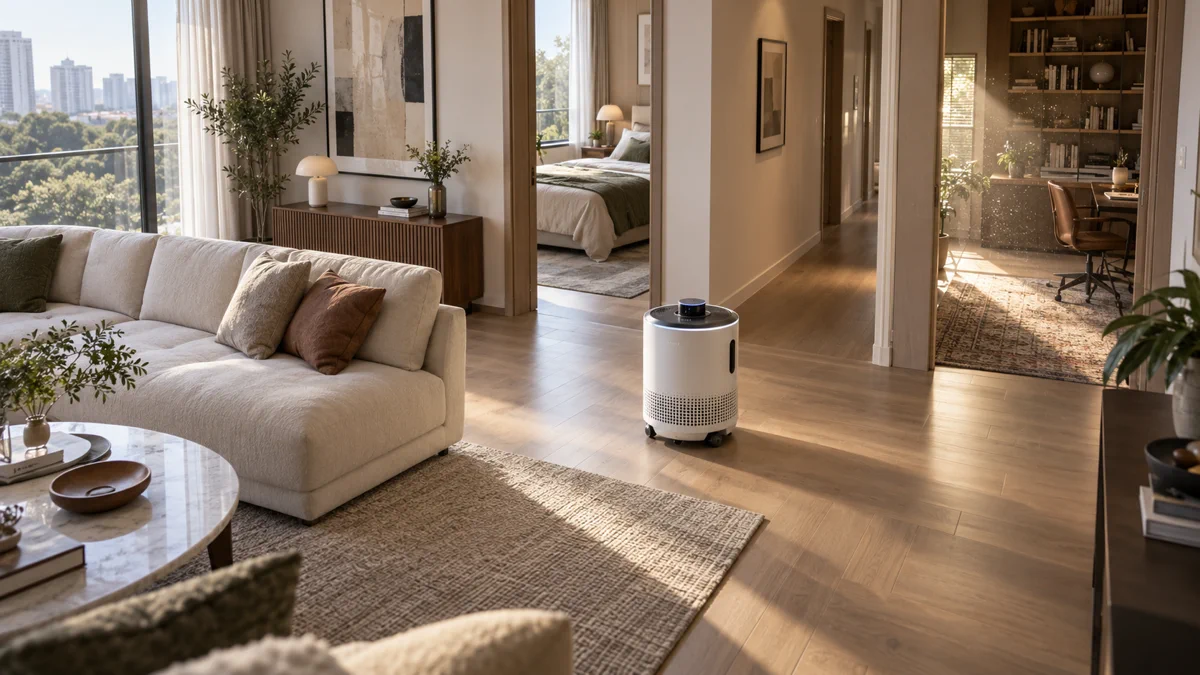
Our current Minfu platform combines real-time air-quality sensing with LDS full-home mapping, route planning, room zoning, obstacle avoidance, targeted stay and automatic recharge. Its current published purification platform includes 698.3 m³/h particle CADR, 560 m³/h gas CADR and H13 HEPA filtration.
The important product idea is not simply that the machine has wheels.
It is the possibility of connecting:
air-quality information
with
location and movement.
That is a much more useful definition of intelligent mobility.
But More Data Does Not Automatically Mean Better AI
There is another side buyers should understand.
Every decision depends on the quality of the inputs.
If a sensor gives poor information, a sophisticated algorithm can still make a bad decision.
Indoor air sensors have real limitations.
EPA guidance notes that sensor readings can be affected by factors such as:
- temperature;
- relative humidity;
- sensor placement;
- pollutant type;
- calibration;
- and the specific contaminant the sensor was designed to measure.
A sensor that measures particulate matter cannot tell you everything about every possible indoor pollutant.
Placement matters too.
EPA guidance recommends considering airflow around indoor sensors and notes that measurements close to pollution sources, windows, HVAC outlets or even air cleaners themselves may not represent the broader room.
This becomes especially interesting for a mobile purifier.
The sensor itself is moving.
That means the engineering team needs to think about:
When should the reading be trusted?
How long should the machine sample one area?
Is the purifier measuring ambient room air or air affected by its own outlet?
How should sudden short-term changes be handled?
This is where the quality of implementation matters more than the marketing label.
The Best AI Cannot Fix a Bad Air Purifier
This deserves its own section because it is an easy mistake for product teams to make.
Suppose a purifier has:
excellent mapping,
beautiful app visualization,
advanced sensing,
and sophisticated automation.
But its physical purification system has poor airflow.
The result is still a poor purifier.
The opposite problem can happen too.
A purifier can have excellent CADR and filtration but a poor navigation system that:
- gets trapped;
- repeatedly misses rooms;
- cannot find the dock;
- responds to the wrong area;
- or spends too much battery simply driving around.
The product has to succeed at both jobs.
For a mobile air purifier:
Purification performance × robotic reliability
is a better way to think about the total product than:
AI = better.
That is one reason our product page deliberately separates the mobility story from the purification core. Buyers still need to evaluate CADR, filtration, noise, battery configuration and the complete hardware platform.
What AI Cannot Tell You About Indoor Air
AI also should not be treated as a universal environmental-health detector.
A purifier only knows what its sensors and connected data sources allow it to know.
If a machine has a particulate sensor, it may respond to airborne particle concentration.
That does not automatically mean it can identify:
- carbon monoxide;
- radon;
- every VOC;
- every allergen;
- every biological contaminant;
- or every cause of poor indoor air quality.
EPA guidance specifically notes that consumer air monitors do not provide a complete representation of indoor air quality and can only detect the pollutants or environmental factors their sensors are designed to measure.
Likewise, an air purifier is a supplement to source control and ventilation—not a machine that magically solves every indoor air-quality problem.
For brands, this matters because AI claims should remain connected to demonstrable product behavior.
“Detects PM2.5 and adjusts purification” is testable.
“Understands everything about your home’s air” is a very different claim.
So What Should an OEM Buyer Ask When a Supplier Says “AI”?
This is where we think procurement teams can quickly separate a useful system from a marketing label.
Do not begin with:
Does it have AI?
Almost every supplier can answer yes.
Instead ask:
What does the product actually measure?
Which sensors?
Which pollutants?
Which environmental variables?
What decisions can those inputs change?
Only fan speed?
Operating schedule?
Purification mode?
Room selection?
Movement?
Dwell time?
Can we reproduce the behavior?
If the air-quality condition changes in a controlled test:
does the machine respond the same way repeatedly?
What happens when readings change quickly?
Does the purifier react to every short spike?
Does it wait?
Does it verify the condition?
What happens when the purifier moves?
Does the sensor stabilize?
Does it recognize meaningful differences between zones?
Does it spend enough time in each area to generate a useful reading?
What happens when the battery gets low?
Does purification stop?
Does it finish the task?
Does it recharge and continue?
What happens when Wi-Fi disappears?
Can the core sensing and movement logic still operate locally?
Which functions depend on the cloud or app?
Can firmware changes alter the approved behavior?
For an OEM project, software is part of the product specification.
A change to decision thresholds, route logic or fan control can change the user experience even if the hardware BOM remains identical.
These questions are much more useful than asking whether the carton can carry an AI logo.
How We Would Test the “AI” Before Approving a Bulk Order
For an ordinary stationary air purifier, buyers may focus heavily on CADR, noise and filtration.
For an AI-powered mobile purifier, we would add a behavioral test.
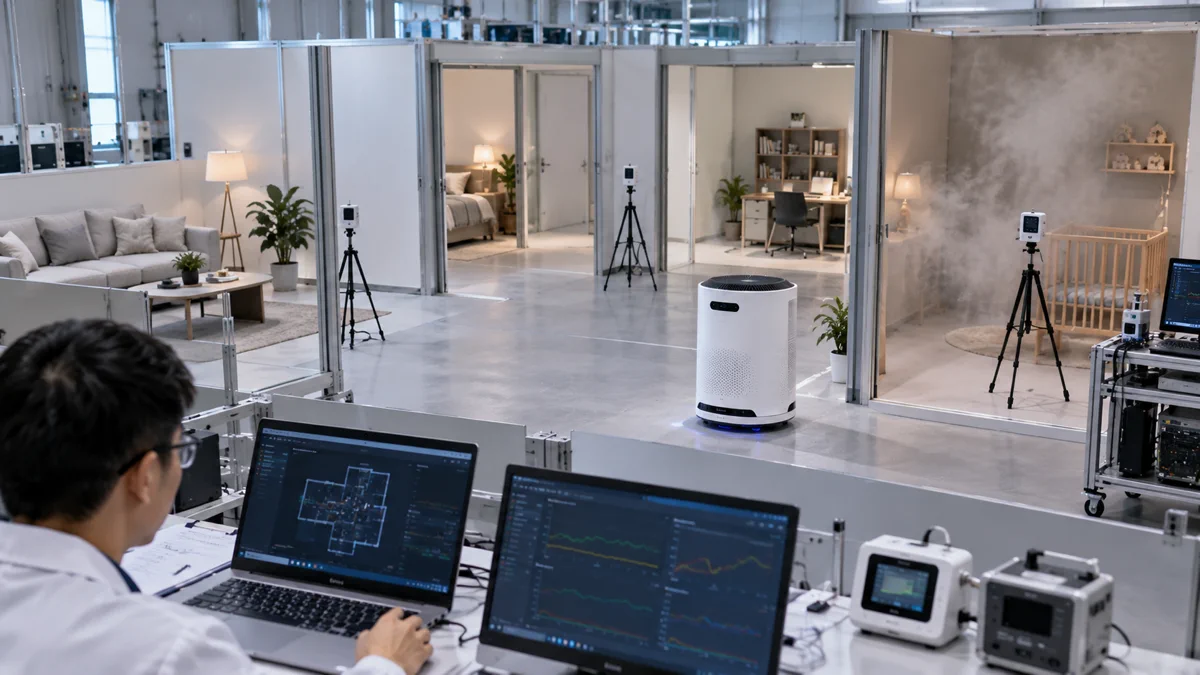
One useful test layout could divide a controlled indoor space into several zones.
Start with the purifier in Zone A.
Then introduce a controlled air-quality change in Zone B.
Observe:
1. Does the sensor detect the change?
2. Does the control system determine that another area needs attention?
3. Does the machine navigate to the intended location?
4. Does it stop in an appropriate position?
5. Does it remain long enough to perform the assigned purification task?
6. Does its reading change as the environment improves?
7. Does the system know when to finish or move on?
8. Can it return to the charger reliably afterward?
Then repeat the test.
Once is a demonstration.
Repeated behavior is validation.
For B2B buyers, that distinction matters.
A Useful AI Feature Should Be Easy to Explain
There is also a commercial side to this.
Buyers do not only purchase technology.
They purchase something their sales team eventually has to explain.
Compare these two product descriptions.
The first:
AI-enabled algorithmic intelligent indoor environmental management platform.
Technically impressive.
Commercially difficult.
Now this:
It detects where air quality is worse and can move there to purify.
That is much easier to understand.
This matters for:
- distributor catalogues;
- retail staff;
- trade shows;
- e-commerce video;
- product demonstrations;
- and social media.
One reason we think mobile air purification has interesting potential is that the intelligent behavior can become visible.
Customers can watch the machine:
sense
move
stop
purify
return
The “AI” is no longer only happening invisibly inside a PCB.
Its decisions create visible product behavior.
AI Should Create a Better Product, Not Just a Better Specification Sheet
The air-purifier industry already has enough specifications to compare.
CADR.
HEPA grade.
Noise.
Coverage area.
Filter life.
Sensors.
App control.
Adding another line that says:
AI Technology
does not automatically create a new product category.
What matters is whether intelligence changes something meaningful.
Can the machine respond better?
Can it reduce unnecessary operation?
Can it adapt to changing conditions?
Can it make a more useful decision?
And for a mobile purifier:
Can it decide not only how to purify, but where purification should happen?
That is the question we think makes this category worth watching.
How We Think About AI at Minfu
From our side as an OEM/ODM manufacturer, we prefer to work backwards.
First:
Does the purifier physically perform?
Then:
Can the sensing system produce useful and repeatable data?
Then:
Can the robot move reliably?
Only after those layers are working together does the intelligence layer become valuable.
Our current AI mobile air purifier robot platform combines air-quality sensing, algorithmic decision-making, autonomous mobility, LDS mapping, room zoning, targeted purification and automatic charging.
But for an OEM project, those features still need to be translated into specific, testable requirements.
If a buyer wants a different sensor strategy, patrol logic, battery configuration, app setup or market positioning, the discussion should eventually become:
What should the machine do?
Under what condition?
How do we verify it?
That is how “AI” becomes an engineering specification rather than a marketing word.
Our Simple Test for Any AI Air Purifier Claim
When we see the phrase AI air purifier, we now ask five questions:
What does it sense?
What does it understand from that information?
What decision can it make?
What physical action changes because of that decision?
Can we test the result repeatedly?
If those questions have clear answers, the AI label starts becoming useful.
If they do not, the label may be doing more work than the technology.
And as more air-care products add sensing, prediction, connected data and autonomous mobility, we think that distinction will become increasingly important for buyers.
Because the future of air purification probably will not be decided by who puts “AI” on the carton first.
It will be decided by whether the intelligence actually gives the machine something useful to do.
FAQ
What is an AI air purifier?
An AI air purifier uses sensor data and software logic to make or adapt operating decisions. Depending on the product, this may involve adjusting fan speed, predicting air-quality changes, selecting modes or, in a mobile purifier, deciding where purification should take place.
How does an AI air purifier work?
Typically, sensors collect environmental data, software interprets the information, the control system chooses an action, and the purifier then continues monitoring conditions. More advanced systems may combine multiple data sources, prediction, mapping or autonomous movement.
Is an AI air purifier better than a smart air purifier?
Not automatically. “Smart” and “AI” are used differently across brands. Buyers should compare what the product actually senses and what decisions it can make rather than judging the product from the label alone.
Does AI improve HEPA filtration?
No. AI does not change the physical filtration efficiency of the HEPA media itself. It can influence when, how or where the filtration system operates.
Can an AI air purifier detect every indoor pollutant?
No. A purifier can only respond to pollutants or environmental conditions that its sensors or connected data sources can detect. Different sensors have different limitations.
What makes an AI mobile air purifier different?
Mobility adds location as another possible decision. Instead of only adjusting fan speed where the purifier is currently positioned, a mobile system can potentially use air-quality data together with mapping and navigation to determine where it should operate.
What should OEM buyers test on an AI air purifier?
In addition to CADR, filtration, noise and electrical performance, buyers should evaluate sensor consistency, decision logic, navigation, hotspot response, docking, battery behavior, app/firmware operation and repeatability.
Work With Minfu
Looking for a differentiated smart air-care product for your market?
Minfu provides one-stop OEM/ODM manufacturing, product development, customization, quality control and mass-production support for brands, importers, distributors and retailers worldwide.
Our AI mobile air purifier platform combines purification, sensing, autonomous mobility and smart control to create a different product story from conventional stationary air purifiers.
Website: minfutech.com
OEM/ODM Solutions: /oem-odm-solutions/
Email: info@minfutech.com
WhatsApp / Phone: +86 13760255781
Contact: /contact-minfu/
Contact Minfu to discuss your target market, product configuration, samples and OEM/ODM requirements.