

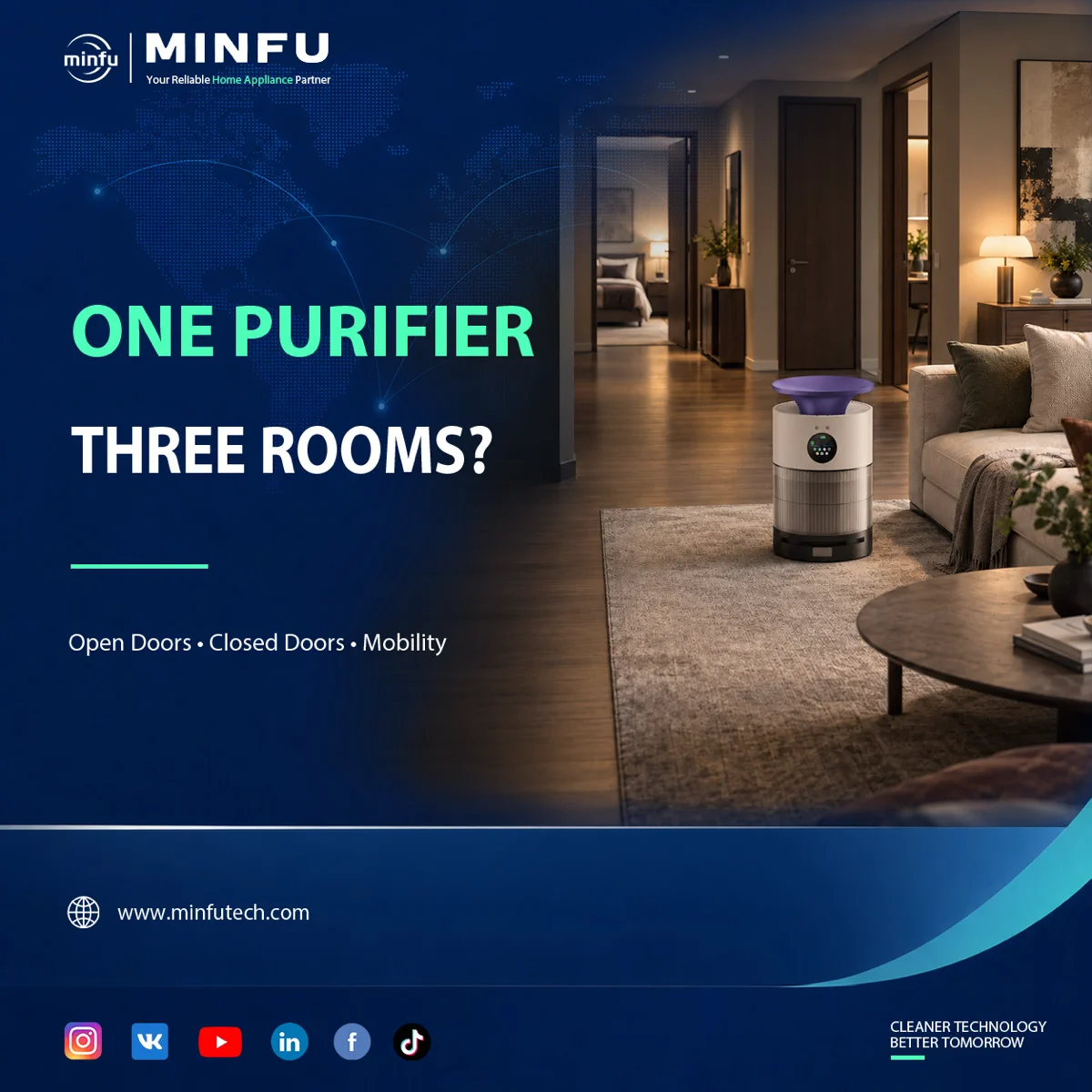

A powerful air purifier in the middle of a home sounds like a simple solution. If the machine has a high CADR and the bedroom or home office is only a few metres away, it is reasonable to ask why anyone would need several purifiers. Why not use one strong unit for the entire home?
The problem is that an air purifier does not clean a floor plan. It cleans the air that can actually reach its intake. Walls, doors, hallways and room layout determine how easily air moves from one space to another, which means a purifier can perform extremely well in the room where it is standing while producing a much weaker effect elsewhere.
This is why the question “Can one air purifier clean multiple rooms?” cannot be answered from CADR alone. The real answer depends on how the rooms are connected, whether doors are open or closed, how the air circulates, where the purifier is placed and whether the purifier itself can change location.
An Air Purifier Can Only Clean the Air That Reaches It
Consider a purifier operating in a living room. Air enters the machine, particles are captured, and cleaner air is returned to the room. Over time, the purifier repeatedly processes the air circulating through that space.
Now imagine a bedroom ten metres away. Between the bedroom and the purifier there may be a doorway, a hallway, several corners and furniture. If the bedroom door is closed, the purifier is not directly drawing that room’s air through a duct. It is relying on whatever natural air leakage and air exchange exists between the two spaces.
This is an important distinction. A high-performance fan may move a large volume of air through the purifier itself, but that does not mean the machine can force air from every separate room in a house to pass through the filter at the same rate.
For B2B buyers, this is one reason a large whole-home coverage claim should always be examined carefully. The purifier may have enough theoretical clean-air capacity for the total air volume, but the building layout may prevent that capacity from being distributed evenly.
Open-Plan Space and Multiple Rooms Are Not the Same Problem
An open-plan living room, dining room and kitchen can often behave more like one large connected air zone because there are few physical barriers between them. In that situation, one properly sized high-CADR purifier may be a reasonable solution if its airflow is not obstructed.
Now take the same total floor area and divide it into a living room, bedroom, office and hallway. The total number of square metres may be almost identical, but the way air moves through the home is completely different.
This is why a 40 m² open-plan apartment and four separate 10 m² rooms should not automatically be treated as the same air-purification problem. Their floor area is the same, but their airflow paths are not.

For brands and distributors, this distinction is commercially important because customers frequently judge an air purifier by a single coverage-area number. A product may be advertised for a large area, yet customers can still experience uneven results when they use it in a heavily divided home.
A Closed Door Can Change the Result Significantly
Doors are one of the simplest variables and one of the easiest to ignore. When a bedroom door is open, air can exchange more freely with the hallway and surrounding areas. When the door is closed, the room becomes much more isolated.
This does not mean a purifier located outside a closed room has absolutely no influence inside it. Air can still move through gaps and through normal building air exchange. The issue is speed and consistency. The purifier may clean the room where it is installed quickly while the closed bedroom improves much more slowly.
This is why statements such as “one purifier cannot clean another room” are too absolute, but saying “one purifier cleans every room equally” is equally misleading. Real homes sit somewhere in between, and door position can make a noticeable difference.

High CADR Does Not Remove the Airflow Problem
This connects directly to our previous article about air purifier CADR and room size.
Imagine a purifier with a CADR of approximately 700 m³/h installed in a home containing 150 m³ of air. A simple calculation gives roughly 4.7 equivalent clean-air changes per hour. On paper, that looks strong.
However, that calculation assumes the 150 m³ behaves like one well-mixed volume. A real home may contain three or four separate rooms with different door positions and different levels of air exchange. The purifier may therefore process the living-room air repeatedly while air from the bedroom reaches the machine much more slowly.
This is an important point for buyers: the calculation itself may be correct while the assumption behind the calculation is wrong.
CADR tells us how much clean air the purification system can deliver. It does not tell us how effectively the building will distribute untreated air toward the purifier.
Placement Becomes Part of the Performance
The same purifier can behave differently depending on where it is installed. A unit hidden behind furniture, placed in a narrow corner or positioned where its inlet and outlet are obstructed may not interact with the room air as effectively as expected.
For a customer who owns only one stationary purifier, placement also creates a practical compromise. During the day, the living room may be the priority. At night, the bedroom may matter more. A stationary purifier cannot be in both places at the same time.
Customers can solve part of this problem manually by moving the purifier between rooms. Many portable air cleaners are used this way: living room during the day, bedroom at night. The concept is simple and effective, but it requires someone to remember to move the machine, unplug it, find another suitable position and reconnect it.
This is where mobile purification starts to become more interesting.
Mobility Does Not Increase CADR — It Changes Where CADR Is Applied
A mobile air purifier does not suddenly become more powerful because it has wheels. A 700 m³/h purification system is still a 700 m³/h purification system whether the machine is stationary or moving.
What mobility changes is location.
A stationary purifier asks, in effect, “How can I clean the air from this position?” A mobile purifier can potentially ask, “Where should I be operating now?”
Our current Minfu AI mobile air purifier robot combines air-quality sensing, LDS mapping, room zoning, autonomous navigation, targeted stay and automatic charging with a published particle CADR of 698.3 m³/h.
For multi-room use, the interesting part is not the wheels themselves. It is the connection between room location, air-quality information and purification time. Instead of depending entirely on bedroom air eventually travelling to a machine in the living room, a mobile platform can physically bring the purification system into the bedroom.
This addresses one limitation of stationary purification, but it does not eliminate every limitation.
One Mobile Purifier Still Cannot Be in Three Rooms at the Same Time
This point is important because “whole-home purification” can easily become an exaggerated marketing claim.
Suppose three bedrooms all require strong filtration at the same moment. A mobile purifier may be able to visit all three rooms, but while it is working in Room A, it is not simultaneously operating inside Rooms B and C.
A mobile purifier should therefore be thought of as a shared purification resource rather than a direct replacement for several independent units.
If a home requires continuous high-rate filtration in three closed rooms at the same time, three correctly sized stationary purifiers have an obvious advantage: they can work simultaneously. A mobile purifier works sequentially.
The value of mobility appears in different situations, such as when different rooms are occupied at different times, pollution hotspots change during the day, customers prefer one premium machine rather than several separate appliances, or periodic targeted purification is more important than continuous simultaneous filtration.
Multi-Room Air Purification Becomes a Scheduling Problem
Once a purifier can move, the question changes from “Can it reach another room?” to “Which room should it serve first, and how long should it stay there?”
Imagine that the living room currently has good air quality, the bedroom has rising particulate levels and the home office has moderate pollution. A sensible mobile system might give the bedroom the highest priority, then visit the office, then return to patrol or recharge.
That means multi-room purification becomes a combination of airflow, sensing, navigation and scheduling.
The system may need to consider room size, current air quality, time since the previous visit, distance, battery condition and required purification time. This connects directly to our previous article about what the AI in an AI air purifier is actually doing. The interesting intelligence is not simply an AI label on the packaging. It is whether environmental information changes the machine’s actual behaviour.
How Long Should the Purifier Stay in Each Room?
This is an important OEM question because there is no universal dwell time that works in every room.
If a purifier enters a bedroom with elevated particulate concentration, should it stay for five minutes, twenty minutes or until the air-quality reading falls below a defined threshold? Should it leave when improvement begins to slow, or should it remain until the target condition is reached?
Different products may use different logic, and that is not necessarily a problem. What matters is that the buyer understands the logic and can test whether it produces consistent results.
A simple preset routine may still be useful. For example, a purifier could spend a fixed period in each mapped room. However, this should not automatically be described as adaptive AI purification. If the product claims that air-quality data affects where it goes and how long it stays, that behaviour should be reproducible during sample testing.
The Sensor Location Matters More Than It First Appears
This question becomes surprisingly important when the air-quality sensor is built into the purifier itself.
Suppose the robot enters a bedroom while the fan is already running. The sensor is now measuring air close to the machine. Is it seeing the true ambient condition of the room, air already affected by the purifier’s circulation, or a mixture of both?
This is why mobile air-quality sensing needs validation. We would want to understand where the sensor intake is located, how long the machine waits after entering a room, whether the reading is stable and whether an independent reference instrument shows a similar trend.
Without this validation, a product may appear to be finding polluted areas when the sensor is actually responding partly to its own operating environment.
The algorithm can only make a good decision if the data feeding that algorithm is reliable.
Doors and Thresholds Become Navigation Problems Too
Even if the purification logic is excellent, the robot still has to physically enter the room.
A mapped bedroom may be inaccessible if the door is closed. A high threshold, thick rug, narrow passage, scattered objects or unusual floor transition may also prevent reliable navigation.
This is why a realistic multi-room claim should be based on accessible mapped rooms, not simply the number of rooms shown on a floor plan.
For buyers evaluating samples, navigation testing should therefore include real residential conditions rather than only a perfectly empty showroom floor.
Door widths, thresholds, furniture layouts and charging-dock placement can all influence whether the machine delivers the experience shown in promotional material.
Multiple Floors Create a Clear Physical Boundary
A floor-based mobile robot normally cannot climb stairs. That means a two-storey house is not one continuous robotic service area unless someone physically moves the purifier between floors.
For this reason, we would not describe a single mobile purifier as a universal whole-house solution for every residential layout.
A more accurate positioning might be:
multi-room active air management
or
room-to-room targeted purification
within an accessible floor.
That language is less dramatic than “whole-home purification,” but it is also more technically defensible.
One Large Purifier, Several Purifiers, or One Mobile Purifier?
There is no single architecture that is best for every customer.
| Setup | Main Advantage | Main Limitation |
|---|---|---|
| One stationary high-CADR purifier | Simple and relatively low device count | Limited direct access to separated rooms |
| Several stationary purifiers | Simultaneous room-by-room filtration | More devices, filters and maintenance |
| One mobile purifier | Can relocate purification between accessible rooms | Rooms are served sequentially |
| Central HVAC filtration | Can distribute filtered air through building ducts | Depends on HVAC design and operating conditions |
A brand should therefore decide what problem the product is intended to solve before deciding which architecture is “better.”
For a small open-plan apartment, a strong stationary purifier may be enough. For several closed bedrooms requiring continuous filtration, multiple units may make more sense. For a premium smart-home customer who wants one machine that can actively serve different rooms at different times, mobility creates a very different value proposition.
The Most Interesting Use Case May Not Be “Whole House”
From our perspective as a manufacturer, we think the phrase “whole-home air purifier” can create more expectations than a mobile product should promise.
Customers may interpret it to mean every room receives continuous and equal purification. That is not how a single mobile unit operates.
A more useful product story is that the purifier can move to where purification is needed, rather than remaining beside one wall all day.
That difference is also easier to demonstrate visually. A customer can watch the machine detect a condition, leave the current room, enter another mapped area, stay there to purify and later return to charge.
The product behaves differently from a traditional tower purifier, and customers can actually see that difference.
How We Would Test Multi-Room Performance Before Mass Production
For an OEM/ODM project, we would not approve a multi-room mobile purifier based only on a one-room CADR test.
A more meaningful validation environment would include several connected simulated residential spaces, such as a living area, bedroom and office. Each room should have an independent reference air-quality instrument.
The purifier would begin from a defined location. A controlled particulate load could then be introduced into one area while the engineering team records whether the machine detects the change, navigates to the intended room, positions itself correctly, remains there for the expected time and produces a measurable improvement on the independent reference instrument.
The test should also record what happens when another room becomes a higher priority, when the battery becomes low, when a doorway is partially blocked and when the robot needs to return to its charging dock.
Most importantly, the sequence should be repeated. A trade-show demonstration only needs to work once. A mass-produced product needs to behave predictably again and again.

A Simple Sample Test Can Still Reveal a Lot
Not every distributor or private-label brand has access to a full air-quality laboratory. A simpler comparative test can still be useful during sample approval.
Use two or three connected rooms and place an independent PM monitor in each one. Record baseline readings, introduce the same controlled particle source under repeatable conditions and observe how a stationary purifier and the mobile purifier behave.
The objective is not to create a certification claim. It is to understand the product. Which room improves first? Does the robot choose the expected room? How long does it remain there? What happens when a door is open or closed? Does navigation take so long that the purification advantage becomes less meaningful?
These observations often reveal more about the user experience than another line of specifications on a quotation sheet.
Mobility Still Depends on Good Purification Hardware
Mobility does not replace CADR, filtration, airflow design or noise control.
If the purification system is weak, moving it between rooms does not suddenly make the filtration stronger. A mobile platform still needs appropriate CADR, effective filtration, reliable airflow, good sealing and acceptable noise.
The two questions should therefore be kept separate:
Is the purifier powerful enough for the room?
Can the purifier reach the room that needs it?
Our previous air purifier CADR and room size article deals with the first question. Multi-room mobility deals mainly with the second.
A strong product needs to answer both.
Could One Mobile Purifier Replace Three Stationary Purifiers?
We would not make that claim as a general rule.
If three closed rooms all require continuous high-rate filtration at the same time, three properly sized stationary purifiers can provide simultaneous service. One mobile unit cannot physically duplicate that because it can only occupy one location at a time.
However, the answer changes if rooms are used at different times or if pollution conditions vary throughout the day. In those situations, one mobile purifier may allow the brand to offer a different ownership model: instead of several simple units, the customer purchases one more intelligent system that actively moves between areas.
Whether that is commercially attractive depends on the target market, retail price, reliability and how clearly the value can be demonstrated.
That is a product-positioning decision, not simply an engineering comparison.
For Distributors, the Benefit Has to Be Easy to Explain
A distributor does not sell SLAM, LDS or navigation algorithms by themselves. Those technologies only matter when they support a customer benefit that can be explained quickly.
For a mobile purifier, one of the clearest messages is:
One purifier that can move from room to room by itself.
Behind that simple sentence are much more complicated systems involving sensing, mapping, navigation, room identification, battery management, charging and purification control.
That combination is what makes the category interesting. It gives brands a visible product difference instead of relying only on another higher CADR number, another HEPA label or another app feature.
Our View: One Purifier Can Serve Multiple Rooms, but It Cannot Ignore Physics
A powerful stationary purifier can influence connected spaces, especially in open-plan homes where air can move relatively freely. Open doors help. Closed rooms make the process slower. Multiple floors create another clear boundary.
A mobile purifier does not remove these physical limitations. What it changes is that the purification system no longer has to remain where the customer first placed it.
Instead of relying entirely on polluted air travelling toward the purifier, the purifier can potentially travel toward the area that needs attention.
That is a much more realistic way to describe the value of mobile air purification than simply claiming “whole-home coverage.”
For us at Minfu, the opportunity is not to pretend one machine replaces every possible air-care setup. It is to develop a product that uses sensing, navigation and purification together so one high-performance platform can actively serve different accessible rooms over time.
That is a different way of thinking about indoor air management, and it is exactly why this category deserves to be tested on real floor plans rather than only on specification sheets.
FAQ
Can one air purifier clean multiple rooms?
One purifier can influence multiple connected rooms, especially when doors are open and air circulates easily between spaces. However, separate rooms may not receive the same purification rate because walls, doors and distance restrict air exchange.
Can one air purifier clean an entire house?
A portable air purifier should not automatically be treated as a whole-house filtration system. Large open-plan spaces are different from homes divided into several closed rooms, and multiple floors create an additional physical boundary.
Does leaving the door open help an air purifier clean another room?
Generally, an open doorway allows easier air exchange between rooms. A closed door restricts that exchange, so a purifier located elsewhere may affect the room more slowly.
Is a high-CADR purifier enough for several rooms?
Not necessarily. CADR describes how much clean air the purifier can deliver, but it does not describe how efficiently air from separate rooms reaches the machine.
Is a mobile air purifier better for multiple rooms?
Mobility can allow the purifier to operate directly inside different accessible rooms instead of remaining fixed in one place. Its advantage is room-to-room relocation, although it still serves rooms sequentially rather than simultaneously.
Can a robotic air purifier move between floors?
Normally not by itself. Stairs create a physical boundary for most floor-based mobile robots, so different floors should usually be treated as separate service areas.
Can one mobile purifier replace several stationary purifiers?
It depends on the use case. If several rooms require continuous filtration at the same time, multiple stationary units have an advantage. If different rooms need attention at different times, a mobile purifier can offer a different and potentially more convenient solution.
Work With Minfu
Minfu provides one-stop OEM/ODM manufacturing, product development, customization, quality control and mass-production support for brands, importers, distributors and retailers worldwide.
Our AI mobile air purifier platform combines air-quality sensing, autonomous navigation, room zoning, targeted purification and automatic charging with a high-performance air-purification system.
Website: minfutech.com
Email: info@minfutech.com
WhatsApp / Phone: +86 13760255781
Contact Us
Contact Minfu to discuss your target market, product requirements, samples and OEM/ODM cooperation.