



A large filter sounds like one of the least complicated features on a robotic pool skimmer. If one machine holds six liters of debris and another holds four, the six-liter option appears to offer an obvious advantage: the customer can collect more leaves before stopping to empty it.
That advantage is real, but the number leaves out most of what happens inside the machine.
A pool skimmer rarely fills with neat, dry material. Leaves become saturated with water and fold together. Flower petals soften. Grass, seeds and small twigs settle into the spaces between larger debris. Fine floating material can coat the filter surface long before the container looks physically full. As the load changes, water still has to move through the collection system while the robot remains stable enough to navigate around the pool.
For importers, the useful question is therefore not simply “How many liters does the filter hold?” It is how much usable debris the system can collect before performance, handling or maintenance becomes noticeably worse.
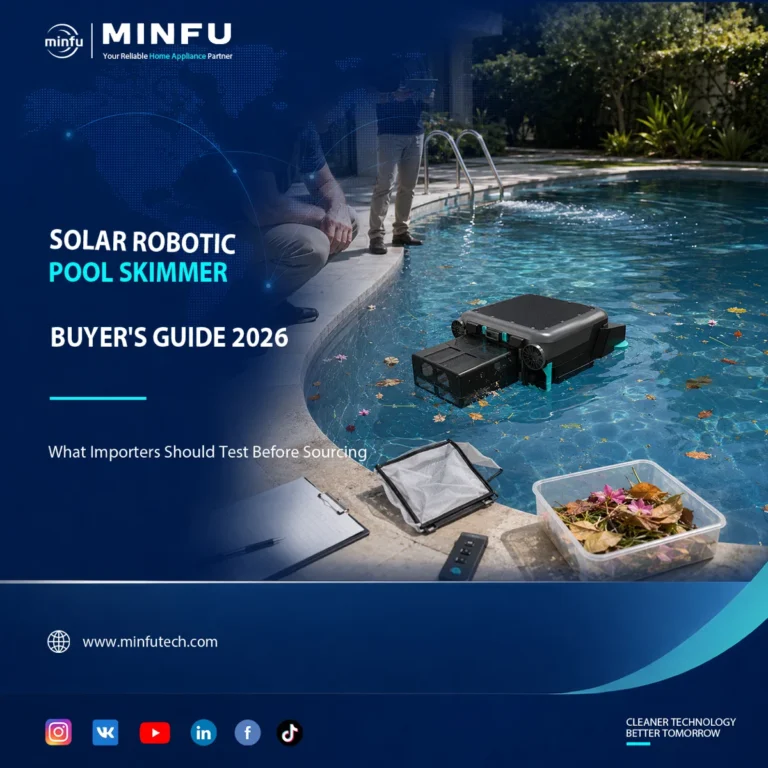
Minfu currently specifies a 6-liter removable and washable filter bag for the MFS01 solar robotic pool skimmer. That puts the product in a range already used by current dedicated surface robots, but the 6L figure should be treated as the beginning of the sample test rather than the conclusion.
Six Liters of What?
Capacity is a volume measurement. Pool debris is not a standardized material.
Six liters of broad dry leaves, six liters of wet leaves and six liters of tightly packed flower petals can represent very different operating conditions. They differ in mass, how closely they pack together, how easily water passes through them and how they behave when the robot changes direction.
This is one reason product comparisons based only on basket liters can be misleading.
The current surface-skimmer market already shows different approaches. Beatbot’s iSkim Ultra uses a 9L basket, while Maytronics offers a 6L filter basket for the Skimmi 300 and has described the Skimmi 200 with a 4L basket. Those figures show that manufacturers are deliberately designing different collection capacities, but they do not establish a universal “correct” size for every pool or robot architecture.
A nine-liter basket can be valuable in a heavily landscaped backyard where broad leaves continually fall into the water. A smaller system can still make sense when the robot itself is compact, the expected debris load is moderate or the product is positioned around easier handling.
The buyer therefore needs to define the debris environment before deciding what the capacity number means.
A pool beneath large deciduous trees creates a different requirement from a pool surrounded by tiled paving and a few ornamental plants. One environment may fill the robot with broad leaves in an afternoon; the other may mainly produce insects, pollen and small pieces of vegetation.
The filter should be evaluated against the first environment in which the product will actually be sold, not against an abstract liter figure.
A Filter Is Usually Useful Long Before It Is Completely Full
There is another problem with treating nominal capacity as usable capacity: customers do not necessarily wait until the basket is packed to its physical limit.
The robot may begin telling them that it needs attention earlier. Water flow may change. Large leaves may accumulate close to the entrance instead of distributing evenly through the available space. A branch can block part of the debris path even though most of the container is still empty.
In other words, the filter’s theoretical volume and its effective working capacity may not be identical.
This is exactly what a sourcing test should investigate.
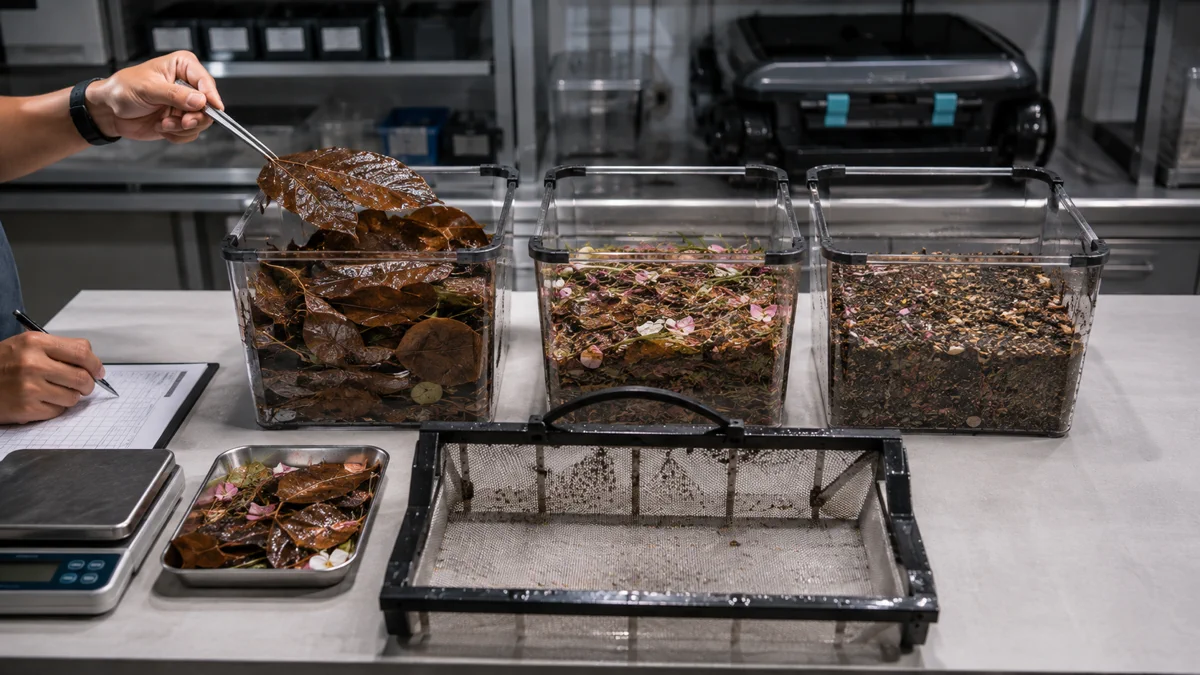
Instead of filling a basket once and checking whether six liters physically fit inside, introduce debris gradually while the machine is operating. Use the same type and quantity of material at each stage so that results can be compared. Watch the robot when the filter is relatively empty, then continue the test as the collected load grows.
At each stage, look at the behavior that a customer would notice. Is floating material still entering the collection area cleanly? Do leaves begin accumulating in front of the intake? Is previously collected debris escaping when the robot reverses or turns sharply? Does the machine sit differently in the water as the wet load increases?
There is no need to invent a universal “80% full” threshold. Different filter geometries and debris types can behave differently. The goal is to identify the point at which the exact sample stops performing like the machine that was demonstrated with an empty filter.
That point is much more valuable to a buyer than the maximum volume of an empty plastic container.
Capacity and Filtration Accuracy Are Two Different Specifications
Another common mistake is assuming that a large filter also means better filtration.
They describe different things.
Capacity tells the buyer how much volume is available for collected material. Filtration characteristics determine what size and type of material the filter can retain while allowing water to continue passing through the system.
Beatbot, for example, currently specifies both a 9L basket and filtration down to 380 micrometers for the iSkim Ultra. Those are two separate claims about the same debris system. A buyer should not transfer that filtration figure to another skimmer simply because another product also has a large basket.
Minfu currently publishes the MFS01’s 6L filter capacity but does not state a public micron rating for the filter material. That distinction is worth preserving in private-label content. If an OEM buyer wants to advertise pollen or fine-particle filtration at a particular size, the exact filter configuration should be tested and the claim supported before it appears on the retail package.
There is also an engineering trade-off hidden behind filtration density. A finer filter may capture smaller material, but water still needs to pass through the collection system as contamination builds on the surface. A more open mesh may handle large leaves efficiently while allowing finer particles to continue circulating.
Neither approach is automatically superior.
A product intended mainly for visible leaf removal may reasonably prioritize large organic debris. A premium model positioned around fine surface maintenance may need a different filtration system, potentially with more demanding maintenance.
This is why I would ask the supplier for more than the liter capacity. The buyer should understand the filter material, intended debris range and whether different filter options are available for the final OEM configuration.
Wet Leaves Are a Better Test Than a Box of Dry Leaves
There is a reason large-capacity product demonstrations often look impressive: dry leaves are visually dramatic and easy to handle.
They are not particularly difficult.
Real pool debris becomes wet quickly. Leaves soften, bend and stick together. Some overlap into broad layers across the filter surface, while smaller material fills gaps between them. When the customer removes the basket or bag, that material is also substantially less pleasant to handle than the dry leaves used for the marketing photograph.
Beatbot’s current iSkim Ultra documentation is unusually useful here because the company publishes internal test information for medium-sized leaves and explicitly distinguishes between wet and dry conditions, while also noting that laboratory results can differ from actual use. That is the right general idea for buyers even when the exact numbers do not apply to another product.
For MFS01, I would build a simple mixed-debris test rather than trying to recreate a competitor’s laboratory procedure.
Start with several types of material commonly found around the target market’s pools. Use broad leaves, smaller leaves, petals, grass and a limited amount of fine floating matter. Allow part of the material to soak before the trial instead of dropping everything into the pool completely dry.
Then run the machine long enough for the debris to distribute naturally inside the filter.
Do not rearrange the leaves manually between passes.
The resulting filter will tell the buyer much more about real behavior. Some designs use their internal volume efficiently, while others allow a dense mass of material to form near the entrance even though space remains elsewhere.
That difference will never appear in a specification that says only “6L.”
The Intake Matters Just as Much as the Space Behind It
A robot can have a very large filter and still struggle with debris if material cannot enter it reliably.
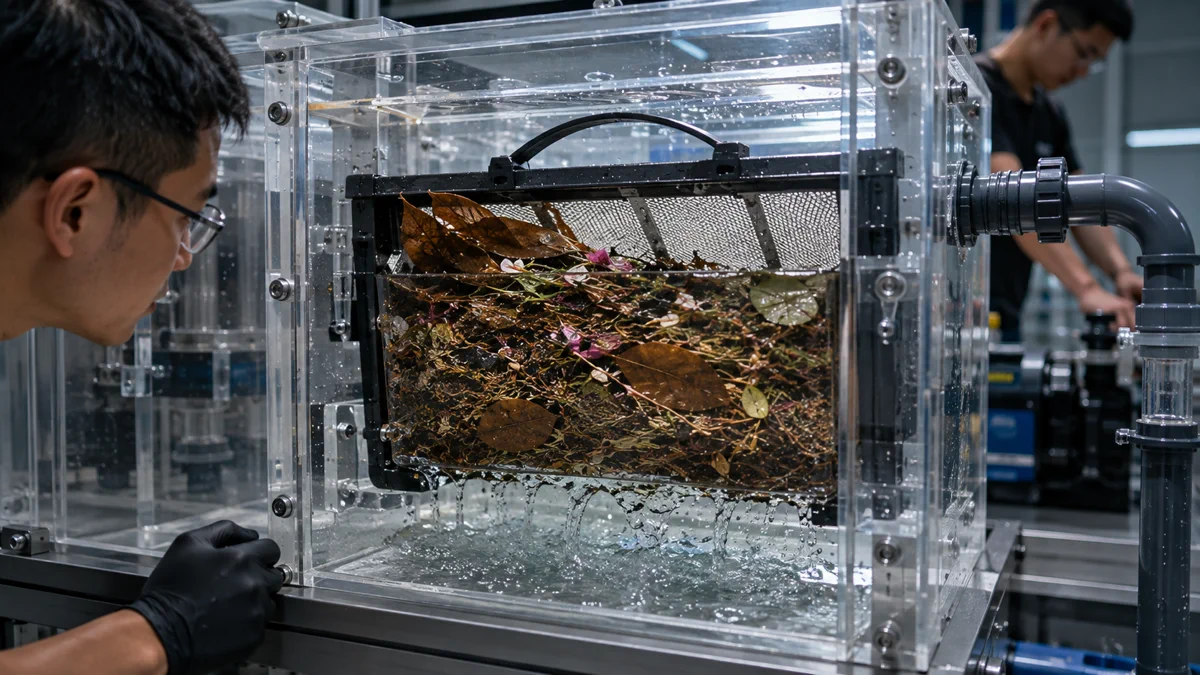
The intake opening, water path and any brushes or guides in front of the collection system determine what reaches the available capacity in the first place.
Imagine a skimmer approaching a cluster of broad leaves. If the entrance handles them cleanly, they move into the filter and make use of the available volume. If several leaves bridge across the opening, the robot may continue moving with a mostly empty container while debris accumulates outside the intake.
The specification still says nine liters, six liters or four liters.
The user’s experience says the filter is blocked.
For sample testing, this is why I would include debris that is slightly awkward rather than perfectly sized for the machine. Add a small twig among the leaves. Allow two or three broad wet leaves to arrive together. Introduce a mixture instead of sending one piece through the intake at a time.
Observe whether material enters naturally or whether the robot needs repeated approaches to the same pile.
The filter system should also be checked during turns. A surface robot does not always travel directly forward. It changes heading around pool edges, responds to water movement and may reverse when it encounters an obstacle. Previously collected material should remain controlled during those movements rather than repeatedly moving back toward the entrance.
Some current skimmer designs address this with dedicated retention structures. Maytronics, for example, sells a non-return flap as part of the Skimmi 200 and 300 basket system. That is a useful reminder that retention after capture is part of debris handling too.
A larger container cannot compensate for poor retention.
Runtime Can End Because the Filter Is Full Before the Battery Is Empty
This is where the fifth article connects directly with the previous runtime discussion.
A robotic pool skimmer can have enough battery energy to operate for many more hours and still need human intervention because the collection system has reached a practical limit.
The previous article, Is 15+ Hours of Runtime Enough for a Robotic Pool Skimmer?, explained why runtime should be thought of as useful availability rather than simply time on a stopwatch.
Filter capacity adds another limit to that availability.
Imagine an MFS01 beginning the morning with a fully charged battery and an empty 6L filter. In a lightly landscaped pool, the machine may continue through a long cleaning window without the filter becoming the limiting factor. In another garden during heavy seasonal leaf fall, the debris system may require attention while substantial battery capacity still remains.
The product has not failed in either case.
The environment has changed which specification matters first.
That relationship is more useful to a buyer than trying to maximize battery and filter capacity independently. If the target market routinely generates heavy debris, a larger filter or easier emptying mechanism may improve the customer experience more than another few hours of battery endurance.
In a relatively clean pool environment, adding more collection volume can become dead space carried around by the robot for most of its life.
This is why capacity should be matched to the intended maintenance interval.
The goal is not necessarily to hold as much debris as physically possible. It is to allow the customer to complete a sensible period of surface maintenance before the next normal interaction with the machine.
A Full Filter Changes the Product the Customer Has to Lift
The filter does not disappear when it is full.
Someone has to remove it.
This becomes particularly relevant for MFS01 because the robot itself is currently specified at 2.8 kg before the filter is loaded with wet debris. A removable filter system makes maintenance easier in principle, but its real usability should be evaluated after the machine has spent hours collecting waterlogged leaves rather than when everything is clean and dry.
The first thing to observe is drainage.
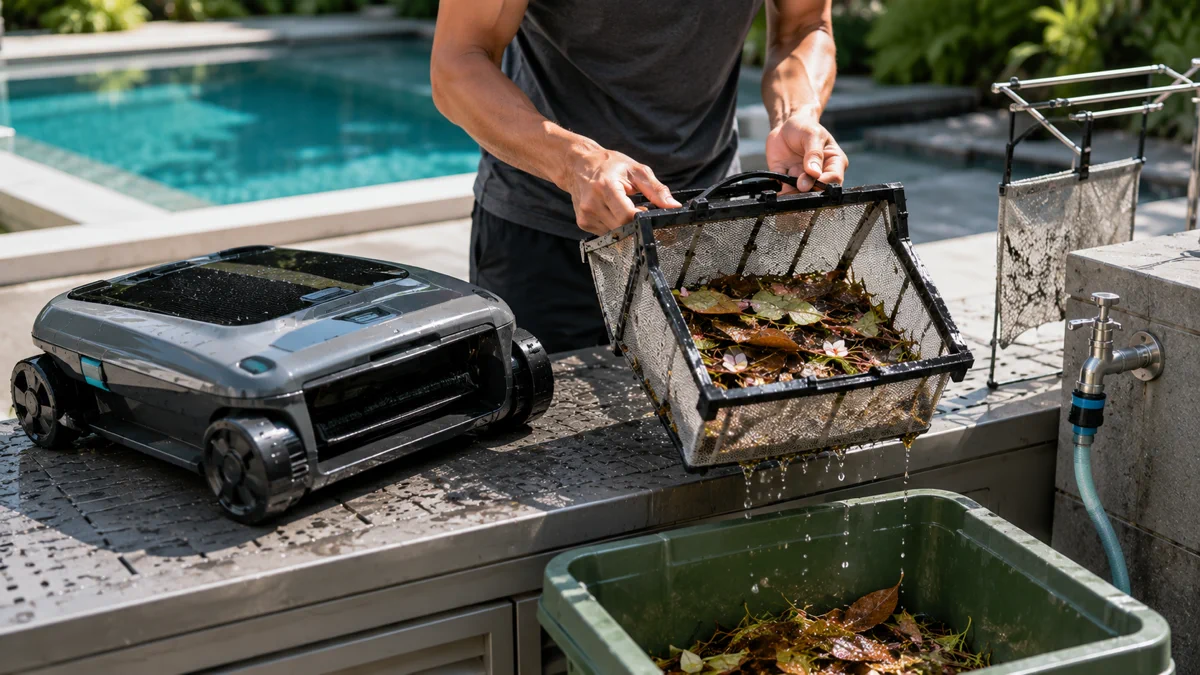
When the customer removes the skimmer from the pool, does excess water drain naturally before the filter is handled, or does the user end up carrying a large amount of unnecessary water with the debris?
Next, remove the filter exactly as a homeowner would. Does the handle or grip remain easy to use when the filter is wet? Can the basket or bag be carried without deforming or spilling material? Does removing it require the user to touch the wet leaves?
Then empty it.
A clever filter design can still become frustrating if debris sticks in corners and has to be pulled out by hand. Broad leaves may fall away easily while grass, seeds and fine matter cling to wet mesh. A bag-shaped filter may behave differently from a rigid basket during this process.
None of these differences can be summarized by the capacity figure.
They are maintenance design.
For B2B buyers, that matters because filter emptying is one of the interactions customers may repeat most often during the life of a skimmer. A small irritation repeated every day can generate more negative feedback than a feature that only matters occasionally.
Bigger Capacity Also Has a Cost
If larger filters are convenient, why not make every robotic pool skimmer with a fifteen-liter basket?
Because volume has to exist somewhere.
A larger collection system can increase the dimensions of the machine, affect buoyancy and change where mass accumulates as the debris load grows. It can also influence packaging size, material use and the way internal components are arranged.
There may be good reasons to accept those trade-offs in a product intended for very large or heavily landscaped pools. They are less obvious in a compact residential skimmer.
Current market products illustrate that there is no single capacity target. Beatbot uses 9L on iSkim Ultra, Maytronics has a 6L basket for Skimmi 300 and has described a 4L basket for Skimmi 200, while Minfu currently uses a 6L removable filter bag on MFS01.
Those products do not have identical size, navigation systems, price positioning or overall architecture.
Comparing liters without the rest of the product is therefore similar to comparing battery capacity without considering power consumption.
The larger number tells you something useful.
It does not tell you everything you need to know.
For an OEM project, I would start with the expected debris interval. If the target customer normally empties the skimmer once each day, the filter should handle that interval comfortably under a representative debris load. If the product is intended for properties where leaves accumulate rapidly, the design may need a different emphasis.
The capacity decision should follow the use case.
Do Not Ignore the Filter When Planning Spare Parts
A removable and washable filter is not necessarily a lifetime component.
Repeated handling, outdoor exposure and cleaning can eventually affect filter material, seams, frames or retaining features. Even when a component remains mechanically usable, customers may still want a second filter so that one can dry while another is installed.
That makes the filter part of the after-sales strategy.
Before a private-label launch, the buyer should confirm whether replacement filters can be ordered separately, whether the filtration specification will remain consistent across production batches and how the part will be identified for customer support.
This is especially important when the same product platform can accept different filter versions. The retail team, factory and after-sales staff should all know exactly which filter belongs to the approved model.
The product page should also avoid promises that go beyond the tested filtration system.
MFS01 can reasonably be marketed around its current 6L removable and washable filtration system. More specific claims about particle size, pollen filtration or specialized filtration performance should be tied to the exact filter material and supporting test evidence.
That keeps the marketing useful without making maintenance or replacement more complicated later.
How I Would Test the MFS01 6L Filter Before an OEM Order
The first test would be deliberately simple.
Begin with a clean, empty filter and a known quantity of representative pool debris. Use several materials rather than one perfect type of dry leaf. Run the MFS01 normally and record how cleanly that material enters the collection system.
Then continue adding debris.
Do not empty the filter simply because the marketing photograph already looks impressive. The important part of the test begins after the first layer has accumulated.
Observe intake behavior, debris retention and robot stability as the load grows. Check whether wet leaves concentrate in one area of the bag, whether useful space remains elsewhere and whether the machine continues collecting material at a reasonable rate.
After the operating test, remove the MFS01 from the pool and perform the maintenance sequence without special tools.
Let the machine drain naturally. Remove the filter. Carry it several meters. Empty the wet debris. Rinse the filter and reinstall it.
Time is not the only metric. Ask the person doing the job whether any step feels unnecessarily awkward or dirty.
Finally, repeat the process.
One successful emptying tells you very little about long-term ownership. After several cycles, inspect the filter material, seams, attachment points and the areas where organic material tends to remain after rinsing.
For the current product, Minfu publishes a 6L removable washable filter bag but does not publicly state a micron filtration rating. That means OEM buyers interested in more specific fine-filtration positioning should confirm the exact filter configuration and evidence during sample approval rather than deriving the claim from the six-liter capacity alone.
Buyers can review the current MFS01 solar-powered robotic pool skimmer for the published product configuration.
Final Thoughts
A larger debris container is useful when it gives the customer more useful cleaning time between maintenance stops. That is the practical value of filter capacity.
The mistake is treating liters as if they describe the entire filtration system.
A robotic pool skimmer still has to move debris through the intake, retain it while turning, allow enough water flow as material accumulates, remain stable with a wet load and give the customer a reasonably clean way to empty everything afterward.
Those characteristics become easier to judge once the sample is tested with wet, mixed debris rather than an empty basket and a handful of dry leaves.
For MFS01, the current 6L filter gives the platform meaningful collection volume without turning the product into an unusually large surface robot. Whether that capacity is right for a particular private-label project depends on the debris environment, maintenance interval and filtration requirements of the target market.
A good sourcing decision therefore does not ask:
“Is 6L bigger than the competitor?”
It asks whether those six liters remain useful from the first leaf collected to the moment the customer removes the filter and empties it.
That is the part of the specification the customer actually experiences.
Frequently Asked Questions
Is a larger robotic pool skimmer filter always better?
No. A larger filter can reduce the frequency of emptying, but capacity also affects product size, weight distribution and maintenance. Intake design, debris retention, water flow and ease of emptying should be evaluated together with the nominal liter figure.
Is a 6L filter enough for a robotic pool skimmer?
A 6L filter can provide substantial debris capacity for a residential surface skimmer, but suitability depends on the type and amount of material around the pool. A lightly landscaped pool and a pool beneath several large trees can produce very different maintenance requirements even when the pool dimensions are similar.
Does filter capacity tell me how small a particle the skimmer can capture?
No. Filter capacity and filtration accuracy are separate specifications. Capacity describes available debris volume, while particle retention depends on filter material and structure. Buyers should request or test the filtration specification separately when fine-particle claims are important.
Can wet leaves reduce the usable capacity of a pool skimmer filter?
Wet leaves can fold, stick together and accumulate differently from dry debris, so the physical volume of the filter does not necessarily describe how efficiently it will be used under real conditions. Sample testing with wet mixed debris provides a more representative evaluation.
What should buyers test besides filter capacity?
Buyers should evaluate intake performance, debris retention during turns, behavior as the filter fills, ease of removing and emptying wet debris, rinsing, filter durability and availability of replacement filters. These factors determine whether the stated capacity translates into a convenient ownership experience.
Ready to Start Your OEM/ODM Project?
Whether you are sourcing a new product, developing a private-label line, or looking for a reliable OEM/ODM manufacturing partner, Minfu can support your project from product evaluation and customization to packaging, production and long-term cooperation.
Shenzhen Minfutech Industrial Co., Ltd.
Website:
https://minfutech.com/
Email:
info@minfutech.com
WhatsApp / Tel:
+86 137 6025 5781
Contact Us:
https://minfutech.com/contact-minfu/
OEM / ODM • Private Label • Product Customization • Wholesale
Send us your sourcing requirements, target market and project details. Our team will help you evaluate the suitable solution and discuss the next steps for your OEM/ODM project.