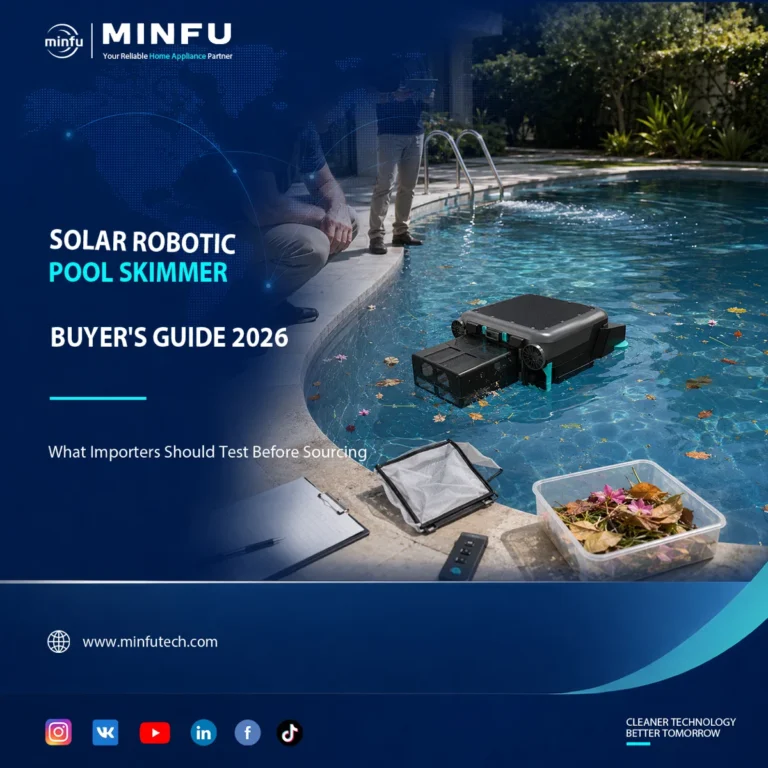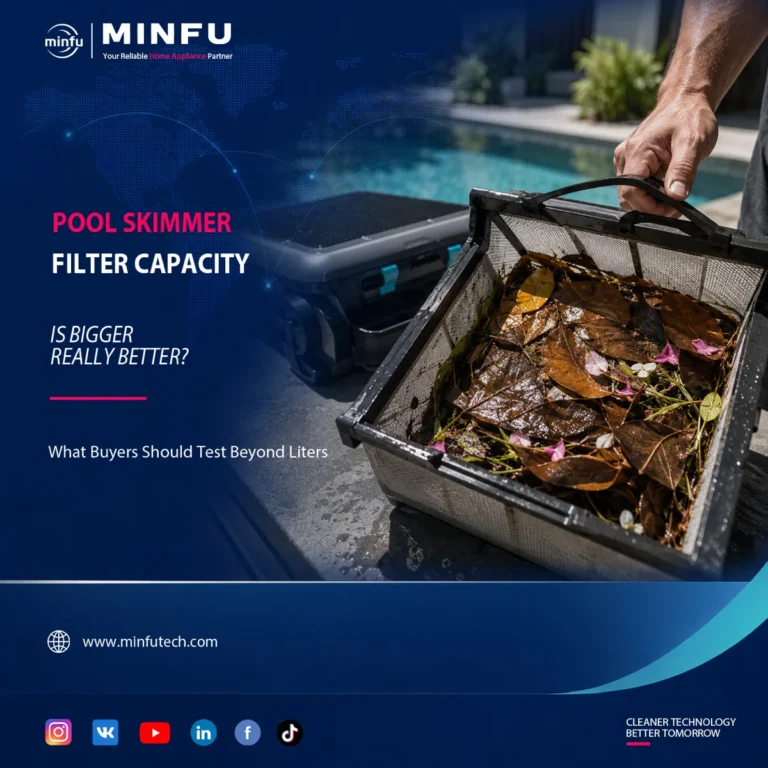




For buyers comparing robotic pool skimmers, debris capacity looks like one of the easiest specifications to evaluate.
One supplier says 3 liters. Another says 5 liters. Another offers 6 liters.
It is tempting to assume that the largest number automatically means better cleaning performance.
In practice, it is not that simple.
A robotic pool skimmer does not work like a stationary storage container. It has to collect debris while moving across the water surface, maintain water flow as the filter fills, handle different types of leaves and insects, and continue operating without becoming overloaded or difficult to empty.
For distributors, private-label brands, and pool equipment importers, the real question is therefore not:
“How large is the debris basket?”
It is:
“How much real-world debris can the robot collect before its performance begins to fall?”
That difference matters when evaluating a robotic pool skimmer for bulk sourcing.
Why Filter Capacity Matters More Than It First Appears
Surface debris varies significantly from one pool to another.
A relatively protected residential pool may mainly collect:
- small leaves,
- insects,
- flower petals,
- pollen,
- grass fragments,
- and light floating particles.
A pool surrounded by trees may face a completely different workload, especially after wind or rain.
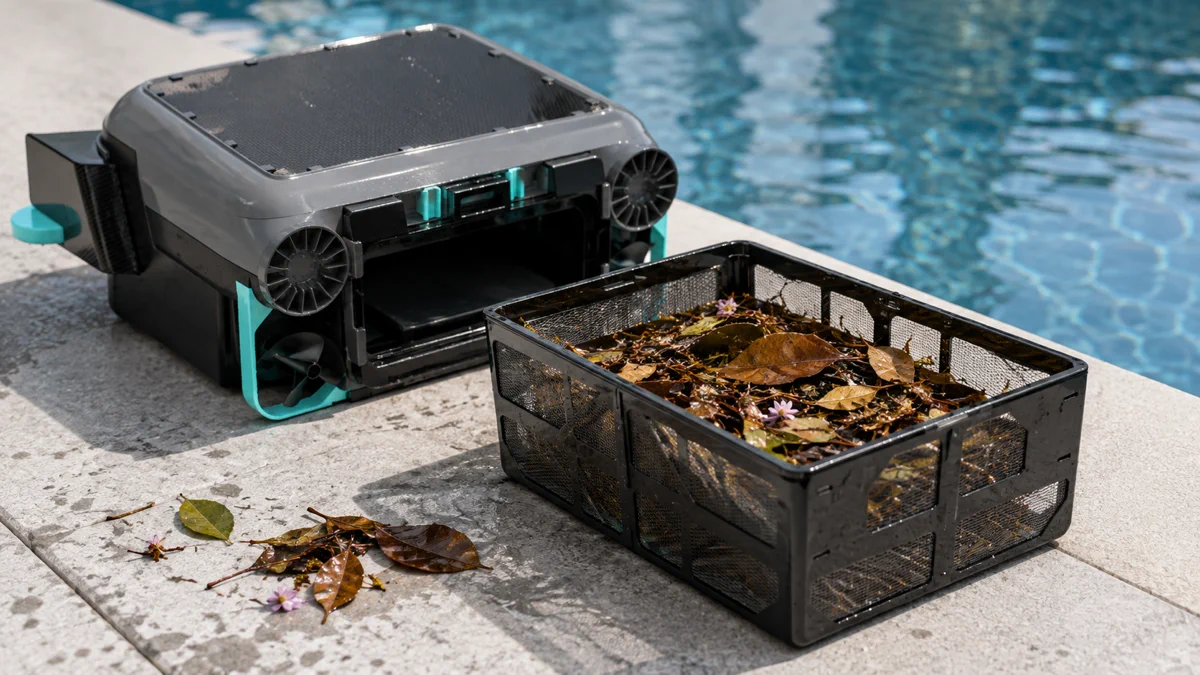
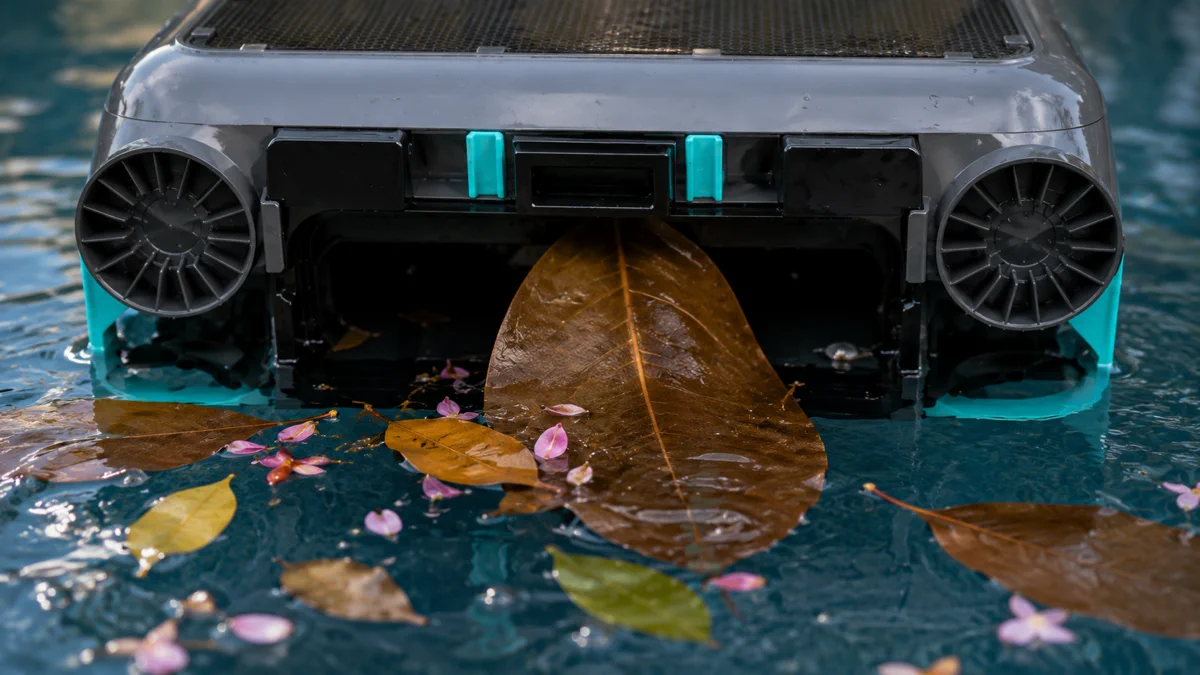
Large leaves can occupy basket volume quickly. Wet leaves may stick together. Fine debris can restrict water flow even when the basket does not appear full.
This means two robotic skimmers with similarly sized filters can behave very differently in actual operation.
For buyers, debris capacity should therefore be treated as part of a broader collection system, not as an isolated specification.
1. Basket Volume Is Only the Starting Point
Filter capacity is still important.
A larger debris compartment generally allows the machine to operate longer before the user needs to remove and empty collected material.
That is especially useful in pools with:
- heavy seasonal leaf fall,
- large surrounding gardens,
- frequent outdoor debris,
- or long unattended cleaning periods.
But nominal capacity does not tell the complete story.
Imagine two skimmers both claiming a large-capacity basket.
One has a wide intake opening and distributes debris evenly throughout the filter.
The other has a narrow intake and allows leaves to pile up directly behind the entrance.
The second machine may begin losing collection efficiency long before its basket is physically full.
That is why buyers should evaluate usable debris capacity, not simply advertised volume.
2. Intake Geometry Determines What Can Actually Enter
A robotic pool skimmer needs to collect everything from tiny insects to broad leaves.
The design of the front intake therefore matters.
Buyers should pay attention to:
- intake width,
- intake height,
- water-flow direction,
- resistance around the opening,
- and whether large debris can enter without folding or jamming.
A specification sheet rarely reveals these differences.
A wide basket connected to a poorly designed inlet can still struggle with large leaves.
During sample evaluation, buyers should test several debris sizes instead of using only small dry leaves.
A useful test mixture includes:
| Debris Type | What the Test Reveals |
|---|---|
| Small dry leaves | Basic collection ability |
| Large broad leaves | Intake opening and blockage risk |
| Wet leaves | Realistic heavy-debris performance |
| Flower petals | Lightweight surface collection |
| Small insects or similar particles | Fine floating debris capture |
| Mixed debris | Overall real-world performance |
The mixed-debris test is particularly valuable because residential pools rarely contain only one type of contaminant.
3. A Full Filter Should Not Immediately Destroy Water Flow
One of the most important tests happens after debris has already accumulated.
A new, empty filter will naturally provide relatively unrestricted water movement.
The challenge is maintaining collection performance as that filter fills.
Leaves, pollen, and organic debris can gradually cover the filter surface and increase resistance.
Buyers should therefore observe whether:
- intake performance noticeably weakens,
- debris begins escaping,
- movement becomes unstable,
- the robot slows near heavily contaminated areas,
- or collected debris blocks the inlet.
This is a much more useful sourcing test than simply running a clean machine for several minutes.
A Better Buyer Test
Instead of testing only an empty robot:
- Run the skimmer with an empty filter.
- Add a controlled quantity of mixed floating debris.
- Allow the robot to collect approximately half of the expected capacity.
- Continue adding debris.
- Observe collection efficiency as the filter becomes progressively loaded.
- Check whether previously collected material remains securely contained.
The objective is not necessarily to fill every basket to its absolute physical limit.
The objective is to identify when practical performance begins to decline.
4. Filter Design Matters as Much as Filter Size
The structure of the filtering system influences both cleaning performance and user experience.
For a robotic pool skimmer intended for regular residential use, buyers should evaluate several areas.
Filtration Area
A larger effective filtering area can help distribute collected debris instead of concentrating it in one location.
Debris Retention
Once leaves or insects enter the collection system, they should not easily escape when the robot turns, reverses, or encounters water movement.
Removal
The filter should be easy to remove without requiring users to touch complicated internal components.
Cleaning
Reusable filters need to be practical to rinse and clean.
Reinstallation
After cleaning, the filter should return to the correct position easily and securely.
These details may look minor during sourcing.
After hundreds or thousands of units enter the market, however, they can become important drivers of customer satisfaction and after-sales workload.
5. Test the Robot With Wet Debris, Not Only Clean Demo Leaves
Supplier demonstrations often use dry leaves because they look clear on camera and are easy to prepare.
Actual pools are less predictable.
Once organic material remains in water, it becomes heavier and may stick together.
Wet leaves can:
- form dense clusters,
- block smaller openings,
- adhere to filter surfaces,
- reduce water flow,
- and become harder to remove from the basket.
For this reason, buyers should include pre-soaked leaves during sample testing.
This provides a more realistic indication of performance after storms, windy conditions, or extended unattended operation.
A product that performs well with dry demonstration material but struggles with wet debris may create a very different experience once sold to consumers.
6. Large Capacity Only Helps If Runtime Can Support It
Filter capacity and runtime should not be evaluated separately.
A large debris basket provides little practical advantage if the robot stops after a short cleaning period.
Likewise, long runtime becomes less useful if the collection compartment fills too quickly.
For this reason, buyers should consider the relationship between:
Runtime × debris capacity × navigation reliability
A balanced robotic pool skimmer should be capable of remaining on the water long enough to make meaningful use of its debris capacity.
This is particularly important for products positioned around unattended or low-maintenance pool cleaning.
For example, Minfu’s MFS01 robotic pool skimmer combines a 6L removable and washable filter system with 15+ hours of battery operation and dual solar/adapter charging. The value of these specifications is not simply that each number is larger; the combination is intended to reduce how frequently the user needs to intervene during routine surface cleaning.
For buyers, this type of system-level evaluation is more useful than comparing individual specifications in isolation.
7. Debris Capacity Can Affect After-Sales Costs
A buyer may initially evaluate filtration only from the consumer convenience perspective.
There is also a commercial reason to examine it carefully.
Poor debris handling can contribute to complaints such as:
- “The robot stops collecting leaves.”
- “Leaves keep getting stuck at the entrance.”
- “I have to empty it too frequently.”
- “The filter is difficult to clean.”
- “The debris falls back into the pool.”
- “Performance drops after several minutes.”
Not every complaint represents an electrical or mechanical defect.
Sometimes the underlying problem is simply that the collection system does not match the real operating environment.
For distributors and private-label brands, these issues can still create:
- customer service tickets,
- returns,
- replacement requests,
- negative reviews,
- and additional local support costs.
A filter system should therefore be evaluated as part of after-sales risk management, not just as a product feature.
8. What Buyers Should Test Before Approving a Bulk Order
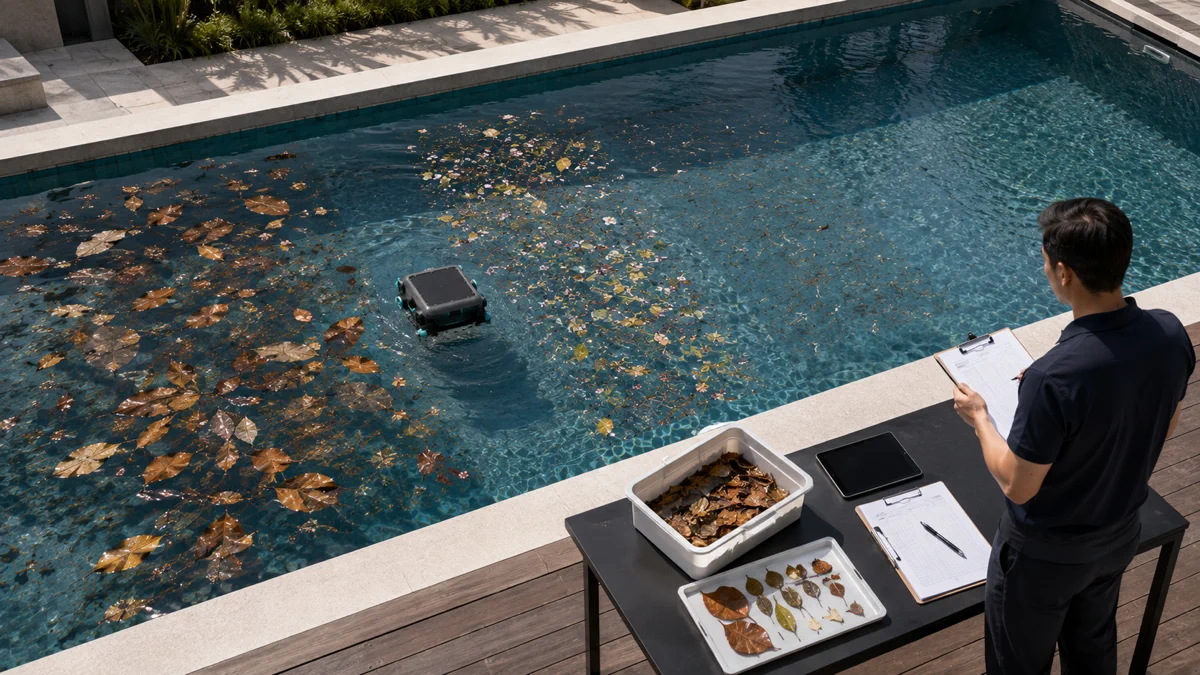
A sample test does not need sophisticated laboratory equipment to reveal obvious filtration weaknesses.
A practical buyer evaluation can include the following.
Test 1 — Light Debris Collection
Scatter a small amount of leaves and lightweight floating debris across the pool.
Check:
- pickup consistency,
- missed debris,
- intake behavior,
- and debris retention.
Test 2 — Large-Leaf Test
Use broad leaves that approach the size of the intake opening.
Check whether they:
- enter smoothly,
- fold naturally,
- become trapped,
- or block subsequent debris.
Test 3 — Mixed-Debris Test
Combine small leaves, large leaves, petals, insects or equivalent materials.
This is more representative of normal outdoor pool conditions.
Test 4 — Partial-Fill Performance
Continue testing after the filter has already accumulated debris.
Compare collection behavior with the empty-filter condition.
Test 5 — Wet-Debris Test
Soak leaves before adding them to the pool.
Observe whether wet material creates clogging or excessive resistance.
Test 6 — Filter Removal and Cleaning
After the test:
- remove the basket or filter,
- empty the debris,
- rinse it,
- reinstall it,
- and restart the robot.
A good design should make this process intuitive.
Test 7 — Long-Run Test
Do not evaluate only the first ten minutes.
Allow the robot to continue operating with accumulated debris so you can observe whether collection efficiency remains stable over time.
9. Questions to Ask a Robotic Pool Skimmer Supplier
Before approving an OEM or private-label project, buyers should ask for more than a capacity number.
Useful questions include:
What is the nominal debris capacity?
Confirm how the supplier defines the stated volume.
Is the filter removable and washable?
This affects recurring maintenance.
How does performance change as the filter fills?
Ask whether the supplier performs loaded-filter testing.
What types of debris were used during validation?
Dry leaves alone are not enough.
Can the filter handle large wet leaves?
This is particularly relevant for pools surrounded by vegetation.
How is collected debris prevented from escaping?
Review retention design when the robot turns or reverses.
Are filter components available as spare parts?
For distributors, long-term spare-part availability can simplify after-sales service.
Can samples be tested before mass production?
Whenever possible, confirm real performance before approving a large order.
10. What OEM and Private-Label Buyers Should Look Beyond
A robotic pool skimmer is not defined by one headline specification.
For sourcing decisions, filtration should be evaluated together with:
- navigation,
- anti-stuck performance,
- runtime,
- charging method,
- waterproof design,
- maintainability,
- spare-part support,
- and production quality control.
A strong product is one in which these systems support each other.
A large basket cannot compensate for poor navigation.
Long runtime cannot compensate for frequent clogging.
A sophisticated charging system cannot compensate for difficult maintenance.
This is why experienced buyers increasingly evaluate robotic cleaning products as complete operating systems rather than collections of impressive numbers.
FAQ
Is a larger filter always better for a robotic pool skimmer?
Not necessarily. Larger capacity can reduce emptying frequency, but inlet design, filtering area, debris distribution, water flow and ease of cleaning also affect real-world performance.
What debris should buyers use when testing robotic pool skimmers?
A useful evaluation should include small leaves, large leaves, wet leaves, lightweight debris and a mixed-debris load rather than testing only one clean material.
Why should the filter be tested when partially full?
A partially loaded filter provides a better indication of actual operating performance. Some designs work well when empty but experience reduced intake or clogging as debris accumulates.
Is a washable filter important for private-label products?
A removable and washable filter can make routine maintenance easier for consumers and may reduce unnecessary after-sales complaints related to dirty or blocked collection systems.
Should buyers test filtration before placing a bulk order?
Yes. Sample testing allows buyers to observe intake performance, usable capacity, clogging behavior, cleaning convenience and debris retention before committing to mass production.
Final Takeaway
When comparing robotic pool skimmers, do not allow one capacity number to make the sourcing decision for you.
What matters is the complete debris-handling process:
collection → retention → filtration → continued operation → emptying → cleaning → reinstallation.
A well-designed system should perform consistently throughout that cycle.
For buyers, distributors and private-label brands, a simple mixed-debris test can reveal much more about a robotic pool skimmer than a specification sheet alone.
The best time to discover a filtration weakness is during sample validation—not after thousands of units have reached customers.
Work With Minfu
Looking for a reliable manufacturing partner for your next smart cleaning appliance project?
Minfu provides one-stop OEM/ODM manufacturing, product development, customization, quality control and mass-production support for brands, importers, distributors and retailers worldwide.
Website: https://minfutech.com/
OEM/ODM Solutions: https://minfutech.com/oem-odm-solutions/
Email: info@minfutech.com
WhatsApp / Phone: +86 13760255781
Contact: https://minfutech.com/contact-minfu/
Contact Minfu to discuss your product requirements, samples and OEM/ODM cooperation.