

Introduction
A clean industrial floor is easy to recognize after the work is finished. Dust is gone, tire marks have disappeared, spilled liquid has been recovered, and the walking surface looks ready for the next shift.
Maintaining that condition every day is much harder.
In a warehouse, manufacturing plant, hospital, transportation hub or large commercial facility, hygiene is not one cleaning event. It is a system of schedules, zones, equipment, cleaning methods, inspections and responses to unexpected contamination.
That is where industrial cleaning robots can make a real difference.
But there is an important distinction that is often lost in robot marketing:
A cleaning robot can automate part of a hygiene program. It does not become the hygiene program.
Autonomous machines are particularly good at repeatable floor-care work: following defined routes, covering large areas, scrubbing and recovering dirty water, operating on schedules and recording whether assigned missions were completed.
They are much less suited to tasks such as cleaning door handles, responding to unusual chemical spills, sanitizing specialized equipment or deciding which disinfectant a regulated environment requires.
Understanding that boundary is important because it tells facility managers where automation creates real value—and where human procedures still matter.
The Short Answer
Industrial cleaning robots help maintain hygienic facilities by automating routine floor-soil removal, scheduled cleaning, repeatable area coverage and dirty-water recovery. Connected systems can also provide mission records that help managers verify whether assigned cleaning work was completed.
However, robots do not automatically disinfect a facility, guarantee infection control or replace site-specific cleaning protocols.
CDC guidance makes an important distinction between cleaning and disinfecting: cleaning physically removes soil and reduces germs, while disinfection is a separate process used when appropriate for the environment and risk level.
That distinction should also guide how we talk about autonomous cleaning.
Hygiene Is a Process, Not a “Clean-Looking Floor”
One of the easiest mistakes in facility cleaning is to judge hygiene entirely by appearance.
A glossy floor may still have problems.
A visually dull floor may simply have a different finish.
Good hygiene management depends less on shine and more on whether the facility has a repeatable process for dealing with:
- dust;
- soil;
- tracked-in debris;
- liquid spills;
- oils and residues;
- contaminated zones;
- cleaning frequency;
- dirty-water removal.
This is why industrial cleaning robots are interesting from an operations perspective.
Their biggest contribution is not that they make floors look futuristic.
It is that they can make part of the cleaning process repeatable.
If Zone A should be scrubbed every evening, an autonomous robot can be assigned a defined route and repeat that task consistently instead of relying entirely on somebody remembering the exact coverage pattern from the previous shift.
That does not guarantee hygiene.
But it creates a more controlled process.
Cleaning and Disinfection Are Not the Same Thing
This distinction deserves its own section because the words are often mixed together in marketing.
The CDC defines cleaning as the removal of dirt and impurities from surfaces, while sanitizing and disinfecting are separate processes used to reduce or kill remaining microorganisms when appropriate.
Even healthcare guidance does not treat every floor as something that must constantly be disinfected.
CDC guidance describes routine patient-area floors as low-touch surfaces and generally recommends regular cleaning, with disinfection used when the specific area or contamination risk requires it.
This matters when evaluating industrial cleaning robots.
A robotic scrubber may be excellent at:
removing soil → scrubbing → recovering dirty water
but that does not automatically mean:
the area has been disinfected according to a healthcare, food-processing or pharmaceutical protocol.
Those facilities may have additional requirements for:
- chemicals;
- concentration;
- dwell time;
- equipment segregation;
- microbiological testing;
- cleaning sequence.
So we would never advise a B2B customer to buy a robot based only on a vague claim such as:
“This robot keeps the facility germ-free.”
That is not a serious hygiene strategy.
Where Industrial Cleaning Robots Actually Help
A more useful way to evaluate the role of robotics is to separate the hygiene objective from the task the machine performs.
| Hygiene Objective | What an Industrial Cleaning Robot Can Do | What Still Requires Human / Facility Control |
|---|---|---|
| Remove routine floor soil | Sweep, vacuum or scrub defined zones | Determine correct cleaning method |
| Remove dirty water | Scrub and recover wastewater | Maintain tanks, squeegees and water system |
| Maintain cleaning frequency | Run scheduled missions | Set the correct frequency |
| Reduce missed floor areas | Follow mapped coverage routes | Validate route design |
| Separate cleaning zones | Use different maps/routes | Define contamination-control policy |
| Document routine cleaning | Record missions and operating status | Review records and act on exceptions |
| Respond to unusual contamination | Limited | Human assessment and specialist procedures |
| Disinfect regulated areas | Only if specifically configured and permitted | Chemical selection, SOPs and compliance |
This is the point where robotics becomes more useful than the phrase “automated cleaning.”
The robot is not replacing hygiene management.
It is automating the parts of hygiene management that are predictable enough to automate.
Why Floors Matter More in Industrial Facilities Than They First Appear
Floors are not only cosmetic surfaces.
In warehouses and factories, they are part of the operating environment.
They carry:
- employees;
- forklifts;
- carts;
- pallet trucks;
- raw materials;
- finished goods;
- maintenance equipment.
Anything left on the floor can be moved through the building by shoes and wheels.
Dust near a loading bay does not necessarily stay near the loading bay.
Oil residues near production equipment do not necessarily remain in one square metre.
And spilled water is not only a cleanliness problem—it may become a walking-working-surface issue.
In the United States, OSHA requires workplaces, passageways and walking-working surfaces to be maintained in a clean, orderly and sanitary condition, and floors should be kept dry to the extent feasible. Hazards such as leaks and spills also need to be addressed.
This is one reason routine industrial floor cleaning has value beyond appearance.
A clean floor supports:
hygiene + safety + operational discipline.
Repeatability Is Where Automation Starts to Matter
Imagine a 15,000 m² warehouse.
Every night, the same wide aisles need floor cleaning.
The basic requirement does not change very much from Monday to Tuesday.
This is an ideal type of workload for automation because the task contains a large amount of repetition.
An industrial cleaning robot can follow mapped zones and execute systematic floor-care missions without requiring somebody to continuously steer the machine.
The advantage is not that the robot suddenly understands hygiene better than an experienced cleaner.
The advantage is that:
a validated routine does not need to be reinvented every shift.
That distinction is important.
Automation is strongest when the process has already been defined well.
If the original cleaning route misses important areas, the robot may simply repeat the mistake more consistently.
That is why mapping and route commissioning should be treated as part of the hygiene program rather than merely a technical setup step.
A Hygienic Facility Is Usually a Collection of Different Zones
This is where industrial cleaning becomes more interesting.
A factory is rarely one uniform environment.
Consider a typical facility:
Loading dock
Outdoor dirt, tire debris and pallet traffic.
Warehouse aisles
Dust, packaging debris and forklift tracks.
Production area
Process-specific residues and stricter operating rules.
Office corridors
Lower contamination but more pedestrian traffic.
Cafeteria or staff areas
Different soils and different cleaning procedures again.
Treating all five areas as one identical cleaning zone may be convenient, but it is rarely good hygiene management.
Autonomous cleaning makes zoning easier to operationalize because missions can be organized around specific areas rather than telling an operator:
“Clean the whole building.”
A better approach might be:
Zone A → high-frequency routine floor care
Zone B → scheduled heavy scrubbing
Zone C → manual/specialist procedure
Zone D → autonomous off-hours cleaning
The robot becomes one tool inside that zone-based strategy.
The Bigger Question: What Crosses From One Zone to Another?
This is one of the most overlooked issues in robotic floor cleaning.
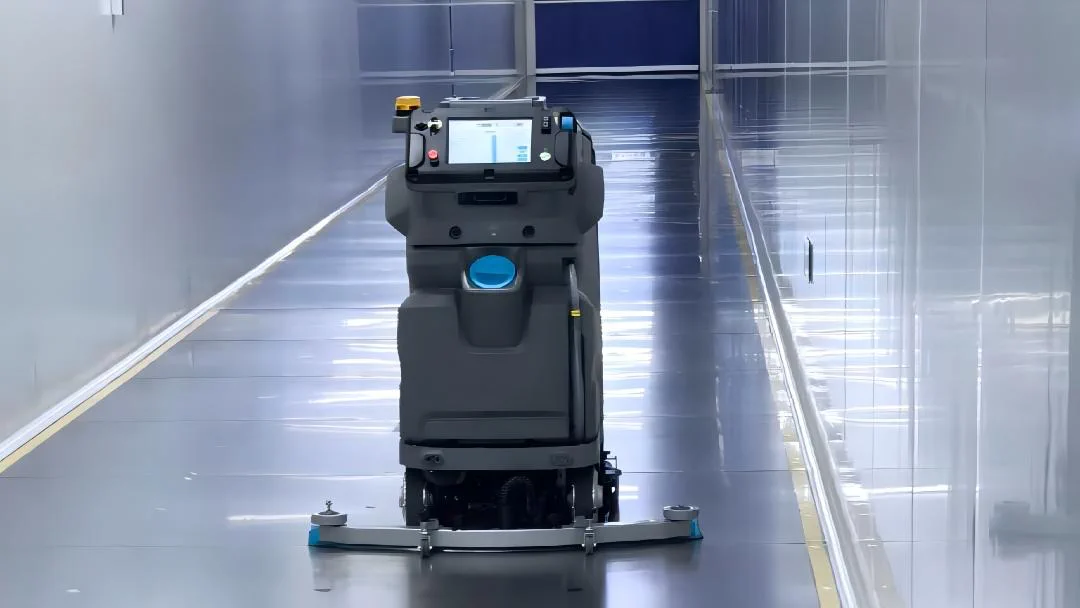
Imagine a robot cleans a dirty loading area and then immediately enters a cleaner production corridor.
The navigation system may have performed perfectly.
But hygiene is not only a navigation problem.
What is now on:
- the brushes?
- the wheels?
- the squeegee?
- the recovery system?
A robot can physically move contamination just as other mobile equipment can.
That means route planning should consider not only:
Where can the robot go?
but also:
In what order should the robot clean these areas?
CDC environmental-cleaning guidance uses a similar principle in healthcare: cleaning should proceed systematically, generally moving from cleaner areas toward dirtier areas to reduce the risk of contaminating areas that have already been cleaned.
Industrial facilities may have completely different contamination risks, but the underlying lesson is useful:
cleaning sequence matters.
A high-quality autonomous program therefore needs both:
navigation logic
and
hygiene logic.
They are not the same thing.
Dirty Water Has to Go Somewhere
Autonomous navigation gets most of the attention in robot marketing.
But from the hygiene side, what happens underneath the machine may be more important.
A scrubber typically has to perform several physical tasks:
- Apply water or cleaning solution.
- Agitate soil with brushes or pads.
- Separate contamination from the floor surface.
- Recover dirty liquid.
- Leave the floor with acceptable residual moisture.
If the recovery system performs poorly, the robot may successfully complete 100% of its route while still leaving behind undesirable residue or excess water.
This is why we do not evaluate an industrial cleaning robot only by:
- LiDAR count;
- camera resolution;
- navigation algorithm;
- maximum speed.
We also look at:
- brush pressure;
- brush coverage;
- squeegee performance;
- water control;
- wastewater recovery;
- tank capacity;
- floor compatibility.
The floor does not care how intelligent the navigation algorithm is.
The floor cares what happens when the cleaning system passes over it.
Large Facilities Add Another Hygiene Problem: Capacity
A small tank may perform perfectly during a demonstration.
The problem appears when the machine needs to clean thousands of square metres.
Every interruption for:
- clean-water refill;
- dirty-water emptying;
- charging;
reduces the amount of autonomous work the machine can complete.
This is one reason industrial platforms need to be evaluated differently from compact commercial robots.
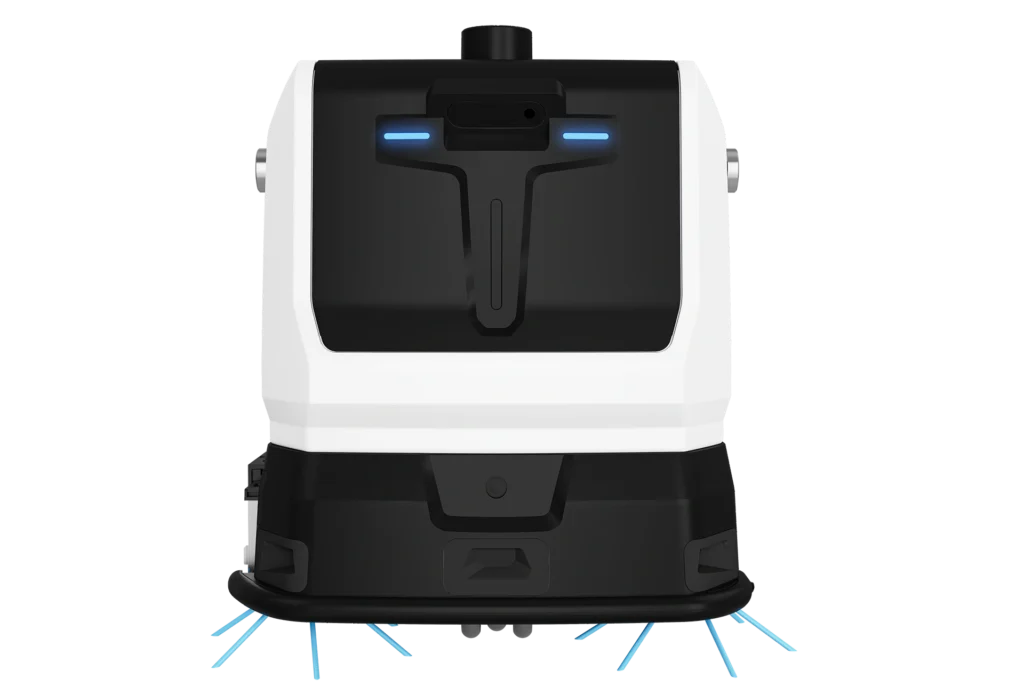
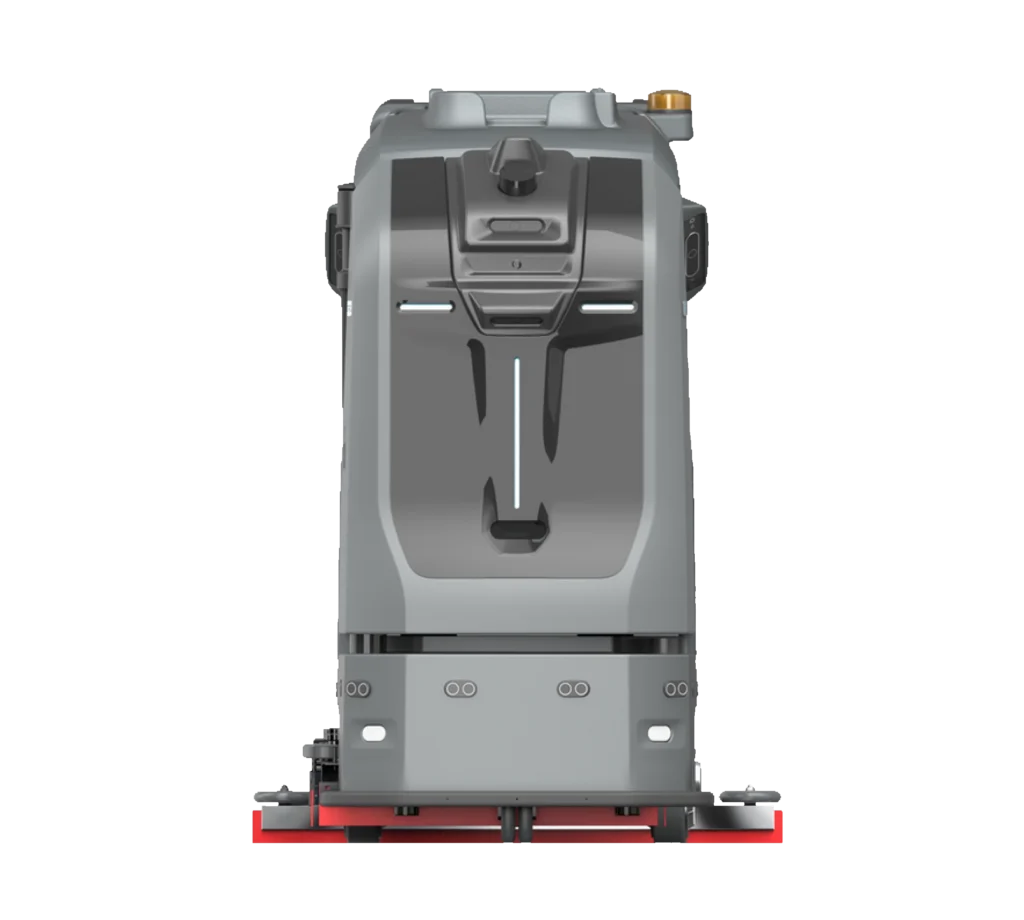
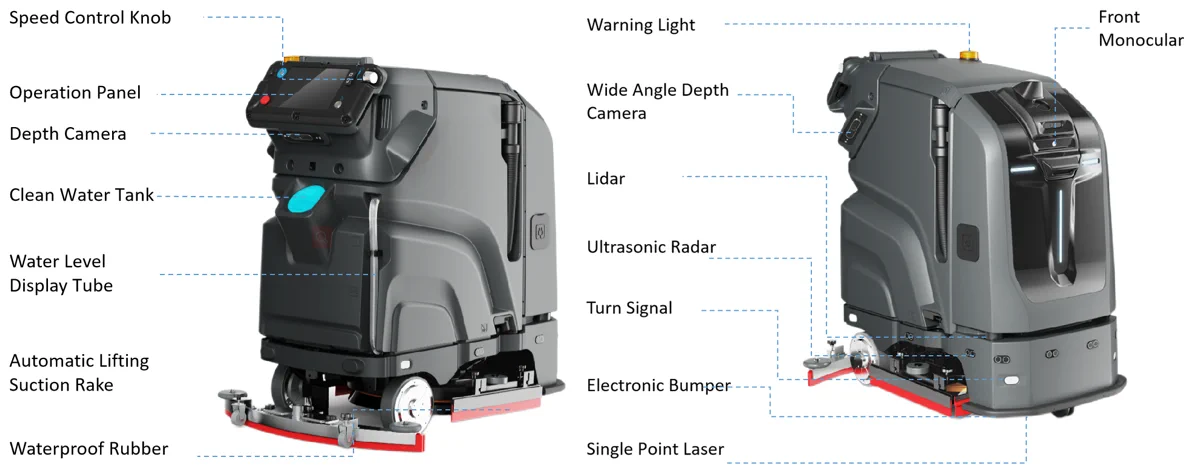
Minfu’s LT70 Pro heavy-duty autonomous floor cleaning robot, for example, uses a 70 L clean-water tank and 80 L recovery tank with a 51 cm brush-cleaning width. Its design is aimed at larger commercial and industrial environments where cleaning capacity matters as much as navigation.
By comparison, our LT10 commercial cleaning robot uses a much smaller and more agile platform, with a 35 cm cleaning width and integrated sweeping, vacuuming and scrubbing for more constrained environments.
Both can contribute to facility hygiene.
But the correct machine depends on the scale and geometry of the cleaning workload.
The Robot Itself Has to Be Cleaned
This part rarely makes it into robotics marketing.
But it should.
A machine that removes dirty water eventually contains dirty water.
A brush that lifts soil eventually becomes soiled.
A squeegee that contacts hundreds of metres of floor eventually needs inspection and cleaning.
So an autonomous cleaning program also needs an answer to:
Who cleans the cleaning robot?
Routine maintenance may include:
- emptying and rinsing recovery tanks;
- cleaning brushes;
- checking squeegee blades;
- removing wrapped debris;
- inspecting filters;
- cleaning sensor surfaces;
- checking wheels and contact areas.
This is especially important when one machine serves several hygiene zones.
Autonomy can reduce operator time during the cleaning mission.
It does not eliminate equipment hygiene.
Cleaning Data Can Prove a Process Happened — Not That the Floor Is Hygienic
Connected robots introduce another useful capability: operational records.
Depending on the platform, managers may be able to review:
- mission start and finish;
- mapped cleaning area;
- task duration;
- completed route;
- machine status.
That can be valuable.
A manager can move from:
“This aisle should have been cleaned.”
to:
“This cleaning mission ran at this time.”
But this needs an important qualification.
A completed mission is not the same as a verified hygiene result.
A robot can report that it covered Zone 4.
That does not automatically prove:
- all soil was removed;
- chemical concentration was correct;
- microbial limits were achieved;
- the floor passed a regulated hygiene standard.
Those questions may require:
- visual inspection;
- soil testing;
- ATP testing where appropriate;
- microbiological testing;
- facility-specific verification.
The role of robot data is therefore process traceability, not magical proof of cleanliness.
That distinction becomes especially important in regulated environments.
Healthcare Is a Good Example of Why These Boundaries Matter
Healthcare is frequently used in commercial cleaning robot marketing because hygiene standards are understandably important.
Robots can certainly support routine floor care in suitable hospital corridors, waiting areas and other environments.
But a floor-cleaning robot is not an infection-control program.
CDC guidance emphasizes standardized protocols, staff training, monitoring and cleaning schedules as core parts of environmental cleaning programs.
It also distinguishes high-touch surfaces from low-touch floors and recommends different cleaning intensity based on risk.
That means a robot cleaning a hospital corridor might automate one well-defined part of the process.
It does not replace:
- bed-rail cleaning;
- door-handle disinfection;
- toilet cleaning;
- isolation-room procedures;
- clinical equipment reprocessing.
This is why buyers should be cautious with phrases such as:
“Hospital-grade autonomous sanitation.”
Ask what the machine actually cleans.
Then ask what procedure remains outside the machine.
That gives a much more accurate picture.
Where Industrial Cleaning Robots Fit Best in Hygiene Programs
Different environments create different reasons for using automation.
| Facility Type | Typical Floor-Hygiene Challenge | Where Robots Can Help |
|---|---|---|
| Warehouse | Dust, tire tracks, packaging debris, large area | Repeated aisle cleaning and large-area coverage |
| Manufacturing Plant | Process residue, industrial soil, equipment traffic | Scheduled cleaning of defined production/support zones |
| Airport / Transport Hub | High traffic and long operating hours | Off-peak routine floor cleaning |
| Retail / Commercial | Continuous pedestrian traffic | Scheduled maintenance of public hard floors |
| Healthcare | Structured environmental cleaning requirements | Routine cleaning of suitable low-touch floor areas |
| Education | Large corridors and common areas | Scheduled cleaning outside peak occupancy |
This table is deliberately not called:
“Best Industries for Cleaning Robots.”
Because suitability still depends on:
- floor type;
- contamination type;
- facility layout;
- traffic;
- local procedure;
- cleaning chemistry;
- regulatory requirements.
Industry alone does not determine whether autonomy is appropriate.
What Industrial Cleaning Robots Cannot Replace
There are several parts of hygiene management that should remain clearly outside the robot’s job.
High-touch surface cleaning
Door handles, switches, railings, desks and other frequently touched surfaces usually require separate cleaning procedures.
Unexpected hazardous spills
A robot should not be expected to independently decide how to handle an unknown chemical or biological spill.
Deep-cleaning judgment
Some contamination requires an experienced person to inspect the surface and determine whether additional cleaning is necessary.
Hygiene policy
The machine cannot decide what cleaning standard your facility must meet.
Verification
The robot can provide operating data. Final verification may still require people or dedicated testing methods.
This is not a limitation that makes robots less valuable.
It simply defines the part of the workflow where automation belongs.
How We Would Test an Industrial Cleaning Robot for Hygiene Performance
If the goal is maintaining a hygienic facility, we would not evaluate the robot only by watching it drive around obstacles.
We would test the complete cleaning process.
1. Soil Removal
Prepare representative contamination:
- dust;
- tracked-in dirt;
- tire marks;
- routine industrial residue.
Then evaluate what remains after cleaning.
2. Dirty-Water Recovery
Inspect the floor after the robot passes.
Look for:
- standing water;
- streaks;
- poor recovery at turns;
- missed sections.
3. Edge Performance
Columns, walls and equipment boundaries often expose weaknesses that open-floor demonstrations hide.
4. Repeatability
Run the same mission repeatedly.
Does coverage remain consistent?
5. Zone Behavior
Test transitions between different areas.
Does the cleaning program follow the intended sequence?
6. Human Intervention
Record how often somebody must:
- rescue the robot;
- restart a mission;
- adjust the route;
- clear an obstacle.
7. Post-Mission Maintenance
Measure how easy it is to clean:
- brushes;
- tanks;
- squeegee;
- debris areas.
A robot that is difficult to clean may create its own maintenance problem.
A Better Hygiene KPI: Useful Cleaned Area, Not Just Maximum m²/h
Robot specifications frequently advertise maximum cleaning efficiency.
That number is useful—but incomplete.
Suppose Machine A theoretically cleans more square metres per hour but requires frequent:
- refill stops;
- rescue;
- tank cleaning;
- route correction.
Machine B has a lower theoretical speed but completes the shift with less interruption.
Which one supports the hygiene program better?
Probably Machine B.
For real facilities, we think a more useful question is:
How much validated floor area can the robot clean correctly during a normal operating window with acceptable human intervention?
That number combines:
- cleaning performance;
- navigation reliability;
- tank capacity;
- route design;
- charging;
- maintenance.
It is much closer to real operational value.
How Minfu Approaches Industrial Floor Hygiene
At Minfu, we see hygiene-oriented floor automation as the combination of two systems:
autonomous mobility
and
professional floor-care hardware.
The LT10 and LT70 Pro are designed for very different operating environments.
The LT10 uses a compact chassis, multi-sensor navigation and integrated sweeping, vacuuming and scrubbing for environments where maneuverability and mixed commercial traffic matter.
The LT70 Pro is designed for larger industrial and commercial areas, with a 51 cm brush-cleaning width, 70 L clean-water tank, 80 L recovery tank and a larger heavy-duty platform.
For OEM/ODM projects, the right starting point is therefore not:
“Which robot has more AI?”
We would rather ask:
- What contamination are we removing?
- What floor material are we cleaning?
- How large is the zone?
- How frequently is it cleaned?
- What happens between hygiene zones?
- What procedures remain manual?
- How will cleaning performance be verified?
Those questions determine whether automation fits the facility.
Conclusion
Industrial cleaning robots can play an important role in maintaining hygienic facilities, but their value is more specific than many marketing claims suggest.
They are particularly effective at turning routine floor cleaning into a repeatable, scheduled and traceable process.
They can remove everyday soil, scrub defined zones, recover dirty water, repeat validated routes and provide operating records.
What they cannot do is replace the entire hygiene program.
A clean facility still depends on:
- correct cleaning methods;
- suitable chemistry;
- contamination zoning;
- machine maintenance;
- staff procedures;
- inspection;
- verification.
That is why we believe the best way to think about industrial cleaning robotics is not:
robot = hygiene
but:
robot + process + people + verification = better controlled facility hygiene.
The robot is one part of the system.
When that part is assigned the right job, automation becomes much more valuable.
FAQ
What are industrial cleaning robots?
Industrial cleaning robots are autonomous machines designed to perform repetitive cleaning tasks in large commercial or industrial facilities. Depending on the platform, they may sweep, vacuum, scrub and recover dirty water while using sensors and navigation technology to operate within mapped areas.
How do industrial cleaning robots improve facility hygiene?
They can improve the consistency of routine floor cleaning by following defined schedules and routes, removing soil and dirty water and recording whether assigned cleaning missions were completed.
Can industrial cleaning robots disinfect floors?
Some machines may support specific chemical or disinfection functions, but cleaning and disinfection are different processes. Whether disinfection is required depends on the facility, contamination risk, chemical product and applicable procedure. A robot should not automatically be assumed to provide regulatory-grade disinfection.
Are industrial cleaning robots suitable for hospitals?
They can support routine floor cleaning in suitable healthcare areas, but they do not replace environmental cleaning and infection-control protocols. High-touch surfaces, specialized areas and clinical equipment still require appropriate procedures.
Can industrial cleaning robots work in warehouses?
Yes. Warehouses are often suitable because they contain large, repeatable floor areas. However, forklift traffic, dust, pallet debris, floor condition and changing obstacles should be evaluated during deployment.
How should an industrial cleaning robot be tested?
A useful pilot should evaluate soil removal, dirty-water recovery, edge cleaning, route completion, intervention frequency, zone behavior and post-mission machine maintenance—not just navigation.
Work With Minfu
Minfu provides industrial and commercial cleaning robot OEM/ODM solutions for equipment brands, distributors, facility-service companies and commercial robotics partners.
We support product configuration, customization, testing, manufacturing and mass-production development for different facility applications.
Our current platforms include compact autonomous floor care for more complex commercial spaces and heavy-duty robotic cleaning for larger industrial environments.
LT10 Commercial Cleaning Robot
LT70 Pro Industrial Cleaning Robot
Email: info@minfutech.com
WhatsApp / Phone: +86 13760255781
Contact Minfu to discuss your facility type, floor conditions, target market or industrial cleaning robot project.
Explore More Commercial Cleaning Robot Guides
How Autonomous Cleaning Robots Work
See how sensors, mapping, obstacle avoidance, route planning and floor-care hardware work together inside an autonomous cleaning robot.
7 Benefits of Commercial Cleaning Robots
Learn where autonomous cleaning creates real operational value—from labor reallocation and scheduling to repeatable coverage and cleaning data.
How Commercial Cleaning Robots Are Changing Floor Care
Explore how floor cleaning is evolving from operator-driven equipment toward connected, mission-based autonomous cleaning systems.