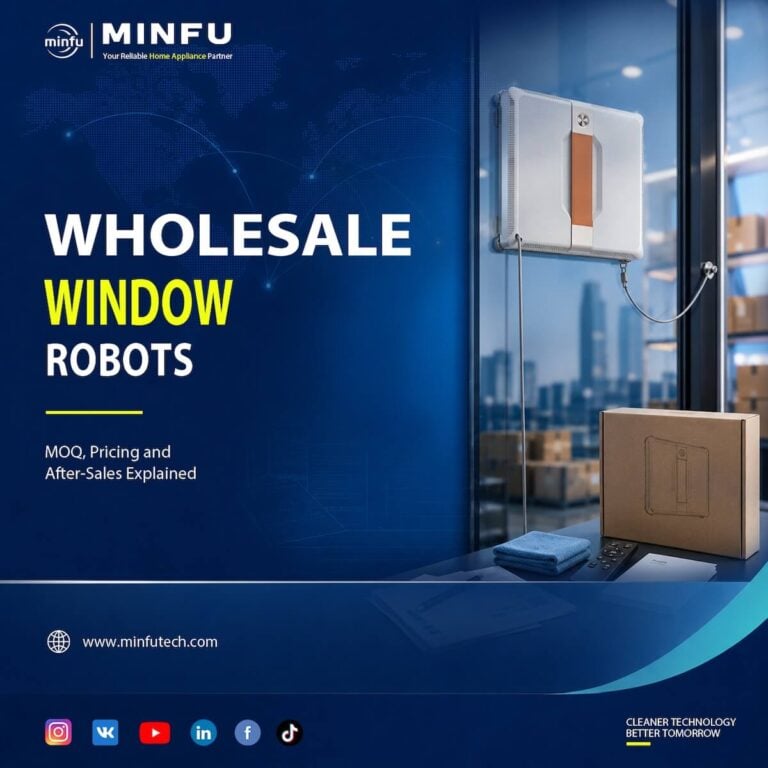




Launching a private-label window cleaning robot involves far more than placing a logo on an existing machine.
The buyer must decide how the product will be positioned, which functions are appropriate for the target market, how safety information will be communicated, which accessories should be included, what documentation is required and how the product will be supported after launch.
For window cleaning robots, these decisions are especially important because the product operates vertically on glass and combines:
- Suction adhesion
- Electronic sensors
- Backup power
- Water spray
- Navigation software
- Power cables
- Safety accessories
- Cleaning consumables
A private-label project must therefore connect product engineering, branding, compliance, packaging, quality control and after-sales planning.
This guide explains how importers, distributors and appliance brands can develop an OEM or ODM window cleaning robot project from the initial market brief to the first commercial launch.
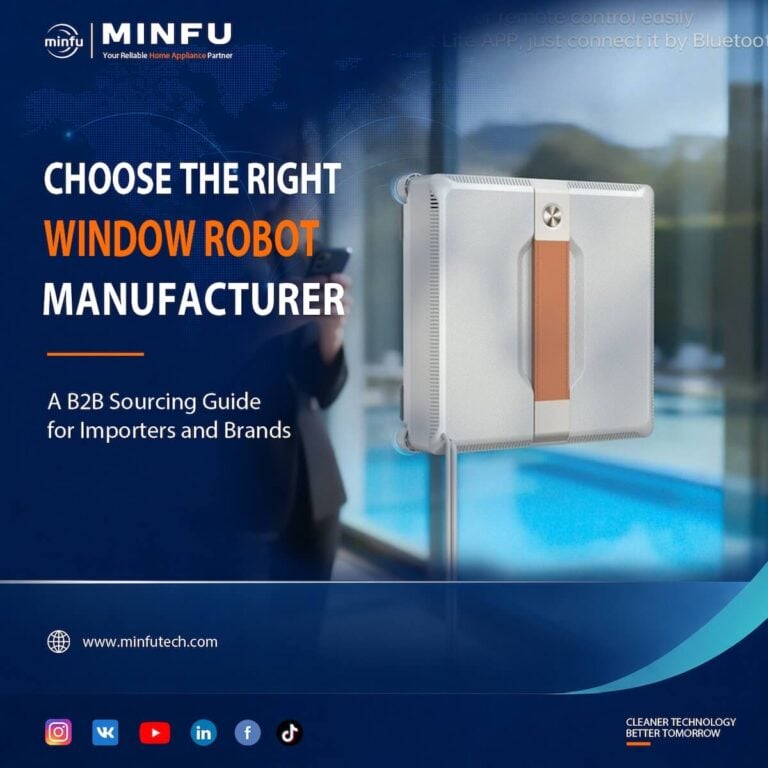
Buyers who are still comparing potential production partners can first review the B2B guide to choosing a window cleaning robot manufacturer.
Private Label Project Roadmap
| Project Stage | Main Decision |
|---|---|
| Market brief | Who will buy the product and through which channel? |
| Base model selection | Which existing platform fits the market? |
| Product configuration | Which functions, accessories and controls are required? |
| Brand customisation | Logo, colour, packaging and model name |
| Localisation | Plug, voltage, language, labels and warnings |
| Compliance review | Which documents apply to the exact configuration? |
| Golden sample | What final version will mass production follow? |
| Pilot production | Can the product and packaging be produced consistently? |
| Market launch | Are content, spare parts and support materials ready? |
| Repeat order | What should be improved using real sales data? |
The most reliable private-label projects move through these stages in order. Skipping directly from a catalogue photo to a bulk order increases the risk of incorrect specifications, packaging mistakes and inconsistent expectations.
1. Understand OEM, ODM and Private Label
These terms are often used together, but they describe different levels of involvement.
OEM Window Cleaning Robot
In a typical OEM project, the buyer selects an existing product platform and applies market-specific customisation.
This may include:
- Brand logo
- Product colour
- Model name
- Colour box
- User manual
- Labels
- Regional plug
- Cleaning cloth design
- Accessory configuration
OEM is generally the fastest route for brands that want to enter the market using an existing, tested product structure.
ODM Window Cleaning Robot
ODM involves deeper product development or modification.
Possible ODM work includes:
- Housing changes
- New moulded components
- Spray-system modifications
- Water-tank changes
- Sensor or navigation adjustments
- New control logic
- App-interface development
- Voice prompts
- Accessory development
- Packaging-structure redesign
ODM normally requires more engineering time, testing, cost and approval stages.
Private Label
Private label describes the commercial result: the product is sold under the buyer’s own brand.
A private-label project can use either:
- A relatively simple OEM model;
- Or a more customised ODM platform.
The right choice depends on market size, target retail price, brand strategy and development budget.
2. Start with a Product and Brand Brief
The first document in a private-label project should not be a quotation request.
It should be a short product brief that explains what the buyer is trying to build.
Recommended Market Information
The brief should include:
- Target country
- Target customer
- Main sales channel
- Expected retail-price range
- Competing product types
- Framed or frameless glass requirements
- Typical window size
- Preferred product shape
- Required control method
- Warranty expectations
- Initial order strategy
Recommended Brand Information
The supplier should also understand:
- Brand positioning
- Existing brand colours
- Logo files
- Preferred model naming
- Packaging style
- Marketing language
- Required product claims
- Whether the product will join an existing appliance range
For example, an established smart-home brand may want the window robot to match its robot vacuum and floor washer packaging. A new online brand may need a simpler launch package focused on marketplace imagery and short videos.
Without a clear brief, suppliers may optimise the product around the lowest factory price rather than the buyer’s real commercial objective.
3. Choose the Base Product Platform Before Customising It
The most efficient private-label projects normally begin with a suitable existing platform.
Before discussing colours or packaging, buyers should confirm whether the base product fits the intended market.
Important questions include:
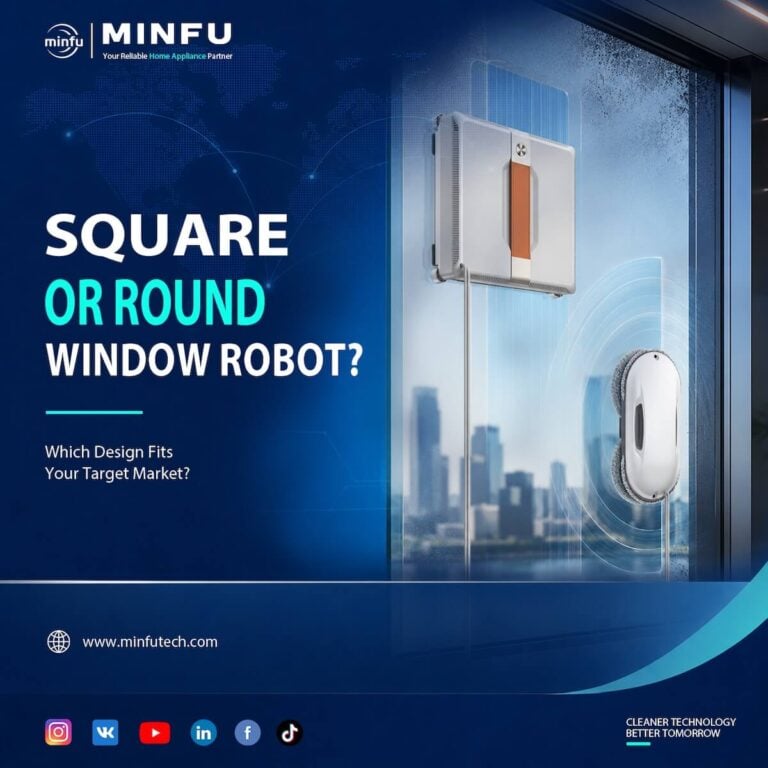
- Is the body square, round or oval?
- Does it support framed and frameless glass?
- How does it detect edges?
- What type of spray system is used?
- How many spray outlets are included?
- Does it use remote control, app control or both?
- How is backup power handled?
- What safety rope is included?
- What is the product size and weight?
- How is the cleaning cloth installed?
- Can the product handle the target window dimensions?
- Which components are already covered by test documentation?
Changing the appearance of an unsuitable product does not make it market-ready.
A product platform should first pass real sample testing. Only then should the buyer invest in branding and localisation.
4. Build a Customisation Ladder
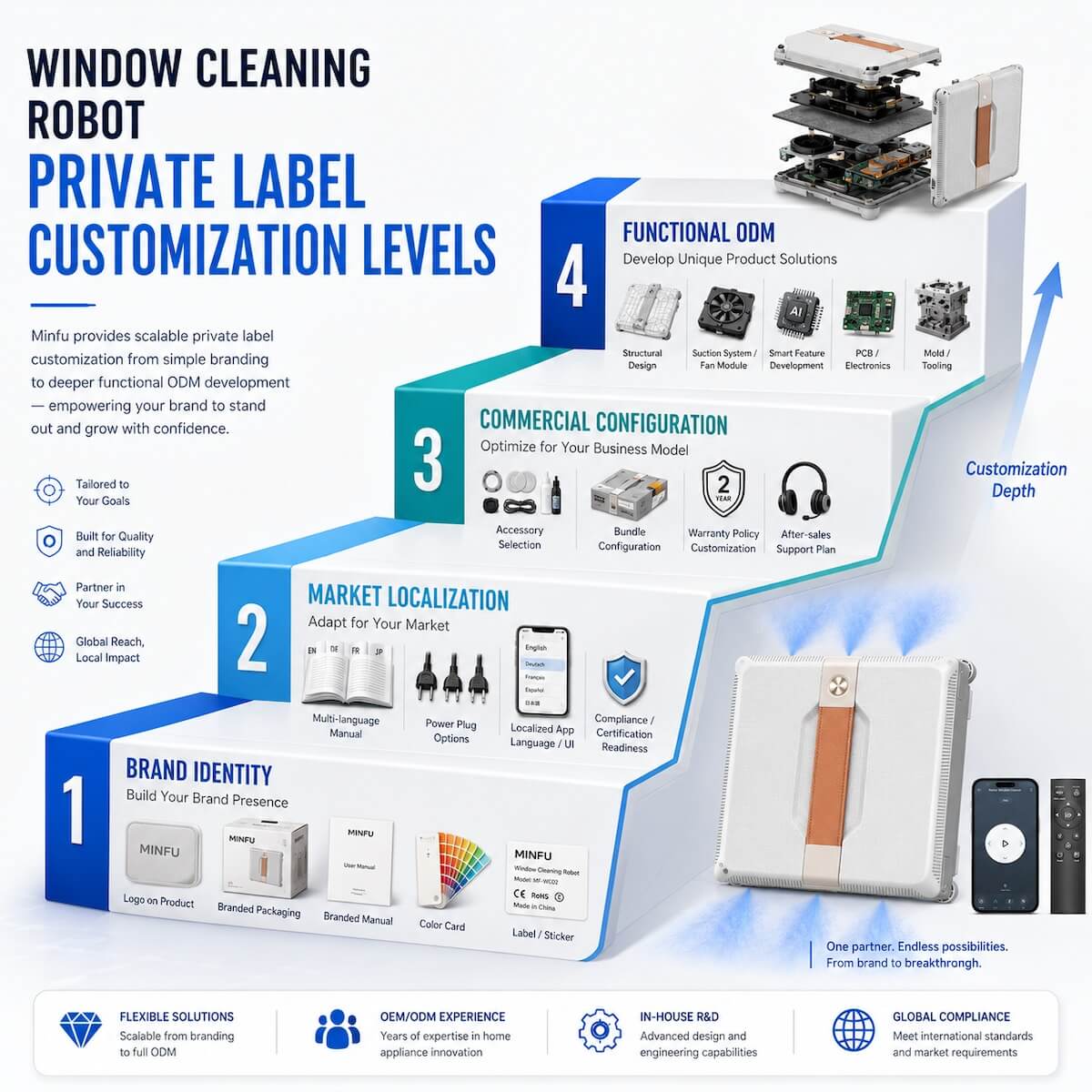
Not every project needs deep ODM development. Customisation can be divided into four practical levels.
Level 1: Brand Identity
This is the fastest and least complex private-label level.
Typical changes include:
- Logo printing
- Model number
- Product label
- Housing colour
- Colour box
- Outer carton
- Warranty card
This level is suitable for distributors and online sellers that want to test the category without changing the core product.
Level 2: Market Localisation
The second level adapts the product to a specific country.
Possible requirements include:
- Regional plug
- Voltage and adapter configuration
- Local-language manual
- Local-language safety warnings
- Packaging translations
- Voice-language options
- Local contact information
- Recycling and disposal labels
- Importer or responsible-party information
Localisation should not be left until the packaging-production stage. It must be confirmed before final artwork approval.
Level 3: Commercial Product Configuration
At this level, the buyer changes how the product is packaged and sold.
Possible options include:
- Number of cleaning cloths
- Safety-rope length
- Water bottle
- Spare spray nozzles
- Extension cable
- Storage bag
- Cleaning-fluid container
- Remote-control configuration
- Accessory bundles
- Replacement-cloth retail packs
The core machine may remain unchanged, but the retail proposition becomes more differentiated.
Level 4: Functional or Structural ODM
This is the most complex level.
Possible work includes:
- Modified water-tank capacity
- Different spray configuration
- Housing or handle changes
- New sensor positions
- Firmware changes
- Navigation-mode adjustments
- Custom app interface
- Brand-specific voice prompts
- New cleaning-cloth structure
- New packaging inserts
- New mould development
These changes may affect tooling, testing, compliance documentation and production lead time.
5. Customise the Product Claim, Not Only the Product
Private-label projects often focus heavily on physical design while neglecting product claims.
Window cleaning robot claims must be accurate and supported by the actual product configuration.
More Credible Claims
Examples include:
- Dual-sided ultrasonic spray
- Automatic edge detection
- UPS emergency backup
- Multiple navigation modes
- Remote control
- Optional app control
- Suitable for framed and frameless glass
- Includes physical safety rope
- Customisable packaging and accessories
Claims That Require Caution
Avoid unsupported absolute statements such as:
- Cannot fall
- Completely risk-free
- Works on every glass surface
- Fully cordless
- Cleans every corner perfectly
- Requires no supervision
- Guaranteed streak-free on all windows
A window robot should be presented as a multi-layer system rather than a machine protected by one headline specification.
For example, backup power is generally intended to maintain attachment temporarily during an interruption. It should not be marketed as normal cordless operating time unless the product was specifically designed and tested for that use.
The planned safety article in this cluster will examine suction, UPS backup, edge detection and safety ropes in greater detail.
6. Design Packaging Around Installation and Safety
Window cleaning robot packaging has two jobs:
- Sell the product;
- Help the customer use it correctly.
A visually attractive box is not enough if important setup information is hidden.
Front-of-Box Content
The front panel may highlight:
- Product image
- Product category
- Main control method
- Spray feature
- Navigation feature
- Framed or frameless glass application
- Core brand message
Side and Back Panels
These areas can explain:
- Product dimensions
- Included accessories
- Cleaning modes
- Safety system
- Installation sequence
- Glass-use conditions
- Power and adapter information
- App information
- Customer-support contact
Warning Communication
Important warnings should not rely only on a long user manual.
Packaging inserts or quick-start cards may remind users to:
- Secure the safety rope;
- Confirm stable power connection;
- Install the cleaning cloth correctly;
- Avoid heavily damaged glass;
- Keep the product within reach during setup;
- Recover the robot promptly after a power interruption;
- Follow the specified cleaning and storage instructions.
For B2B buyers, clear warnings can reduce incorrect use, avoidable support questions and negative reviews.
7. Localise the User Manual Properly
A direct machine translation is rarely sufficient for a safety-related appliance.
The manual should be reviewed for both language and technical accuracy.
Recommended Manual Structure
- Product overview
- Included accessories
- Button and indicator explanation
- Safety warnings
- Safety-rope installation
- Power connection
- Cleaning-cloth installation
- Water-tank filling
- Operating modes
- Framed and frameless glass guidance
- Power-failure procedure
- Cleaning and maintenance
- Troubleshooting
- Storage
- Warranty and contact details
Common Localisation Problems
Private-label manuals often contain:
- Old model numbers
- Incorrect app names
- Wrong voltage information
- Missing accessories
- Untranslated warning labels
- Inconsistent button names
- Poorly translated safety instructions
- Images from another model
- Incorrect QR codes
The final manual should be checked against the golden sample, not against an early catalogue specification.
8. Decide Whether App Control Adds Commercial Value
App control can strengthen a smart-appliance brand, but it also adds responsibilities.
Before selecting an app-enabled configuration, buyers should ask:
- Is the app essential or optional?
- Which wireless technology is used?
- Who maintains the app?
- Is the app owned by the factory or a third-party platform?
- Can the interface be branded?
- Which languages are available?
- How are firmware updates handled?
- What happens if the app platform changes?
- Is the remote control still included?
- Can the product operate without creating an account?
For radio-enabled products entering the EU, the configuration may fall within the Radio Equipment Directive. The European Commission states that RED establishes requirements covering safety, electromagnetic compatibility and efficient use of the radio spectrum. Applicable requirements depend on the exact wireless configuration and destination market.
App development should therefore be considered part of the product system—not merely a marketing icon on the box.
9. Understand the Compliance Responsibilities of an Own Brand
Private label changes more than the visible brand name.
In the EU, the General Product Safety Regulation defines a manufacturer as a person or company that manufactures a product—or has it manufactured—and markets it under its own name or trademark. It also states that a business placing a product on the market under its own name or trademark is subject to manufacturer obligations under the regulation.
This means a private-label buyer should not assume that the overseas factory carries every legal responsibility after the buyer’s brand is placed on the product.
For products entering the European Economic Area, the European Commission also states that manufacturers are responsible for conformity assessment, the technical file, the EU Declaration of Conformity and CE marking. Importers and distributors must understand the applicable requirements and ensure that compliant products are placed on the market.
Depending on the product configuration and destination market, relevant areas may include:
- Product safety
- Electrical safety
- Electromagnetic compatibility
- Radio requirements for wireless models
- RoHS hazardous-substance restrictions
- Battery documentation
- Adapter documentation
- WEEE obligations
- Packaging and recycling requirements
- General product-safety information
- Local economic-operator information
RoHS restricts hazardous substances in electrical and electronic equipment, while the EU WEEE framework addresses the collection and treatment of discarded electronic products.
This section is a general sourcing overview, not legal advice. Buyers should confirm the exact requirements with a qualified compliance specialist in the destination market.
10. Control Every Change Against the Compliance File
A supplier may already have reports for the base model, but customisation can affect the relevance of those documents.
Changes that may require technical review include:
- Adapter change
- Battery change
- Motor change
- PCB change
- Wireless module
- New housing or ventilation structure
- New water-pump configuration
- Firmware changes
- Different power cable
- Different plug
- New safety-rope connection
- Substantially different accessory configuration
Before approving an ODM change, ask:
- Does the existing report cover this version?
- Is the model number included?
- Does the adapter match the report?
- Is the wireless version covered?
- Is additional testing recommended?
- Who pays for retesting?
- Who owns the reports?
- Who prepares the technical file?
- Which company appears on the Declaration of Conformity?
- Which product changes require document updates?
The answer should be recorded in writing.
11. Create a Golden Sample and Approval File
The golden sample is the physical reference for mass production.
It should represent the final approved combination of:
- Product colour
- Logo
- Product label
- Model number
- Firmware
- Voice language
- App configuration
- Adapter
- Plug
- Cleaning cloth
- Safety rope
- Accessories
- Packaging
- Manual
- Warning labels
Approving product appearance through photographs alone is risky.
Colours, surface texture, logo position, cable quality, packaging fit and accessory layout should be checked on a physical sample.
Recommended Approval File
| Approval Item | Recommended Record |
|---|---|
| Product appearance | Signed photos and colour reference |
| Logo | Size, position and printing method |
| Product label | Final editable file and approved sample |
| Firmware | Version number |
| Voice prompts | Approved audio list |
| App | Interface screenshots and version |
| Accessories | Quantity and exact specifications |
| Packaging | Artwork, material and dimensions |
| Manual | Final language version |
| Carton | Marks, quantity and dimensions |
| Test configuration | Product version used for reports |
| Golden sample | Signed and dated physical unit |
Once approved, production changes should require written confirmation.
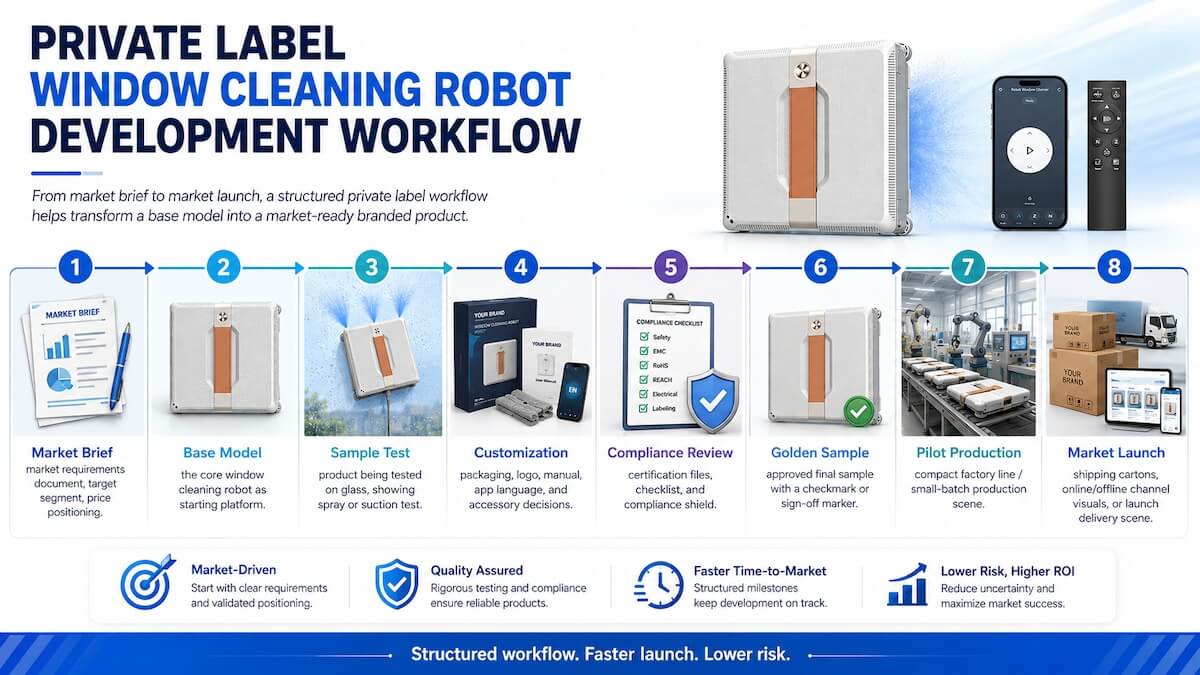
12. Use Pilot Production to Validate the Complete Package
A pilot order is not only a smaller commercial order. It is an opportunity to verify whether all departments can reproduce the approved product.
During pilot production, inspect:
- Logo consistency
- Housing colour
- Label position
- Adapter and plug
- Firmware version
- Voice language
- Remote-control pairing
- App connection
- Spray function
- Edge detection
- Backup power
- Safety-rope inclusion
- Accessory count
- Manual version
- Packaging protection
- Carton markings
- Barcode accuracy
The inspection should cover both the machine and the complete retail package.
A correct robot inside the wrong box is still a failed private-label delivery.
13. Plan MOQ Around the Type of Customisation
MOQ should not be treated as one fixed number for every project.
Different components may have different minimum quantities:
- Logo printing MOQ
- Housing-colour MOQ
- Colour-box MOQ
- Manual-printing MOQ
- Custom cloth MOQ
- Custom accessory MOQ
- App-development MOQ
- New mould MOQ
- Production-line MOQ
A buyer may be able to order a smaller quantity of a standard-colour product with simple branding, while a fully customised housing or new mould may require a larger commitment.
Before confirming the project, request an MOQ breakdown:
| Customisation Item | MOQ | One-Time Cost | Repeat-Order Requirement |
|---|---|---|---|
| Logo | Confirm with supplier | Confirm | Confirm |
| Custom colour | Confirm with supplier | Confirm | Confirm |
| Colour box | Confirm with supplier | Artwork/plate cost | Confirm |
| Manual | Confirm with supplier | Translation/design | Confirm |
| App branding | Project-specific | Development fee | Service/update terms |
| New mould | Project-specific | Tooling fee | Ownership terms |
This is more useful than receiving only one headline MOQ.
14. Prepare the After-Sales Package Before Launch
A private-label brand needs a repair and replacement strategy before the first customer receives the product.
Recommended Spare Parts
Depending on the model, the support package may include:
- Cleaning cloths
- Spray nozzles
- Water tank
- Pump
- Adapter
- Power cable
- Safety rope
- Remote control
- Battery
- Motor
- Sensors
- Plastic covers
- PCB assemblies
Recommended Technical Materials
- Fault-code guide
- Troubleshooting chart
- Repair videos
- Parts diagram
- Disassembly guidance
- Software-reset procedure
- Warranty-claim form
- Batch-tracking method
The buyer should decide which failures can be repaired locally and which require complete-unit replacement.
A product with a slightly lower purchase price may become more expensive when no spare parts or diagnostic information are available.
15. Build a Market-Ready Content Package
Private-label development should include launch content, not only physical production.
For marketplace and distributor sales, prepare:
- White-background product images
- Lifestyle images
- Product dimensions
- Accessory layout
- Safety-system diagram
- Spray demonstration
- Navigation demonstration
- Framed and frameless glass explanation
- Power-failure explanation
- Cleaning-cloth installation
- Maintenance instructions
- FAQ content
- Short-form video
- Distributor product sheet
The claims in marketing materials must match the approved manual and product configuration.
Do not show app control if the ordered version only includes a remote. Do not show six spray outlets if the production configuration uses a different spray system.
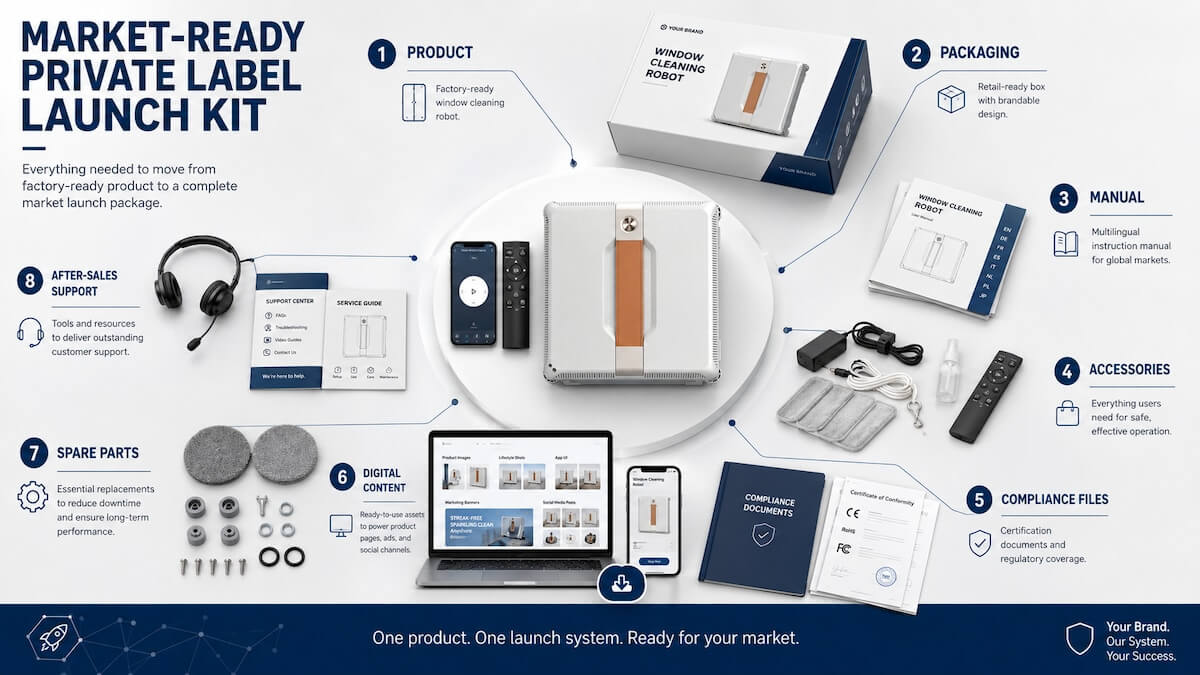
16. MFW01 as a Private Label Platform
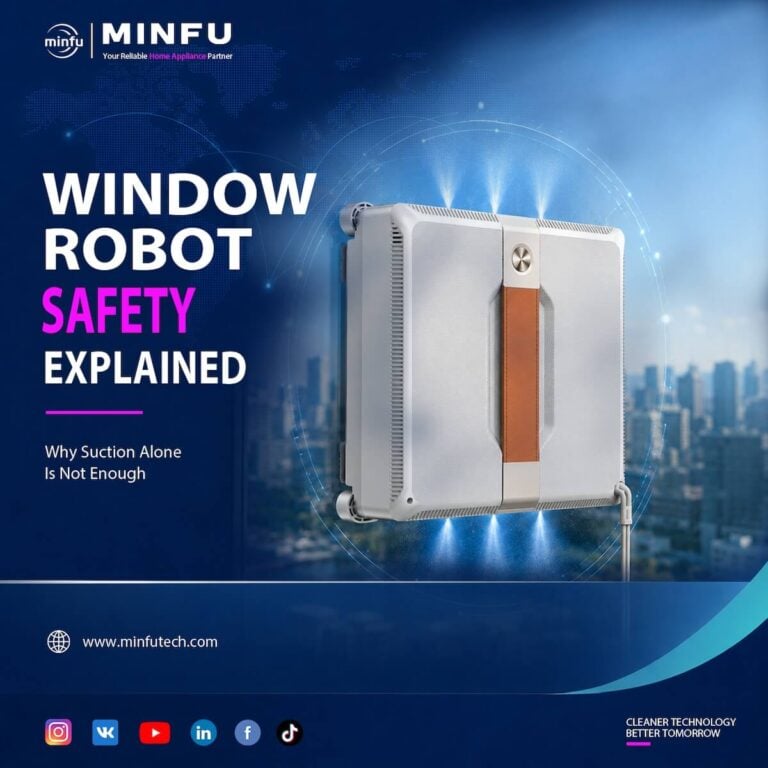
The OEM/ODM MFW01 window cleaning robot can be considered as one base platform for private-label development.
The current product configuration includes:
- Square 220 × 220 × 59 mm body
- Dual-sided six-jet ultrasonic atomisation
- 10,000Pa stated suction
- Automatic edge detection
- Gyroscope navigation
- Multiple cleaning modes
- Auto-return function
- Remote control
- Optional app control
- Voice-function support
- 2,600mAh UPS backup battery
- Four-metre safety rope
- Framed, frameless and bevelled-surface positioning
- 120mL water tank
- 1.23kg net weight
The product page lists customisation options covering logo, housing colour, packaging, regional plug, manuals and accessories. Minfu also describes product-configuration, multilingual packaging and quality-control support for OEM/ODM projects.
A buyer could use MFW01 in several private-label directions.
Online Marketplace Version
Possible priorities:
- Standard housing colour
- Custom logo
- Compact colour box
- Multiple cleaning cloths
- Clear installation video
- Remote-control configuration
- Simple local-language manual
Smart-Home Brand Version
Possible priorities:
- Brand-specific colour
- Optional app configuration
- Voice localisation
- Matching packaging system
- Smart-appliance visual identity
- Expanded digital content
Distributor Version
Possible priorities:
- Spare-parts package
- Repair guidance
- Additional cloth inventory
- Multi-language manual
- Dealer product sheet
- Technical training
The selected configuration should always be verified through sample testing and destination-market compliance review before mass production.
Buyers can also review Minfu window cleaning robot OEM/ODM supplier page for the current product range.
17. Common Private Label Mistakes
Mistake 1: Starting with Packaging Before Testing the Product
Branding an unsuitable product wastes time and artwork cost.
The base model should pass sample testing before packaging development begins.
Mistake 2: Treating a Logo Change as Complete Product Development
A logo creates brand visibility, but it does not solve localisation, compliance, support or product-positioning problems.
Mistake 3: Changing Components Without Reviewing Documents
Adapters, batteries, wireless modules and PCBs should not be changed without checking the impact on testing and documentation.
Mistake 4: Approving Artwork Without a Physical Package
Digital artwork cannot show actual colour, material, fit or shipping protection.
Mistake 5: Using Claims from Another Model
Product pages and packaging are sometimes created from older templates. Every claim must match the ordered configuration.
Mistake 6: Launching Without Spare Parts
Cleaning cloths, spray nozzles, adapters and other replacement items should be planned before retail sales begin.
Mistake 7: Treating the First Order as the Final Product
The first batch should provide market feedback.
Reviews, returns and distributor comments can guide improvements in:
- Packaging
- Manuals
- Accessories
- Product claims
- Software
- Spare-parts inventory
- Future model selection
Conclusion: Build a Complete Product System
A successful private-label window cleaning robot is not simply an existing machine with a new logo.
It is a complete commercial system that includes:
- A suitable base product
- Accurate brand positioning
- Market-specific configuration
- Clear safety communication
- Localised packaging and manuals
- Relevant compliance documentation
- A controlled golden sample
- Repeatable mass production
- Spare parts and technical support
- Launch-ready digital content
OEM is often the most efficient route for entering the market quickly. ODM becomes valuable when the brand has enough market knowledge, sales volume and development budget to justify deeper changes.
For many importers, the most practical approach is:
- Select a proven base platform.
- Complete sample and safety testing.
- Launch with controlled OEM customisation.
- Collect real market feedback.
- Move toward deeper ODM development only where it creates measurable value.
For MFW01 samples, branding, packaging, accessories or private-label project planning, contact the Minfu team.