

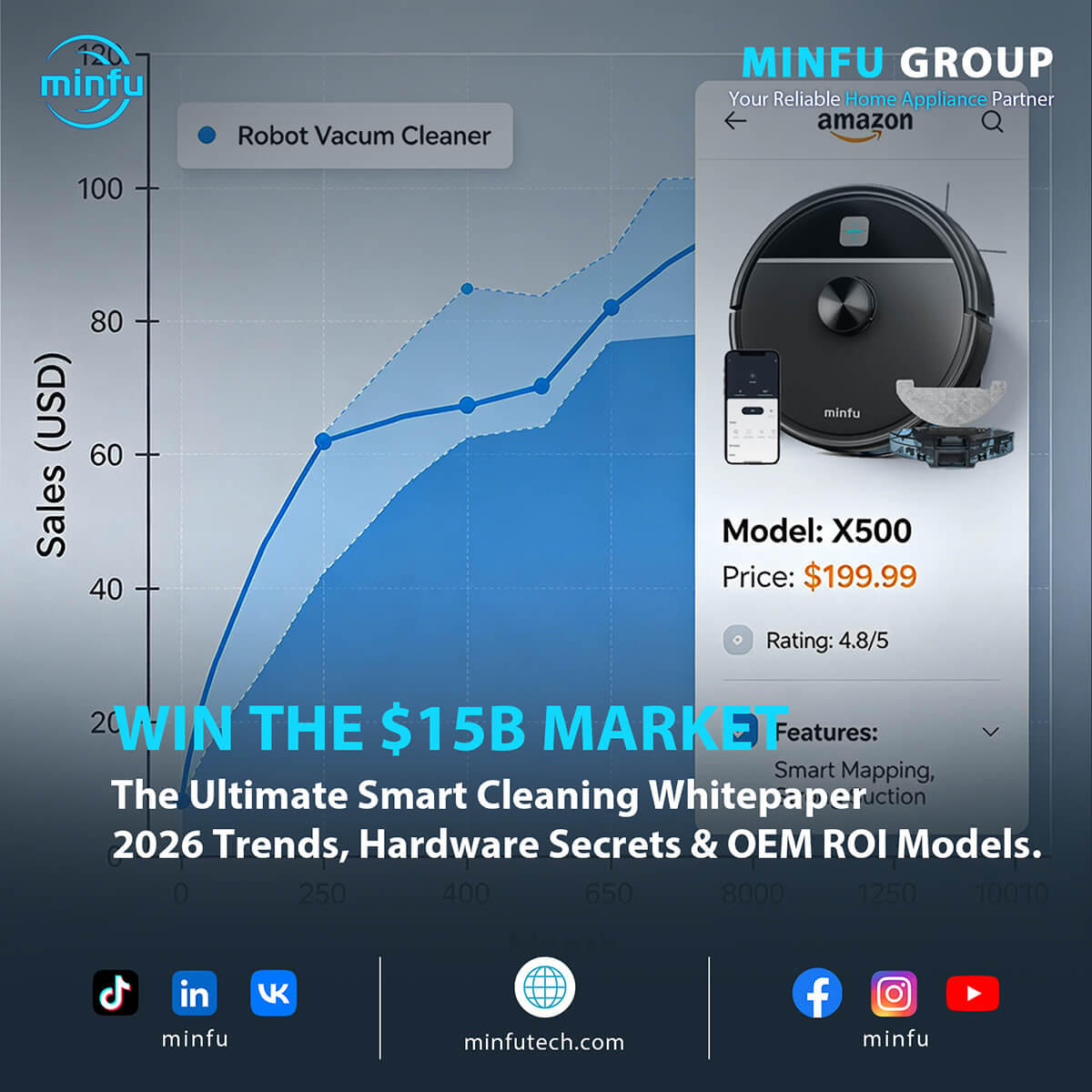

Published by: Minfu Industry Research Institute
Target Audience: Appliance Brand Executives, Regional Distributors, Amazon FBA Aggregators
Executive Summary
The global smart home cleaning ecosystem has reached a critical inflection point as we transition into the second half (H2) of 2026. The novelty of automated cleaning has faded; we have officially entered the era of hyper-rational mass adoption.
Based on our internal manufacturing indices and cross-referenced with leading global market intelligence, this 2026 H2 Industry Report identifies three defining shifts that will dictate market leadership:
- The Eradication of the “Brand Tax”: Consumers are no longer willing to pay a heavy premium for legacy brand names. Profitability has shifted decisively to the “Value Premium” segment.
- “Hands-Free” is the New Baseline: Base station attachment rates have crossed the tipping point. Consumers are purchasing time, not just hardware.
- Agile Manufacturing as a Moat: Brands leveraging “Modular ODM” source factories to achieve sub-90-day market launches are systematically outmaneuvering legacy incumbents.
Chapter 1: The Global Market Landscape in 2026
1.1 Market Sizing and the Revenue Milestone
Looking back over the past five years, the robot vacuum industry has completely transformed from an expensive niche gadget into a fundamental household appliance. The global robot vacuum market is sprinting forward at an unprecedented pace, defying broader macroeconomic sluggishness.
-
Projected Market Revenue: According to market insights, the global robotic vacuum cleaner and domestic service robot market is projected to skyrocket to $22.8 Billion by 2027.
-
Global Unit Volume: The adoption rate is accelerating. Driven by increasing smart home appliance penetration, global unit sales are expected to reach a staggering 50.0 Million units by 2027.
-
Growth Trajectory: We are forecasting a sustained Compound Annual Growth Rate (CAGR) of 10.6%. This robust double-digit growth indicates that household demand for automated cleaning exhibits incredible recession-proof resilience.

1.2 Regional Divergence: The Strategic Opportunity Matrix
Operating on the frontlines of global manufacturing, Minfu observes that demand across different regional markets is diverging sharply. A one-size-fits-all product strategy will fail in 2026. Understanding these regional psychographics dictates how brands should position their product portfolios.
To assist our OEM partners in product selection, we have mapped out the 2026 regional demand matrix below:
Table 1.1: 2026 Global Regional Demand & Product Strategy Matrix
| Target Region | Market Maturity | Core Consumer Demand Drivers | Recommended OEM Strategy (Minfu Platforms) |
|---|---|---|---|
| North America | High | Deep carpet extraction, Pet hair management, Voice AI integration. | Premium LiDAR + Auto-Empty Station. Focus on high suction (5000Pa+) and anti-tangle brushes. |
| Western Europe | High | Hard floor mopping, GDPR data privacy compliance, Quiet operation. | All-in-One Wash & Dry Station. Emphasize local AWS data storage and low decibel output (<65dB). |
| Asia-Pacific | Very High | Bleeding-edge tech (Robotic arms, AI obstacle avoidance), Compact size. | Ultra-Premium Flagship Models. High innovation frequency required to compete. |
| LATAM & SE Asia | Emerging | High Cost-Performance ratio, Durability, Simple app connectivity. | Budget Gyroscope / V-SLAM Models. Focus on massive volume driving and aggressive pricing under $200. |
1.3 The Death of the “Brand Tax” and the $200-$350 Sweet Spot
Historically, consumers willingly paid a 40% or higher premium simply for a recognizable logo. Today, driven by supply chain transparency and an abundance of teardown reviews on social media, consumers have become hyper-rational.
A real-time analysis of current Amazon Best Seller rankings reveals a brutal but lucrative reality: the fastest-growing and most competitive segment has aggressively shifted to the $200 to $350 “Value Premium” tier.

In this highly contested bracket, consumers now expect high-end functionalities—specifically Auto-Empty base stations (which previously commanded prices over $500)—for under $300. As retail prices are driven down by intense market competition (with auto-empty models frequently listed at $219, $249, and $299), legacy brands with bloated overhead are struggling to survive.
This creates a massive opportunity for agile challenger brands. The only way to maintain a healthy 30%+ gross margin when selling a base-station robot for $249 is to utilize a Tier-1 source factory like Minfu to completely cut out the middlemen and slash R&D burn rates.
Chapter 2: The 2026 Tech Roadmap & Hardware Evolution
To compete in the 2026 smart home arena, consumer brands can no longer rely on superficial aesthetic updates. The underlying hardware architecture has undergone a radical evolution. Relying on 2024 technology standards in late 2026 will result in instant market rejection.
2.1 The Baseline Shift: 2022 vs. 2026 Standards
Based on our tear-downs of market-leading models and our internal Minfu R&D roadmap, we have identified the non-negotiable technical baseline required for any competitive robot vacuum this year.
Table 2.1: The Robot Vacuum Hardware Evolution Matrix
| Component / Feature | Legacy Standard (2022-2024) | The 2026 Premium Baseline | Strategic Impact for Brands |
|---|---|---|---|
| Navigation | V-SLAM (Camera) / Gyroscope | LDS LiDAR + Local SLAM | Faster mapping, dark-room operation, and GDPR privacy compliance. |
| Motor & Suction | Brushed DC / 2500Pa | Nidec BLDC / 4500Pa – 6000Pa | Required for deep European/US carpets; 3x longer motor lifespan. |
| Main Brush | Standard Bristle Brush | V-Shape Aerodynamic Silicone | Eliminates 90% of pet hair tangles; drastically reduces RMA rates. |
| Base Station | Standalone Charging Dock | Auto-Empty / Wash & PTC Dry | “Hands-free” is now mandatory for units priced above $350. |
2.2 From Navigation to Intelligence: Edge Computing
The era of random-bounce navigation is effectively over for any product priced above $199. Spatial intelligence is now the baseline expectation.
- The LDS LiDAR Supremacy: Laser Distance Sensor (LDS) LiDAR now commands over 86% of the premium retail segment.
- Edge Computing Transition: Leading OEM factories like Minfu are moving the SLAM processing load away from the cloud and directly onto high-performance, local Quad-Core ARM chipsets on the motherboard. This ensures millimeter-level obstacle avoidance and immediate responsiveness.
2.3 The Hands-Free Revolution: Base Station Architecture
If the robot is the “worker,” the base station has become the “factory.” Our 2026 supply chain data indicates a fundamental shift in base station requirements:
- The Attachment Rate Surge: Currently, Over 70% of Minfu’s Q1 2026 B2B orders included a base station of mid-to-high-end robot vacuum purchases feature an All-in-One or Auto-Empty station.
- The Odor-Elimination Imperative: Early generation base stations suffered from a fatal flaw: damp mop pads breeding bacteria and emitting mildew odors. 2026-grade stations mandate PTC High-Temperature Drying (45°C-60°C heated air emission), drying pads in under two hours to guarantee hygienic operation.

Global Google search data (Past 5 Years) illustrates the irreversible consumer shift toward “hands-free” cleaning. Notice the aggressive, recurring spikes preceding Q4 holiday seasons.
2.4 Motor Engineering: Aerodynamics vs. Raw Suction
For years, the industry engaged in a purely numerical “suction war,” misleading consumers with inflated Pascal (Pa) ratings. However, raw motor power is irrelevant if the internal airway is compromised. Advanced OEM engineering now focuses heavily on aerodynamic duct sealing. Precision engineering ensures near-zero suction loss from the motor impeller down to the floor-contact brush roll, translating raw power into actual deep-carpet extraction capability.
Chapter 3: Shifting Consumer Psychographics & Purchasing Triggers
Understanding macroeconomic data and hardware capabilities is irrelevant if a brand does not deeply understand the daily frictions of the end-user. In 2026, consumer purchasing decisions are largely driven by a desire to eliminate “Maintenance Fatigue.”
3.1 Translating Pain Points into Profit
Successful challenger brands do not sell technical specifications; they sell the elimination of household frustration. By aligning hardware choices with consumer psychographics, brands can justify premium pricing.
Table 3.1: Consumer Pain Point & Hardware Solution Mapping
| Top Consumer Complaint (Amazon Reviews) | Root Cause in Legacy Models | The Minfu Hardware Solution | Retail Premium Justification |
|---|---|---|---|
| “It gets stuck on everything!” | Poor obstacle avoidance logic. | Local Edge-Computing SLAM algorithms. | High. Consumers pay for peace of mind while away from home. |
| “I hate cutting hair off the brush.” | Bristle brushes trapping pet hair. | V-Shaped Anti-Tangle Silicone Roller. | Very High. Pet owners are the highest-spending demographic. |
| “The mop pad smells like mildew.” | Air-drying takes too long (12+ hrs). | PTC 60°C High-Heat Active Drying Station. | Critical. Hygiene is a non-negotiable factor for families. |
| “It misses dirt on thick carpets.” | Weak motors & poor air sealing. | 5000Pa+ BLDC Motor + Sealed Air Ducts. | High. Directly correlates with perceived cleaning effectiveness. |
3.2 The Pet Economy: The Unstoppable Market Driver
The single most lucrative demographic in the floor care industry is the pet owner. They have the highest frequency of cleaning needs, the highest pain tolerance for premium pricing, and the highest rate of appliance replacement.

Macro-demographic baseline confirming the massive scale of the pet economy. Source: FEDIAF European Overview
-
The Demographic Reality: According to comprehensive baseline industry reports from the APPA and FEDIAF, pet ownership has reached staggering levels. With 71% of U.S. households and 139 million (49%) of European households owning at least one pet, the addressable market for pet-focused cleaning is massive.
-
The “Tangle” Pain Point: When analyzing negative consumer feedback, nearly 40% of 1-star reviews on entry-level vacuums are directly related to brush maintenance and hair clogs leading to motor burnout.
-
The Strategic Move: Brands that leverage Minfu’s anti-tangle hardware ecosystem and actively market their units as “Pet-Friendly” see significantly lower return rates and higher customer lifetime value (LTV).
3.3 The Demand for Durability over Gimmicks
The early adopters of smart vacuums (2018-2022) were willing to tolerate minor inconveniences. The mass-market consumer of 2026 has zero tolerance for “maintenance fatigue.” Consumers are explicitly stating that an appliance designed to save them time should not require 15 minutes of weekly maintenance to clean the machine itself. This psychological shift is exactly why All-in-One Wash & Dry stations have transitioned from luxury add-ons to absolute necessities.
Chapter 4: Supply Chain Realities and Economic Risks
Selecting a manufacturing partner based solely on the lowest initial Bill of Materials (BOM) quote is the most common and fatal mistake made by emerging appliance brands. In the complex world of robotics, the true cost of manufacturing includes the hidden liabilities of the supply chain.This is exactly why buyers must conduct rigorous vetting when evaluating the Top 10 Robot Vacuum Manufacturers in China.
4.1 The Hidden Cost of RMA & NCX Spikes in 2026
In the smart home appliance sector, poor quality control destroys profitability faster than any competitor. The industry average out-of-box defect rate for complex robotic vacuums currently hovers between 4.0% and 5.5% for entry-level factories.
However, the real danger on modern retail platforms like Amazon is the NCX (Negative Customer Experience) rate.

When NCX rates spike due to hardware failures or software bugs (as seen in the real-world dashboard above), it doesn’t just result in returned inventory. E-commerce algorithms will actively suppress or completely suspend your product listing, freezing your cash flow overnight.
To illustrate the devastating financial impact of poor quality control, we have modeled the true cost of RMA for a standard 1,000-unit pilot order.
Table 4.1: The Hidden Financial Impact of Defect Rates (Based on 1,000 Units at $300 Cost)
| Financial Metric | Sub-Par Factory (5% RMA) | Minfu AQL 1.0 (1.2% RMA) | The Bottom Line Impact |
|---|---|---|---|
| Defective Units (Out of 1k) | 50 Units | 12 Units | 38 fewer angry customers. |
| Lost Inventory Value | -$15,000 | -$3,600 | Saves $11,400 in sunk hardware costs. |
| Reverse Logistics & FBA Fees | -$3,500 | -$840 | Eliminates excessive Amazon penalty fees. |
| Brand Reputation Damage | High Risk of Listing Suppression | Highly Protected | Protects long-term organic sales rank. |
| Total Net Profit Impact | Severely Reduced (-$18,500) | Preserved (-$4,440) | Partnering with Minfu saves $14,060. |
Quality control is not a cost center; it is a profit-preservation strategy. At Minfu, operating from our 30,000-square-meter facility in Shenzhen, we enforce strict AQL (Acceptable Quality Limit) 1.0 standards. Even when handling ultra-high-performance models—such as our HW1 featuring 15000Pa suction power—we utilize 100% AOI (Automated Optical Inspection) and 500-hour reliability aging tests to keep our defect rate strictly under 1.2%, safeguarding your listing health and profit margins.
4.2 Global Logistics: Navigating Transit Times
Once the product is manufactured, moving high-volume, heavy base-station models across the globe presents a severe cash-flow challenge. Tying up millions of dollars in inventory adrift on the ocean is dangerous for growing brands.
For brands rushing to hit Q3/Q4 deadlines (like Black Friday or Prime Day), selecting the right logistics pathway is critical.
Table 4.2: Emergency Logistics Matrix (Shenzhen to EU/US)
| Transport Mode | Est. Transit Time | Cost Multiplier | Strategic Application |
|---|---|---|---|
| Ocean Freight | 35-45 Days | 1x (Base) | Standard restocks; requires advanced 3-month forecasting. |
| Air Freight | 5-7 Days | 6x – 8x | Only for spare parts; destroys gross margins on heavy machines. |
| China-Europe Railway | 15-18 Days | 1.5x – 2x | The Perfect Balance. Cuts transit time in half to hit Black Friday deadlines while preserving margins. |
| Minfu Local Stock | 3-5 Days | 0x (Domestic) | Buy directly from our US/EU warehouses. Eliminates cash flow tie-up entirely. |
4.3 The Spare Parts Ecosystem (Recurring Revenue) & Light Customization
A one-time hardware sale is merely the beginning. Consumables (HEPA filters, brushes, dust bags) represent a highly lucrative, recurring revenue stream with gross margins often exceeding 75%. Minfu strongly advises partners to allocate 3% to 5% of their initial hardware budget to procure a spare parts ecosystem. Furthermore, through our comprehensive Light Customization services, we ensure that these consumables feature your bespoke brand logos, customized color schemes, and dedicated packaging. This ensures immediate, brand-consistent after-sales support, turning potential RMA requests into satisfied customer service interactions and driving repeat purchases.
Chapter 5: The Challenger’s Playbook – Go-To-Market Strategies & Financial Modeling
For entrepreneurs, regional distributors, and established brands seeking to expand into smart floor care, competing against multibillion-dollar mega-brands requires agility, not just capital.
In 2026, the winners are “Challenger Brands” that leverage the established supply chains of Tier-1 source factories to execute rapid, capital-efficient market entries.
5.1 The “Modular ODM” Advantage vs. Traditional Deep ODM
Developing a robotic vacuum and base station entirely from scratch (Deep ODM) requires 6 to 8 months of engineering, high risk of software bugs, and massive upfront capital for new plastic injection molds.
To bypass this burn rate, successful challenger brands utilize “Modular ODM.” By selecting from heavily R&D-backed, pre-certified base platforms (like those developed at Minfu), brands can focus their capital on what actually drives revenue: local marketing, retail distribution, and brand identity.
Table 5.1: Manufacturing Pathway Comparative Matrix
| Strategic Metric | Modular OEM (White Label) | Deep ODM (Ground-Up Build) | The Challenger Advantage |
|---|---|---|---|
| Time to Market | 45 – 90 Days | 6 – 9 Months | Capture Q4 holiday sales instantly. |
| Upfront Tooling / NRE | $0 | $45,000 – $80,000+ | Zero sunk costs in plastic molds. |
| Software Development | $0 (Pre-built UI) | $15,000 – $30,000 | Immediate Tuya/AWS GDPR compliance. |
| Minimum Order (MOQ) | 500 – 1,000 Units | 3,000 – 5,000+ Units | Low inventory risk; agile cash flow. |
| Reliability Risk | Extremely Low | High (Unproven Tech) | Platforms are already market-tested. |
5.2 Financial Modeling: Budgeting for a 1,000-Unit Pilot Launch
“How much does it actually cost to start a robot vacuum brand?” This is the most common question we receive. Transparency in manufacturing is critical for long-term partnerships.
Real-world Amazon advertising dashboards reveal that CPC (Cost Per Click) rates in competitive smart home categories frequently exceed $2.00. Brands must stop burning cash on redundant R&D and allocate maximum capital to customer acquisition.
Below is an estimated financial allocation model for a brand launching a 1,000-unit pilot run of a high-performance smart vacuum, based on current 2026 Tier-1 factory pricing and global logistics rates.
Table 5.2: Estimated Pilot Launch Financial Allocation (1,000 Units)
| Cost Category | Estimated Cost Allocation | Percentage of Budget | Notes & Strategic Value |
|---|---|---|---|
| Core Hardware (1,000 Units) | $90,000 | 75% | The core hardware cost ($90/unit). Highly competitive factory-direct pricing. |
| App UI & Brand Localization | $2,000 | 2% | Custom brand logo, App UI localization, and customized voice prompt packs. |
| Spare Parts Ecosystem | $2,000 | 2% | Crucial for immediate after-sales support (brushes, filters) to reduce RMA risks. |
| Global Freight (Ocean) | $7,000 | 6% | Est. shipping from Shenzhen to EU/US FBA warehouses ($7/unit). |
| Marketing & FBA Buffer | $19,000 | 15% | Capital saved from R&D should be deployed into Amazon PPC and influencer seeding. |
| Total Est. Launch Capital | $120,000 | 100% | Generates an estimated MSRP Retail Value of $299,000 – $350,000. |
(Note: The above model demonstrates that with a $120,000 initial investment, a challenger brand can yield over $300,000 in retail revenue, achieving an exceptional gross margin structure.)
5.3 The 90-Day Go-To-Market Blueprint (Step-by-Step)
A successful Modular ODM launch is not a sprint; it is a highly coordinated, 90-day marathon. At Minfu, we utilize a strict, battle-tested timeline to ensure our partners hit their retail deadlines without compromising on AQL 1.0 quality standards.

Missing the Q4 holiday window can cost a brand millions. As historical data shows, US holiday retail sales have consistently hit record highs, surpassing $1 Trillion. Our 90-day execution roadmap is engineered to put your inventory on shelves before this massive spending surge. (Data Source: National Retail Federation / MarketingCharts)
- Phase 1: Discovery & Validation (Weeks 1-2)
- Action: You request physical “Golden Samples” of our base platforms.
- Objective: Validate suction power, obstacle avoidance, and battery degradation in your target market.
- Phase 2: Customization & Sign-Off (Weeks 3-4)
- Action: Finalize the Bill of Materials (BOM). You provide your brand assets.
- Objective: Minfu engineers design localized packaging and customize the Tuya-powered App UI. A final “Pre-Production Sample” is signed off.
- Phase 3: Mass Production & Stringent QC (Weeks 5-9)
- Action: PCBA assembly, component procurement, and full-scale assembly line production begin.
- Objective: 100% of units pass through FQC isolation chambers.
- Phase 4: Logistics & Market Go-Live (Weeks 10-12+)
- Action: Video inspections are completed. Goods are containerized and dispatched.
- Objective: Inventory arrives at your local warehouses or Amazon FBA centers, ready to capture Q4 holiday sales.
Conclusion: Partner With True Engineering Power
The 2026 macroeconomic data, the hardware deep-dives, and the supply chain financial models outlined in this report lead to one definitive conclusion: Building a highly profitable smart cleaning brand is more accessible than ever—but only if you partner with the right source factory.
You do not need a massive R&D facility to compete in today’s multi-billion-dollar smart home market. You do not need to hire an army of software engineers to maintain App infrastructure. You need a silent engineering powerhouse. You need a partner who understands that out-of-box quality protects your brand’s Amazon reviews, and agile manufacturing protects your cash flow.
Armed with the insights from this 2026 Industry Report, it is time to turn data into action.
👉 Contact the Minfu Global B2B Engineering & Sales Team today to request a sample, discuss your ODM roadmap, and access our full 2026 wholesale catalog. Let’s build the future of smart floor care, together.