
Pet Robot Vacuum: What B2B Buyers Should Test Before Sourcing

Pet Robot Vacuum: What B2B Buyers Should Test Before Sourcing

Minfu
February 5, 2025
947 Views

Pet hair looks like a simple cleaning problem until you start testing robot vacuums in real homes.

A robot can perform well on fine dust in a demonstration area and still struggle badly after several days in a home with a long-haired dog or two cats. Hair wraps around the main brush, fur collects at the intake, small pet toys interrupt navigation, and users begin cleaning the robot almost as often as the robot cleans the floor.

For appliance brands and distributors, that difference matters.

The pet market itself is difficult to ignore. APPA reported that 95 million U.S. households owned at least one pet in 2025, including 71 million dog-owning households. In Europe, FEDIAF reports that around 140 million EU households own a pet.

But a large pet-owning customer base does not automatically make every robot vacuum a good “pet” product.

At Minfu, when buyers ask us whether a robot vacuum is suitable for pet households, we normally look beyond suction power first. The more useful questions are about hair management, floor pickup, obstacle handling, maintenance, filtration, noise and how consistently those functions perform after repeated use.

That is what B2B buyers should evaluate before adding “pet-friendly” to a retail box.

1. Start With the Actual Pet Cleaning Problem

Pet households create several different types of floor-cleaning demand.

Loose hair is the most obvious one, but it is not the only one.

A dog may bring fine outdoor dust onto hard floors. Cats can scatter litter around a tray. Dry food crumbs appear around feeding areas. Long hair can wind around brushes and wheel axles. Small toys, bowls and pet accessories create additional navigation obstacles.

Different households also have different floor combinations.

A product intended for a European apartment with mostly hard flooring does not necessarily need the same configuration as a robot aimed at North American homes with rugs and carpeted rooms.

Before selecting a robot vacuum, we therefore recommend defining the expected use case:

What type of pet is common in the target market?

Are long-haired breeds important?

Is the product mainly intended for hard floors, carpets or mixed surfaces?

How much manual maintenance will the target customer accept?

What retail price level is the brand targeting?

These questions should come before comparing headline suction numbers.

A pet robot vacuum is not a separate product category simply because “Pet Mode” appears in the app. It should solve the cleaning and maintenance problems that pet owners actually experience.

2. Hair Pickup and Anti-Tangle Performance Are Different Things

This distinction is easy to miss.

A robot may collect pet hair very effectively from the floor and still require frequent brush cleaning.

That means there are really two things to test.

The first is pickup performance: how much loose hair the machine removes from different surfaces.

The second is hair management: what happens to that hair after it reaches the brush and suction inlet.

A strong motor can help with pickup, but motor power alone does not prevent wrapping.

Brush diameter, bristle arrangement, rubber or silicone structures, the relationship between the roller and intake port, airflow and combing structures can all affect how much hair stays wound around the roller.

For buyers, the practical test is simple.

Do not test a sample with a small amount of neatly placed synthetic hair for one minute.

Run repeated cleaning cycles.

Use both short and long fibers. Test along room edges. Let the machine complete several sessions before checking the main roller, side brushes, wheel axles and intake.

The question is not whether any hair appears on the brush.

The question is how quickly the buildup becomes a maintenance problem.

Pet robot vacuum hair pickup and anti-tangle performance test for B2B sourcing


This is also why we treat anti-tangle design as an engineering feature rather than a marketing label.

A buyer should be able to see how the system behaves after repeated exposure to hair.

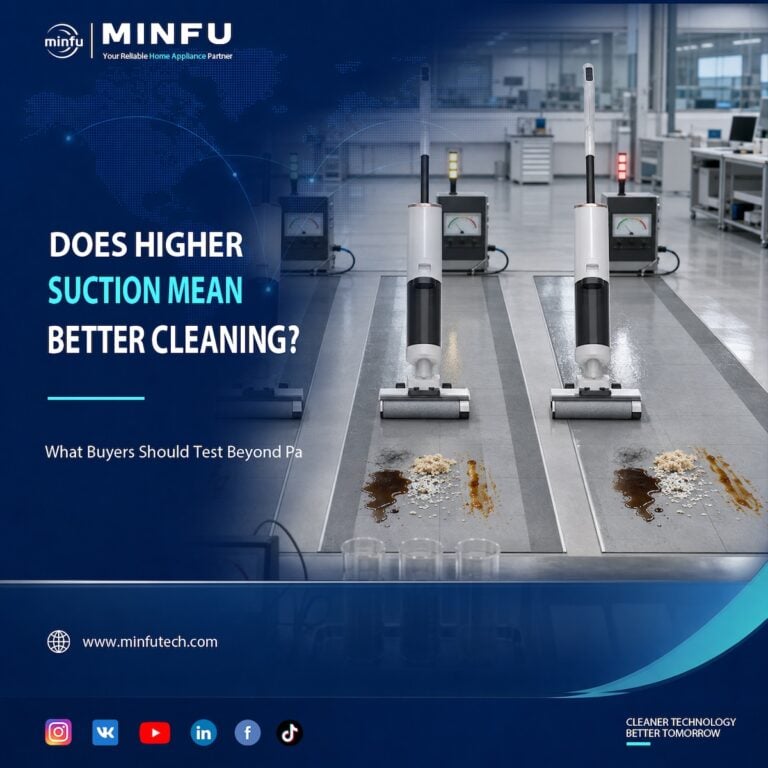
3. Do Not Judge Pet Performance by Suction Power Alone

Robot vacuum specifications have moved steadily toward higher Pa numbers.

Those numbers are useful, but they can easily become misleading when compared without context.

The motor creates suction, but effective floor pickup depends on the complete airflow path.

Leaks around the dustbin, filter resistance, intake geometry, brush contact with the floor and the relationship between the brush chamber and suction channel all influence actual cleaning.

Carpet adds another variable.

A robot may perform well on hard floors but leave visible hair embedded in a rug because the roller does not agitate the fibers effectively.

For this reason, when we evaluate samples for pet-focused projects, we prefer practical surface tests.

Place a controlled amount of hair on hard flooring.

Repeat the test on a low-pile rug.

Add fine dust or pet litter.

Then examine what reaches the dustbin, what remains on the floor and what stays wrapped around the brush.

This gives a buyer much more useful information than comparing 3,000Pa, 5,000Pa or 10,000Pa on a catalogue.

Higher suction can be valuable.

It simply should not be treated as proof of better pet cleaning by itself.

4. Obstacle Avoidance Matters More in Pet Homes

Pet homes are rarely empty test rooms.

There may be feeding bowls, toys, scratching accessories, pet beds, charging cables and objects that move between cleaning sessions.

Navigation therefore deserves more attention when the product is marketed toward pet owners.

Basic robots may rely mainly on bump sensors, infrared sensors and gyroscope-based navigation.

More advanced products can combine LiDAR, structured-light systems, cameras or other obstacle-detection technologies.

But again, the technology name alone is not enough.

What matters is what the robot actually detects.

A buyer should test objects of different heights and shapes.

Can the robot detect a pet bowl?

Does it repeatedly push lightweight objects?

Can it navigate around toys without creating large uncleaned areas?

What happens when an object appears after the map has already been created?

How close does the robot clean around the obstacle?

There is always a balance.

A robot that avoids every object from a large distance may be safe but leave too much floor uncleaned. A robot that cleans very aggressively around objects may increase the risk of contact.

The correct balance depends on the target product tier.

5. Be Careful With “Pet Waste Detection” Claims

This deserves its own section because it is easy to oversell.

Advanced obstacle-recognition systems may be designed to identify certain objects associated with pet households.

That does not mean buyers should promise that the robot will recognize every type of pet accident under every lighting and floor condition.

Recognition performance can change with object size, color, lighting, camera angle, sensor configuration and software version.

For brands, absolute claims create unnecessary risk.

Instead of asking:

“Does it detect pet waste?”

ask:

“What objects has this system been trained or designed to recognize, and under what test conditions?”

Then verify those conditions using actual samples.

If the function is important to your retail positioning, it should be included in your sample-validation process rather than copied directly from a supplier presentation.

6. Filtration Needs to Be Evaluated as a System

Pet households often generate a mixture of visible hair and much finer material.

The dustbin and filtration system therefore affect both user experience and maintenance.

A filter with very fine media may improve particle capture, but it can also create higher airflow resistance as it becomes dirty.

A large dustbin may reduce emptying frequency, but only if the internal airflow and filter remain effective as debris accumulates.

For B2B buyers, we recommend checking:

how easily the dustbin can be removed,

whether pet hair becomes trapped in difficult corners,

how the filter is removed and cleaned,

whether replacement filters are readily available,

and how suction changes as the bin fills.

This is particularly important for private-label products.

Consumable parts such as filters, brushes and dust bags become part of the long-term after-sales system.

A good robot vacuum project should therefore consider spare parts before the first bulk order, not after customer service complaints begin.

7. Noise Should Be Tested in Normal Cleaning Modes

Pet-focused marketing often emphasizes quiet operation.

There is a reasonable basis for that: a robot designed to run frequently inside occupied homes should not always need maximum-power mode.

But one noise number on a specification sheet does not tell the whole story.

Robot vacuums produce different noise profiles depending on suction mode, brush speed, floor surface and mechanical vibration.

Docking stations may also produce significantly more noise during self-emptying than the robot produces during ordinary cleaning.

For buyers, compare at least normal mode and maximum suction mode.

If a self-emptying station is included, test that separately.

Listen for vibration, rattling and high-frequency mechanical noise as well as the overall dB reading.

A machine can have an acceptable measured sound level and still sound unpleasant if the motor or chassis produces strong tonal noise.

The goal should be a product that users are comfortable running regularly.

8. Maintenance Is Part of the Pet-Owner Experience

One of the biggest mistakes in pet-cleaning product development is focusing entirely on what happens while the robot is moving.

The customer also has to live with the machine after cleaning finishes.

How quickly can the roller be removed?

Can wrapped hair be cut away easily?

Are the side brushes simple to replace?

Does hair accumulate around the caster wheel?

Can the dustbin be emptied without pulling debris out by hand?

Are filters and replacement parts available?

If the product includes a self-emptying station, how effectively does the station remove hair from the robot’s internal dustbin?

These details may not look impressive in an advertisement.

But they have a direct effect on reviews, returns and repeat purchases.

For that reason, a useful pet-product sample test should always include cleaning the robot itself.

Time the process.

If your engineer needs several tools and ten minutes to remove wrapped hair, the end customer will probably dislike it even more.

9. Test the Product After Repeated Cleaning Cycles

A new robot is always at its best.

The more useful sourcing question is what happens after repeated use.

Pet hair is particularly good at exposing weak points because it accumulates gradually.

During sample validation, inspect the machine after multiple cycles rather than resetting it after every demonstration.

Check:

the main roller,

side brush shafts,

caster and drive wheels,

dustbin inlet,

filter surface,

sensor areas,

and docking contacts.

Look for changes in noise and movement.

Check whether accumulated debris affects charging or docking.

Run the same cleaning scenario again and compare the result.

Robot vacuum roller wheel and dustbin inspection after repeated pet hair cleaning tests


This type of repeated-use testing is far more relevant to wholesale buyers than a perfectly prepared showroom demonstration.

10. Choose the Product Tier Before Adding Features

Not every pet-focused robot vacuum needs the most advanced navigation system or an all-in-one docking station.

For an entry-level retail channel, a well-designed robot with reliable hair pickup, straightforward navigation and simple maintenance may make more commercial sense.

For mid-range positioning, buyers may prioritize mapping, app control, stronger carpet performance and improved anti-tangle systems.

Premium projects may add LiDAR, advanced obstacle avoidance, self-emptying stations, automatic mop maintenance and more sophisticated software.

The important point is that each feature should support the market position.

Adding technology increases BOM cost, packaging volume, software complexity and potentially after-sales requirements.

At Minfu, we normally recommend defining the target retail segment first and then building the configuration around it.

That tends to produce a more commercially balanced OEM project than simply selecting every available feature.

11. What B2B Buyers Should Ask a Robot Vacuum Supplier

When evaluating a pet-oriented robot vacuum, a useful supplier discussion should go beyond the catalogue.

Ask how the anti-tangle system works.

Ask to see the roller after repeated hair tests.

Ask which floor surfaces were used during testing.

Ask how obstacle recognition is validated.

Ask which consumables and replacement parts are available.

Ask whether the firmware or app functions change between product versions.

Ask which customization options affect MOQ or certification.

Most importantly, ask what happens if the sample fails one of your tests.

A capable OEM/ODM supplier should be able to discuss the problem with engineering rather than simply changing the marketing claim.

A Practical Pet Robot Vacuum Test Matrix

Test Area What Buyers Should Check
Hair pickup Short and long hair on hard floor and carpet
Anti-tangle Hair remaining on roller, side brushes and wheel shafts after repeated cycles
Airflow Pickup consistency as dustbin and filter load increase
Navigation Coverage around furniture, pet bowls and changing obstacles
Obstacle avoidance Detection behavior with toys and small household objects
Dustbin Capacity, emptying convenience and hair accumulation
Filtration Filter access, maintenance and replacement availability
Noise Normal mode, maximum mode and docking-station operation
Maintenance Time required to clean roller, wheels, brushes and dustbin
Repeated use Performance changes after multiple cleaning cycles
Spare parts Availability of brushes, filters, batteries and accessories
OEM support Logo, packaging, app, accessories and configuration options

This matrix is much more useful than asking whether a product has a “Pet Mode.”

FAQ

What makes a robot vacuum suitable for pet hair?

A suitable product needs more than strong suction. Buyers should evaluate the brush structure, airflow path, anti-tangle performance, floor pickup, dustbin design and maintenance requirements together.

Is higher suction always better for pet hair?

Not necessarily. Higher suction can improve pickup, but roller design, floor contact, airflow sealing and carpet agitation also influence performance.

Should a pet robot vacuum have LiDAR?

LiDAR can improve mapping and navigation, but it is not mandatory for every market segment. The appropriate navigation system depends on retail positioning, expected environment and target cost.

How should buyers test anti-tangle performance?

Run repeated cleaning cycles using different hair lengths and inspect the main roller, side brushes, wheels and intake afterward. A single short demonstration is not enough to evaluate long-term hair accumulation.

Can pet waste detection be guaranteed?

Buyers should avoid treating object recognition as an absolute guarantee. Detection performance depends on the sensors, algorithm, object characteristics and environment. Important recognition claims should always be tested under defined conditions.

What OEM options are available for pet robot vacuums?

Depending on the platform and project volume, customization can include branding, color, packaging, accessories, plug type, manuals, app configuration and selected hardware or software options.

Work With Minfu on Your Next Cleaning Appliance Project

Shenzhen Minfutech Industrial Co., Ltd. works with overseas brands, importers, wholesalers and distributors on OEM and ODM cleaning appliance projects.

Our product range covers multiple smart cleaning categories, while our OEM/ODM process supports projects from initial product selection and sample evaluation through customization, mass production and shipment.

If you are evaluating a new cleaning appliance project, send us your target product, market, expected quantity and customization requirements. Our team can help you evaluate the available options before moving into sampling and production.

Website: https://minfutech.com/
OEM/ODM Solutions: https://minfutech.com/oem-odm-solutions/
Email: info@minfutech.com
WhatsApp / Phone: +86 137 6025 5781
Contact: https://minfutech.com/contact-minfu/

Inquire Now

Partner With Us
Get a customized wholesale quote from our specialists within 24 hours.