


When sourcing cordless vacuum cleaners from China, B2B buyers—whether Amazon aggregators, retail chain procurement managers, or DTC brand founders—often face a frustrating black box of pricing. Why does one factory in Ningbo quote $45.00 for a stick vacuum while a tier-1 agile ODM manufacturer in Shenzhen quotes $85.00 for a product that looks almost identical on a PDF catalog?
The answer lies hidden deep within the Bill of Materials (BOM). In the 2026 floorcare manufacturing ecosystem, the difference between a highly profitable, 5-star-reviewed vacuum and a disastrous product plagued by a 15% return rate (RMA) comes down to where the factory allocates your budget.
Many buyers make the fatal mistake of negotiating purely on the final Ex-Works (EXW) price without understanding the underlying cost physics. When you squeeze a factory for a $5.00 discount on a $60.00 vacuum, they do not absorb that loss in their profit margin; they subtract it from the BOM. They swap a high-speed brushless motor for a brushed alternative, or they downgrade the lithium-ion cells, directly transferring the reliability risk onto your brand.
This comprehensive, data-driven guide pulls back the curtain on the Chinese cordless vacuum manufacturing industry. We provide a transparent, component-by-component cost breakdown of a premium, modern cordless vacuum, helping you negotiate with factories like an industry insider and ensuring you never overpay for low-tier components.
1. The Executive Summary: The 2026 BOM Cost Allocation
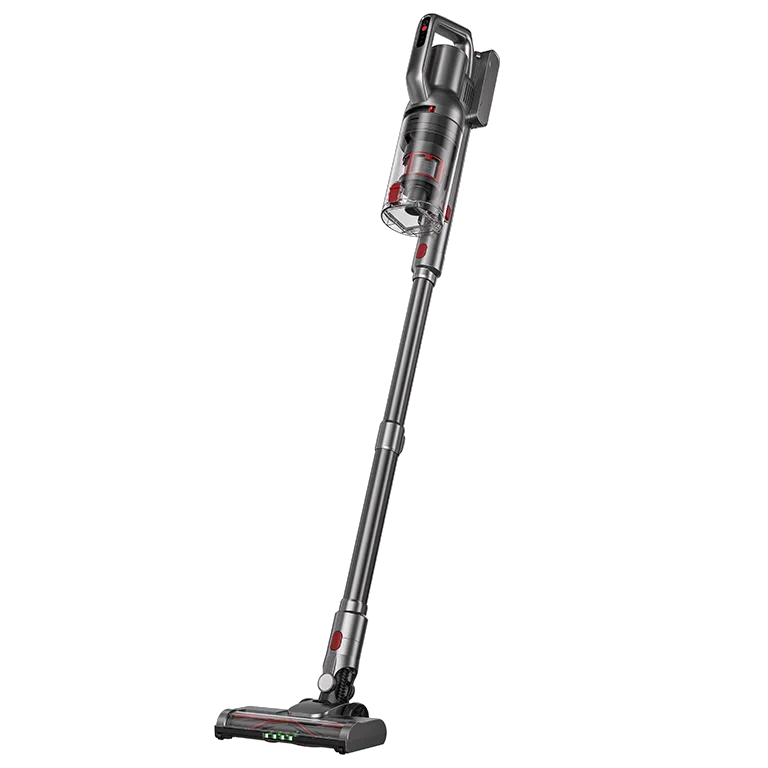
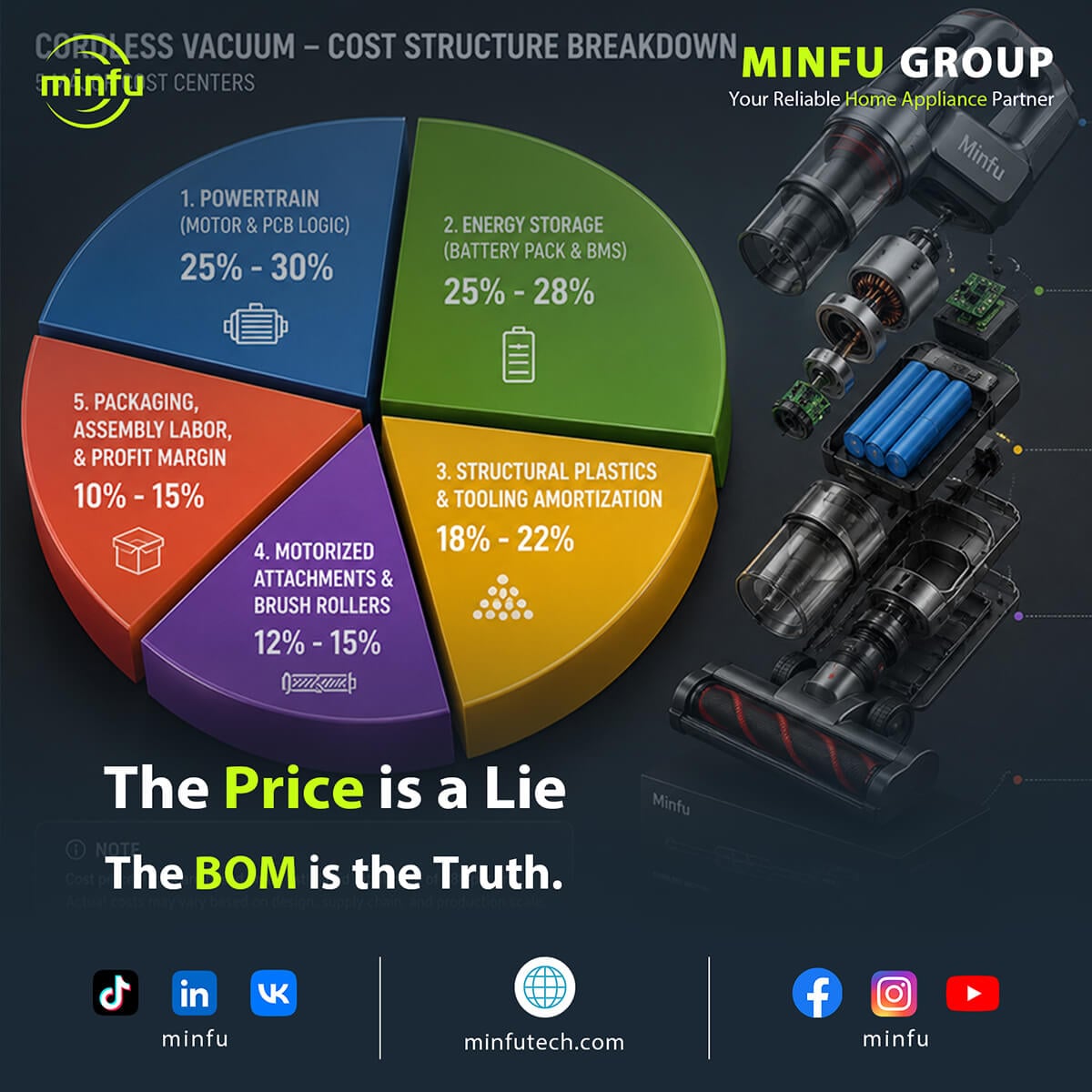
To understand cordless vacuum pricing, you must visualize the budget distribution. For a premium, 2026-standard cordless stick vacuum (featuring a High-Speed BLDC motor, True HEPA filtration, and a detachable lithium-ion battery pack) with a factory ex-works (EXW) price of approximately $75.00 to $95.00 USD, the budget is typically allocated across five major cost centers.
The Standard Premium Vacuum Cost Breakdown (Percentage & Estimated USD)
| Cost Center / Component Category | Percentage of Total Cost | Est. USD Cost (Based on an $80 Unit) | Impact on Consumer Experience & RMA Rate |
|---|---|---|---|
| 1. Powertrain (Motor & PCB Logic) | 25% – 30% | $20.00 – $24.00 | Critical: Determines absolute suction power (Air Watts), motor lifespan (hours), and operating noise levels (dBA). |
| 2. Energy Storage (Battery Pack & BMS) | 25% – 28% | $20.00 – $22.40 | Critical: Determines runtime, safety (fire risk mitigation), and compliance with the 2027 EU Battery Regulation. |
| 3. Structural Plastics & Tooling Amortization | 18% – 22% | $14.40 – $17.60 | High: Dictates chassis durability, drop-test survival, air-tight sealing, and premium aesthetic appeal. |
| 4. Motorized Attachments & Brush Rollers | 12% – 15% | $9.60 – $12.00 | High: Dictates actual carpet cleaning efficiency, anti-hair wrap capabilities, and maneuverability. |
| 5. Packaging, Assembly Labor, & Profit Margin | 10% – 15% | $8.00 – $12.00 | Medium: Affects the unboxing experience, shipping density, and factory quality control (QC) thoroughness. |

2. Deep Dive: The Powertrain (25% – 30% of Total Budget)
The powertrain is the absolute heart and brain of the vacuum. In 2026, the industry standard for export-grade vacuums has shifted entirely to Brushless DC (BLDC) motors, rendering old brushed motors (PMDC) virtually obsolete for high-end markets in North America and Europe.
The BLDC Motor Economics ($8.00 to $15.00+)
A high-speed BLDC motor running at 120,000 to 150,000 RPM provides massive static suction (up to 35kPa or 150+ Air Watts) without the friction, heat, and carbon dust generated by traditional carbon brushes.
- The Cost Drivers: The price of a BLDC motor depends heavily on the wattage rating (e.g., 350W vs. 500W), the quality of the internal permanent magnets (rare-earth NdFeB magnets vs. standard ferrites), and the precision of the rotor’s dynamic balancing.
- Current 2026 Wholesale Pricing: Based on current B2B supply chain data from Chinese motor manufacturing hubs (like Changzhou and Shenzhen), a standard 350W BLDC motor ranges from $5.80 to $9.50 depending on the volume commitment (1,000 pieces vs. 100,000 pieces).
- The Aerospace Premium: Ultra-high-speed, aerospace-grade motors (similar to those utilized in Dyson or Shark flagships) that require micro-gram level dynamic balancing to eliminate high-frequency whine can easily drive the motor BOM cost over $15.00 per unit.
The PCBA (Printed Circuit Board Assembly) ($5.00 to $9.00)
A BLDC motor cannot operate independently. It requires a sophisticated Printed Circuit Board Assembly (PCBA) featuring an Electronic Speed Controller (ESC).
- The Silicon Impact: The PCBA utilizes a Microcontroller Unit (MCU) to manage the incredibly fast RPMs, translate the user’s trigger pulls into varying power modes (Eco/Auto/Max), and communicate telemetry data to the LED or OLED smart display. The integration of high-quality silicon chips and power MOSFETs to handle 400W+ of current drives this cost up.
- Smart Dust Sensors: If your ODM design includes an infrared dust sensor (similar to Tineco’s iLoop technology) that automatically adjusts suction based on dirt volume, expect to add an additional $2.00 to $3.50 to the PCBA BOM.
⚠️ The Budget Trap (How Cheap Factories Cheat): If a supplier quotes you an incredibly low overall product price (e.g., $39.00), they are almost certainly substituting the BLDC motor with a heavy, noisy brushed motor (costing as little as $2.50). Brushed motors suffer from catastrophic commutator wear and typically burn out after a mere 50 to 80 hours of total runtime, guaranteeing a massive spike in your Amazon RMA rates.
3. Deep Dive: Energy Storage & Battery Safety (25% – 28% of Total Budget)
The lithium-ion battery pack is the single most expensive module in a cordless vacuum. It is also the highest liability risk for importers, as battery failures are the leading cause of thermal runaway (fires) and product recalls.
Lithium-Ion Cells: 18650 vs. 21700 ($12.00 to $18.00)
A premium cordless stick vacuum typically utilizes a 6-cell (21.6V) or 7-cell (25.2V) series configuration. In 2026, the industry is rapidly shifting from the standard 18650 cells to larger 21700 lithium-ion cells to achieve 45+ minute runtimes on higher power settings.
- The Cost Driver (Cell Grading): The source of the lithium cells dictates the price. Grade-A cells from tier-1 manufacturers (such as Samsung SDI, LG Chem, EVE Energy, or BAK) with capacities of 2500mAh to 4000mAh command a premium. Sourcing seven high-drain (30A continuous discharge) Samsung 21700 cells alone can cost the factory over $14.00 to $16.00 before any assembly, spot welding, or casing costs are factored in.
The Battery Management System (BMS) ($3.00 to $5.00)
The BMS is a specialized, intelligent circuit board integrated inside the battery pack. Its primary function is to prevent catastrophic failures such as thermal runaway, overcharging, deep discharge, and short circuits.
- Essential Safety Sensors: A high-quality BMS will include multiple Negative Temperature Coefficient (NTC) thermal sensors that instantly cut power if the battery cells exceed safe operating temperatures (typically around 65°C) during a heavy cleaning session on thick carpets.
The 2026/2027 EU Regulatory Impact on BOM
With the impending implementation of the EU Battery Regulation (Regulation (EU) 2023/1542) and the associated “Right to Repair” mandates taking full effect in 2027, standard internal, soldered-in batteries are becoming illegal to import into Europe.
Factories must now engineer “Click-In Detachable Battery Packs.” The complex injection-molded plastic housings, spring-loaded release mechanisms, and gold-plated high-current contact pins required for these modular packs add an additional $2.00 to $4.50 to the battery BOM.
⚠️ The Budget Trap (The B-Grade Cell Disaster): Low-tier factories drastically slash their BOM costs by utilizing unbranded, recycled, or “B-grade” lithium cells rejected by EV manufacturers. They further compound this risk by stripping critical NTC thermal sensors from the BMS to save $1.50. This lethal combination is the primary cause of sudden battery death after 3 months and devastating Amazon storefront suspensions due to safety hazards.

4. Structural Plastics, Tooling & Sealing (18% – 22% of Total Budget)
The physical body of the vacuum—comprising the main handle housing, the multi-cone cyclonic dustbin, the trigger assembly, and the aluminum extension wand—accounts for roughly a fifth of the unit cost.
Virgin ABS & Polycarbonate (PC) ($8.00 to $12.00)
High-impact areas, particularly the transparent dustbin and the main motor housing, must be injection-molded using 100% virgin Polycarbonate (PC) or high-grade Acrylonitrile Butadiene Styrene (ABS) plastics.
- Drop Test Survivability: These premium plastics are necessary to ensure the vacuum survives the industry-standard 1-meter double-drum drop tests without cracking or shattering. Cheap factories mix calcium carbonate (talcum powder) into recycled plastics to lower costs, resulting in brittle housings that crack during international shipping.
- TPE Air-Tight Sealing: A vacuum is only as good as its aerodynamic seal. Premium factories utilize double-molded Thermoplastic Elastomer (TPE) gaskets instead of cheap glued silicone strips. This ensures zero pressure drop across the HEPA filters, preventing microscopic dust from escaping back into the room.
The Tooling Amortization Secret (The NRE Cost)
Injection molding is not just about the raw plastic pellets; it is about the massive hardened steel molds (tooling) used to form those plastics. A custom, high-precision set of steel molds for a new ODM vacuum cleaner costs between $30,000 and $80,000 USD.
If you order a small batch, the factory bakes the amortization of those expensive steel molds into your unit price.
$$ \text{Amortized Cost per Unit} = \frac{\text{Total Tooling Cost}}{\text{Order Volume}} $$
💡 Pro-Tip for B2B Buyers: This exact financial dynamic is why navigating your factory selection is so critical. Instead of paying exorbitant Non-Recurring Engineering (NRE) tooling fees or suffering through high MOQs (Minimum Order Quantities) with legacy factories, smart buyers are partnering with agile manufacturers.
You can shortcut your sourcing process and drastically reduce your per-unit cost by reviewing our comprehensive breakdown of the Top 5 Cordless Vacuum Manufacturers in China, where we evaluate which factories offer modular “Agile ODM” platforms to bypass heavy tooling investments while securing unique external designs.
5. Motorized Floor Brushes & Attachments (12% – 15% of Total Budget)
The main floor head is effectively a second, self-contained vacuum cleaner. It contains its own independent brushed or brushless DC motor (usually rated between 15W and 30W) to spin the brush roller, a set of LED headlights for dark corners, and a highly complex swivel neck mechanism for steering.
Anti-Hair Wrap Innovation & Floor Head Costs
- The Basic Nylon Head ($4.50 to $6.00): Basic floor heads utilizing soft nylon bristles and a simple planetary gear are relatively cheap. However, they suffer from severe hair tangling, requiring the consumer to cut hair off the roller with scissors constantly.
- The Premium Pet-Friendly Head ($10.00 to $12.50): In 2026, over 47% of Western consumers demand pet-friendly models. Upgrading to a patented, V-shaped silicone anti-hair wrap roller with internal detangling combs (often featuring a separate micro-PCB for stall-protection) pushes the floor head BOM cost significantly higher.
- Multi-Surface Sensors: High-end floor heads now include floor-type detection sensors (piezoelectric or optical) that automatically boost the main motor suction when transitioning from hard floors to thick carpets, further increasing the attachment cost.

6. Packaging, Labor, & Quality Control (10% – 15% of Total Budget)
The final segment of the BOM covers the elements required to get the raw components assembled and safely shipped to your destination port.
Assembly Labor & Factory Overhead ($4.00 to $6.00)
While Chinese manufacturing labor is no longer as cheap as it was a decade ago, it remains highly efficient. This cost includes the wages of the assembly line workers (operating in ESD anti-static environments to protect the PCBAs), the technicians running the dynamic balancing machines, and the quality assurance (QA) inspectors conducting the final air-tightness tests.
Packaging & Unboxing Experience ($2.50 to $4.00)
- The Unboxing Factor: Premium DTC (Direct-to-Consumer) brands invest heavily in the unboxing experience. Upgrading from standard brown corrugated cardboard to a full-color, high-gloss UV-coated retail box with custom molded pulp inserts (which are eco-friendly and replace environmentally harmful EPS styrofoam) adds noticeable cost but significantly reduces shipping damage.
- Logistics Density: Smart factories engineer the packaging to be as compact as possible. Saving just 2 inches on the box length can allow an importer to fit 300 additional units into a 40-foot High Cube (40HQ) shipping container, drastically lowering the landed cost per unit.
Conclusion: How to Negotiate Based on BOM Data
Armed with this 2026 Bill of Materials breakdown, you are no longer at the mercy of arbitrary factory quotations. The “Black Box” of pricing is officially open. When a supplier quotes you a suspiciously low price (e.g., $35.00 for a “high-end” stick vacuum), you now possess the engineering knowledge to know exactly what to ask them:
- “Are you using a brushed motor or a BLDC motor, and what is the exact residual unbalance tolerance (in mg) on the rotor?”
- “What is the brand and mAh capacity of the lithium-ion cells, and does the Battery Management System (BMS) include active NTC thermal sensors?”
- “Is the battery pack fully modular and compliant with the 2027 EU Right-to-Repair mandates?”
- “Are the plastic housings molded from 100% virgin ABS/PC, or do they contain recycled fillers?”
If a manufacturer cannot answer these technical questions instantly, or if they refuse to disclose their sub-component suppliers, they are actively cutting dangerous corners with your sourcing budget.
By partnering with factories that invest their BOM heavily into the Powertrain and Energy Storage centers, you guarantee a product with massive suction, zero safety liabilities, and an ultra-low RMA rate that protects your brand equity and profit margins for years to come.
B2B Sourcing FAQs: Understanding Vacuum Costs
Q1: Can I reduce the BOM cost by ordering a vacuum without a HEPA filter?
A: While it is technically possible and saves about $1.50 to $2.50 per unit, it is highly discouraged in 2026. Non-HEPA vacuums vent microscopic dust back into the air, leading to terrible consumer reviews regarding allergies and odors. Furthermore, without a high-quality filter, dust bypasses the cyclonic separator and rapidly destroys the high-speed BLDC motor bearings.
Q2: Why does an Auto-Empty Base Station add so much cost to the vacuum?
A: Auto-empty base stations (where the vacuum automatically empties its dustbin into a larger tower) are extremely complex. They require a secondary, heavy-duty suction motor inside the tower (often $15.00+ just for the secondary motor), complex one-way silicone valves on the vacuum dustbin, and significant additional injection molding tooling. A base station can easily double the overall BOM cost of a standard stick vacuum.
Q3: What is “Total Cost of Ownership (TCO)” and why should importers care?
A: TCO is the realization that the initial factory price is only part of the story. A $40.00 vacuum with a brushed motor and cheap battery might have a 15% return rate. Processing one return on Amazon (including lost FBA fees, reverse logistics, and disposal) can cost $50.00+. Therefore, spending $65.00 on a high-quality BLDC vacuum with a 1% return rate yields a vastly superior Net Margin.