

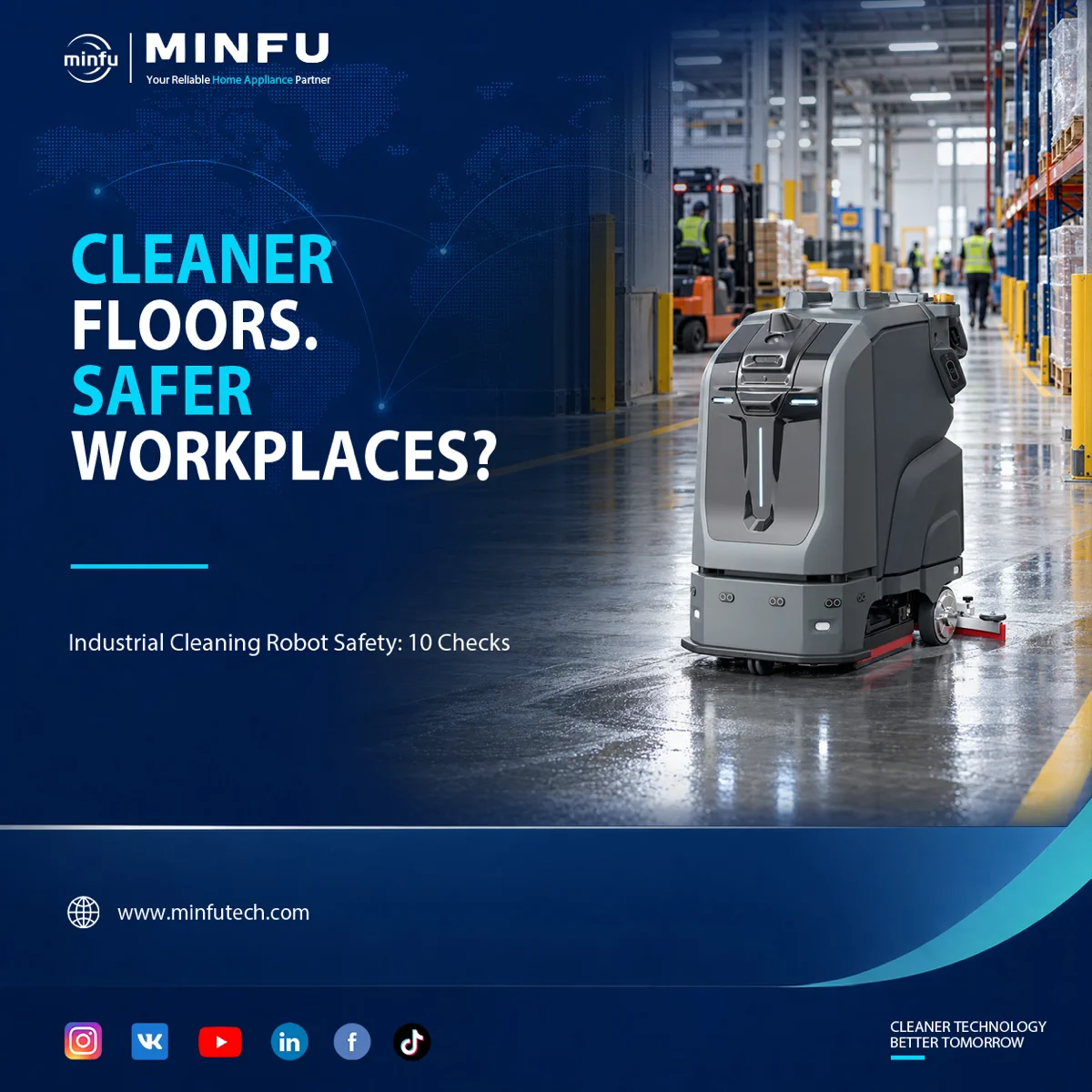
The floor of a manufacturing plant can look perfectly clean at the beginning of a shift. By midday, forklift traffic has brought dust into the aisles, moisture has collected near a loading entrance, and packaging debris has started to accumulate around storage racks.
None of these conditions necessarily looks dramatic. But workplace safety is often affected by small hazards that become serious when people and equipment move through the same space.
Industrial floor cleaning robots offer a way to make routine floor maintenance more consistent without requiring an operator to drive a scrubber through every cleaning route. They can help facilities maintain scheduled cleaning programs, reduce some repetitive manual work and support better visibility into completed tasks.
That sounds like a convincing safety argument—until we consider what happens when the cleaning robot itself enters a busy workplace.
It is now another moving machine in an environment that may already include forklifts, pallet trucks, pedestrians and production equipment. Its cleaning system uses water, brushes and mechanical components. Its sensors have operating limitations, and its route may change when an obstacle appears.
So, can industrial cleaning robots actually make workplaces safer?
At Minfu, we believe they can contribute to a safer operating environment when the equipment is properly selected, configured and managed. But safety does not come from autonomy alone. It comes from understanding which risks the robot helps control, which risks it introduces and how both will be managed.
Before introducing an autonomous floor scrubber into an industrial facility, we recommend examining ten specific areas.
The Short Answer: How Do Industrial Cleaning Robots Improve Workplace Safety?
Industrial cleaning robots can support workplace safety by helping maintain cleaner walking surfaces, reducing some repetitive equipment-handling tasks and providing more systematic floor-maintenance coverage.
When appropriately designed and deployed, their obstacle-detection systems can also support operation in spaces shared with people and other equipment.
However, robotic cleaning does not eliminate slip-and-fall hazards, guarantee collision avoidance or make hazardous industrial areas automatically suitable for unmanned cleaning.
A safe deployment requires a site-specific risk assessment, suitable machine safety measures, appropriate cleaning procedures, trained personnel and ongoing inspection.
The distinction is important: a robot can help control workplace hazards without being capable of controlling every hazard in the workplace.
1. Start With the Floor Hazards, Not the Robot Specifications
When a facility begins evaluating industrial cleaning automation, the conversation often starts with machine specifications: cleaning width, navigation sensors, battery life or theoretical efficiency.
For a workplace safety project, we would start somewhere else.
Walk the facility and identify the problems the cleaning program is expected to address.
Perhaps forklift tire marks are becoming difficult to remove from the main warehouse aisles. Maybe fine packaging debris regularly collects near loading areas. Or perhaps the floor around an entrance becomes slippery during wet weather.
These situations may all require floor maintenance, but they do not necessarily require the same cleaning process.
Oil contamination, ordinary dust, standing water and abrasive metal debris can create different hazards. A robotic floor scrubber suitable for everyday wet cleaning may not be approved to collect hazardous substances or sharp industrial waste.
The first task is therefore to separate routine floor-maintenance work from conditions requiring specialist intervention.
OSHA’s walking-working surface requirements provide a useful reference for U.S. workplaces. They address clean and orderly surfaces, appropriate control of wet conditions and the need to correct or guard hazardous floor conditions.
A cleaning robot may support those objectives. It does not replace the employer’s responsibility to identify and control hazards.
What we would verify: Which floor hazards are routine and suitable for robotic cleaning, and which require exclusion, manual intervention or a separate cleaning procedure?
2. Scrubbing the Floor Must Not Create a New Slip Hazard
One of the strongest arguments for automated floor cleaning is that systematic maintenance may reduce the accumulation of dirt and certain residues.
But wet scrubbing introduces a second safety question.
What condition does the machine leave behind?
A commercial floor scrubber applies cleaning liquid, agitates soil and attempts to recover the resulting wastewater. If its water-delivery or recovery system is poorly configured, excess liquid may remain on the floor.
This can create a temporary hazard even when the cleaning route has been completed successfully.
Recovery performance may also vary across smooth epoxy, textured concrete, tile joints and damaged flooring. A squeegee that works well in one part of the building may leave more moisture in another.
For this reason, we would evaluate more than soil removal.
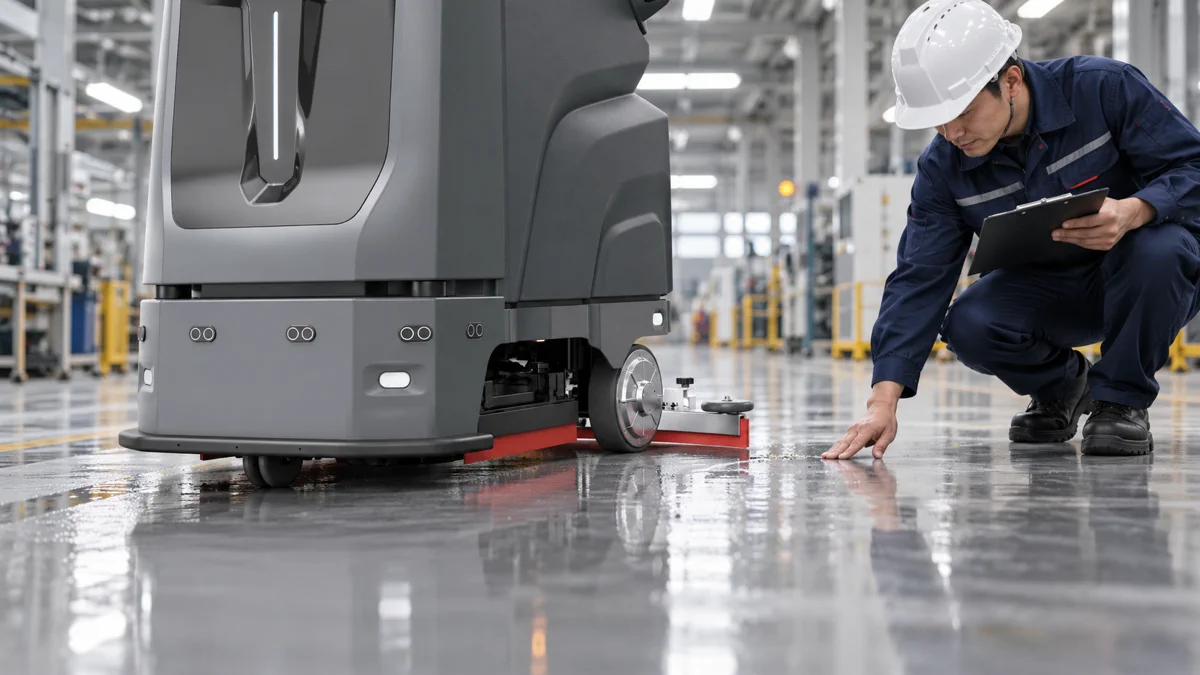
The facility should also inspect residual water, streaks, liquid accumulation at turns and the condition of the floor before people are allowed to use the area normally.
Where needed, cleaning should take place during restricted-access windows with suitable temporary controls, such as signage or barriers determined by the facility’s safety procedures.
No responsible supplier should promise that robotic floor cleaning eliminates slip-and-fall risks.
A better objective is to demonstrate that the selected cleaning process removes the intended contamination while leaving the surface in an acceptable condition.
3. Forklift Traffic Changes the Safety Equation
A quiet office corridor and a busy distribution centre are very different environments for an autonomous cleaning robot.
In an industrial warehouse, the robot may need to operate near forklift routes, pallet trucks, loading areas and employees moving between workstations.
These interactions deserve their own risk assessment.
A forklift operator may have restricted visibility when carrying a large load. A pallet truck may emerge from an aisle with little warning. A cleaning robot can also be partially hidden behind stored materials.
Even sophisticated obstacle-detection technology does not remove the risks created by blind intersections and moving industrial equipment.
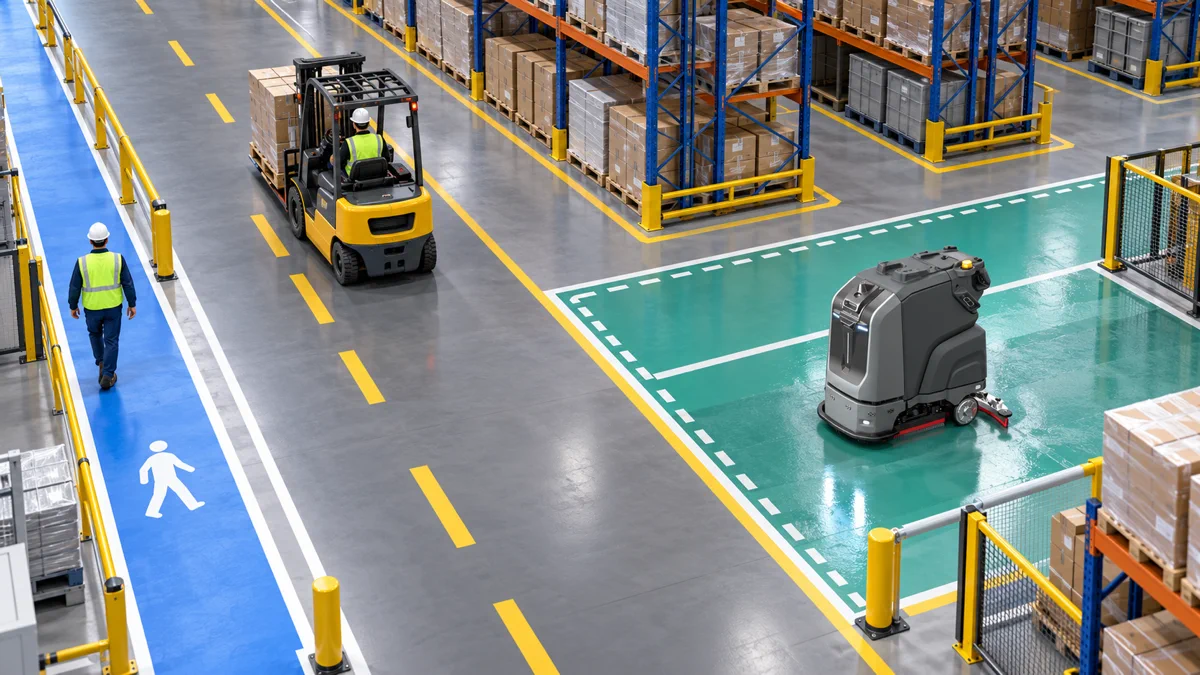
The U.S. Occupational Safety and Health Administration recommends separating forklift traffic from pedestrians where possible, using measures such as designated walkways, barriers, markings and traffic-control arrangements.
The same general principle is valuable when planning where and when an autonomous cleaning robot should operate.
At a busy distribution site, it may be preferable to assign routine robot missions to periods when forklift activity is reduced or to areas separated from high-risk vehicle movements.
We would not assume that sensors alone make unrestricted robot operation among moving forklifts acceptable.
An appropriate trial should evaluate intersections, visibility, stopping behavior and traffic interactions under controlled conditions.
4. Obstacle Avoidance Is a Safety Function to Evaluate, Not a Guarantee
Commercial cleaning robots may combine LiDAR, depth cameras, ultrasonic sensors, inertial measurements and contact-detection components.
These technologies provide valuable information, but they have different fields of view, detection ranges and limitations.
For example, a 2D laser scanner measures objects intersecting its scanning plane. A low object or protruding structure outside that plane may require another sensing method.
Transparent partitions, reflective materials and unusual object shapes may also complicate environmental perception.
Our commercial cleaning robot sensor fusion guide explains these technical limitations in greater detail.
From a workplace safety perspective, the important issue is how the machine behaves when the environment becomes uncertain.
Does it respond appropriately to someone entering the route?
Can it maintain suitable clearance from equipment?
What happens when there is no safe route around an obstruction?
Does the machine stop rather than attempting an unsafe maneuver?
The answers must be established through the selected robot’s documentation and practical validation.
The complete operating footprint should also be considered, including protruding brushes, squeegees and other cleaning components.
A navigation path that clears an obstacle by a few centimetres may still be unsuitable if the machine’s full physical dimensions have not been considered.
For industrial buyers, collision avoidance should therefore be evaluated as part of an overall safety strategy—not presented as proof that collisions are impossible.
5. Keep Robots Out of Areas They Are Not Designed to Enter
Some of the most serious industrial hazards are not created by thefloor surface itself.
Production facilities may contain exposed moving machinery, electrical equipment, hazardous chemicals, high-temperature processes and areas with special access restrictions.
Removing the need for a person to drive a scrubber through such areas can sound attractive.
But a robot cannot automatically be assumed suitable for those environments.
For instance, a machine designed for routine indoor commercial cleaning should not be sent into an area containing potentially flammable vapours or combustible dust unless the equipment, cleaning process and installation have been specifically evaluated and approved for that hazardous environment.
The same caution applies to unknown chemical spills, exposed electrical hazards and areas containing machinery that can create trapping or crushing risks.
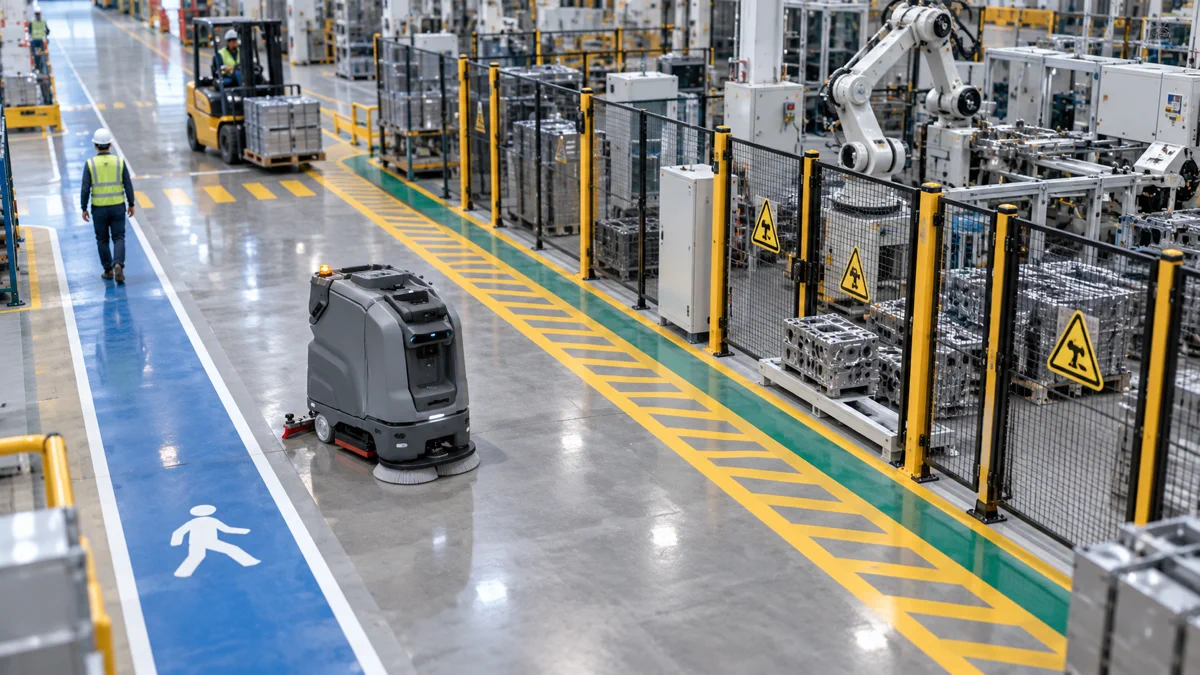
A useful deployment plan distinguishes between permitted cleaning areas, conditional-access areas and excluded areas.
These boundaries should be reflected in both facility procedures and the robot’s configured operating missions, where supported.
Where physical barriers, restricted access or process shutdowns are necessary, a digital exclusion zone alone should not be treated as a substitute.
The purpose of automation is not to send a robot into every location people should avoid. It is to automate work in areas where the machine itself can operate appropriately.
6. Reducing Physical Str ain Requires Looking at the Whole Job
Traditional floor cleaning can involve repetitive walking, pushing equipment, handling cleaning tools and maintaining awkward postures.
Automating suitable cleaning routes may reduce some of this work.
For example, a cleaner who previously spent several hours operating a floor scrubber across wide warehouse aisles may be able to spend more time on inspection and other detailed tasks.
That can be a meaningful operational change.
However, physical demands do not disappear entirely.
Someone may still need to refill tanks, empty wastewater, remove debris, inspect brushes, replace consumables or service the machine.
Poorly designed maintenance procedures can introduce their own lifting and handling risks.
This is why we recommend examining the complete cleaning workflow when evaluating ergonomics.
How frequently do operators need to handle the recovery tank? Are maintenance components accessible? Are suitable tools and handling procedures provided? Does the machine reduce repetitive work without creating a difficult servicing process?
NIOSH guidance on workplace ergonomics emphasizes designing tasks around human capabilities and reducing risk factors such as force, repetition and awkward posture.
The correct objective is therefore not to claim that a robot eliminates ergonomic injuries.
It is to determine whether the new operating process reduces relevant exposure to physically demanding work.
7. Industrial Dust Requires the Right Collection Method
Dust is another area where robot marketing can become misleading.
A floor may contain ordinary warehouse dust, packaging particles, fine mineral debris or materials generated by industrial processes.
These substances do not present identical health risks.
Some industrial dusts require particular exposure-control methods. Fine respirable crystalline silica, for example, is subject to specific occupational exposure and housekeeping requirements in the United States.
OSHA’s general-industry silica standard restricts certain dry sweeping and dry brushing practices where those activities could contribute to exposure, subject to the standard’s specified conditions and exceptions.
This has an important implication for cleaning robots.
A machine with a sweeping function is not automatically suitable for controlling respirable hazardous dust. The correct collection method, filter performance, dust containment and exposure-control procedure must be verified.
Nor should a manufacturer describe its robot as an industrial air purifier simply because it collects floor debris.
The original Sparkoz article discusses HEPA filtration and airborne particulate control. Those are relevant topics, but they should not be transferred to the Minfu LT10 or LT70 Pro without confirmed filter specifications and appropriate test evidence.
For Minfu’s current commercial cleaning platforms, we would evaluate the intended debris and contamination type before recommending a cleaning mode.
Where hazardous dust or other regulated substances are present, the site’s EHS procedures must determine whether robotic cleaning is an appropriate method.
8. Night Cleaning May Reduce Traffic Conflicts—but Adds Other Responsibilities
Many industrial and commercial facilities prefer to clean floors during periods of reduced activity.
That can make operational sense.
A warehouse aisle that is crowded during production hours may be much easier to clean when deliveries and forklift movements are reduced.
But low-traffic operation is not automatically risk-free.
During night shifts, fewer employees may be present to notice a stopped machine, a spill, a charging problem or an unexpected obstruction.
Access-control arrangements may also differ from daytime operation.
An autonomous cleaning plan should therefore define who is responsible for checking the robot, what happens if it stops unexpectedly and how personnel are informed when assistance is needed.
Emergency routes are particularly important.
The facility must not allow cleaning equipment, charging stations or temporary operating arrangements to obstruct required escape routes.
OSHA’s exit-route requirements establish that exit routes in covered U.S. workplaces must remain free and unobstructed.
In practice, cleaning routes and charging locations should be reviewed with the facility’s emergency arrangements before unattended operation begins.
Our article on unsupervised commercial cleaning robots examines the operational responsibilities that remain when a machine no longer needs continuous manual driving.
9. Emergency Response Must Be Defined Before an Incident
A cleaning robot should not be expected to invent a safe response during an emergency.
Its actions need to follow the capabilities and procedures established for the machine and the facility.
Depending on the design, a robot may have emergency-stop controls, obstacle-triggered responses, protective monitoring or fault-handling functions.
However, these mechanisms should not be confused with broader emergency-management capabilities.
A robot that can stop when a hazard is detected is not automatically capable of helping employees evacuate a building.
A robot with remote monitoring is not necessarily equipped with a safety-rated remote emergency-stop function.
And a machine that can receive a software update should not be assumed capable of automatically adapting to every future safety requirement.
For commercial automatic floor-treatment equipment, IEC 63327:2021 provides relevant particular safety requirements for the types of indoor machines within its scope, in conjunction with other applicable requirements.
The existence of this standard does not establish that any specific robot has been certified.
For LT10 or LT70 Pro projects, the appropriate approach is to request model-specific documentation and confirm the relevant safety functions for the target market.
We would also want to understand the machine’s response to abnormal conditions.
For example, what happens if a sensor fault occurs? What if a bumper is activated? What if power becomes insufficient during a mission? What if the robot stops in a busy aisle?
These situations should have documented operating responses rather than depending on assumptions about what an autonomous system will do.
10. Safety Monitoring Matters Only When It Leads to Action
Connected robots can provide useful information about scheduled missions, operating status and interruptions.
That visibility may help facility managers maintain more consistent cleaning procedures.
But a task report does not automatically prove that the workplace is safe.
A completed route does not establish that every slip hazard has been removed. A robot that reports normal navigation does not prove that every pedestrian interaction was risk-free.
Safety management therefore requires information beyond mission completion.
A practical review may include repeated intervention events, unexpected stops, equipment damage, reported near misses, floor-condition inspections and feedback from employees working in the area.
These observations can help managers identify operating patterns that require changes to cleaning schedules, routes or site procedures.
It is also important to distinguish an operational dashboard from a validated safety-monitoring system.
Software visibility is valuable, but its functions, reliability and role in the facility’s procedures must be clearly understood.
For a cleaning-equipment distributor or OEM partner, this is another reason to look beyond an impressive product demonstration.
A commercial robot should be evaluated not only by how successfully it completes a planned route, but also by how predictably it behaves when something goes wrong.
A Practical Safety Assessment Before Deployment
The ten areas above can be converted into a pre-deployment review.
The following checklist is intended as a practical buyer-evaluation tool. It is not a substitute for a formal machinery risk assessment, applicable regulatory requirements or the manufacturer’s safety instructions.
| Assessment Area | What to Check Before Deployment |
|---|---|
| Floor conditions | Identify routine contamination, spill hazards and unsuitable materials |
| Wet-floor safety | Validate cleaning-solution delivery, wastewater recovery and access controls |
| Vehicle interaction | Evaluate forklift routes, intersections, blind spots and separation arrangements |
| Obstacle detection | Test representative objects, pedestrians and restricted clearances |
| Restricted areas | Define prohibited zones and required physical or procedural controls |
| Ergonomics | Review handling, refilling, wastewater disposal and maintenance tasks |
| Dust control | Confirm suitability for the actual particles and exposure-control requirements |
| Off-hours operation | Assign oversight responsibilities and protect emergency access |
| Emergency response | Review applicable safety documentation, stop behavior and fault procedures |
| Ongoing monitoring | Record interventions, near misses, floor inspections and corrective actions |
We recommend testing the robot under representative operating conditions rather than relying on an empty showroom.
The test should be planned and supervised by competent personnel, with appropriate controls in place. It should not deliberately create uncontrolled collisions, hazardous spills or unsafe vehicle encounters.
The goal is to identify where the selected robot fits into the existing safety system—and where the facility needs additional measures.
Where Minfu’s LT10 and LT70 Pro Fit Into the Discussion
Minfu’s current commercial cleaning robot platforms are designed for different operating environments.
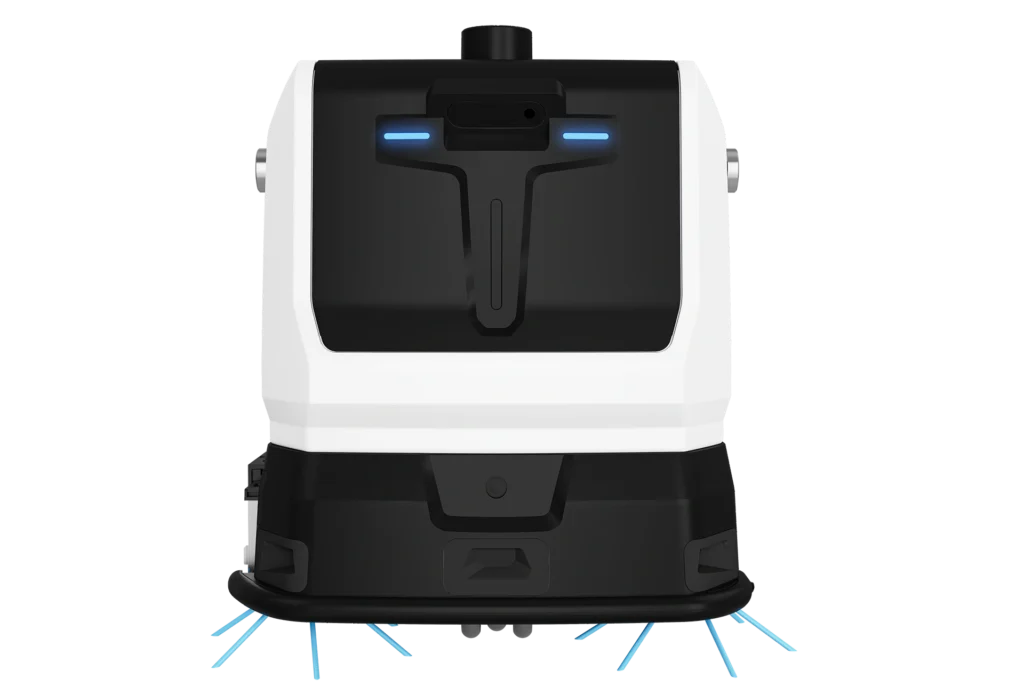
The LT10 compact autonomous cleaning robot combines sweeping, vacuuming and scrubbing with multi-sensor navigation and digital mission management. Its published configuration includes LiDAR, 3D ToF, a monocular camera, IMU, odometry and an electronic bumper strip.
The LT10 product page also describes an emergency-stop control and obstacle-response behavior in dynamic commercial environments.
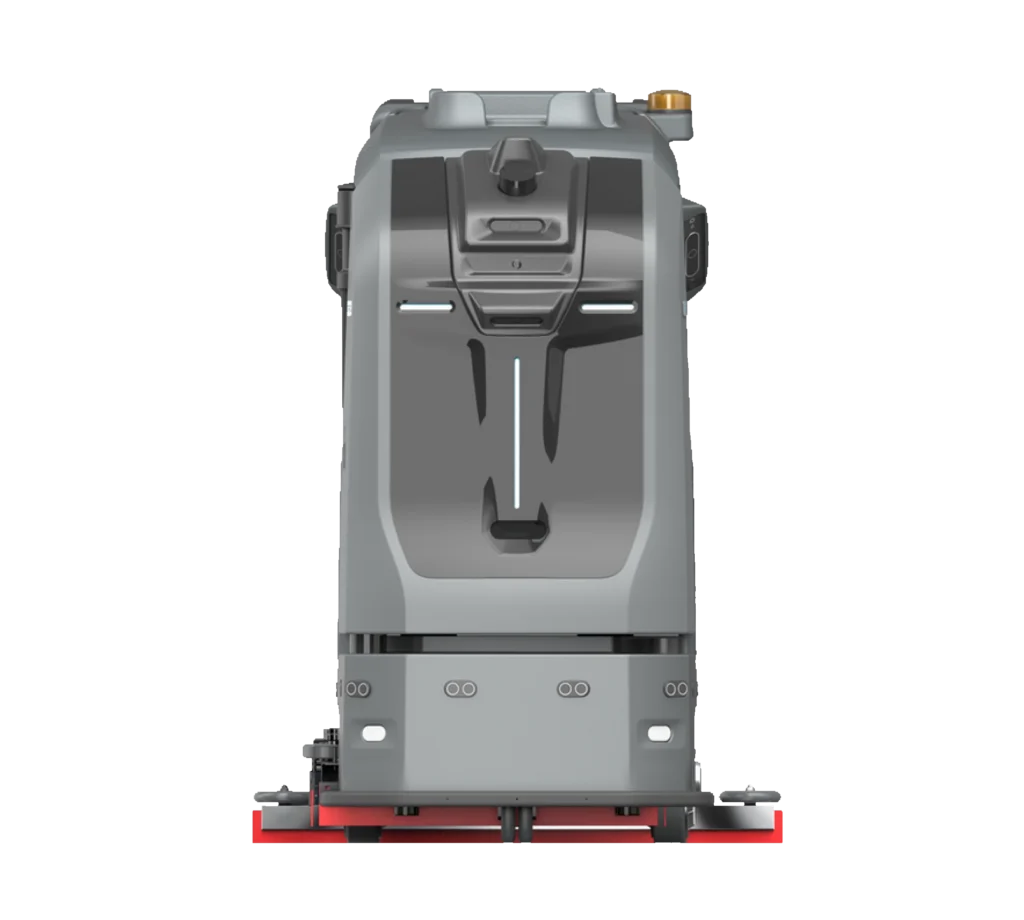
The LT70 Pro heavy-duty autonomous floor cleaning robot uses a larger industrial platform with a published 51 cm brush-cleaning width, 70 L clean-water tank and 80 L recovery tank. Its listed sensing equipment includes 2D LiDAR, a 3D depth camera, ultrasonic sensors, IMU and an electronic bumper strip.
These published features are relevant when evaluating the machines for commercial floor-care applications.
However, a sensor list is not a complete safety assessment.
The presence of a bumper or depth camera does not establish a particular safety performance level, certified stopping distance or suitability for every type of industrial traffic.
Likewise, a robot designed for a warehouse does not automatically have approval to operate in hazardous chemical areas or among unrestricted forklift movements.
For OEM/ODM customers, we believe the right approach is to match the equipment configuration with the facility’s operating requirements and confirm the necessary technical and safety evidence before market introduction.
What Should Commercial Cleaning Robot Buyers Ask Their Supplier?
When the objective includes workplace safety, a useful supplier discussion should go beyond cleaning efficiency and navigation technology.
We would encourage buyers to ask for information about the model’s intended operating environment, applicable safety documentation, protective functions, maintenance requirements and known operating limitations.
They should also establish whether the sample being demonstrated matches the actual production configuration.
A robot with a different sensor package, software version or cleaning assembly may not behave exactly like the unit previously evaluated.
The supplier should be able to explain how the machine responds to obstacles and faults, what personnel need to do during an interruption and which conditions are outside its intended use.
For industrial customers, this information is often more valuable than another general claim that the product is safe, intelligent or fully autonomous.
A useful safety claim should describe a defined capability supported by evidence—not imply that all workplace risks have been eliminated.
Conclusion
Industrial cleaning robots can make a meaningful contribution to workplace safety by supporting more consistent floor maintenance, reducing some repetitive manual work and helping facilities organize cleaning around real operating conditions.
But the same machines also introduce considerations involving movement, cleaning liquids, restricted areas, traffic interactions, maintenance and abnormal events.
That is why safety should never be evaluated from the robot alone.
The facility, the machine and the operating procedure must be assessed together.
For commercial equipment buyers, the most important question is not whether an industrial floor cleaning robot has advanced safety technology.
It is whether the selected machine can carry out its intended cleaning tasks within a clearly defined and properly managed workplace safety system.
That is the standard we believe professional autonomous cleaning projects should aim for.
FAQ
Do industrial cleaning robots improve workplace safety?
They can support workplace safety by helping maintain routine floor cleanliness, reducing certain repetitive manual tasks and providing controlled autonomous cleaning in suitable areas. However, actual safety outcomes depend on the facility, machine configuration, cleaning process and risk controls.
Can robotic floor scrubbers prevent slip-and-fall accidents?
Robotic floor scrubbers may help remove routine soil and certain residues, but they cannot guarantee prevention of slip-and-fall incidents. Wet scrubbing itself can create temporary hazards if wastewater is not adequately recovered or access is not managed.
Are commercial cleaning robots safe around forklifts?
Suitability depends on the operating environment and assessed controls. Industrial facilities should evaluate traffic separation, intersections, visibility, machine behavior and applicable procedures before operating cleaning robots near forklift traffic.
Can industrial cleaning robots operate in hazardous chemical areas?
Not automatically. Areas with hazardous chemicals, flammable atmospheres, combustible dust or other special risks may require specifically approved equipment and procedures. A standard commercial cleaning robot should not be assumed suitable.
Do industrial cleaning robots reduce worker injuries?
They may reduce exposure to some repetitive or physically demanding cleaning tasks, but that does not establish a measurable injury reduction without appropriate evidence. New maintenance and supervision tasks must also be assessed.
Do industrial cleaning robots improve indoor air quality?
Some specialized cleaning machines may collect dust using suitable filtration systems. However, air-quality improvement and hazardous-dust control depend on the exact equipment, filter performance, contaminants and operating procedures. These outcomes should not be assumed for every industrial cleaning robot.
What safety standards apply to autonomous commercial floor scrubbers?
IEC 63327:2021 addresses particular safety requirements for automatic floor-treatment machines intended for commercial indoor use. Other standards, regulations and conformity requirements may also apply depending on the machine and target market.
What should buyers check before deploying an industrial cleaning robot?
Buyers should review floor conditions, pedestrian and vehicle traffic, restricted areas, obstacle response, cleaning-liquid recovery, emergency behavior, maintenance procedures and applicable safety documentation. A controlled site-specific evaluation is recommended.
Work With Minfu
Minfu provides commercial and industrial cleaning robot OEM/ODM manufacturing and development support for equipment brands, distributors, wholesalers and commercial cleaning solution providers.
Our LT10 and LT70 Pro platforms offer different cleaning capacities, operating formats and sensor configurations for commercial and industrial floor-care applications.
We support product configuration, customization, sample evaluation, manufacturing preparation and quality-control coordination according to project requirements.
For projects involving workplace safety considerations, our team can help partners review the published platform specifications and coordinate technical discussions about the intended applications, operating limitations and documentation required for evaluation.
Explore Minfu Commercial Cleaning Robots
LT10 Compact Commercial Cleaning Robot
LT70 Pro Heavy-Duty Industrial Cleaning Robot
OEM/ODM Manufacturing Solutions
Website: https://minfutech.com/
Email: info@minfutech.com
WhatsApp / Phone: +86 13760255781
Contact Minfu to discuss your industrial cleaning robot project, facility requirements or OEM/ODM development needs.
Explore More Commercial Cleaning Robot Guides
Industrial Cleaning Robots and Facility Hygiene
Understand how autonomous floor cleaning fits into facility hygiene programs, including cleaning zones, wastewater recovery and contamination-control procedures.
Commercial Cleaning Robot Sensor Fusion
Explore the roles of LiDAR, depth cameras and other sensing methods in obstacle detection and autonomous navigation.
Can Commercial Cleaning Robots Run Unsupervised?
Learn where autonomous operation can reduce continuous manual control and which responsibilities remain with facility personnel.