



Introduction
A facility manager watching an autonomous scrubber work for the first time can easily come away with one conclusion: this is the machine that will replace the traditional floor scrubber.
We think that is the wrong way to frame the decision.
A commercial cleaning robot and a traditional floor scrubber can use similar brushes, water systems and dirty-water recovery principles, yet they solve very different operational problems. One is designed to perform predictable floor-care missions with limited continuous supervision. The other keeps a trained operator directly in control of the machine and can respond immediately when the cleaning situation changes.
That distinction matters more than whether one machine has LiDAR and the other has a steering wheel.
In a 20,000 m² distribution center with long, repeatable aisles, autonomy may completely change how cleaning labor is allocated. In a small facility where spills appear unpredictably and every cleaning task is different, the economics can look very different.
So the useful question is not:
Which technology is newer?
It is:
Which operating model fits the way your facility actually needs to be cleaned?
The short answer
A commercial cleaning robot is generally strongest where large or repeatable hard-floor areas need scheduled cleaning and staff time can be redirected to detail work. A traditional floor scrubber remains highly useful where cleaning is irregular, immediate human judgment matters, or operators frequently need to respond to concentrated soil and changing conditions. In many facilities, the best answer is not one or the other, but a combination of both.
ISSA describes autonomous mobile robots in much the same operational context: they can take over repetitive, time-consuming floor work while employees focus on detailed or higher-touch cleaning tasks.
The Real Difference Is Not the Brush — It Is Who Makes the Decisions
Put an autonomous scrubber and a conventional scrubber beside each other and many of the physical cleaning principles may look familiar.
Both may carry clean water.
Both may use brushes or pads.
Both may recover dirty water.
Both ultimately need to leave the floor clean and reasonably dry.
The biggest difference happens before the brush reaches the floor.
With a traditional scrubber, the operator decides where to go, when to turn, what to avoid, which area needs another pass and when the job is complete.
With an autonomous machine, many of those repeated decisions move into the navigation and mission-management system.
That changes the labor model.
| Operational Question | Commercial Cleaning Robot | Traditional Floor Scrubber |
|---|---|---|
| Who drives the machine? | Navigation system | Human operator |
| Who follows the route? | Robot executes mapped or assigned mission | Operator decides continuously |
| Best at repeated routes? | Strong | Possible, but depends on operator |
| Immediate response to unusual soil | More limited by programmed capability | Strong human judgment |
| Continuous operator required | Usually no | Yes |
| Cleaning records / task data | Often available | Depends on machine/platform |
| Upfront complexity | Higher | Usually lower |
| Best value | Predictable, repeatable cleaning workload | Flexible, direct intervention |
The table makes the distinction look clean. Real buildings are less clean than the table.
And that is where the decision becomes interesting.
A Traditional Floor Scrubber Still Does Something Robots Struggle to Copy: Human Judgment
Imagine a warehouse worker drops a container and leaves a concentrated patch of heavy contamination on the floor.
An experienced scrubber operator sees it immediately.
They may slow down, adjust the route, make several passes, change the cleaning approach and inspect the result before moving on.
That flexibility is difficult to reproduce with a scheduled autonomous mission.
The same applies when a facility changes unexpectedly. Temporary construction, a crowded staging area or equipment placed across the normal cleaning route can turn yesterday’s perfect autonomous zone into today’s poor candidate for automated cleaning.
This is why traditional scrubbers are not becoming obsolete simply because autonomous machines exist.
For some jobs, having a person directly controlling the cleaning process is an advantage.
We would be cautious about automation when the majority of the work consists of unpredictable, short, highly variable cleaning events rather than repeatable floor maintenance.
Where Commercial Cleaning Robots Start to Change the Economics
Now consider the opposite situation.
Every night, a member of the cleaning team spends two hours scrubbing the same wide corridors and open floor areas.
The route barely changes.
The task has to be completed every shift.
There is nothing particularly complicated about the work, but someone must remain behind the machine for the entire two hours.
This is exactly the kind of workload where autonomy becomes more interesting.
The value is not that the robot can spin a brush better than a person.
The value is that the employee no longer needs to spend the entire cleaning window performing the same repetitive route.
ISSA’s guidance on integrating robots into cleaning workloads describes this model directly: autonomous equipment can handle large, time-consuming floor areas while employees move to detail cleaning and other tasks that still need people.
That means the business case should not begin with:
“How many people can this robot replace?”
A more useful question is:
“How many repetitive floor-cleaning hours can we reassign?”
That difference matters.
The Labor Question Is Really About Work Reallocation
The phrase “labor savings” can make robotic cleaning sound like a headcount exercise.
In practice, it is often more complicated.
Restrooms still need attention.
Edges still need detail cleaning.
Trash still needs collecting.
Unexpected spills still happen.
Equipment still needs inspection.
A floor-cleaning robot does not make those tasks disappear.
What it can do is remove one large block of repetitive floor work from the shift.
Suppose an employee currently spends three hours running a scrubber across open hallways and lobby areas. If an autonomous robot can perform most of that route reliably, those three hours can potentially be used elsewhere in the cleaning program.
That is why we prefer to think about automation in terms of workloading, not simply “robot versus worker.”
Recent ISSA reporting is making the same distinction: the industry conversation has moved beyond whether robots can run and toward whether organizations know how to integrate them into an actual cleaning operation.

Cleaning Consistency Is Often a Bigger Advantage Than Speed
There is another difference that is easy to miss when buyers compare machines by square metres per hour.
Humans do not clean exactly the same route every day.
One operator may overlap passes generously.
Another may leave larger gaps.
Someone under time pressure may shorten the route.
A new employee may simply clean differently from the person who trained them.
An autonomous route can be much more repeatable.
Once a zone and mission have been validated, the robot can execute the defined route again without relying on memory or personal habit.
This does not mean the robot automatically produces a better cleaning result.
The brush, water control, ground pressure, suction and recovery system still matter.
But repeatable navigation can make the process more consistent.
For facilities where management cares about verifying that a scheduled area was covered, this can be as valuable as raw cleaning speed.
But Consistency Only Helps When the Environment Is Consistent Enough
This is where some automation projects go wrong.
A buyer sees an impressive autonomous demonstration and assumes the same performance will transfer to every part of the building.
It may not.
Robots tend to benefit from environments with enough structure for repeatable missions:
- broad corridors;
- regular hard-floor zones;
- defined cleaning windows;
- relatively stable layouts;
- manageable pedestrian traffic.
That does not mean a robot needs an empty warehouse.
Your robot still needs to recognize people, carts and temporary obstacles—that is part of what modern navigation systems are designed to do.
But there is a difference between:
a stable route with changing obstacles
and
a space whose usable layout changes completely every day.
The first is largely a navigation problem.
The second may be an operations problem.
No amount of LiDAR automatically makes a poor automation zone into a good one.
Large Floor Area Alone Does Not Automatically Mean “Buy a Robot”
Square footage matters, but we would never use it as the only decision criterion.
Consider two facilities of the same size.
Facility A
A large distribution center with long epoxy-floor aisles, predictable night shifts and repeated cleaning routes.
Facility B
A mixed-use event venue where chairs, displays, barriers and foot traffic change every day.
Both may have 10,000 m² of hard floor.
Operationally, they are completely different.
Facility A gives automation a large amount of predictable work.
Facility B may still benefit from robots in selected areas, but the entire facility may not justify autonomous cleaning.
This is one reason we prefer facility zoning rather than asking whether “the building” is suitable for robots.
Some zones may be ideal.
Others may remain better suited to traditional equipment.
What About Cleaning Power?
This is where the robot-versus-scrubber discussion sometimes becomes misleading.
Autonomy does not automatically make a floor scrubber clean better.
A machine’s physical floor-care performance still depends on factors such as:
- brush or pad design;
- cleaning width;
- brush pressure;
- water delivery;
- recovery performance;
- floor compatibility;
- chemical process.
A large traditional ride-on scrubber may be excellent at aggressive cleaning in a difficult industrial area.
A compact autonomous robot may be far better at running repeated missions through narrower commercial spaces.
Those are different strengths.
At Minfu, for example, the LT10 compact autonomous cleaning robot uses a 35 cm cleaning width and combines sweeping, vacuuming and scrubbing in a compact chassis designed for tighter commercial spaces. Its platform also includes autonomous mission management and a multi-sensor perception stack.
The LT70 Pro heavy-duty autonomous floor cleaning robot moves in a different direction: a 51 cm brush width, 70 L solution capacity and 80 L recovery capacity place it much closer to high-capacity industrial floor care.
The point is not that one replaces every conventional scrubber.
The point is that autonomy can now be combined with cleaning platforms large enough to handle serious commercial work.
Upfront Price Is Only One Side of the Cost Equation
Traditional floor scrubbers normally have a major advantage at the point of purchase: they are simpler operating systems and do not require the same navigation sensors, autonomous computing, software or safety stack.
A commercial cleaning robot therefore needs a stronger business case than:
“It is newer.”
When we evaluate the economics, we would look at several costs together.
Traditional scrubber
- Equipment purchase
- Operator hours
- Training
- Maintenance
- Battery / consumables
- Supervision
Commercial cleaning robot
- Equipment purchase
- Deployment / mapping
- Maintenance
- Software or service requirements where applicable
- Charging or workstation infrastructure
- Human intervention time
- Remaining cleaning labor
The important figure is therefore not just purchase price.
It is:
cost per useful cleaning hour over the machine’s operating life.
And even that number needs context.
If a robot sits unused because the facility was poorly prepared, its theoretical labor savings mean very little.
ISSA has specifically warned about this deployment gap: autonomous equipment only creates value when the organization has identified a suitable workload and understands how to integrate the machine into the cleaning program.
Data Changes What “The Job Is Done” Can Mean
With a traditional machine, proof of cleaning may depend heavily on supervision, checklists or employee reporting.
Connected commercial cleaning robots can introduce another layer: mission data.
Depending on the platform, managers may be able to review:
- assigned missions;
- completed areas;
- cleaning time;
- machine status;
- maps;
- operational history.
This does not make the floor cleaner by itself.
But for a Building Service Contractor managing several sites, or a facility manager responsible for a large property, visibility can matter.
The conversation moves from:
“Did somebody scrub that area?”
toward:
“What mission ran, when did it run, and was it completed?”
This is one reason modern commercial cleaning robots increasingly look less like standalone equipment and more like connected facility tools. ISSA has described the same shift toward robotic cleaning as an operating system that combines physical floor care with mapping, repeatable routes and performance visibility.
Maintenance Does Not Disappear When the Operator Does
Autonomy removes continuous driving.
It does not remove maintenance.
Robots still have:
- brushes;
- squeegees;
- tanks;
- filters;
- batteries;
- sensors;
- wheels;
- water systems.
In fact, sensors introduce a new maintenance requirement: if perception hardware is dirty, blocked or damaged, navigation performance can be affected even if the cleaning hardware is perfectly healthy.
Traditional scrubbers are often mechanically simpler and easier for experienced cleaning teams to understand.
Autonomous equipment adds another technical layer.
That means service capability, spare parts and operator training should be considered before buying—not after the first fault appears.
A robot that needs frequent specialist intervention can quickly undermine the reason it was purchased.
When a Traditional Floor Scrubber Is Probably the Better Choice
We would seriously consider keeping traditional equipment when:
The cleaning demand is irregular.
The machine is mostly used for unexpected spills or temporary heavy-soil jobs.
The facility is relatively small.
There may not be enough repeated cleaning hours to justify the autonomous investment.
The layout changes constantly.
Large sections of the normal route become unusable from one shift to another.
Human judgment is required throughout the task.
The operator regularly changes technique depending on what is happening on the floor.
The operation already has available labor and low utilization.
Automating a machine that only runs occasionally may create little economic value.
There is nothing outdated about choosing the machine that fits the job.
When a Commercial Cleaning Robot Starts to Make More Sense
The case becomes stronger when:
The same areas need cleaning every day.
Large floor zones consume significant operator time.
Cleaning happens during night or low-staff shifts.
Labor is better used on detail work than repetitive driving.
Management needs standardized coverage across shifts or sites.
The building has enough stable, accessible floor space for autonomous missions.
This is why warehouses, large office campuses, education facilities, retail environments and other broad hard-floor spaces have been important early-use cases for autonomous floor care. ISSA has documented these kinds of environments as common areas for robotic deployment.
The Best Fleet May Include Both
If there is one point we would want a buyer to remember from this article, it is this:
Buying a commercial cleaning robot does not require throwing away every traditional scrubber.
That is often unnecessary.
A facility might use an autonomous robot for scheduled corridor and open-floor missions while retaining a traditional scrubber for heavy-soil events, rapid response and zones unsuitable for autonomy.
This hybrid approach is increasingly visible in current commercial-cleaning discussions because it treats automation as another tool in the floor-care system rather than a universal replacement.
A well-designed cleaning program assigns work based on strengths.
Robot:
predictable, repetitive, measurable coverage.
Human-operated machine:
immediate flexibility and direct judgment.
That combination may be more valuable than trying to force either machine to do everything.
Before Buying Either Machine, Walk the Facility
This sounds almost too simple, but it is one of the most useful things a buyer can do.
Do not begin in the supplier’s showroom.
Begin on your floor.
Look at:
- where the cleaning hours actually go;
- which routes repeat every day;
- how often the layout changes;
- where people and equipment create congestion;
- which zones generate heavy soil;
- which jobs require immediate response;
- how much time operators spend simply driving a scrubber.
Then identify the parts of the workload that are genuinely predictable.
That is your automation opportunity.
After that, run a pilot.
Do not make the test easy.
Use the real facility.
Let normal people and carts move through the area.
Run the mission repeatedly.
Then compare the result with the way the traditional scrubber is currently used.
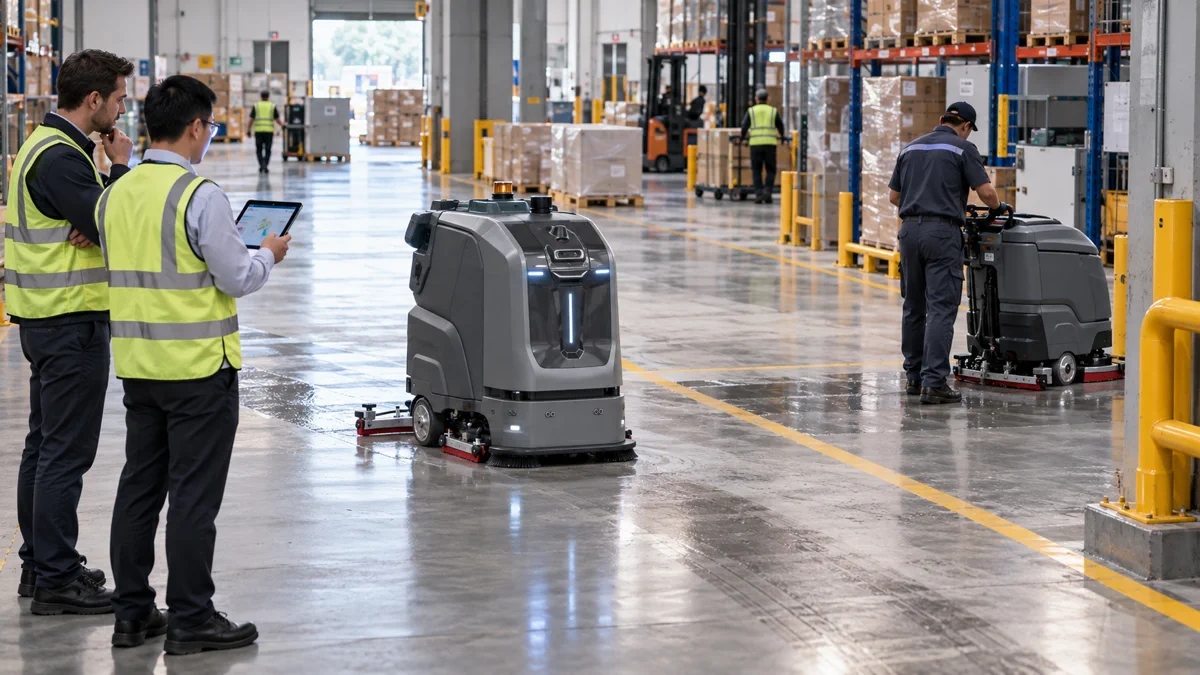
A brochure tells you what the machine is designed to do.
A pilot tells you whether it fits your operation.
A Simple Decision Framework
If we had to reduce the decision to six practical questions, we would use these:
| Ask This Question | If the Answer Is “Yes” |
|---|---|
| Do we clean the same large floor zones every day? | Autonomy becomes more attractive |
| Does repetitive floor scrubbing consume significant staff time? | Strong automation case |
| Is the layout reasonably stable? | Easier autonomous deployment |
| Do we need immediate human judgment for most cleaning tasks? | Traditional scrubber stays valuable |
| Do we frequently deal with concentrated, unpredictable soil? | Keep manual equipment available |
| Can staff be reassigned to useful work while the robot runs? | Better potential ROI |
Notice that none of those questions asks:
“Does the robot have AI?”
That is intentional.
Technology matters.
But facility fit determines whether the technology becomes useful.
Where Minfu’s Commercial Cleaning Robots Fit
At Minfu, we do not approach autonomous floor care as a single machine for every building.
Our commercial platform currently includes two very different operating formats.
The LT10 compact autonomous cleaning robot is designed around maneuverability, multi-action floor cleaning and navigation through more constrained commercial environments.
The LT70 Pro heavy-duty autonomous floor cleaning robot targets larger and more demanding commercial or industrial floor-care workloads with significantly larger cleaning and water-handling capacity.
If your question is specifically which autonomous platform fits which facility, our existing commercial cleaning robot selection guide goes deeper into that decision.
This article is making a different point:
Before choosing the robot, first decide whether the workload should be automated at all.
That decision should come from the facility—not from the brochure.
Conclusion
A commercial cleaning robot is not simply a traditional floor scrubber with autonomy added to make it more modern.
It changes the operating model.
Traditional scrubbers place a person directly in control and remain excellent tools for flexible, irregular and judgment-heavy cleaning tasks.
Commercial cleaning robots transfer much of the repeated navigation and mission execution to the machine, making them particularly useful when facilities have large, predictable floor-care workloads that consume significant staff time.
Neither approach wins everywhere.
For some facilities, the right answer is still a traditional scrubber.
For others, automation can fundamentally change how cleaning labor is used.
And for many larger operations, the most practical answer is likely to be both.
The best equipment strategy begins when a facility manager stops asking:
“Which machine is more advanced?”
and starts asking:
“Which parts of our cleaning workload are predictable enough to automate?”
That is the question that usually leads to a much better investment.
FAQ
What is the main difference between a commercial cleaning robot and a traditional floor scrubber?
A traditional floor scrubber requires an operator to continuously drive and control the machine. A commercial cleaning robot uses mapping, sensors and navigation software to execute assigned floor-cleaning missions with limited continuous human control.
Are robotic floor scrubbers better than traditional floor scrubbers?
Not in every situation. Robotic floor scrubbers are especially useful for repetitive, predictable cleaning routes, while traditional scrubbers remain strong for irregular work, immediate spill response and jobs requiring continuous human judgment.
Can commercial cleaning robots replace floor scrubber operators?
They can automate a significant portion of repetitive floor work in suitable environments, but cleaning teams still handle detailed cleaning, exceptions, maintenance and tasks poorly suited to autonomous machines.
Are commercial cleaning robots suitable for warehouses?
Warehouses can be strong candidates when they have large hard-floor areas, repeatable routes and suitable cleaning windows. Traffic patterns, aisle layout, obstacles and floor conditions still need to be evaluated before deployment.
Is a robotic floor scrubber more expensive?
Autonomous machines generally include additional sensing, computing, navigation and software systems, which can increase upfront investment. The useful comparison is total operating cost and labor reallocation over the expected service life rather than purchase price alone.
Can a facility use robotic and traditional floor scrubbers together?
Yes. A hybrid fleet can allow robots to handle repeatable scheduled areas while traditional equipment remains available for unpredictable, highly soiled or difficult zones.
Work With Minfu
Minfu provides commercial cleaning robot OEM/ODM manufacturing, product engineering, customization, validation and mass-production support for cleaning-equipment brands, distributors, Building Service Contractors and commercial solution providers.
Our current commercial platforms cover compact autonomous cleaning for flexible commercial environments and heavy-duty robotic floor care for large industrial facilities.
LT10:
https://minfutech.com/commercial-cleaning-robots-lt10/
LT70 Pro:
https://minfutech.com/commercial-cleaning-robots-lt70-pro/
OEM/ODM Solutions:
https://minfutech.com/oem-odm-solutions/
Email: info@minfutech.com
WhatsApp / Phone: +86 13760255781
Contact Minfu to discuss your target facility, local market, fleet requirements or commercial robot OEM/ODM project.
Continue Reading
How Autonomous Cleaning Robots Work
Want to understand what actually happens behind autonomous floor cleaning? This guide explains how sensors, mapping, localization, route planning, obstacle avoidance, floor-care hardware and mission management work together inside a commercial cleaning robot.