

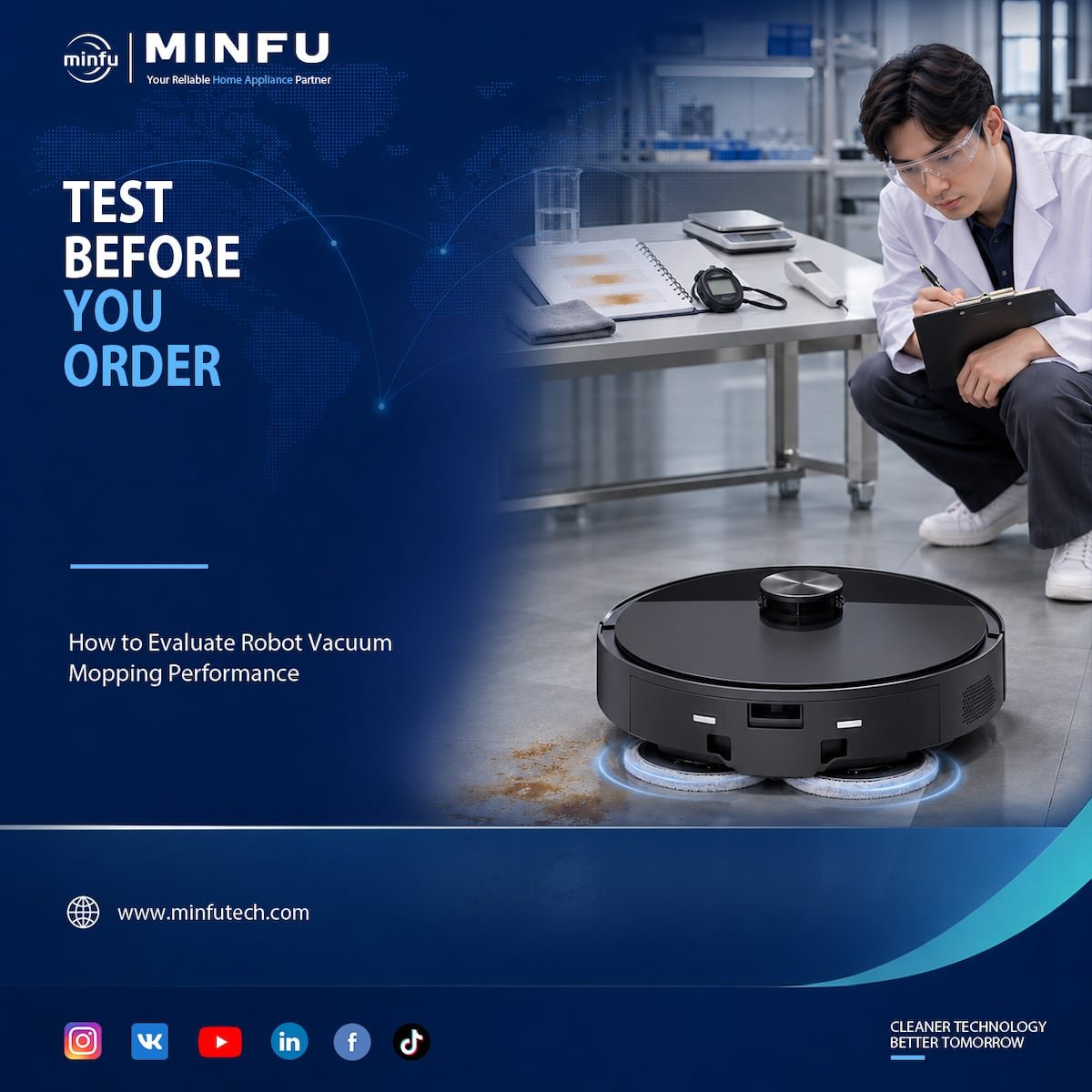
A robot vacuum may look impressive during a product demonstration, but that does not necessarily mean it will deliver consistent mopping results in everyday use.
For importers, wholesalers and private-label brands, evaluating the mopping system before placing a bulk order is an important part of product sourcing. A machine that collects loose dust effectively may still leave visible marks, distribute water unevenly or require excessive maintenance.
The most reliable way to evaluate a robot vacuum’s mopping performance is to test its mop movement, floor contact, water delivery, stain removal, cleaning coverage and long-term pad condition under repeatable conditions.
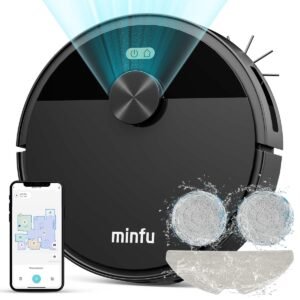
For buyers considering the Minfu MFL02 Rotating Mop Robot Vacuum, this process is particularly relevant because the product supports interchangeable rotating and flat mop configurations. Its electronically controlled water tank also provides adjustable water-flow settings.
Rather than relying on advertised features, buyers should evaluate the complete cleaning process and record the results before approving mass production.
This guide explains how to conduct a practical robot vacuum mopping performance evaluation and what importers should include in their OEM sample approval process.
1. Confirm the Exact Mopping Configuration Before Testing
The first step is to establish exactly which product configuration is being evaluated.
Two robot vacuums carrying the same model number may have different accessories or functional arrangements.
This is particularly important when a product platform supports more than one mopping system.
The Minfu MFL02 supports two mopping configurations:
- Rotating mop configuration.
- Flat mop configuration.
The product specification also identifies an electronically controlled water tank with adjustable water flow and two mop pads in its listed standard accessories.
Before starting a test, buyers should confirm the supplied configuration against the quotation and sample specification.
What Should Be Confirmed?
| Inspection Area | What Buyers Should Check |
|---|---|
| Mop System | Rotating or flat mop configuration |
| Mop Accessories | Correct pads, holders and attachments |
| Water Tank | Correct tank and installation |
| Water Control | Available water-flow settings |
| Robot Configuration | Confirmed model and hardware version |
| Cleaning Mode | Intended vacuuming and mopping combination |
| Documentation | Approved instructions and maintenance information |
Do not compare two samples until their configurations have been documented.
If the purpose is to compare rotating and flat mop systems, record the differences in accessories and operating settings rather than assuming they are mechanically identical.
This creates a more meaningful basis for evaluating the results.
2. Prepare a Controlled Floor-Cleaning Test
A common mistake during product demonstrations is to use different floor conditions for different tests.
For example, one configuration may be tested on a relatively clean floor while another is tested on an area with more visible dirt.
The resulting comparison would not provide reliable purchasing information.
A controlled test should use the same floor material, test area, dirt quantity and cleaning procedure.
Select Appropriate Floor Surfaces
For the MFL02, the product specification lists tiles and wooden floors among its supported floor types.
Buyers can use representative hard-floor surfaces to evaluate mopping performance.
Suitable test surfaces may include:
Ceramic or Porcelain Tiles
Useful for observing water distribution, footprints and visible surface residue.
Sealed Wooden Flooring
Useful for evaluating moisture control and the appearance of the floor after cleaning. Only use flooring that is compatible with the manufacturer’s approved cleaning instructions.
Other Compatible Hard Floors
Additional surfaces can be included when they are relevant to the destination market.
Carpet should be evaluated separately for vacuuming and carpet-handling functions rather than treated as a normal mopping surface.
Standardize the Test Conditions
Before each run, establish:
- The same floor area and material.
- The same type and quantity of test dirt.
- The same starting floor condition.
- A defined cleaning route or operating mode.
- A clean and correctly installed mop pad.
- The agreed water-flow setting.
- A consistent starting condition for the robot.
For a comparison between two mop configurations, each system should be tested using its appropriate manufacturer-recommended settings. Any differences in settings must be recorded.
This makes it easier to identify whether a performance difference comes from the mop design, water delivery or another operating condition.
3. Test Different Types of Household Dirt and Stains
Not all floor contamination behaves in the same way.
Fine dust, footprints and dried surface marks create different cleaning challenges.
A robot vacuum that performs well on loose dust may not necessarily remove dried marks effectively.
For this reason, buyers should divide the mopping evaluation into several test categories.
Test A: Fine Dust and Light Surface Dirt
Apply a controlled amount of fine test dust to a defined hard-floor area.
Observe whether the mop collects the remaining fine particles or simply moves them across the floor.
Pay attention to visible dust accumulation around the mop pad and along the cleaning route.
Test B: Footprints and Everyday Marks
Use representative light surface marks on a compatible floor.
Evaluate whether the robot removes the marks consistently and whether any visible streaks remain.
This test is useful for assessing the product’s suitability for routine household maintenance.
Test C: Dried Surface Stains
Apply a consistent quantity of a suitable test substance and allow it to dry for a controlled period.
Then operate the robot using the agreed cleaning mode.
Record how much residue remains after the first pass and after any additional cleaning cycles.
Avoid using highly aggressive chemicals or substances that could damage the floor or mop components.
Suggested Cleaning Test Record
| Test Category | What to Observe | Evidence to Keep |
|---|---|---|
| Fine Dust | Collection and redistribution | Before-and-after photographs |
| Footprints | Removal consistency | Same-angle floor photographs |
| Light Surface Marks | Visible residue | Cleaning records |
| Dried Stains | Remaining contamination | Number of passes and results |
| Floor Finish | Streaks or excess moisture | Post-cleaning inspection |
For more objective comparisons, buyers can use a consistent visual assessment method or an appropriate measurement technique.
A cleaning score developed for internal supplier comparison should be clearly identified as an internal evaluation, not a certified laboratory result.
The objective is to understand how the product performs under realistic conditions, not to create an impressive demonstration that cannot be repeated.
4. Evaluate Mop Movement and Floor Contact
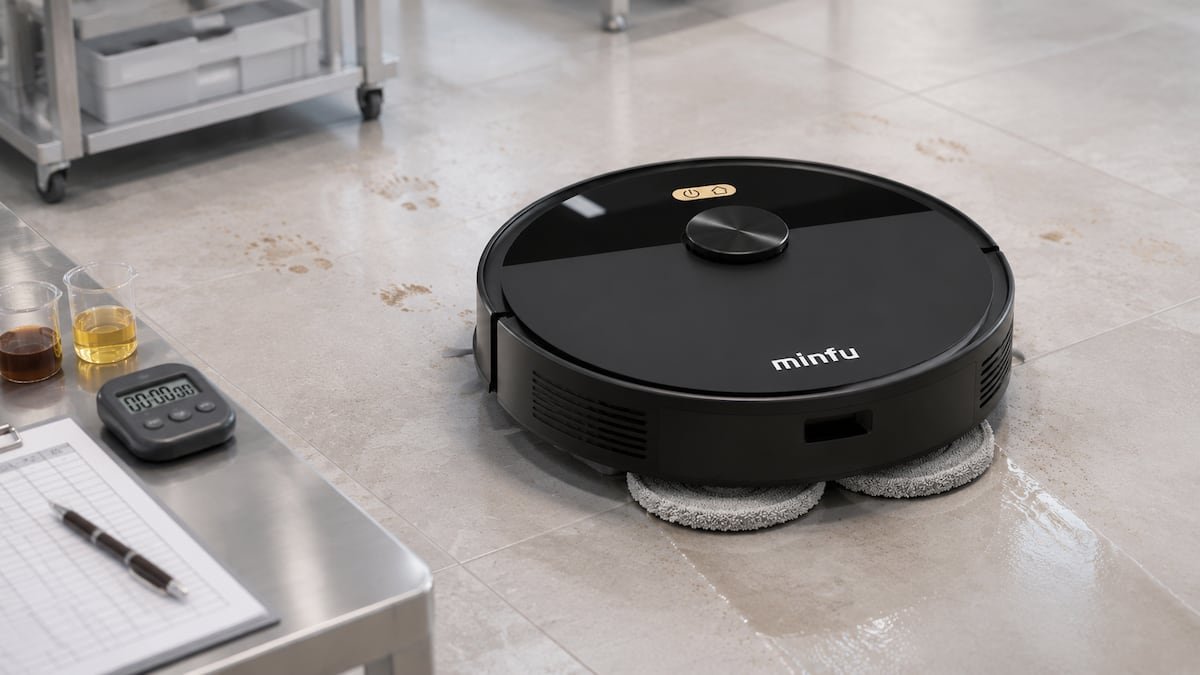
A rotating mop system introduces active movement at the floor-contact surface.
However, observing that the mop pads rotate does not prove that they maintain effective contact with the floor throughout the cleaning process.
Buyers should inspect the complete mechanism.
Rotating Mop Inspection
For the MFL02 rotating configuration, check:
- Whether both mop pads rotate as intended.
- Whether movement remains consistent during normal operation.
- Whether the pads remain correctly attached.
- Whether the mop system operates without unexpected interruptions.
- Whether the pads maintain suitable contact with the floor.
- Whether unusual vibration or mechanical noise occurs.
The inspection should include normal changes in direction and movement around furniture.
Flat Mop Inspection
For the flat mop configuration, buyers should evaluate:
- Whether the pad is installed correctly.
- Whether it remains securely attached.
- Whether the cleaning surface maintains appropriate contact.
- Whether the pad folds or shifts during operation.
- Whether the robot can complete its intended cleaning route.
- Whether dirt accumulates unevenly across the pad.
These checks help buyers identify mechanical issues that may not be visible during a short product demonstration.
Why Floor Contact Matters
The cleaning result depends on the interaction between the mop material and the floor.
If contact is inconsistent, some areas may receive less wiping action than others.
This applies to both rotating and flat mop systems, although the mechanical reasons can differ.
For this reason, mop movement and cleaning results should be inspected together rather than treated as separate selling features.
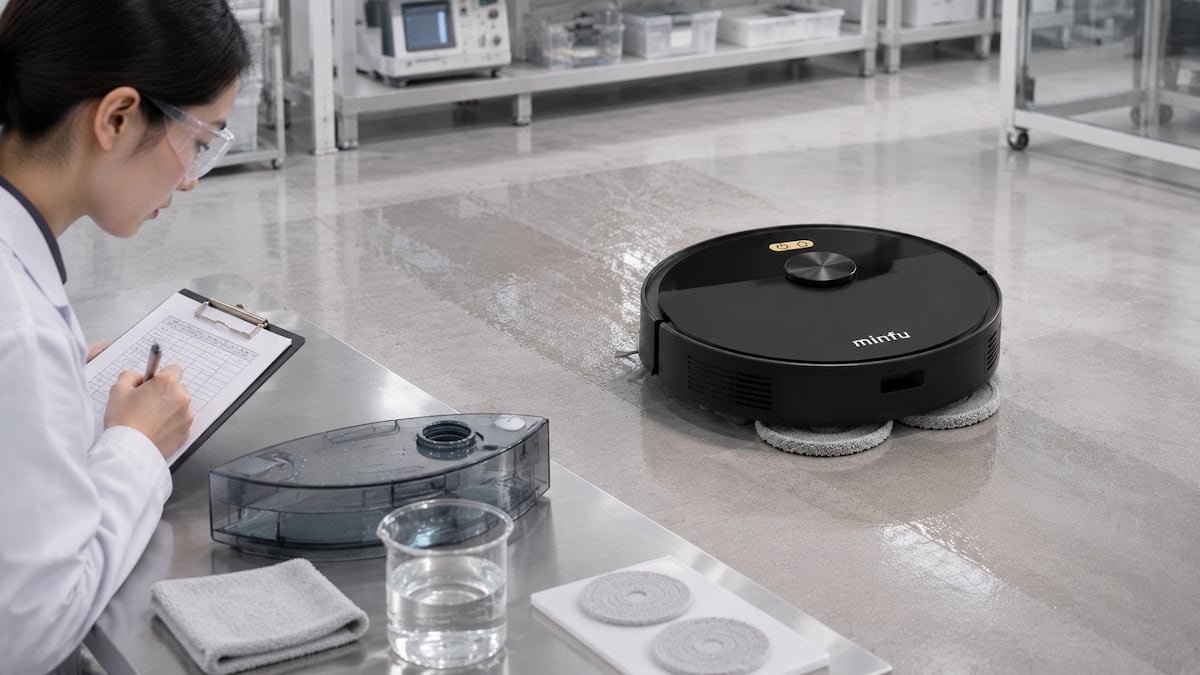
5. Check Water Delivery and Electronic Water Control
Water delivery is another important factor in robot vacuum mopping performance.
The MFL02 uses an electronically controlled water tank with adjustable water-flow settings.
For buyers, this creates an opportunity to evaluate how the selected water setting affects the cleaning result.
What Should Be Tested?
Water Distribution
Observe whether the mop receives water consistently during the cleaning cycle.
Water-Flow Adjustment
Check whether the available settings produce distinguishable and repeatable operating results.
Water Leakage
Inspect the tank, connections and surrounding components for unexpected leakage during normal operation.
Floor Moisture
Observe whether the floor is left excessively wet or develops visible streaks.
Water Consumption
Record the amount of water used during a defined test area and cleaning cycle.
A Practical Water-Control Test
Start with a correctly filled tank and a clean mop pad.
Select the lowest available water-flow setting and run the robot over a defined test area.
Record the operating conditions and inspect the floor after cleaning.
Repeat the procedure using the other available settings.
The results can then be compared.
| Evaluation Item | Low Water Setting | Medium Water Setting | High Water Setting |
|---|---|---|---|
| Water Delivery | Record actual result | Record actual result | Record actual result |
| Floor Moisture | Inspect | Inspect | Inspect |
| Visible Streaks | Inspect | Inspect | Inspect |
| Cleaning Result | Record | Record | Record |
| Water Consumption | Measure | Measure | Measure |
The actual setting names and number of levels should follow the supplied MFL02 software configuration.
Do not assume that a higher water-flow setting always produces better cleaning.
The appropriate setting depends on the floor surface, mop material and type of contamination.
6. Measure Cleaning Coverage and Navigation Consistency
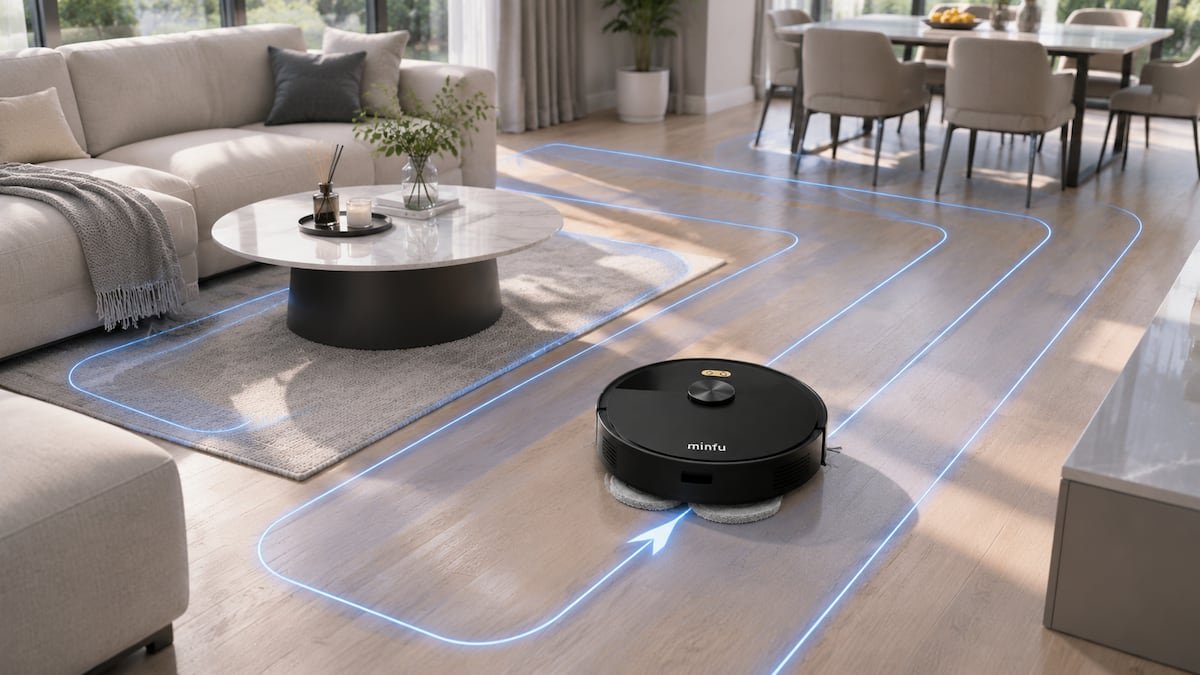
A robot vacuum can have a suitable mop system but still deliver inconsistent results if it does not cover the intended area properly.
Navigation and cleaning coverage therefore need to be included in the mopping evaluation.
The MFL02 uses LDS laser navigation with SLAM mapping.
These functions support room mapping and structured cleaning routes.
For buyers, the important question is whether the robot completes the intended cleaning task consistently.
Recommended Coverage Tests
Open Floor Test
Place the robot in a defined open area and observe whether it covers the intended cleaning zone.
Furniture Obstacle Test
Introduce normal furniture arrangements and check whether the robot can clean accessible areas without repeatedly becoming stuck.
Edge and Corner Test
Observe how effectively the selected mop configuration reaches areas close to walls and furniture.
Room-to-Room Test
Evaluate cleaning transitions between connected rooms and identify any repeatedly missed areas.
Repeatability Test
Run the same cleaning task again and compare the coverage.
What Should Buyers Record?
- Total test area.
- Cleaning start and finish time.
- Areas missed by the robot.
- Repeated cleaning of the same locations.
- Areas where the mop cannot reach.
- Unexpected interruptions.
- Final floor condition.
Navigation coverage and mop cleaning effectiveness are related but different measurements.
A robot may cover the entire room without removing every stain. Equally, a good mop mechanism cannot clean areas the robot never reaches.
Both aspects should be evaluated before bulk approval.
7. Check Mop Pad Durability and Maintenance
A robot vacuum is designed for repeated household use.
Its mopping accessories should therefore remain practical to maintain after multiple cleaning cycles.
For importers, replacement accessories and maintenance requirements also influence the long-term ownership experience.
Inspect Mop Pad Condition
After repeated normal cleaning and washing cycles, examine the mop pads for:
- Changes in material texture.
- Loose stitching or damaged edges.
- Deformation.
- Reduced attachment strength.
- Uneven wear.
- Persistent dirt accumulation.
The number of test cycles should be agreed with the manufacturer according to the intended evaluation scope.
Check Removal and Reinstallation
Buyers should verify whether customers can remove and reinstall the mop pads without excessive effort.
For rotating mop configurations, inspect the attachment points and confirm that the pads remain securely fitted.
For flat mop configurations, check the attachment surface and whether the pad stays in position during operation.
Evaluate Routine Cleaning
The maintenance procedure should be practical for ordinary consumers.
Check whether the pads can be cleaned according to the supplied instructions and whether they dry appropriately between uses.
For private-label projects, replacement-pad availability and identification should be discussed before production.
A product that performs well in its first demonstration but becomes difficult to maintain may create unnecessary customer service problems later.
8. Evaluate Combined Vacuuming and Mopping Performance
The mopping system should not be assessed in isolation.
The MFL02 is designed as a combined sweeping, vacuuming and mopping robot vacuum platform.
Its main brush is specified as an anti-tangle roller brush, and its standard configuration includes a 5,000Pa suction version, with higher suction options available.
For buyers, it is useful to conduct two separate types of test.
Mopping-Only Evaluation
This test focuses on the mopping system.
Prepare the floor consistently and assess the mop’s ability to handle the selected test contamination.
Record the water setting and mop configuration.
Combined Cleaning Evaluation
This test evaluates the complete cleaning process.
Observe how the robot collects loose debris and performs its mopping task during the selected operating mode.
Check whether debris is redistributed across the floor or accumulates around the mop components.
Pay particular attention to:
- Hair accumulation around the brush.
- Dust collection before and during mopping.
- Debris transfer to the mop pad.
- Water delivery during the cleaning cycle.
- Overall cleaning coverage.
- Maintenance after completing the task.
These two tests should not be confused.
A successful mopping-only test does not automatically establish that the complete vacuuming and mopping cycle will produce the same result.
9. Establish Sample Approval Criteria Before Bulk Production
Once the product has completed its initial performance evaluation, buyers should document the results.
This is particularly important for OEM and private-label orders.
A sample approval should identify the exact configuration that the manufacturer is expected to reproduce.
For the MFL02, this includes the selected mop system, accessories, water-control arrangement and other agreed product specifications.
Recommended MFL02 Mopping Acceptance Checklist
| Inspection Category | Acceptance Requirement |
|---|---|
| Mop Configuration | Matches the approved sample |
| Mop Installation | Correct attachment and removal |
| Mop Movement | Stable operation under normal conditions |
| Floor Contact | Consistent with the approved design |
| Water Control | Available settings operate as agreed |
| Water Leakage | No abnormal leakage under normal operation |
| Cleaning Performance | Meets agreed test criteria |
| Coverage | Completes the specified cleaning area |
| Pad Durability | No unacceptable damage during the agreed test |
| Maintenance | Cleaning and replacement procedures work correctly |
Acceptance limits should be established before testing begins.
If a critical requirement fails, the manufacturer should investigate the cause, make the necessary correction and provide evidence from a repeat test.
Use an Approved Golden Sample
After the sample is accepted, buyers should retain a reference configuration.
This approved sample can be used for production comparison and quality inspection.
Changes to important components, such as the mop attachment, water tank or electronic control system, should be reviewed before implementation.
This helps reduce the risk of differences between the sample originally approved and the products eventually delivered.
10. How Minfu Supports MFL02 OEM/ODM Product Evaluation
Shenzhen Minfutech Industrial Co., Ltd. supplies cleaning appliances for international brands, distributors, wholesalers and importers.
The MFL02 Rotating Mop Robot Vacuum is one of the robot vacuum platforms available for evaluation.
For buyers considering this model, the product configuration can be discussed according to the intended market and purchasing requirements.
Relevant project discussions may include:
- Rotating or flat mop configuration.
- Standard or optional suction versions.
- Water-tank and accessory arrangements.
- Product branding and logo placement.
- Retail packaging and user manuals.
- Replacement mop pads and maintenance accessories.
- Sample evaluation and approval requirements.
- Production specifications and quality inspection.
The final configuration, customization scope and commercial terms should be confirmed with Minfu before an order is placed.
For international buyers, the objective is to establish a product specification that can be tested, approved and reproduced consistently.
Frequently Asked Questions
How do you test a robot vacuum’s mopping performance?
Use a controlled floor area with consistent dirt, surface material and cleaning settings. Evaluate mop movement, water delivery, stain removal, floor coverage, remaining residue and mop maintenance.
Is a rotating mop robot vacuum better for removing dried stains?
Rotating mop pads introduce active rotational movement, which may help with certain surface marks. However, actual results depend on mop material, floor contact, water delivery and the type of stain. Buyers should verify performance through controlled tests.
How do you check whether a robot vacuum distributes water evenly?
Run the robot over a defined floor area using a documented water-flow setting. Observe floor moisture and visible streaks, and record water consumption under consistent test conditions.
What should importers check when testing robot vacuum mop pads?
Inspect material quality, attachment strength, wear after repeated washing, deformation and ease of replacement. The pads should remain suitable for the intended cleaning application.
Should rotating mop and flat mop systems be tested separately?
Yes. They use different cleaning mechanisms and should be evaluated independently. Buyers can then compare results using consistent floor surfaces, test contamination and documented procedures.
Why is navigation important when testing robot vacuum mopping performance?
Navigation determines which areas the robot reaches. A mop system cannot clean an area the robot misses, so cleaning coverage and mop effectiveness should be evaluated separately.
What should be included in an OEM robot vacuum sample approval?
The approved sample should identify the mop configuration, water-control settings, accessories, cleaning performance requirements and other critical product specifications. These should be used as references for production inspection.
Can Minfu provide an MFL02 sample for mopping performance evaluation?
Sample arrangements can be discussed with Minfu. Buyers should confirm the selected mop configuration, sample availability, commercial terms and evaluation requirements before proceeding.
Evaluate the MFL02 Before Your Next Bulk Order
Choosing a robot vacuum for a private-label product range requires more than comparing suction specifications or reviewing product photographs.
The mopping system must demonstrate consistent performance under conditions relevant to the intended market.
By evaluating mop movement, water delivery, cleaning coverage, stain removal and maintenance before bulk ordering, buyers can make more informed sourcing decisions.
MinfuTech works with international brands, wholesalers and importers on cleaning appliance OEM/ODM projects.
If you are evaluating the MFL02 Rotating Mop Robot Vacuum, share your target market, preferred mop configuration, expected order quantity and sample requirements with our team.
MFL02 Product Details: https://minfutech.com/mfl02-rotating-mop-robot-vacuum/
OEM/ODM Solutions: https://minfutech.com/oem-odm-solutions/
Contact Minfu: https://minfutech.com/contact-minfu/
Contact Minfu to discuss MFL02 samples, mopping configurations and private-label manufacturing opportunities.