

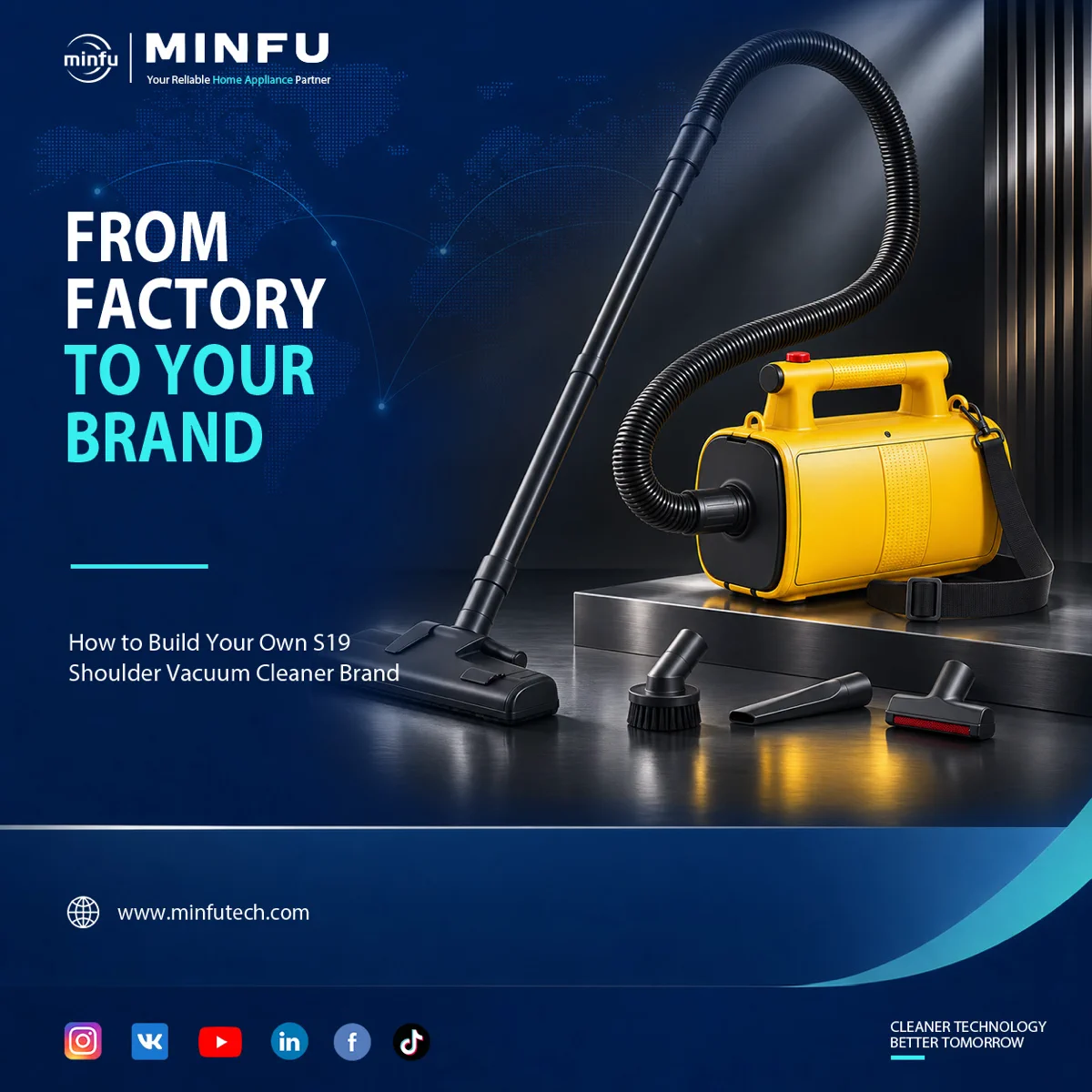
You have found a shoulder vacuum cleaner that fits your target market. The product looks promising, the cleaning functions are practical, and the sample meets your initial expectations. But there is one more question before you can sell it under your own brand: how do you turn an existing vacuum cleaner into a private label product that is ready for your customers?
For importers, wholesalers and cleaning appliance brands, private label manufacturing involves more than printing a logo on the machine. The final product also needs the right accessories, packaging, instructions, electrical configuration, compliance documentation and production specifications.
At Minfu, we work with international B2B customers on cleaning appliance OEM/ODM projects. Our S19 Shoulder Vacuum Cleaner provides a practical starting point for discussing a private label product.
The most efficient approach is usually to begin with an established product platform, define the required branding and market-specific changes, approve a complete sample, and then finalize the production specification before placing a bulk order.
This guide explains how that process works, which customization options buyers should discuss, and what must be confirmed before the product enters mass production.
1. Start with the Right Product Platform
A private label project does not always require a completely new product design.
For many brands, starting with an existing vacuum cleaner platform is a practical way to enter the market without immediately investing in new tooling, mechanical development or extensive product redesign.
The S19 is a corded, shoulder-carried vacuum cleaner with suction and blowing functions.
Its standard product specification includes:
| Specification | S19 Standard Configuration |
|---|---|
| Product Category | Shoulder Vacuum Cleaner |
| Rated Power | 800W |
| Maximum Power | 820W |
| Maximum Suction | ≥17kPa |
| Operating Modes | ECO / MAX |
| Dust Capacity | 1.5L |
| Net Weight | 2.0kg |
| Power Cord | 6m |
| Flexible Hose | 1.2m |
| Filtration | Paper Bag, Sponge and Micro Filter |
These specifications establish the starting point for a private label discussion.
The first decision is which parts of this configuration should remain unchanged and which need to be evaluated for the buyer’s target market.
For example, a distributor may want to retain the existing motor, housing and cleaning functions while introducing a new brand identity, local-language instructions and customized retail packaging.
That is a different project from requesting a new motor, modified housing or redesigned filtration system.
Understanding this distinction helps both parties prepare a more accurate quotation and development plan.
2. What Can Be Customized on a Private Label Shoulder Vacuum Cleaner?
Private label customization can take different forms depending on the manufacturer’s existing platform, production arrangements and the customer’s requirements.
The most common categories involve branding, packaging, documentation and product configuration.
For an S19 project, the following areas can be discussed with our team.
| Customization Area | What Buyers May Request | What Must Be Confirmed |
|---|---|---|
| Product Logo | Brand name, printed or marked logo | Available location, method and durability |
| Product Identification | Model name, product label and barcode | Artwork and legal label requirements |
| Retail Packaging | Branded gift box, graphics and inserts | Dimensions, materials and printing MOQ |
| User Manual | Local language and branded instructions | Translation and required safety information |
| Accessories | Selected attachments or packaged accessory sets | Compatibility and component availability |
| Plug and Electrical Version | Configuration for the destination market | Technical feasibility and compliance |
| Housing Appearance | Alternative color or finish | Minimum quantities, tooling and feasibility |
| Product Structure | Requested mechanical or functional changes | Engineering, testing, costs and development scope |
The table represents customization areas for evaluation, not a promise that every option is immediately available for the S19.
For most buyers, the first four categories are the most important starting points because they help create a recognizable retail product without fundamentally changing its cleaning platform.
More extensive mechanical or electrical modifications should be assessed as separate engineering work.
3. Your Brand Identity Must Be Consistent Across the Product
A branded vacuum cleaner should look like a complete product from one company, not a factory model with an additional sticker.
This means the brand identity should be consistent across the machine, packaging and accompanying materials.
Product Logo
A private label buyer should first specify the intended logo location, size and printing method.
The available area on the S19 housing must be assessed to ensure the marking does not interfere with ventilation, operating controls, safety information or maintenance access.
Before production, the artwork should be approved with its exact dimensions, colors and placement.
Model Name and Product Label
Many brands use their own model numbering system.
For example, a distributor may sell several different vacuum cleaners under one product family and want the S19 to follow its existing naming format.
The commercial model name can be discussed as part of the branding project, while the technical model identification and traceability information must remain properly documented.
Retail Packaging
Packaging deserves particular attention because it is often the first part of the product that a customer sees.
A well-designed product box should communicate the product’s actual functions, included accessories and essential specifications.
It should also protect the machine during transportation and storage.
For the S19, the packaging artwork should accurately represent the shoulder-carried design and corded power configuration.
A battery symbol or cordless product claim, for example, would be incorrect because the S19 uses a 6-meter power cord.
Consistent branding is not only a visual consideration. It also helps prevent mistakes in product descriptions, technical labels and customer expectations.
4. Customize the Accessory Package Around Your Customers
A vacuum cleaner’s accessory configuration affects how users understand and use the product.
The standard S19 accessories include a shoulder strap, crevice tool, round brush, 2-in-1 wide brush, flexible hose, extension tubes and floor brush.
However, different distribution markets may emphasize different applications.
A brand focused on home cleaning may prefer product photography and packaging that emphasize floors, furniture and stairs.
A cleaning equipment distributor may prefer to highlight portable cleaning, vehicle interiors or maintenance applications.
The equipment configuration should be reviewed alongside that positioning.
When requesting an accessory adjustment, buyers should specify:
- Which standard attachments must remain included.
- Whether any additional compatible accessories are required.
- Whether accessories need separate retail labels or protective packaging.
- Which replacement parts should be available for after-sales service.
- Whether the final package weight and dimensions will change.
Even a seemingly small accessory change can affect purchasing, packaging dimensions, carton configuration and the final cost.
Therefore, accessory selection should be finalized before the packaging artwork is approved.
5. Local Market Requirements Come Before Mass Production
A product intended for the European Union may require a different electrical configuration, labeling arrangement or documentation package from a product intended for another market.
Private label buyers should address these requirements at the beginning of the project.
For a corded appliance such as the S19, important considerations include the applicable voltage, frequency, plug type, electrical safety requirements and user instructions.
The product’s existing technical documentation should be checked against the exact version that will be supplied.
Why Brand Owners Should Pay Attention
In the European Union, an operator that has a product manufactured and markets it under its own name or trademark may be treated as the manufacturer for applicable product legislation and assume the associated responsibilities.
This is why private label branding should never be treated as only a printing exercise.
Buyers should verify the applicable requirements with a qualified compliance specialist and ensure that the relevant technical documentation and declarations are available.
Reference: European Commission – CE Marking and Manufacturer Responsibilities.
At Minfu, compliance preparation is considered according to the product model and destination-market requirements.
Buyers should provide their intended sales markets and electrical specifications early so the necessary documentation and testing requirements can be reviewed before order confirmation.
6. Request a Complete Private Label Sample Before Approval
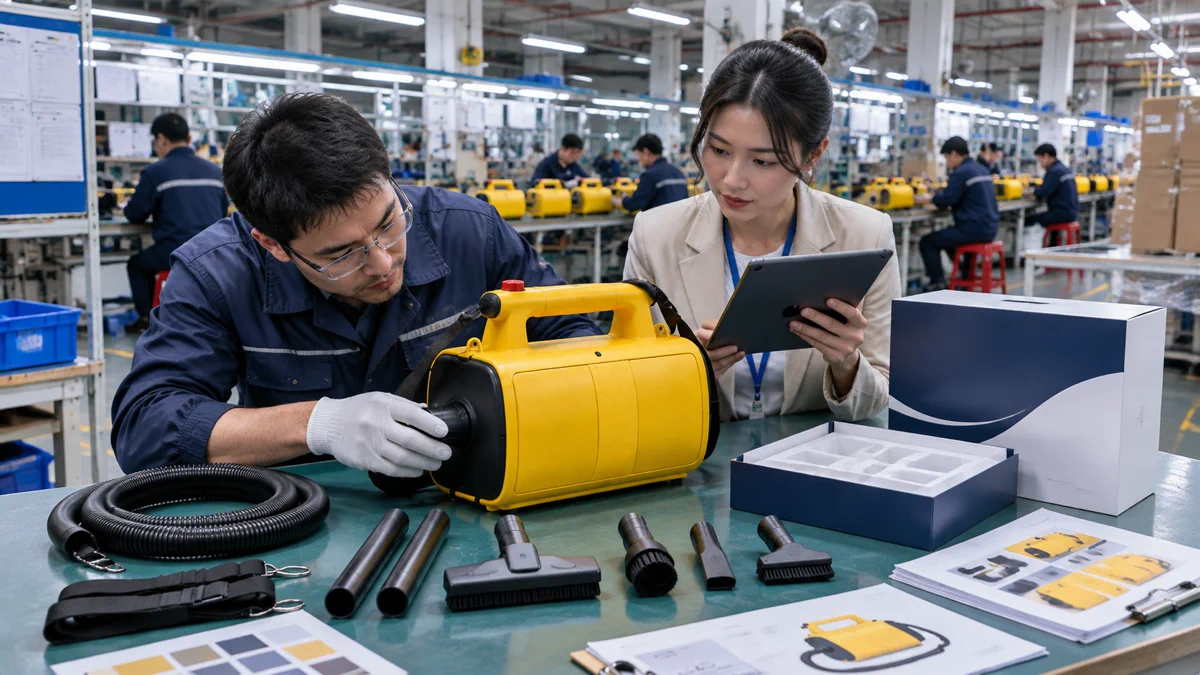
A product sample is more valuable when it represents the version customers will actually receive.
A standard engineering sample can confirm whether the S19’s cleaning performance and handling suit the intended application.
However, a private label approval sample should also reflect the agreed branding, labeling, packaging and accessory configuration.
A practical sample review can be divided into four areas.
Appearance Approval
Confirm the logo, colors, surface finish, model identification and product label placement.
Functional Approval
Test suction and blowing functions, operating modes, switches, cord handling, attachments and normal maintenance procedures.
Packaging Approval
Inspect the gift box, protective inserts, accessory positioning, barcode placement and product information.
Documentation Approval
Review the user manual, safety instructions, specifications, warranty information and applicable labeling.
The buyer and manufacturer should record any requested corrections before approving the final sample.
A written sample approval is particularly useful because it provides a reference for subsequent production inspections.
7. Why a Golden Sample Matters for Private Label Production
Once the final product configuration has been agreed, an approved reference sample can be established.
This sample is often called a Golden Sample.
It represents the agreed product appearance and configuration against which later production units can be evaluated.
A Golden Sample should be linked to an approved specification record covering the following items.
| Approval Item | Reference to Preserve |
|---|---|
| Product Appearance | Housing, finish and logo placement |
| Electrical Configuration | Approved motor and electrical version |
| Accessories | Exact list of included attachments |
| Filtration | Agreed dust bag and filter components |
| Product Labels | Model, ratings and traceability details |
| Retail Packaging | Approved artwork and protective inserts |
| Documents | Approved instructions and safety information |
| Quality Criteria | Agreed inspection methods and limits |
This process reduces the risk of production misunderstandings.
For example, a brand may approve a particular logo color and position, only to discover later that the production artwork uses a different shade or size.
A controlled reference sample and approved artwork help prevent these discrepancies.
For buyers planning repeat orders, the Golden Sample also provides a useful basis for confirming consistency between production batches.
8. Understand MOQ Before Planning Your Market Launch
Minimum Order Quantity, or MOQ, is often one of the first commercial questions raised by private label buyers.
However, the finished product MOQ is not necessarily the same as the MOQ for customized packaging, housing colors or specially manufactured accessories.
Different components can have different purchasing and production requirements.
For example:
| Customization Type | Main MOQ Consideration |
|---|---|
| Standard S19 | Factory order and production planning |
| Custom Logo | Printing or marking setup |
| Branded Gift Box | Packaging supplier’s minimum print quantity |
| Customized Accessories | Component purchasing requirements |
| Housing Color Change | Production batch and material preparation |
| New Mold or Structural Change | Tooling and engineering investment |
The S19 commercial offer sheet dated October 9, 2026 specifies one 40-foot high-cube container as the minimum order for that quotation. Buyers should request an updated quotation rather than assume the same quantity applies to every project or customization arrangement.
When preparing a sourcing inquiry, it is useful to state the expected initial order, projected repeat orders and desired customization level.
This allows the manufacturer to evaluate the project in commercial terms instead of providing a quotation based on incomplete information.
The key is to ask not only, “What is the MOQ?” but also, “Which parts of my customization determine the MOQ?”
9. How Should Buyers Compare OEM Quotations?
A lower unit price does not always mean a lower total procurement cost.
Two suppliers may quote different prices because their product configurations, accessories, packaging, quality requirements or delivery terms are not identical.
A useful quotation should separate the main cost categories.
| Cost Category | Questions to Confirm |
|---|---|
| Unit Price | What exact product configuration is included? |
| Logo Customization | Is artwork preparation or marking included? |
| Packaging | Is the custom gift box included in the unit price? |
| Accessories | Which attachments are supplied with each unit? |
| Tooling | Are any one-time mold or tooling costs required? |
| Sample | What is the sample price and approval process? |
| Quality Inspection | What inspections and tests are included? |
| Compliance | Are additional tests or documents required? |
| Logistics | What are the delivery terms and carton quantities? |
| After-Sales Parts | How are replacement components supplied? |
The buyer should also clarify how product changes will be priced after the initial quotation has been approved.
If an accessory is added or the packaging structure changes, both sides should confirm the resulting commercial impact before production.
This helps avoid disputes after the product has entered the manufacturing schedule.
10. From OEM Requirements to Final Shipment
A structured manufacturing process reduces uncertainty for both the buyer and the factory.
At Minfu, our general OEM/ODM workflow includes requirement review, product design, prototype and testing, tooling or pilot production when required, mass production and quality inspection, followed by packaging and delivery.
For an S19 private label program, the workflow can be applied as follows.
Stage 1: Define the Project
The buyer provides the target country, product application, branding requirements, expected quantities and intended launch schedule.
Stage 2: Confirm the Product Configuration
Both parties review the S19 baseline model, requested changes and the technical feasibility of the customization.
Stage 3: Review Commercial Terms
The scope, quotation, MOQ, payment terms and expected production arrangements are agreed.
Stage 4: Approve the Sample
The buyer reviews the product sample, branding, accessories, packaging and documentation.
Stage 5: Finalize Production Specifications
Approved artwork, product configuration, inspection criteria and packaging requirements are documented.
Stage 6: Manufacture and Inspect
The order proceeds to production according to the approved specification, followed by the agreed quality checks.
Stage 7: Pack and Ship
The finished products are packed according to the approved packaging configuration and prepared for the agreed delivery arrangement.
This staged approach makes it easier to identify disagreements before they become expensive production problems.
It also helps buyers manage the transition from a sample order to an ongoing private label product program.
11. Plan After-Sales Support Before the First Shipment
A successful private label program does not end when the products leave the factory.
Brand owners and distributors should also establish how they will handle customer questions, replacement parts, product defects and future replenishment orders.
For the S19, practical after-sales planning may include:
- Replacement dust bags and filtration components.
- Spare hoses and cleaning attachments.
- Electrical and mechanical spare-part availability.
- Product troubleshooting instructions.
- Warranty procedures and responsibility allocation.
- Serial number or batch identification.
- Procedures for reporting recurring quality issues.
The availability, pricing and supply conditions of these items should be confirmed in the commercial agreement.
For importers, this can be especially important when the product is marketed under their own brand, because customers will usually approach the brand or local distributor when a problem occurs.
12. What Information Should You Send to Minfu for an S19 OEM Quotation?
A detailed inquiry allows our team to assess a potential private label project more accurately.
We recommend including the following information:
| Required Information | Example |
|---|---|
| Destination Market | Germany, United Kingdom, United States or another market |
| Product Model | S19 Shoulder Vacuum Cleaner |
| Brand Name | Your intended retail or distribution brand |
| Branding | Logo placement and artwork |
| Packaging | Standard or custom gift box |
| Electrical Requirements | Voltage, frequency and plug type |
| Accessories | Standard set or requested changes |
| Expected Quantity | Initial and repeat order estimates |
| Target Launch | Preferred shipping or sales period |
| Special Requirements | Compliance, documentation or technical changes |
With these details, the manufacturer can assess the product configuration, confirm which customization requests are feasible and prepare the next steps for the project.
Frequently Asked Questions About Private Label Shoulder Vacuum Cleaners
Can I sell the S19 Shoulder Vacuum Cleaner under my own brand?
Minfu supports OEM/ODM cooperation for cleaning appliances. Private label branding for the S19 can be discussed, including the intended logo, product identification and packaging requirements. The final scope must be confirmed before production.
Can I customize the color of the S19?
A housing color change can be evaluated as a separate customization request. Availability depends on the production process, materials, order quantity and technical feasibility.
Can I use my own retail packaging?
Custom retail packaging can be discussed as part of an OEM project. Artwork, carton dimensions, printing requirements and minimum quantities need to be confirmed.
Can I change the accessories supplied with the S19?
Accessory configuration changes may be possible subject to component compatibility, availability and the agreed order conditions.
Does private labeling require a new product mold?
Not necessarily. Basic branding and packaging changes can often use an existing product platform. A new housing design or structural change may require additional engineering and tooling.
How long does an S19 OEM order take?
The timeline depends on the approved product configuration, branding requirements, packaging preparation, sample approval and production schedule. Buyers should request a project-specific timeline rather than rely on a universal delivery estimate.
What is the MOQ for a private label S19?
The October 2026 S19 offer sheet specifies one 40-foot high-cube container for that quotation. The current order requirement and the effect of any requested customization should be confirmed directly with Minfu.
Can Minfu provide documentation for my destination market?
Minfu supports technical documentation and compliance preparation based on product configuration and market requirements. Buyers should confirm the specific documents and applicable regulatory requirements before ordering.
Build Your Private Label Shoulder Vacuum Cleaner with Minfu
The S19 gives cleaning appliance brands a practical starting point for developing a shoulder vacuum cleaner under their own brand.
Instead of beginning with a completely new product design, buyers can first evaluate the existing S19 platform and identify the branding, packaging, accessories and market-specific requirements that matter to their business.
At Shenzhen Minfutech Industrial Co., Ltd., we work with international importers, distributors and cleaning appliance brands on OEM/ODM manufacturing projects.
If you are planning to introduce a private label shoulder vacuum cleaner to your market, share your project requirements with our team.
Explore the S19: https://minfutech.com/s19-shoulder-vacuum-cleaner/
OEM/ODM Manufacturing Solutions: https://minfutech.com/oem-odm-solutions/
Website: https://minfutech.com/
Email: info@minfutech.com
WhatsApp / Phone: +86 13760255781
Get a Quote: https://minfutech.com/contact-minfu/
Let us help you evaluate the S19 configuration and build a practical sourcing plan for your brand.