


Executive Summary (TL;DR)
The Macro Problem: Global food waste will cost the global economy an estimated $540 Billion in 2026 alone, generating 8–10% of total global greenhouse gas emissions.
The Regulatory Hammer: Governments are responding with harsh financial penalties. California’s SB 1383 is now actively levying fines up to $500 per day using AI-equipped “Smart Trucks,” while the EU is rolling out strict “Pay-As-You-Throw” (PAYT) garbage taxes.
The Hardware Boom: Driven by consumer panic and regulatory compliance, the Household Food Waste Composting Machine market has surged to $3.44 Billion in 2026 and is projected to hit $4.51 Billion by 2030 (CAGR of 7%).
The OEM Opportunity: Appliance brands that move past cheap “dehydrators” and source 4.5L, PFAS-Free, “Self-Cleaning” smart composters (like the Minfu H3002A) are poised to capture massive market share and lucrative recurring filter revenue.
Chapter 1: The $540 Billion Crisis & The Methane Threat
If your home appliance brand is still focusing the majority of its R&D and marketing budget on traditional air fryers, blenders, or basic stick vacuums, you are actively missing the most significant, legislatively driven hardware boom of this decade.
The traditional “white goods” market is saturated. Consumers upgrade their microwaves every seven years. But in 2026, a massive external force is forcing consumers to buy a completely new category of kitchen appliance: The Government.
According to the United Nations Environment Programme (UNEP), roughly one-third of all food produced globally is lost or wasted. New economic modeling from the World Economic Forum estimates that in 2026 alone, the global cost of food waste will reach an astonishing $540 Billion.
But the economic loss is dwarfed by the environmental catastrophe. When organic food scraps (meat, dairy, vegetables) are thrown into standard plastic garbage bags and sent to traditional landfills, they decompose anaerobically (without oxygen). This process produces methane (CH4), a highly volatile greenhouse gas roughly 80 times more potent at trapping atmospheric heat than carbon dioxide (CO2) over a 20-year period.
Voluntary recycling has failed. Global leaders have realized it is mathematically impossible to hit the Paris Agreement’s 2030 climate targets without completely eliminating organic waste from landfills. The era of “encouraging” composting is over; the era of mandatory compliance has begun.
Chapter 2: The 2026 Legislative Hammers (Global Breakdown)
For B2B appliance brands and importers, understanding these new laws is critical. These regulations act as the greatest free marketing campaign in the history of the appliance industry.
1. North America: California’s SB 1383 & The “Smart Truck” Era
California is the bellwether for environmental policy in the United States. Its landmark Senate Bill 1383 (Short-Lived Climate Pollutants Act) set an aggressive, legally binding target: a 75% reduction in organic waste disposal by 2025.
By 2026, the multi-year “education phase” has officially ended. We are now in the strict enforcement phase, and it is destroying consumer complacency.
The Surveillance Technology: Major waste haulers (such as Waste Management) are actively deploying Smart Truck® AI camera technology. These trucks use computer vision and live video streaming to look inside residential curbside bins during automated pickup. They instantly identify prohibited food waste hidden in the black landfill bins.
The Fines (Active Now): Under CalRecycle regulations, local jurisdictions are issuing heavy fines directly onto utility bills for contamination or failure to sort:
Table 1: Typical California SB 1383 Fine Structure (2026)
| Violation Tier | Description of Offense | Penalty Amount (Per Incident/Day) |
|---|---|---|
| First Offense | Initial detection of food waste in the landfill bin. | $50 – $100 |
| Second Offense | Repeat contamination within a 12-month period. | $100 – $250 |
| Third Offense+ | Chronic non-compliance or failure to subscribe to organic service. | $250 – $500 |
Note: Municipalities themselves face fines of up to $10,000 per day from the state if they fail to enforce these rules on their residents.
2. The European Union: The WFD and the “PAYT” Revolution
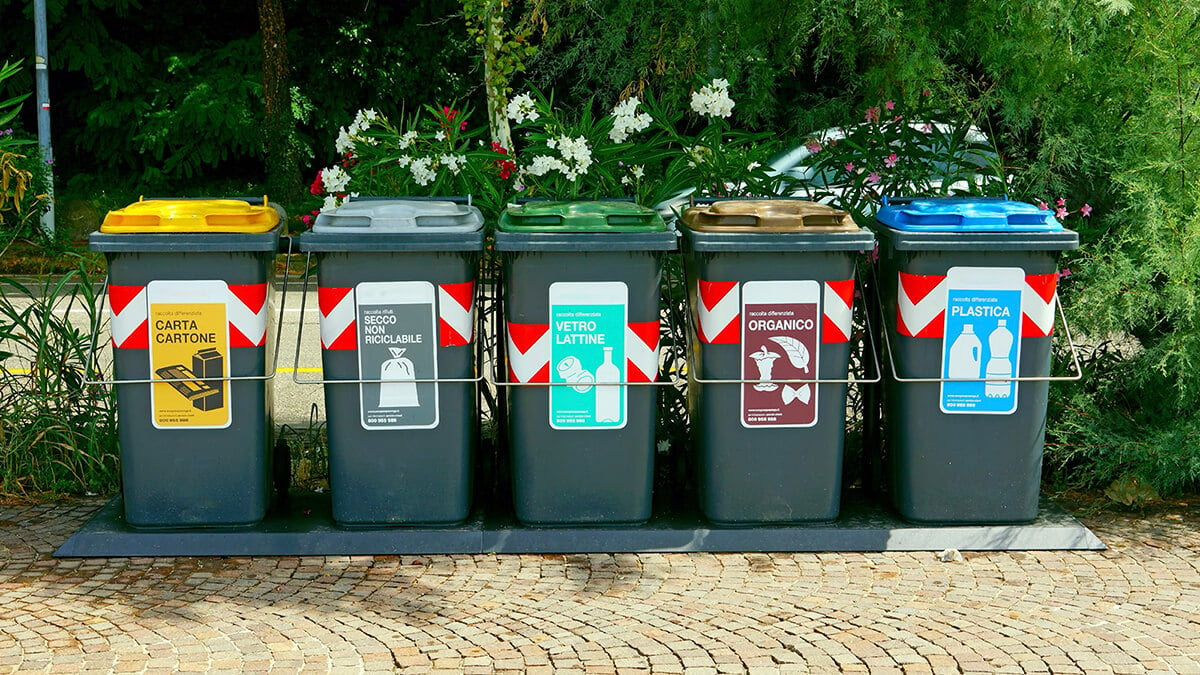
Across the Atlantic, the European Union has implemented equally draconian mandates under the revised Waste Framework Directive (WFD). Since January 1, 2024, all EU member states have been mandated to ensure bio-waste is separated and collected at the source.
The “Pay-As-You-Throw” (PAYT) Model: To force compliance, progressive European cities are abandoning flat-rate garbage taxes. Instead, they are charging residents based on the exact weight or volume of the mixed waste they produce, often using RFID-chipped bins.
Real-World Costs: In regions like Sardinia, Italy, the gate fee for residual waste disposal sits at an exorbitant €200 per ton. In municipalities across Spain and Switzerland, residents must buy standardized municipal garbage bags (costing up to €1.50 to €2.00 per bag).
The Math: Because food waste is 80% water, it is the heaviest and bulkiest item in the trash. Throwing away wet food scraps costs European residents a fortune in daily taxes under PAYT systems.
Chapter 3: The Consumer Nightmare = Your Brand’s Profit Center
🛒 Case in Point: Legislation forces consumers to separate their food waste, but it inadvertently creates a massive, localized psychological nightmare inside the home: The Kitchen Stink.
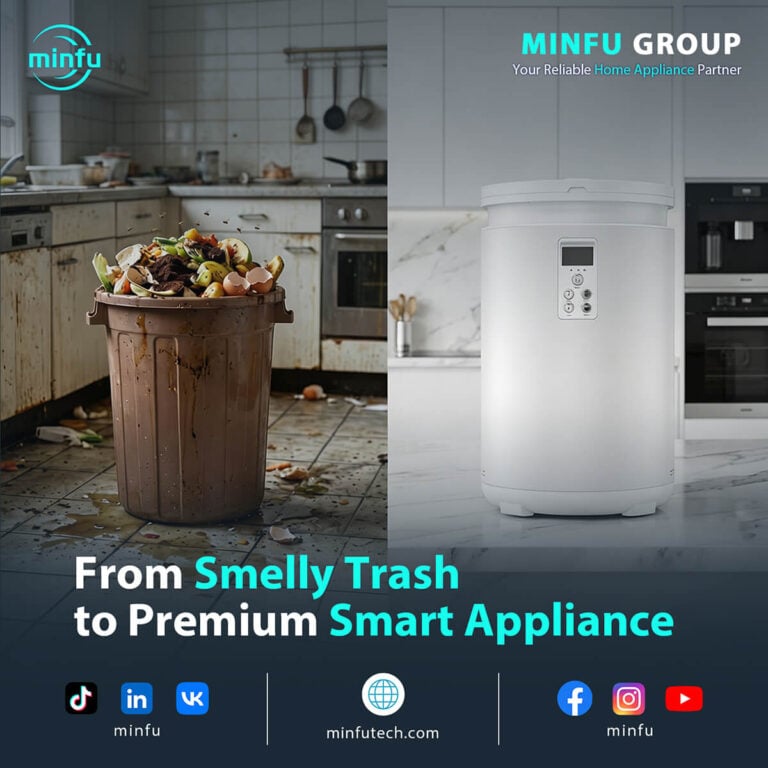
Before owning an indoor smart composter, a compliant citizen must scrape their wet, rotting food into a small countertop caddy or a green curbside bin. In the summer heat, this creates an unbearable living situation:
Immediate Odor: Fermenting dairy, rotting meat, and degrading vegetables create sulfuric odors within 12 hours.
Pest Infestations: Countertop bins instantly breed fruit flies and attract ants.
The “Dripping Bag” Walk: No one wants to carry a leaking, smelly bag of wet garbage down an apartment hallway or out to the freezing driveway in winter.
This specific psychological pain is the exact trigger for a $400+ appliance purchase.
For the consumer, spending $400 on a machine that instantly dehydrates, sterilizes, and shrinks their daily food scraps indoors is significantly cheaper than paying $500 in municipal fines or paying exorbitant weight-based (PAYT) taxes every month. The ROI for the consumer is undeniable. According to the Business Research Company, this precise dynamic has pushed the Household Food Waste Composting Machine Market to $3.44 Billion in 2026.
Chapter 4: The Appliance Industry Shift & The “Fake Composter” Trap
While the demand is explosive, brand owners cannot simply import cheap, 2L public-mold dehydrators from Alibaba, slap a logo on them, and expect to succeed in 2026. The market has matured, and consumer expectations are incredibly high.
If you source from a low-tier factory to save $30 on the FOB price, you will experience a catastrophic return rate (RMA). Here is why first-generation and cheap machines fail:
The Capacity Trap (2L is too small): A 2L unit is fine for a single person. But a standard household generates about 1.5kg of scraps daily. If the machine is too small, it becomes a chore, not a convenience.
“Fake” Composting (Just baking garbage): Cheap machines are just glorified heaters. They bake the food into sterile, hard “jerky.” If a consumer puts this unfermented jerky into their garden, it will rehydrate, rot, attract mold, and kill their plants.
The Toxic PFAS / Teflon Ban: Low-end factories use cheap PTFE (Teflon) on the inner buckets. global regulatory bodies (especially the EPA and EU) are actively banning PFAS (“Forever Chemicals”) in household appliances. Importing these can result in immediate customs seizures in 2026.
The “Cleaning” Nightmare: The #1 cause of 1-star Amazon reviews. If a user processes high-sugar fruits, it caramelizes into a sticky, black tar on the bottom of the bucket. If the bucket must be scrubbed by hand, the user will hate the machine within a week.
Table 2: The Evolution of Indoor Composting Technologies
| Technology Type | Process | Pros | Cons | 2026 Market Status |
|---|---|---|---|---|
| Basic Dehydrators | Heat & Grind | Cheap, Compact | No real fertilizer, high odor leakage, burns out. | Declining (High Returns) |
| Pure Biodigesters | 100% Microbes | True organic output | Massive physical size, requires constant microbe maintenance. | Niche Market Only |
| Advanced Hybrid (H3002A) | Heat + Grind + Ferment Algorithm | Odorless, 95% Volume Reduction, True Fertilizer Output | Requires OEM R&D | The 2026 Industry Standard |
Chapter 5: The Ultimate OEM Blueprint — The Minfu H3002A
To dominate this legislatively driven market and capture the $3.44 Billion industry wave, your brand needs a machine engineered specifically for large households, zero-maintenance, and true ESG compliance.
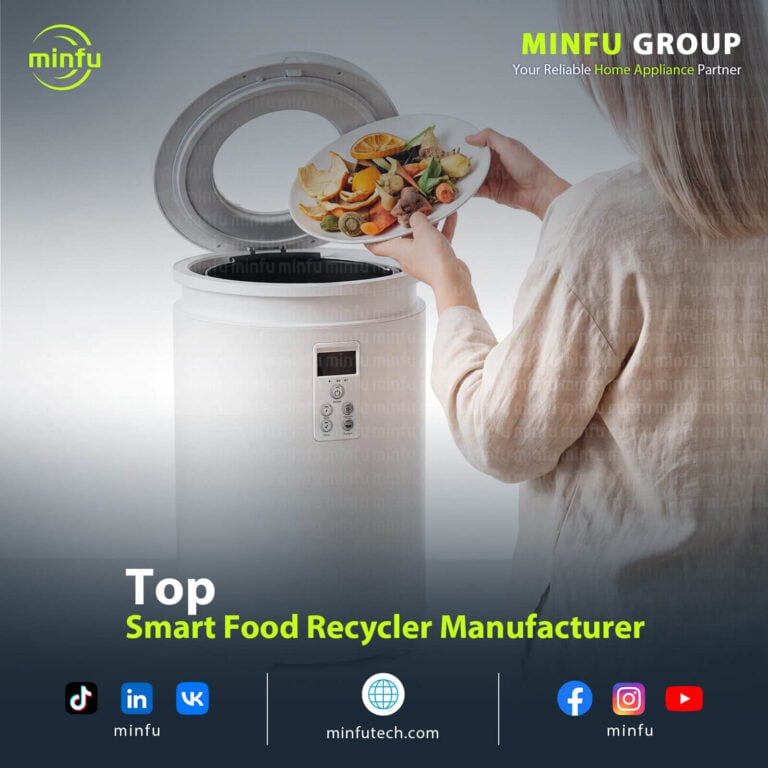
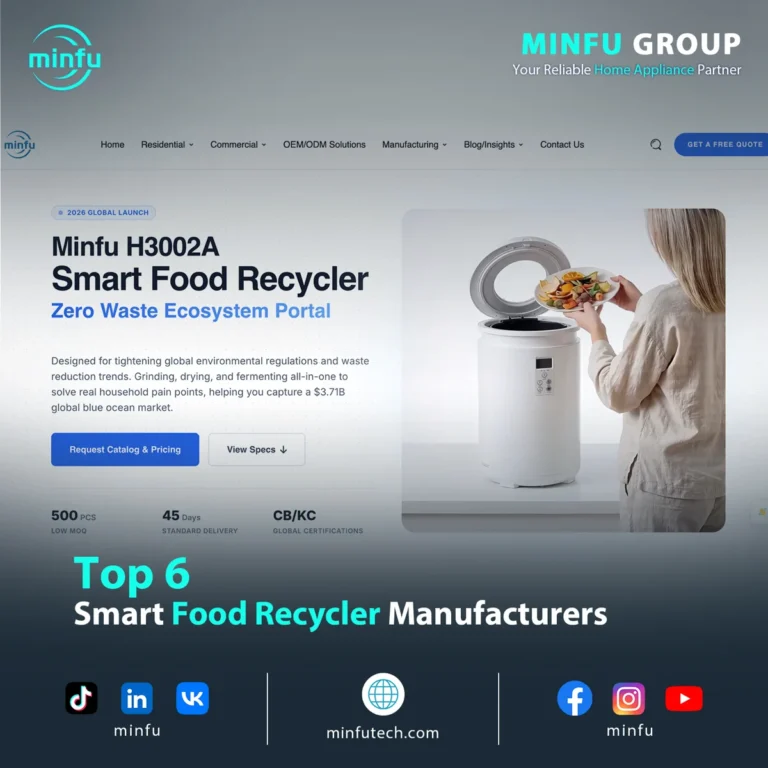
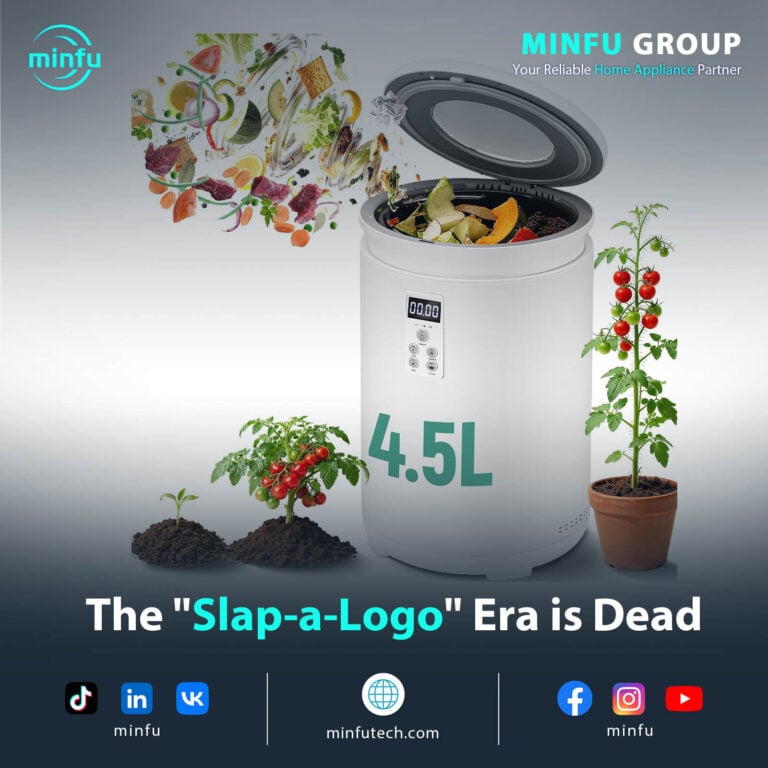
At Minfu Group, our R&D team anticipated this 2026 legislative boom. We tore down every competitor unit on the market and engineered the flagship H3002A Smart Food Recycler. It is designed to be the ultimate OEM/ODM white-label solution for premium global brands.

Here is how the Minfu H3002A provides an unfair competitive advantage for your brand:
1. Massive 4.5L Capacity (The Family Standard)
Unlike 2L entry-level units, the H3002A easily handles an entire day’s worth of meal prep and leftovers for a 4-to-5 person family in a single cycle. It eliminates user frustration and justifies a premium retail price.
2. 95% Volume Reduction (The PAYT Tax Saver)
Powered by a heavy-duty BLDC motor and a proprietary 3-stage grinding algorithm, it crushes hard items (like chicken bones) alongside soft organics. It instantly reduces waste volume and weight by up to 95%, literally paying for itself by lowering the consumer’s monthly Pay-As-You-Throw garbage weight taxes.
3. True “Ferment” Mode & PFAS-Free Ceramic
We utilize a heavy-duty A380 Die-Cast Aluminum bucket coated with a 100% PFAS-Free Ceramic Coating, guaranteeing global regulatory compliance. The dedicated “Ferment” mode uses a specific microbial incubation algorithm (controlling humidity and temperature) to turn food scraps into nutrient-rich organic soil amendments within 24 hours.
4. Zero-Odor Guarantee (≥830g Carbon Filter)
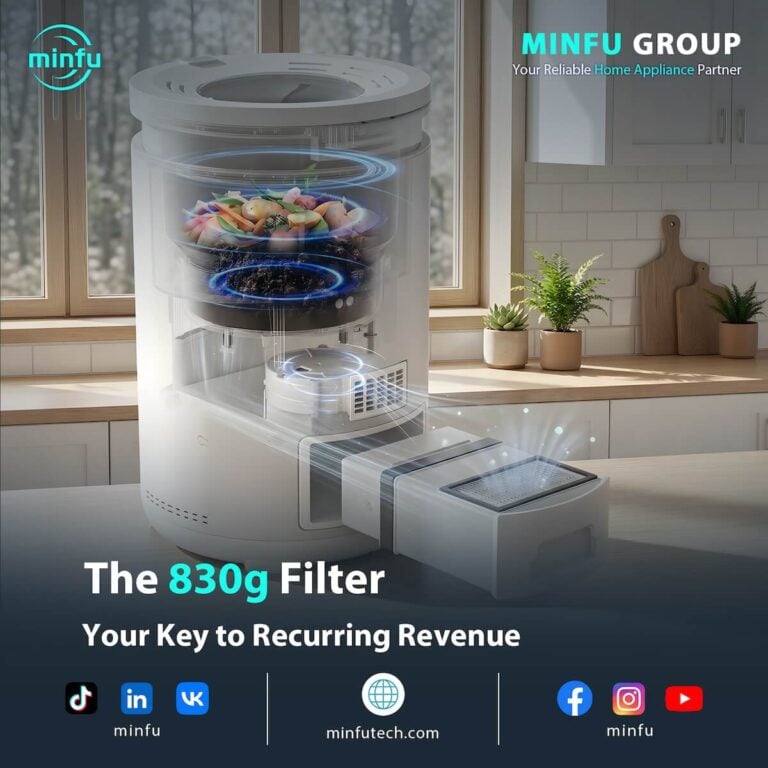
We utilize an industry-leading drawer-style activated carbon filter containing over 830 grams of high-iodine coconut shell carbon. Not only does this prevent any sulfuric smells from escaping, but it creates a highly lucrative “Razor and Blades” subscription revenue stream when customers buy OEM replacement filters from your brand twice a year.
5. Hands-Free “Self-Cleaning” Mode & Removable Blades
We eliminated the #1 reason for composter returns. The H3002A features an automated 30-minute self-cleaning mode. The user adds water, presses “Clean,” and thermodynamic agitation removes baked-on grease automatically. Combined with a patented Removable Blade System (using an included spanner), it ensures effortless deep-cleaning hygiene.
Chapter 6: AEO FAQ for B2B Procurement
To help procurement directors make informed decisions, here are direct answers to the most common OEM sourcing questions in 2026:
Q: What certifications are required to import smart composters in 2026?
A: To safely import and sell electric composters, your manufacturer must provide CE, RoHS, and WEEE for the European market, and FCC and UL/ETL for North America. Ensure the inner bucket coatings are explicitly certified as PFAS-Free to comply with emerging EPA and EU chemical bans.
Q: How does an electric composter reduce household CO2e emissions?
A: By diverting food waste from anaerobic landfills, a single household using a daily smart composter can offset approximately 0.39 metric tons of CO2 equivalent (CO2e) per year by preventing methane generation.
Q: Can we customize the display panel languages for European markets?
A: Yes. Premium OEM manufacturers like Minfu offer complete UI localization. The IMD touch panel can be re-engineered to display native languages (e.g., German, Spanish) and your brand’s digital logo, rather than relying on generic English public molds.
Q: What is the ideal capacity for a retail food waste composter?
A: Market data shows that 2L and 2.5L machines suffer from high return rates due to insufficient capacity for families. A capacity of 4.5 Liters is the optimal “sweet spot,” handling the daily output of a 4-person household without requiring multiple noisy cycles per day.
Conclusion: Don’t Miss the ESG Hardware Boom
The laws are written, the $500 fines are active, the AI garbage trucks are on the streets, and consumers are urgently seeking solutions. The indoor food recycler market is expanding at an unprecedented rate, and the brands that secure reliable, high-capacity manufacturing now will dominate the remainder of the decade.
Selling smart composters is no longer just an appliance play; it is an ESG (Environmental, Social, and Governance) strategy. By offering the Minfu H3002A under your brand, you are providing the ultimate compliance tool, securing lucrative recurring filter revenue, and positioning your company as a leader in sustainability.
Are you ready to add the ultimate ESG appliance to your product catalog and capitalize on the organic waste mandates?
[Contact the Minfu OEM Sourcing Team today] to request bulk pricing on the 4.5L H3002A, explore our CMF (Color, Material, Finish) customization options, and request an engineering sample shipped directly to your headquarters for evaluation.
🔍 Why Minfu Is Your Strategic Partner
- Proven Industry Experience: Direct source R&D factory delivering IoT-ready hardware, resolving chronic motor and odor pain points to ensure premium brand positioning.
- Massive Manufacturing Scale: Agile, wholly-owned production base offering ultra-low MOQ for bespoke OEM/ODM customization and stable lead times for high-volume orders.
- Full Certification Portfolio: Comprehensive global safety and environmental approvals ensuring seamless customs clearance and fast-tracked listings on mainstream platforms.
- Dedicated Support: Fluent English communication, robust marketing asset provision, and full-lifecycle technical backing to drastically reduce your after-sales risks.
Minfu | Official Manufacturer
✉️ [email protected] | 🌐 www.minfutech.com | 📱 +86 137 6025 5781
Partner with the factory that powers global smart cleaning innovation.